

A parent's guide to the evidence
From a score to a conversation.
Inspect Revanth’s fictional Maths history. Select a check-in, open a misconception, and see the question a parent can ask next.
PROGRESS HAS A HISTORY
Revision tests for older concepts
Chapters · check-in scores
Oldest → newest · 4 per chapter- CHAPTER 3Matrices25557085Now59Climbing steadily
- CHAPTER 4Determinants40654575Now56A dip, then recovery
- CHAPTER 5Continuity and Differentiability-10305570Now36More to work on
CHAPTER 3 · 4 CHECK-INS
Matrices
Each of the four check-ins is higher than the one before.
CHAPTER 4 · 4 CHECK-INS
Determinants
The August dip is visible. October adds a stronger result.
CHAPTER 5 · 4 CHECK-INS
Continuity and Differentiability
Recent scores have improved; the full history still shows work to do.
Select a chart point to inspect that check-in.
How to read these scores
These are Abhranti scores on a −100 to +100 scale, not percentages or predicted exam marks. Each cell and point shows one check-in. “Now” is accumulated evidence from scored answers in that chapter, not a fresh measurement of understanding; it can differ from the latest result. This sample gives each check-in 20 scored answers, so “Now” is the rounded average of its four check-in scores.
Each chapter has its own dates. Lines connect recorded check-ins; they do not measure what happened between them. Four check-ins per chapter means 12 chapter check-ins across this example.
Read the report guide and its limitations.
Real NCERT chapters: Matrices, Determinants, and Continuity and Differentiability.
85 in the latest check. 59 across the history.
Select the October Matrices point above: 85 from 20 scored answers. Earlier check-ins were 25, 55 and 70, also from 20 scored answers each. Together, (25 + 55 + 70 + 85) ÷ 4 = 58.75, displayed as 59. That difference is exactly why the two numbers belong side by side.
Latest check-in describes a single completed assessment, with its recorded date. Now combines scored answers from the chapter's completed check-ins. It is accumulated historical evidence, not a direct measurement of what the student knows at this moment.
Longer sittings contribute more scored answers. Averaging the displayed sitting scores is only equivalent when each sitting has the same number of scored answers. A newer result can improve while the accumulated figure remains lower.
Read the scale before comparing numbers
The assessment score runs from −100 to +100. Correctness determines the sign and reported confidence affects the size of each contribution. Confidently wrong answers can lower the score more than guesses. It is not percentage correct or a predicted exam mark.
The example's chapter labels are Weak below 40, Struggling from 40 to below 75, and Confident from 75. These are score bands for that view, not judgements about a child. A session's recommendation may also consider how much evidence was collected; do not assume all report labels use identical rules.
Accuracy, coverage, consistency and confidence provide different context. Two correct answers do not show that the whole chapter has been tested. A confidence insight compares the student's stated sureness with correctness; it does not infer emotion or ability.
No evidence is different from a low score
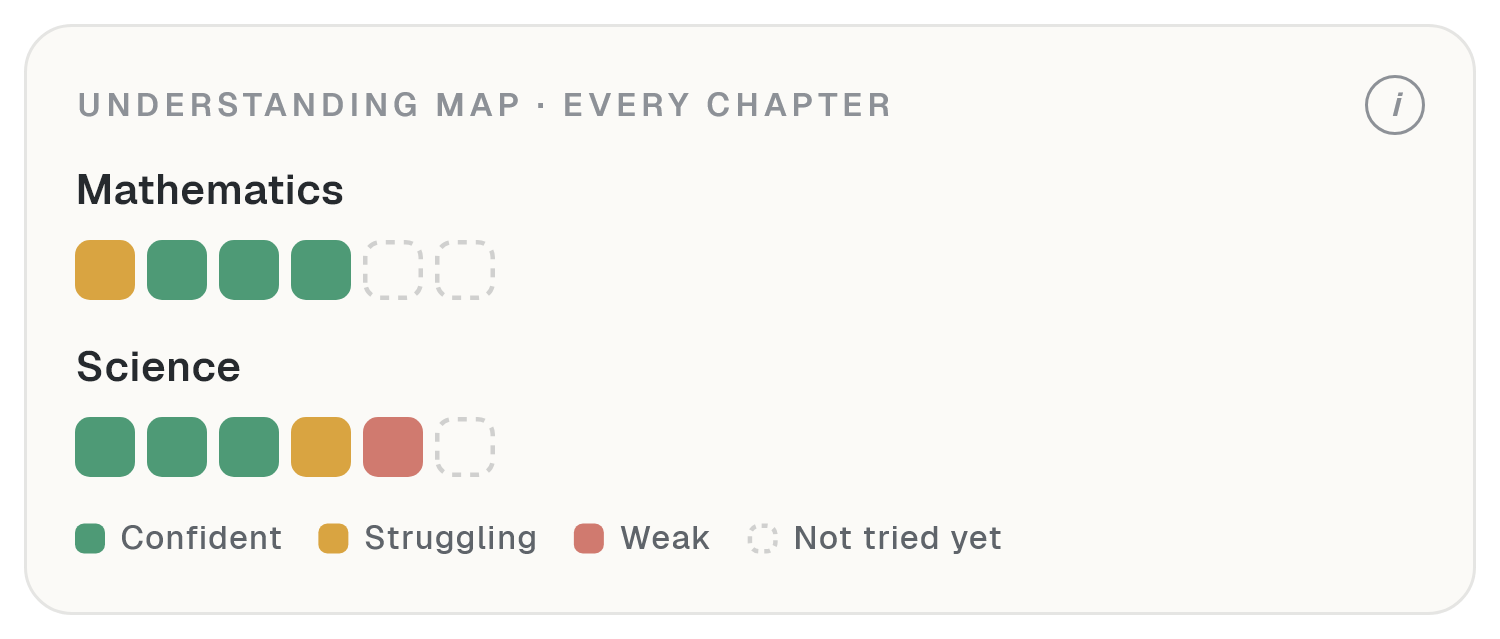
- Not assessed: no completed assessment evidence for that chapter.
- No composed score: answers without recorded confidence cannot supply the confidence-based score. Correct and wrong counts can still be useful.
- Limited evidence: a small number of questions or narrow concept range cannot support a whole-chapter conclusion.
- Locked: the plan does not cover the chapter or detail. It is an access state, not a learning result.
The date beside a result tells you when that check-in was recorded. An old high score is still old evidence; use a later check to investigate what has stayed with the student.
PARENTS’ REPORT · MISCONCEPTIONS
A report for the parent to help the child
Try “AB always equals BA.”
Select that misconception in the report. Open Revanth’s answer and the dated history. The example uses A of order 2 × 3 and B of order 3 × 2: AB is 2 × 2, while BA is 3 × 3. Their dimensions alone show they cannot be the same matrix.
The parent prompt turns that evidence into a conversation: “What would the order of AB be? What about BA?” Switch to the zero-determinant example to see how a mistake that did not recur in two checks is displayed, without treating that as permanent understanding.
From a report to a conversation
- Check the chapter, assessment date and amount of evidence.
- Open an answer that needs attention. Ask the child to explain their choice.
- Review the explanation together and try an available fresh variant.
- Compare a later independent check, rather than treating an immediate retry as proof of retention.
Free accounts can open overall and subject reports and see detail for their granted chapters, including misconception names and immediate confidence information. Prime adds weekly confidence insights, revision, retention checks and the parent–teacher meeting (PTM) card. See the plan comparison.
The PTM card is a parent-initiated PDF export in the paid product. A parent can take or share it with a teacher. This public example does not grant teachers access to a child's account or records. Exports contain student information; choose the recipient yourself.
What supports these reports?
Their immediate evidence is the student's recorded answers, confidence and assessment history. The method guide explains how to interpret that evidence and its limits. The sample charts are fictional demonstrations, not an outcomes study, academic endorsement or validated diagnosis.