Skip to content

Teach Exploring Algebraic Identities in eight steps.

For each idea: show it, ask before you tell, then say one line.

Gather a 6 cm paper square, plain paper, a ruler and a pencil.

Common misconceptions & worked visual for this chapter · 15 practice questions with answers

How to teach it

Understand and expand squares

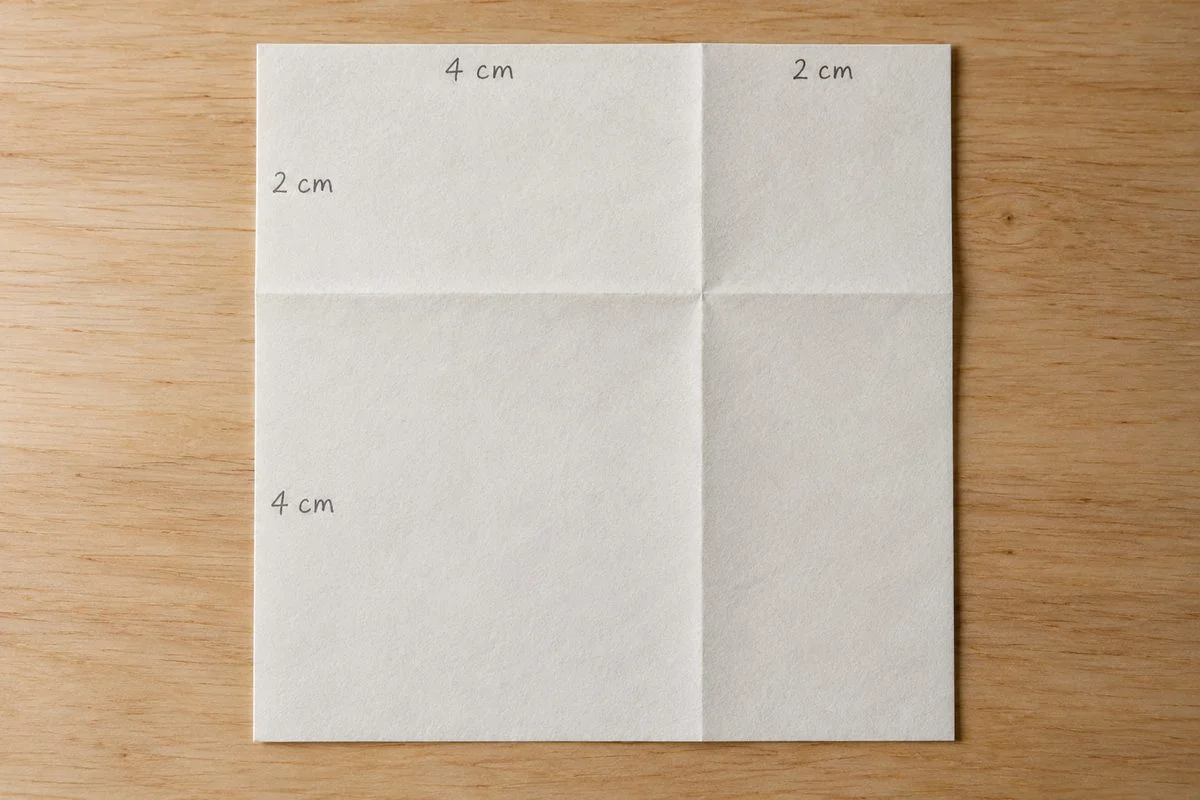
Paper square with perpendicular creases forming two squares and two rectangles.

1. The square of a sum

Squaring a sum includes both squares and both cross-products.

Show
Fold the 6 cm square 2 cm from its top and right edges. Unfold it. Mark the side lengths 4 cm and 2 cm. Find each region’s area.
Ask
Will adding just the small squares give the whole paper’s area?
Say
Include both rectangles too; each comes from multiplying the two side lengths.
Used in
Floor extensions need tiles for the added strips as well as the corner.
If your child says…“I just square each part and add.”
Ask
Which parts of this paper have you left out?
What’s true
Adding only the squares leaves both rectangles uncounted.
(a+b)2=(a+b)(a+b)(a+b)^2=(a+b)(a+b)

=a(a+b)+b(a+b)=a(a+b)+b(a+b)

=a2+ab+ba+b2=a^2+ab+ba+b^2

2. Algebraic identity

An equality that survives every allowed choice of numbers.

Show
Write these lines. Say: “The letters a and b can include negative numbers and fractions.”
Ask
What does the next line become when you collect the matching products?
Say
The middle products combine: (a+b)2=a2+2ab+b2(a+b)^2=a^2+2ab+b^2. These operations work without choosing particular numbers.
Used in
Equivalent spreadsheet formulas let calculations become simpler while preserving their results.
If your child says…“It worked once, so I have proved it.”
Ask
If x plus one equals two works at 1, must it work at every value?
What’s true
One successful substitution checks only that value.

(x−1)2=(x−1)(x−1)(x-1)^2=(x-1)(x-1)

=x(x−1)−(x−1)=x(x-1)-(x-1)

=x2−x−x+1=x^2-x-x+1

3. The square of a difference

Add the squares of both parts, then subtract twice their product.

Show
Write these lines. Say: “x is any number; multiply every term across both brackets.”
Ask
What does the next line become when you collect the two negative x terms?
Say
The negative terms combine, while the final product stays positive: (x−1)2=x2−2x+1(x-1)^2=x^2-2x+1.
Used in
Trimming a square cloth along adjacent edges changes the area available for sewing.
If your child says…“The last term must be negative too.”
Ask
What sign does negative one times negative one give?
What’s true
The final term comes from multiplying negative one by negative one.

(x+y+1)2=(x+y)2+2(x+y)+1(x+y+1)^2=(x+y)^2+2(x+y)+1

=x2+2xy+y2+2(x+y)+1=x^2+2xy+y^2+2(x+y)+1

4. The square of three terms

Add the three squares and twice the product of each pair.

Show
Write these lines. Say: “x and y are numbers. First treat their sum as one part.”
Ask
What does the next line become when you expand the remaining bracket?
Say
Include the products involving the last part: (x+y+1)2=x2+2xy+y2+2x+2y+1(x+y+1)^2=x^2+2xy+y^2+2x+2y+1.
Used in
A square plot’s side can be measured in parts. Squaring their sum gives its area for planting.
If your child says…“Only neighbouring parts multiply together.”
Ask
When each bracket multiplies the other, can x miss the final 1?
What’s true
The first and last parts also multiply in both orders.

Rearrange and factor

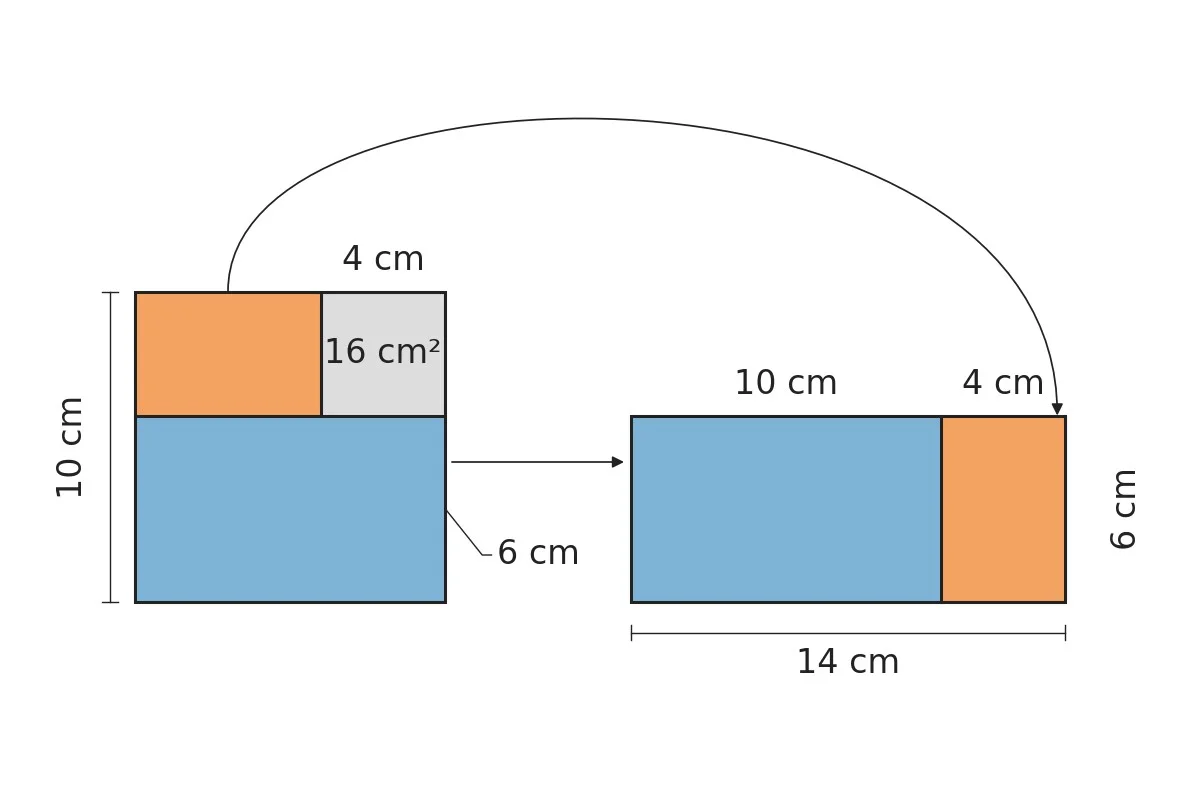
A square minus its corner rearranged into a rectangle, with matching coloured pieces.

5. The difference of two squares

Subtract square areas; multiply their side-length sum and difference.

Show
Look at the diagram’s left square and its grey corner. Match the coloured pieces to the rectangle on the right. Read the rectangle’s full width and height.
Ask
Will joining the coloured pieces into the rectangle change their total area?
Say
Multiply the sides’ sum by their difference; rearranging keeps the remaining area unchanged. Here, 102−42=(10+4)(10−4)10^2-4^2=(10+4)(10-4).
Used in
Subtracting square areas gives border areas, helping estimate mounting card.
If your child says…“I subtract the sides, then square the answer.”
Ask
Does the rearranged rectangle have two sides of 6 cm?
What’s true
The remaining area uses both the sum and the difference of the sides.

x2+3x+2=x2+x+2x+2x^2+3x+2=x^2+x+2x+2

=x(x+1)+2(x+1)=x(x+1)+2(x+1)

6. Factorisation without using algebra tiles

Find a pair matching both the required sum and product.

Show
Write these lines. Say: “x is any number. Our pair adds to 3 and multiplies to 2.”
Ask
What product comes next when you take out the repeated bracket?
Say
Both groups contain the same bracket: x2+3x+2=(x+1)(x+2)x^2+3x+2=(x+1)(x+2).
Used in
Factoring a rectangular garden’s area expression can reveal possible side lengths.
If your child says…“Any pair with the right product will work.”
Ask
Which part of the expression checks your pair’s sum?
What’s true
The pair must also add to the middle coefficient.

Extend and simplify

(x+1)3=(x+1)(x2+2x+1)(x+1)^3=(x+1)(x^2+2x+1)

=x(x2+2x+1)+(x2+2x+1)=x(x^2+2x+1)+(x^2+2x+1)

=x3+2x2+x+x2+2x+1=x^3+2x^2+x+x^2+2x+1

7. Identities involving cubes

Multiply a square once more; collect all repeated products.

Show
Write these lines. Say: “Cubing multiplies the square by another copy.”
Ask
What comes next after collecting repeated powers?
Say
Collect like terms: (x+1)3=x3+3x2+3x+1(x+1)^3=x^3+3x^2+3x+1.
Used in
Cubing a box’s inside edge gives its volume when the box is a cube.
If your child says…“The middle coefficients stay 2, just like a square.”
Ask
How many copies of x squared appear before you collect them?
What’s true
Multiplying once more supplies additional products, making both middle coefficients 3.

x2−1x−1=(x−1)(x+1)x−1\frac{x^2-1}{x-1}=\frac{(x-1)(x+1)}{x-1}

=x−1x−1(x+1)=\frac{x-1}{x-1}(x+1)

8. Simplifying rational expressions

Divide out shared nonzero factors after factoring.

Show
Write these lines. Say: “x can be any number except 1, because the denominator cannot be zero.”
Ask
What remains next when the matching factors divide to one?
Say
The matching nonzero factors divide to one, leaving x+1x+1. The original restriction still excludes 1.
Used in
Recipe ratios simplify through common factors, making ingredient amounts easier to compare.
If your child says…“I can cross out matching terms inside sums.”
Ask
After rewriting the numerator as a product, which factor does it share with the denominator?
What’s true
Cancellation divides whole products by a shared nonzero factor.

A real problem

An algebraic square helps explain inheritance.

Hardy and Weinberg independently described this inheritance principle in 1908.

The model squares the combined proportions of two versions of one gene to predict their pairings.

A dominant gene version does not automatically become more common.

Nature EducationNature EducationEncyclopedia.com

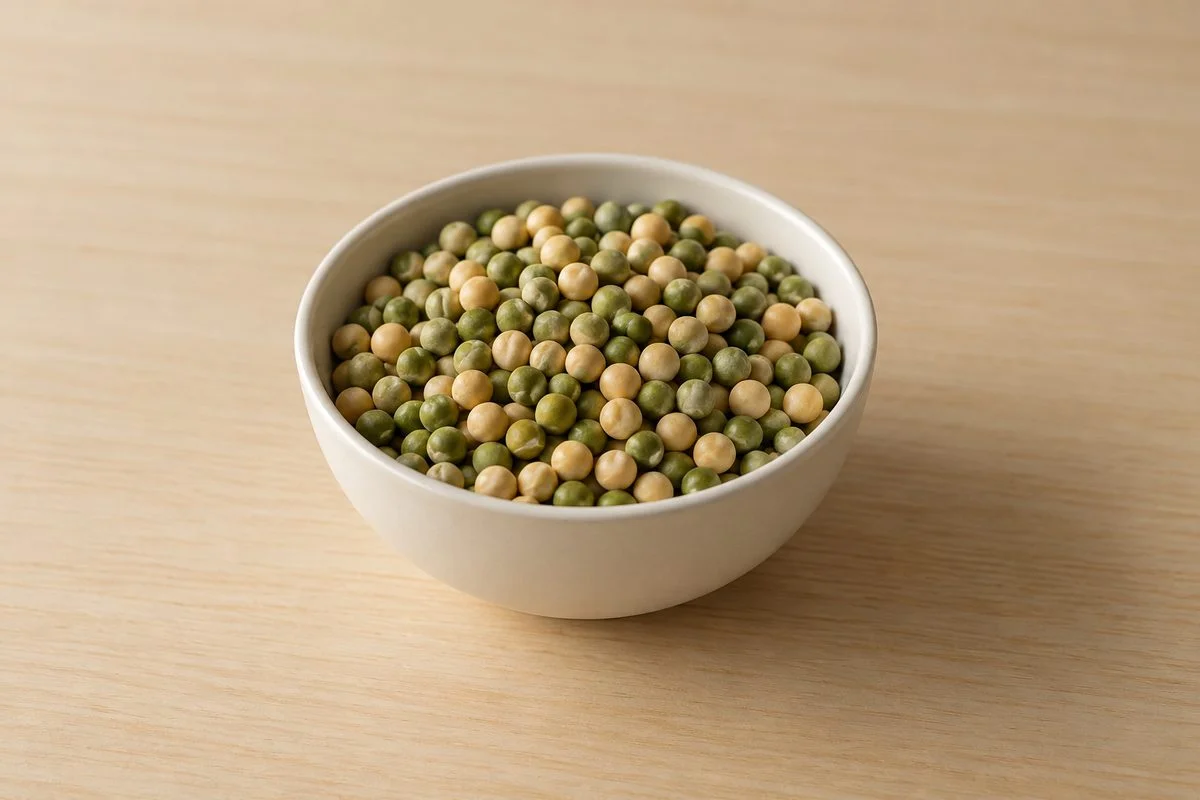
A plain bowl containing green and yellow peas.

Concept Lab · Common misconception

The tempting mistake in Exploring Algebraic Identities

Open standalone misconception page →

Does expanding a product mean multiplying only matching terms?

Wrong

(x + 2)(x + 3) = x² + 6

Why it feels right. I multiply the first terms together and the last terms together.

Right

Each term in one factor multiplies each term in the other factor.

Worked example

At x = 1, the two missed products contribute another 5.
  1. With x = 1, the original product is 3 × 4 = 12, but x² + 6 gives 7.
  2. The missing terms are 3x and 2x.
  3. The complete expansion is x² + 5x + 6.

Ask your child eight quick questions.

One per step. The answer and the reason are given.

  1. Which regions are missing if you add only the two small square areas?

    Both rectangles. Each rectangle belongs to the whole square and must be counted.

  2. What does one successful number check establish?

    Only that case. Other values may fail; an identity needs a general argument.

  3. What sign belongs before the final 1?

    Plus. Multiplying two negative numbers gives a positive number.

  4. Which term comes from pairing x with 1 in both orders?

    2x2x. The first and last parts contribute a product twice.

  5. Which multiplication gives the area left after removing the corner square?

    14×614\times6. The rectangle’s sides are the original sides’ sum and difference.

  6. Besides multiplying to 2, what must our pair add to?

    3. Both conditions are needed to reproduce the original middle and final terms.

  7. What coefficient belongs to x squared after collecting?

    3. Two copies from one product combine with another copy.

  8. Which part needs factoring to expose the shared factor?

    The numerator. Factoring exposes a shared factor multiplying the whole numerator and denominator.

15 more questions with answers