Skip to content

Teach Measuring Space: Perimeter and Area in eight steps.

For each idea: show it, ask before you tell, then say one line.

Gather paper, centimetre-squared paper, a pencil, a ruler, two differently sized circular lids, a long paper strip and scissors.

An adult handles scissors and makes every cut.

Common misconceptions & worked visual for this chapter · 15 practice questions with answers

How to teach it

Measuring borders

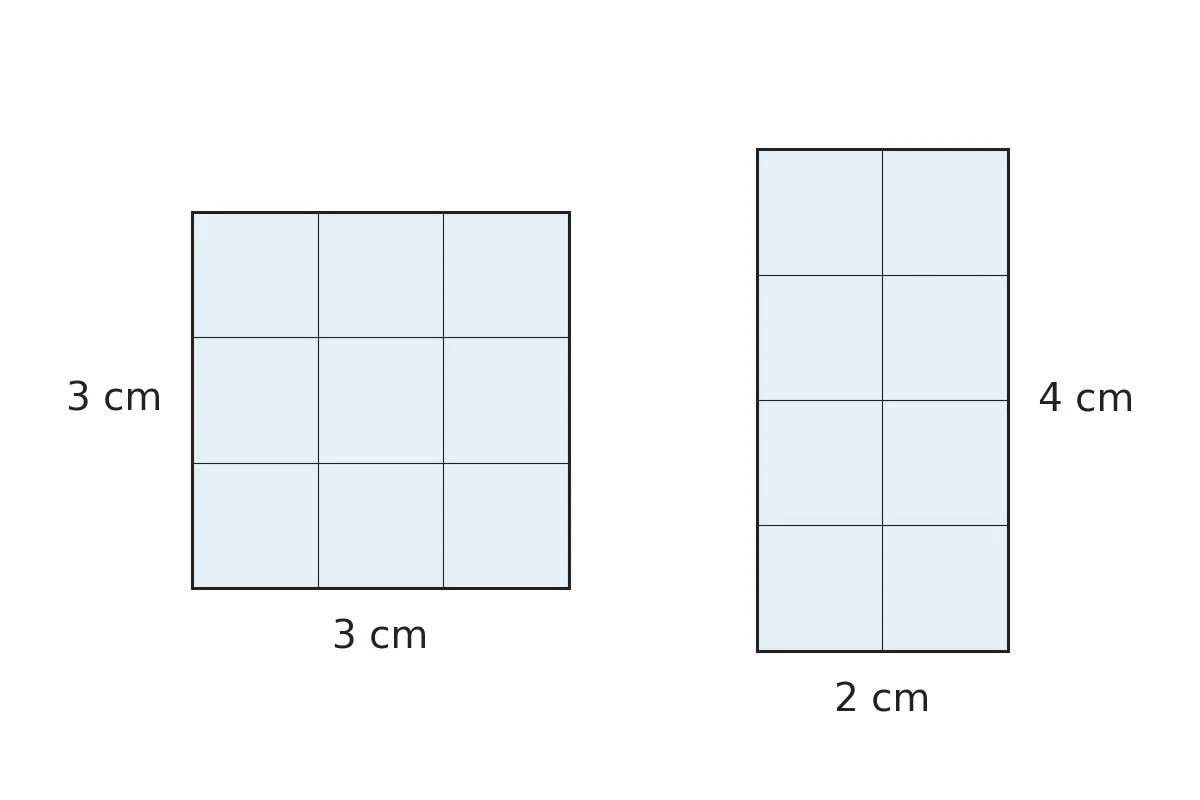
A square and a longer rectangle on the same centimetre grid.

1. Perimeter

The distance along the complete outside border.

Show
Find the 3-by-3 square and 2-by-4 rectangle in the diagram. After predicting, trace their borders. Count boundary lengths and enclosed squares.
Ask
Will equal border lengths mean equal amounts of paper inside?
Say
Both borders measure 12 cm, but they enclose 9 and 8 square centimetres. Equal perimeters can enclose different areas.
Used in
Fencing follows a garden’s perimeter, so its length tells us how much fencing is needed.
If your child says…“The same perimeter means the same area.”
Ask
Do these shapes contain the same number of squares?
What’s true
Changing the outline can change the enclosed area without changing the perimeter.
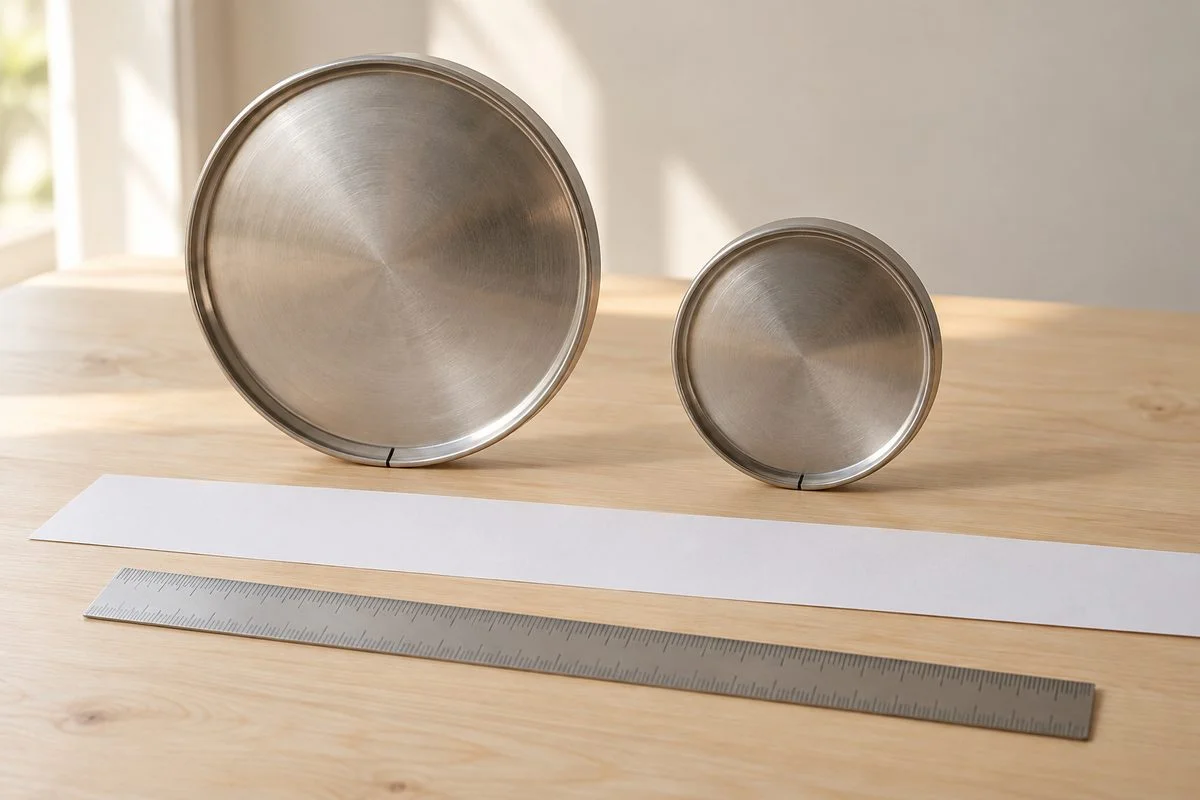
Two circular lids beside a paper strip and ruler.

2. Perimeter of a Circle — The C/D Ratio

Circumference divided by diameter gives pi.

Show
Measure each lid’s diameter. Mark each rim. After predicting, measure each lid’s travel over one complete roll without slipping. Divide by its diameter.
Ask
Which lid will travel farther?
Say
The wider lid travels farther. Both ratios should approach 3.14.
Used in
Wheel circumference gives distance travelled per turn without slipping.
If your child says…“Doubling a circle’s width makes its border four times longer.”
Ask
Does dividing each travelled distance by its diameter give very different results?
What’s true
Circumference grows by the same multiplier as diameter, which is twice the radius.

227=3+17\frac{22}{7}=3+\frac{1}{7}

227=3.142857‾\frac{22}{7}=3.\overline{142857}

3. Pi

An irrational number that no fraction of integers equals.

Show
Write these lines beside pi, written π=3.14159265…\pi=3.14159265\ldots. Say: “The bar marks a block that repeats forever.”
Ask
Which sign completes the next line between twenty-two sevenths and pi: equals or not equals?
Say
Their decimals differ, so 227≠π\frac{22}{7}\ne\pi.
Used in
Approximations of pi make circular measurements practical when buying edging for a round tabletop.
If your child says…“Enough matching digits make a fraction exactly pi.”
Ask
Do the third decimal digits match?
What’s true
Both 3.14 and twenty-two sevenths approximate pi, and closer fractions always exist.
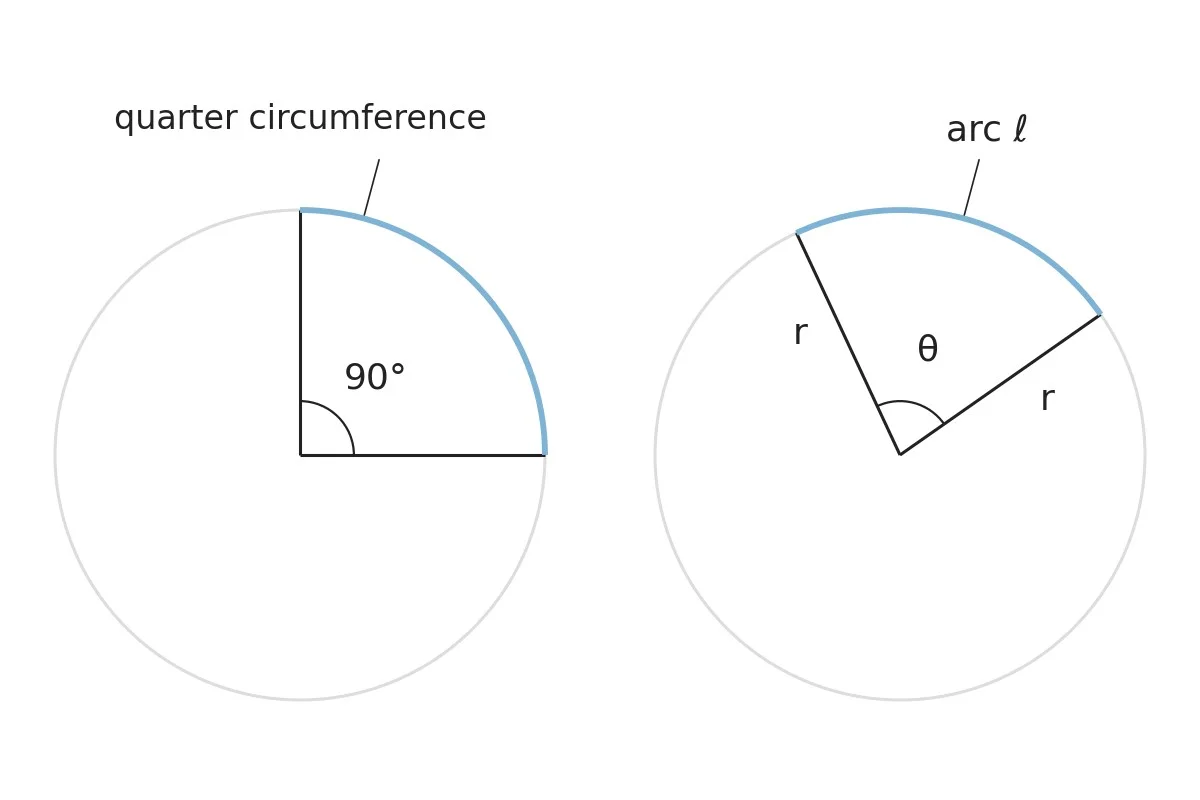
A quarter-arc and a general arc, with central angles and bounding radii.

4. Length of an Arc of a Circle

An angle selects part of the circumference.

Show
Find both arcs in the diagram. Read ell as length, theta as degrees, and r as radius.
Ask
How can the angle give the curved length?
Say
Take the angle’s fraction of the circumference: ℓ=θ360×2πr\ell=\frac{\theta}{360}\times2\pi r.
Used in
Running tracks stagger starts to compensate for longer outer curves.
If your child says…“The same angle means the same curved distance.”
Ask
If the radius doubles, what happens to the circumference you take a fraction of?
What’s true
Equal angles select equal fractions of circumferences, but larger radii give longer arcs.

Measuring covered space

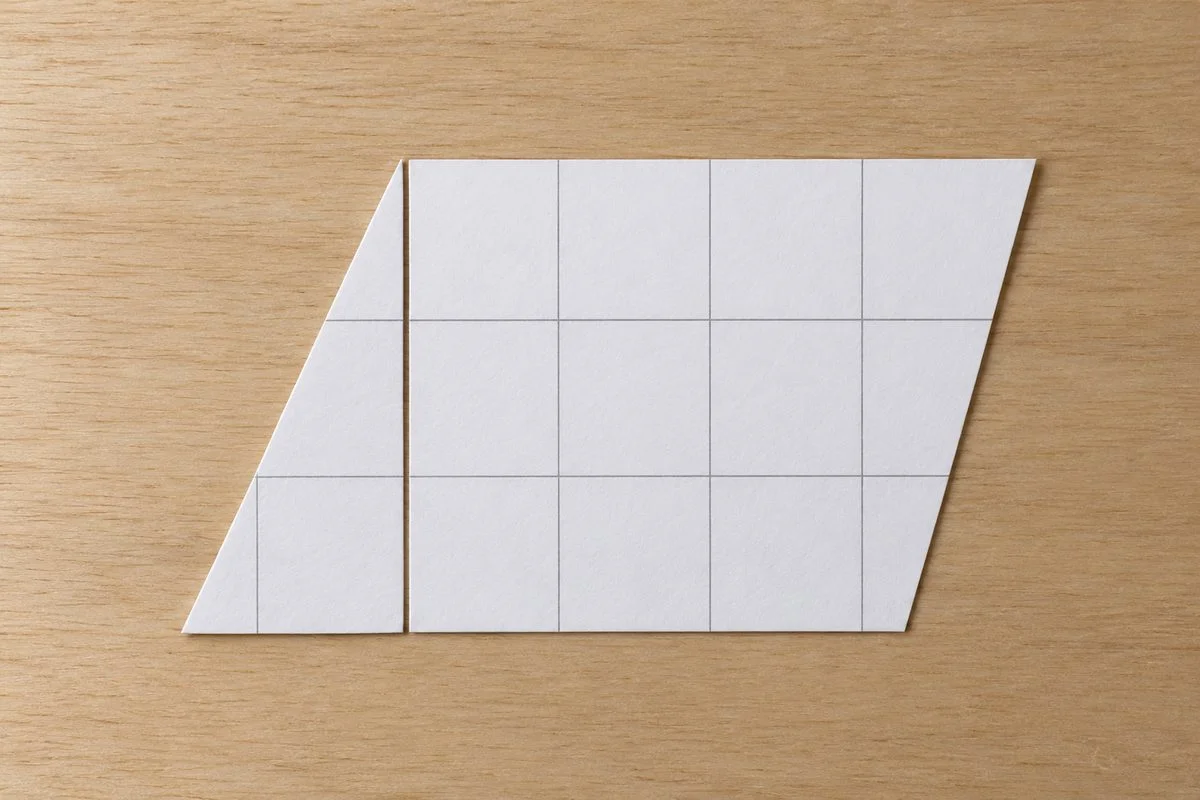
Squared-paper parallelogram with its left triangular piece cut loose.

5. Area of a Rectangle; Area of a Parallelogram

Area counts the square units covered.

Show
An adult cuts a squared-paper parallelogram: base 4 cm, height 3 cm, top shifted 1 cm right. Cut vertically from its top-left corner. After predicting, move the triangle right.
Ask
How many squares will the rectangle cover?
Say
Three rows of four give 12 square centimetres. Rearranging preserves area: multiply base by perpendicular height.
Used in
Area tells a glazier how much glass a slanted window needs.
If your child says…“Multiply the base by the sloping side.”
Ask
Which distance becomes the rectangle’s width when you move the triangle?
What’s true
The rectangle’s width matches the perpendicular height, rather than the sloping side.
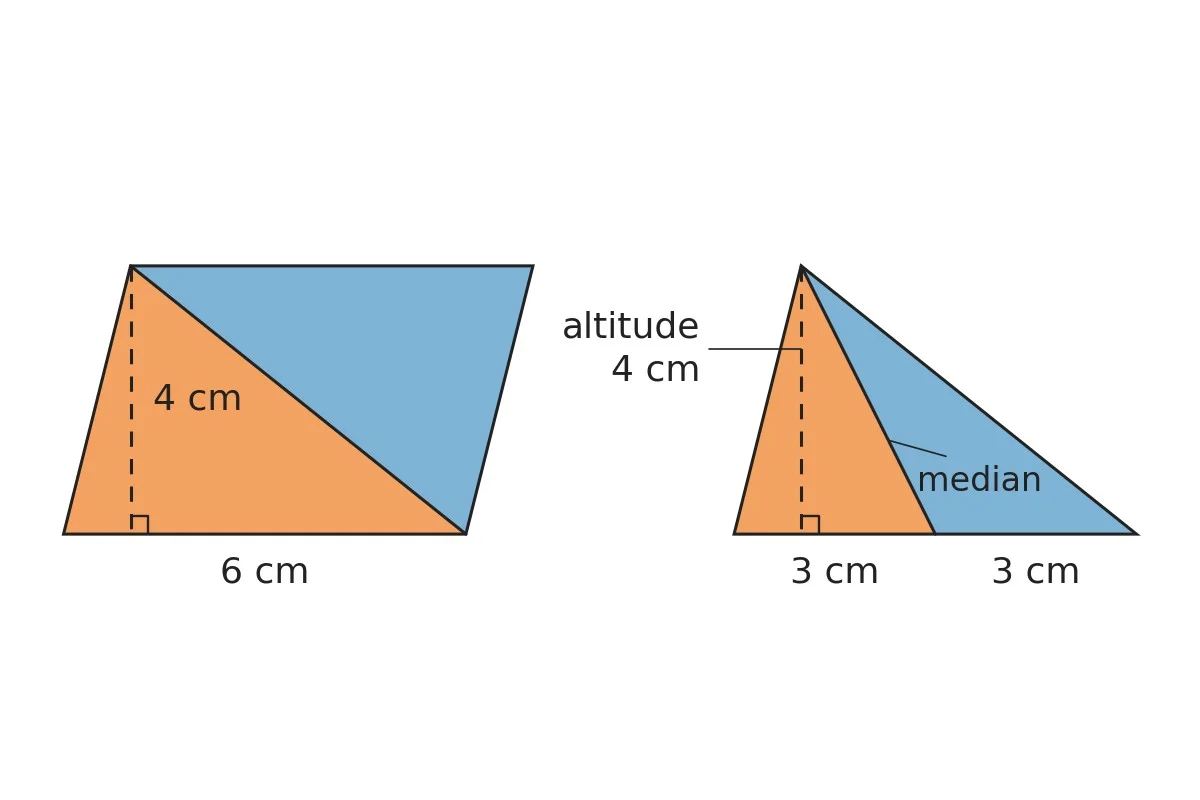
Matching triangles form a parallelogram; a separate triangle shows its median and perpendicular altitude.

6. Area of a Triangle

Half the base multiplied by the perpendicular height.

Show
Find the diagram’s matching triangles inside the parallelogram. Point to its base and perpendicular height. On the right, find the median, equal base halves and dashed altitude.
Ask
What fraction of the parallelogram’s area will one triangle cover?
Say
Each triangle covers half, so multiply base by perpendicular height and halve: 12 square centimetres. The median makes equal bases sharing one height, so each smaller triangle covers 6 square centimetres.
Used in
A triangular panel’s area helps estimate cloth needed.
If your child says…“Those smaller triangles have different shapes, so their areas differ.”
Ask
Which changed between the smaller triangles: base length or perpendicular height?
What’s true
Equal bases and equal perpendicular heights give equal areas, even when shapes differ.
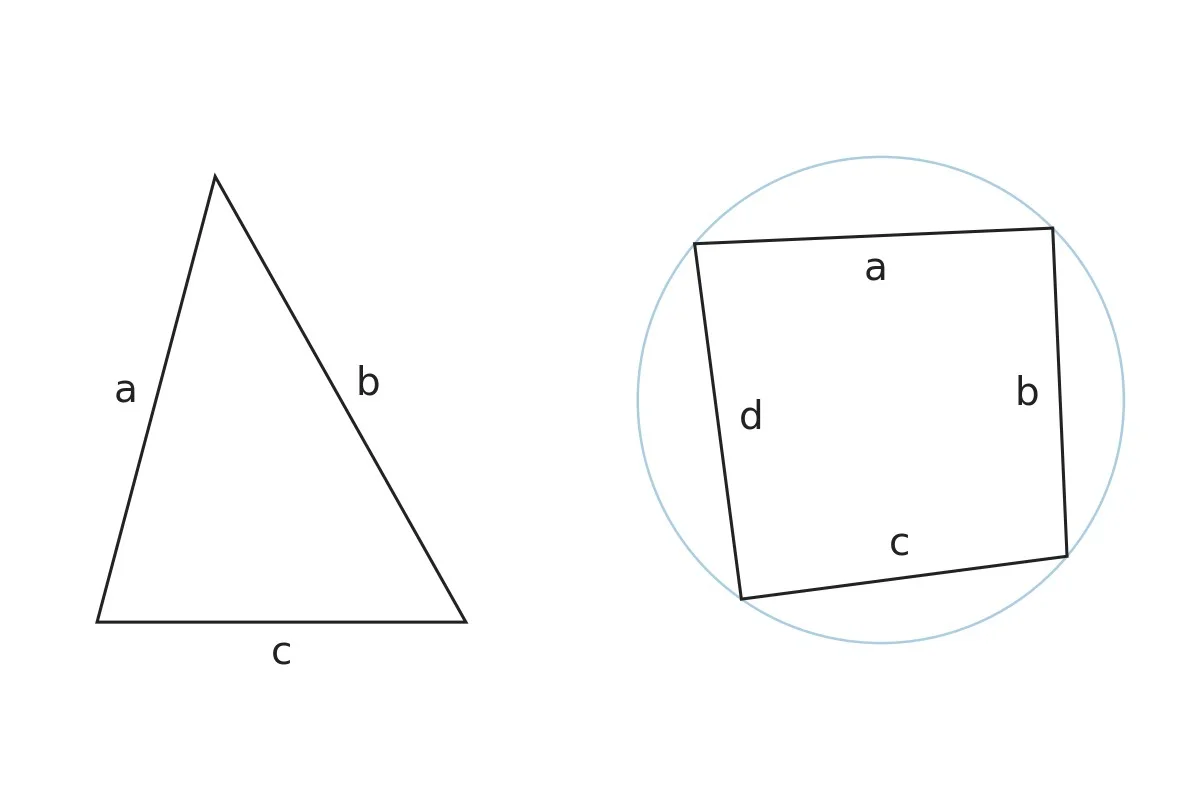
A triangle with labelled sides beside a quadrilateral whose corners lie on one circle.

7. Heron’s Formula and Brahmagupta’s Formula

Side lengths give areas under specific conditions.

Show
Find the diagram’s labelled sides and circle. Call half-perimeter s and area A.
Ask
Can these sides give areas without heights?
Say
Yes, Heron gives triangle area: A=s(s−a)(s−b)(s−c)A=\sqrt{s(s-a)(s-b)(s-c)}. Brahmagupta gives quadrilateral area: A=(s−a)(s−b)(s−c)(s−d)A=\sqrt{(s-a)(s-b)(s-c)(s-d)}. All four corners must share the circle.
Used in
Heron’s formula finds triangular plot areas without measuring heights.
If your child says…“Four side lengths always tell us a shape’s area.”
Ask
A square leans into a rhombus, keeping its side lengths. Must its area stay unchanged?
What’s true
Brahmagupta’s rule requires all four corners on one circle, and a zero-length fourth side gives Heron’s.
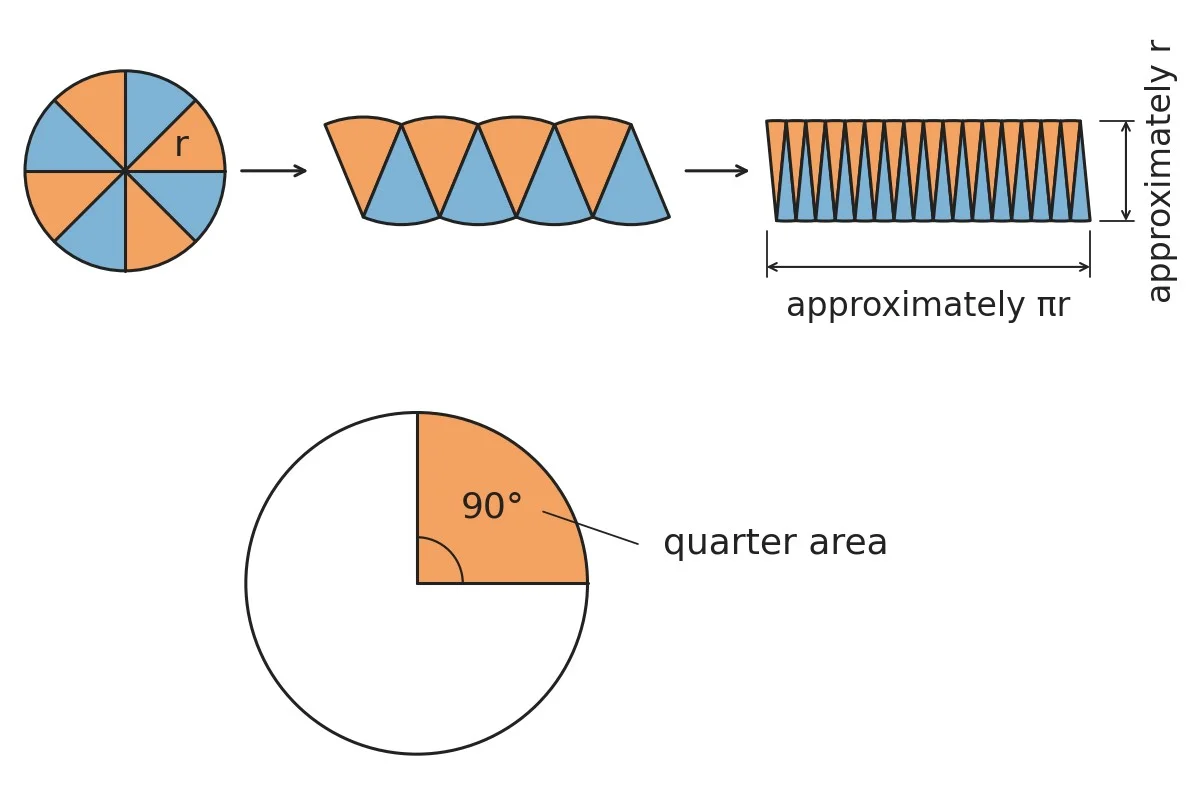
Circle sectors approach a rectangular strip; a shaded quarter shows the sector’s share of area.

8. Area of a Circle; Area of Sector of a Circle

Sectors cover fractions of a circle’s area.

Show
Follow the diagram’s arrows. Read r as radius, theta as degrees, and A as sector area.
Ask
What shape does the finer strip approach?
Say
A rectangle gives pi times radius squared. Sectors take an angle’s fraction: A=θ360πr2A=\frac{\theta}{360}\pi r^2.
Used in
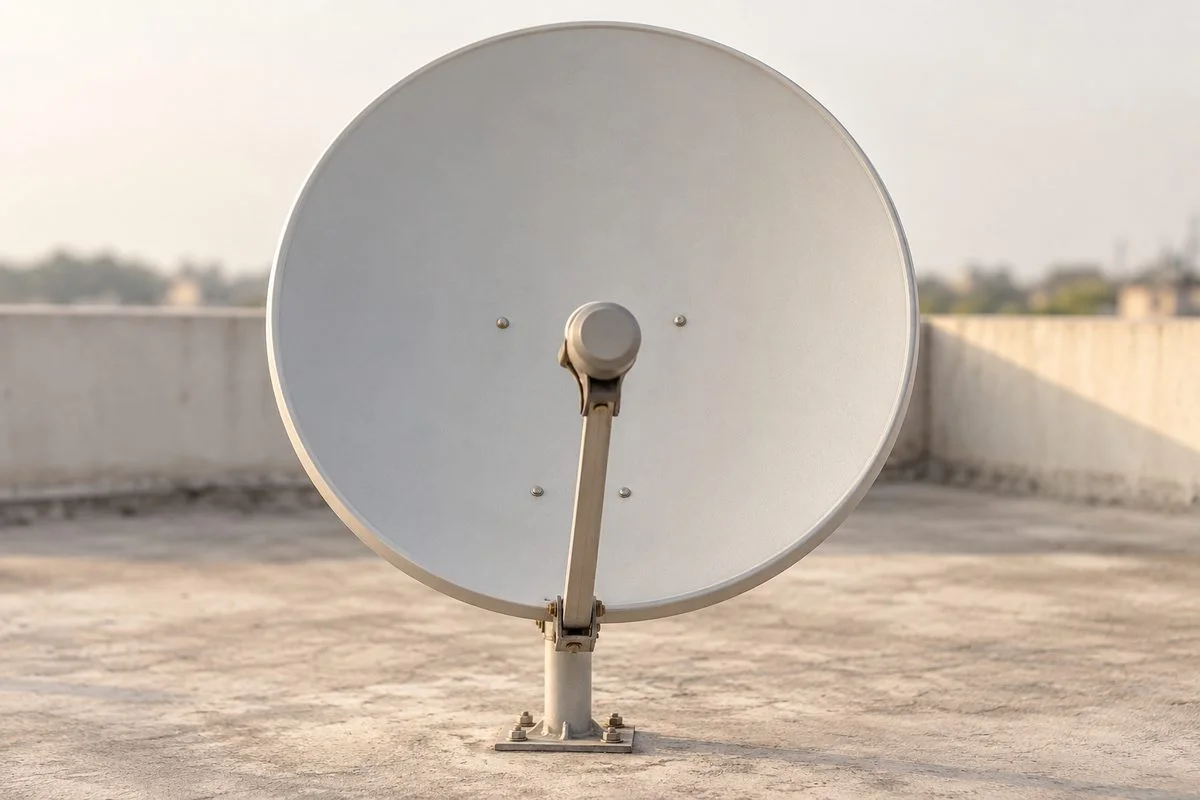
Dish opening area helps describe radio signal collection.
If your child says…“A quarter-circle’s area is a quarter of its curved border’s length.”
Ask
Does the shaded quarter cover part of the surface or just part of the border?
What’s true
A sector takes its angle’s fraction of the circle’s area, rather than its circumference.

A real problem

A radio telescope’s collecting area helps it detect faint signals.

The Giant Metrewave Radio Telescope became available to astronomers worldwide in October 2001.

GMRT’s large collecting area helps it detect faint radio signals.

A circular dish’s geometric aperture area is pi times its radius squared.

Engineering and Technology History WikiNCRA–TIFR

An unbranded circular satellite dish on a rooftop.

Concept Lab · Common misconception

The tempting mistake in Measuring Space: Perimeter and Area

Open standalone misconception page →

What happens to area when lengths double?

Wrong

Doubling all side lengths doubles the area.

Why it feels right. I apply the length scale to the area.

Right

Area scales with the square of the length scale.

Worked example

Doubling both dimensions makes four copies of the original rectangle fit inside the larger one.
  1. A 2 × 3 rectangle covers 6 squares.
  2. Doubling both sides gives a 4 × 6 rectangle with 24 squares.

Ask your child eight quick questions.

One per step. The answer and the reason are given.

  1. Which encloses more paper: the 3-by-3 square or the 2-by-4 rectangle?

    The square. It contains nine unit squares; the rectangle contains eight despite having the same perimeter.

  2. A circle’s diameter doubles. What happens to its circumference?

    It doubles. The ratio between circumference and diameter stays constant.

  3. Is 355113\frac{355}{113} an exact value of pi or an approximation?

    An approximation. Matching many digits cannot make a fraction equal an irrational number.

  4. Which has the longer quarter-arc: a circle of radius 7 cm or 14 cm?

    The 14 cm circle. The same fraction of a larger circumference gives a longer arc.

  5. Which multiplies the base for area: the sloping side or the perpendicular height?

    The perpendicular height. That distance becomes the rectangle’s width when the paper is rearranged.

  6. What area lies on each side of the median in the right-hand triangle?

    6 cm². Both smaller triangles have a 3 cm base and the same 4 cm height.

  7. What condition must hold before applying Brahmagupta’s rule to four side lengths?

    All corners share one circle. Four side lengths alone allow different angles and different areas.

  8. Which do you quarter for a quarter-disc’s area: the circle’s area or circumference?

    The circle’s area. The sector covers a fraction of the surface, rather than a length of border.

15 more questions with answers, 2 with pictures