Skip to content

Teach Predicting What Comes Next: Exploring Sequences and Progressions in eight steps.

For each idea: show it, ask before you tell, then say one line.

Gather paper, a pencil and 13 unlit matchsticks.

Common misconceptions & worked visual for this chapter · 15 practice questions with answers

How to teach it

Sequences and their rules

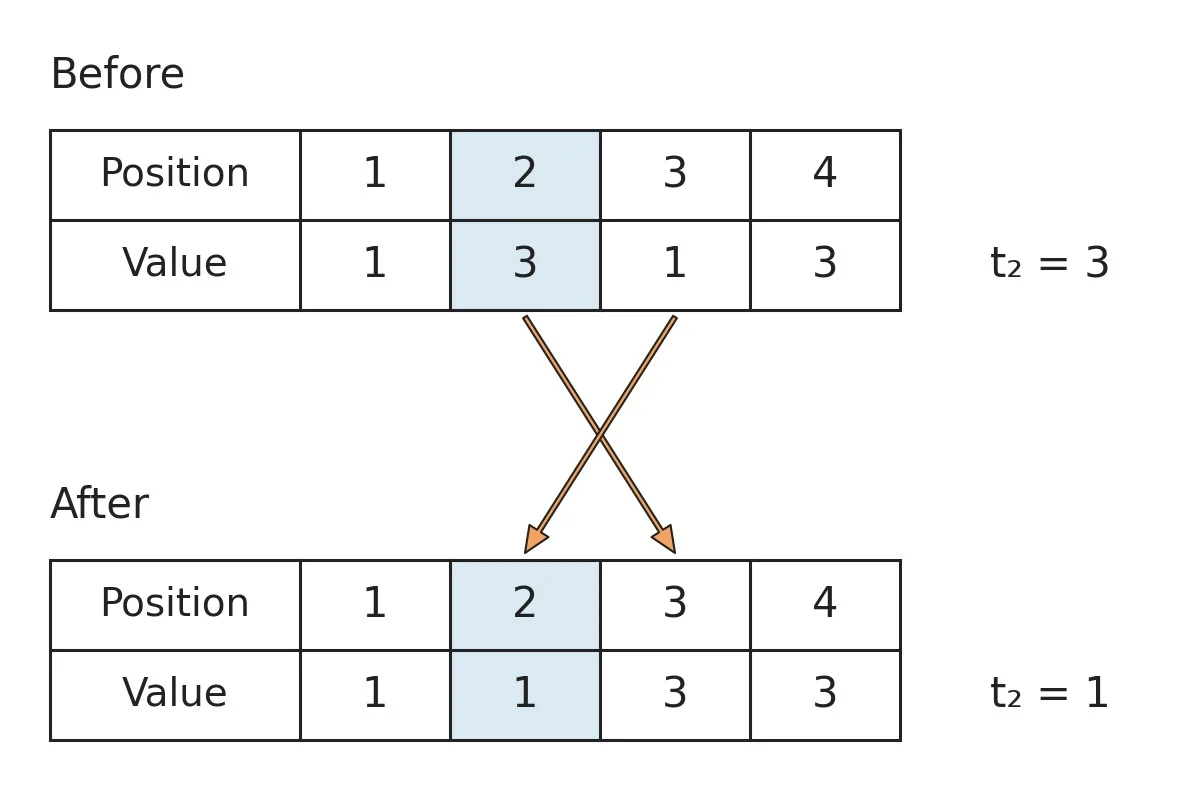
Two tables show positions unchanged while the middle values exchange places.

1. Sequences and terms

A sequence lists numbers in order; a subscript identifies a term's position.

Show
Cover the diagram's lower table with paper. Find position 2 above its value in the upper table. Read t subscript 2 as the value at position 2.
Ask
After the middle entries swap, which value will position 2 identify?
Say
It becomes 1 because position 2 now holds 1.
Used in
Numbered delivery stops keep addresses in the intended visiting order.
If your child says…“The little 2 means the value is 2.”
Ask
Before the swap, which value sits below position 2?
What’s true
The subscript chooses the position; the entry there supplies the value.
un=2n−1u_n = 2n-1

u4=2×4−1u_4 = 2\times4-1

u4=8−1u_4 = 8-1

2. Explicit Rule for a Sequence

Calculate a term directly from its position.

Show
Say: “The term u subscript n comes from doubling position n, then subtracting one.” Then write these lines.
Ask
What is the fourth term?
Say
The fourth term is 7, found directly from its position.
Used in
Regular seating layouts let planners calculate a later row's capacity without counting earlier rows.
If your child says…“A number can be the 94.6th term.”
Ask
Which entry would you point to when counting reaches 94.6?
What’s true
Positions count entries, so fractional positions cannot name terms.

t2=1+3t_2 = 1+3

t2=4t_2 = 4

t3=4+3t_3 = 4+3

3. Recursive Rule for a Sequence

Build terms from earlier values, beginning with enough starting values.

Show
Say: “Start at 1 and add 3 to each previous value.” Then write these lines. Point to 4 as it enters the next calculation.
Ask
What is the third term?
Say
The third term is 7 because the previous value, 4, gains 3.
Used in
Running expense totals use the previous total, helping track spending.
If your child says…“For term three, I add 3 to the position number.”
Ask
Which value did we find for the second term?
What’s true
The rule uses the previous term's value, starting from the given first value.

Arithmetic progressions and sums

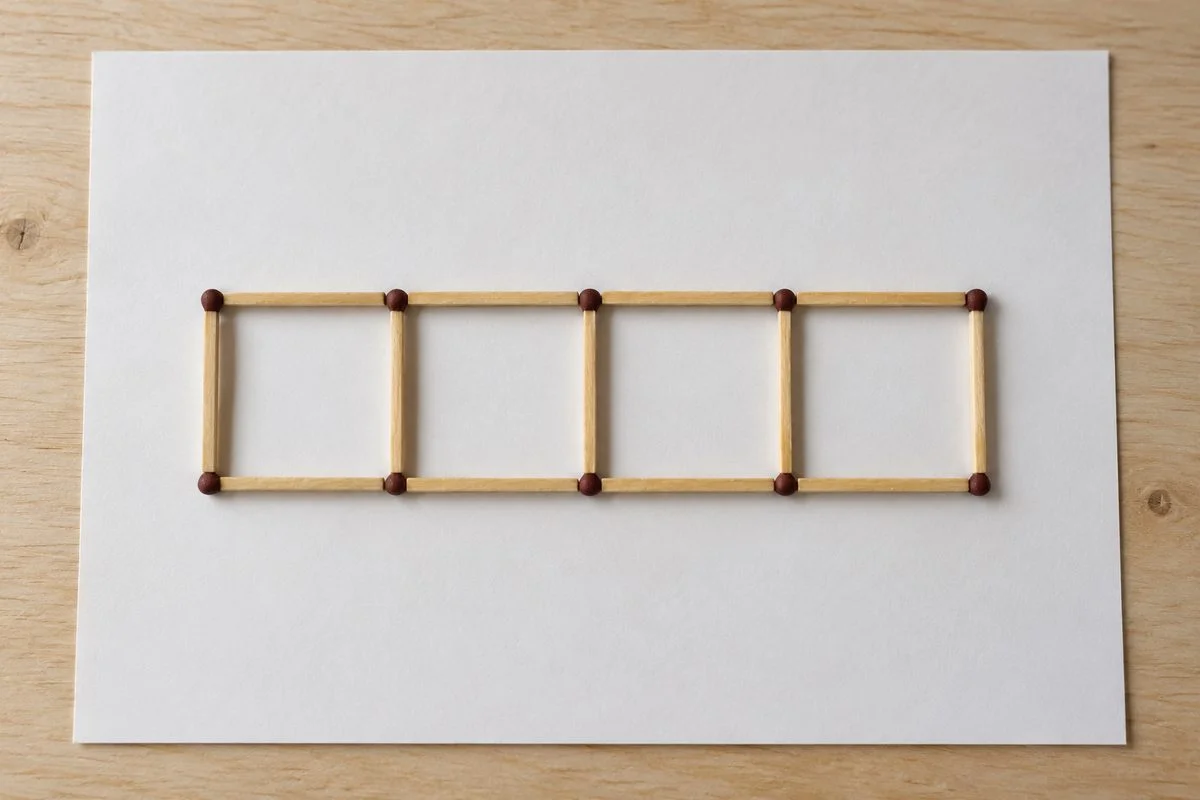
Four adjoining matchstick squares sharing their connecting sides.

4. Arithmetic Progressions

Add the same amount at every move, including negative amounts.

Show
Build one matchstick square. Extend it to four adjoining squares, sharing sides. Record 4, 7, 10 and 13 sticks. Subtract each earlier count from the next.
Ask
For any row length, how many additions come after the first square?
Say
There is one fewer addition than squares.
Used in
Equal daily savings help plan when a target amount will be reached.
If your child says…“The fourth term needs four additions.”
Ask
How many extensions did we make after building the first square?
What’s true
The first term is already present, so reaching the fourth takes three additions.

t3=240+(3−1)×40t_3 = 240+(3-1)\times40

t3=240+2×40t_3 = 240+2\times40

t3=240+80t_3 = 240+80

5. Arithmetic Progressions: taxi fare

Define what each term measures before counting changes.

Show
Say: “This example charges ₹200 for booking and ₹40 per kilometre. Terms record fares after each kilometre, so the first is ₹240.” Then write these lines.
Ask
What is the fare after three kilometres?
Say
The fare is ₹320, including two increases after the first kilometre's fare.
Used in
Delivery charges can combine fixed and distance charges, helping estimate costs.
If your child says…“The booking fee is the first term.”
Ask
Has the taxi covered a kilometre when we record the first term?
What’s true
The first listed fare already includes one kilometre's charge.
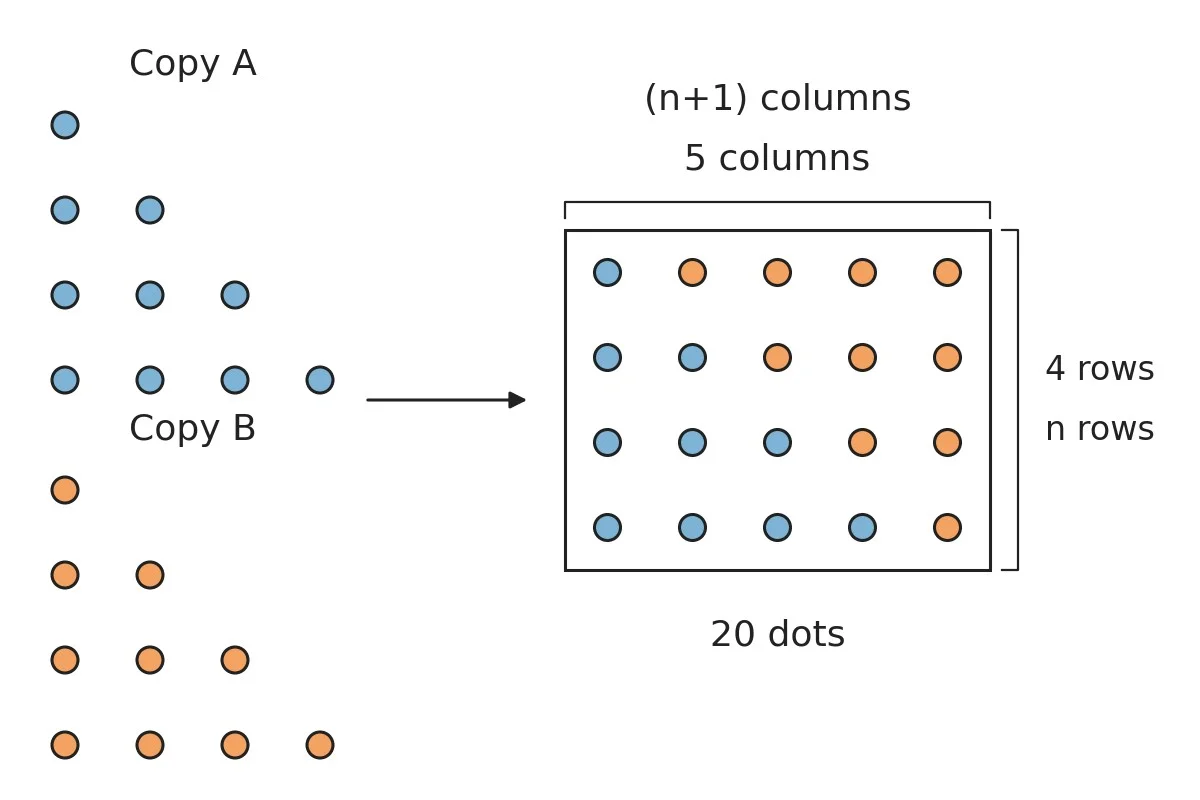
Two coloured dot staircases combine into a rectangle with four rows and five columns.

6. Sum of the First n Natural Numbers

Two matching staircases reveal the total by forming a rectangle.

Show
Find both staircases in the diagram, then their combined rectangle.
Ask
How many dots does one copy contain?
Say
One copy has 10 dots, half the rectangle.
Used in
Triangular stacking totals help count objects without counting every object separately.
If your child says…“One triangle contains the whole rectangle's total.”
Ask
How many copies of the original staircase fill the rectangle?
What’s true
The rectangle holds two equal triangular totals, so either triangle contains half.

Geometric progressions

t4=3×2×2×2t_4 = 3\times2\times2\times2

t4=3×23t_4 = 3\times2^3

t4=3×8t_4 = 3\times8

7. Geometric Progressions

Multiply by the same ratio at every move.

Show
Write 3, 6, 12. Divide each term by the one before it to check the multiplier, 2. Write these lines, saying: “Double three times after the starting 3.”
Ask
What is the fourth term?
Say
The fourth term is 24, with the starting 3 used once.
Used in
Repeated recipe doubling helps calculate ingredient amounts for larger batches.
If your child says…“I cube both the starting 3 and the multiplier 2.”
Ask
How many times does 3 appear in the expanded first line?
What’s true
Only the multiplier repeats, so only it receives the power.
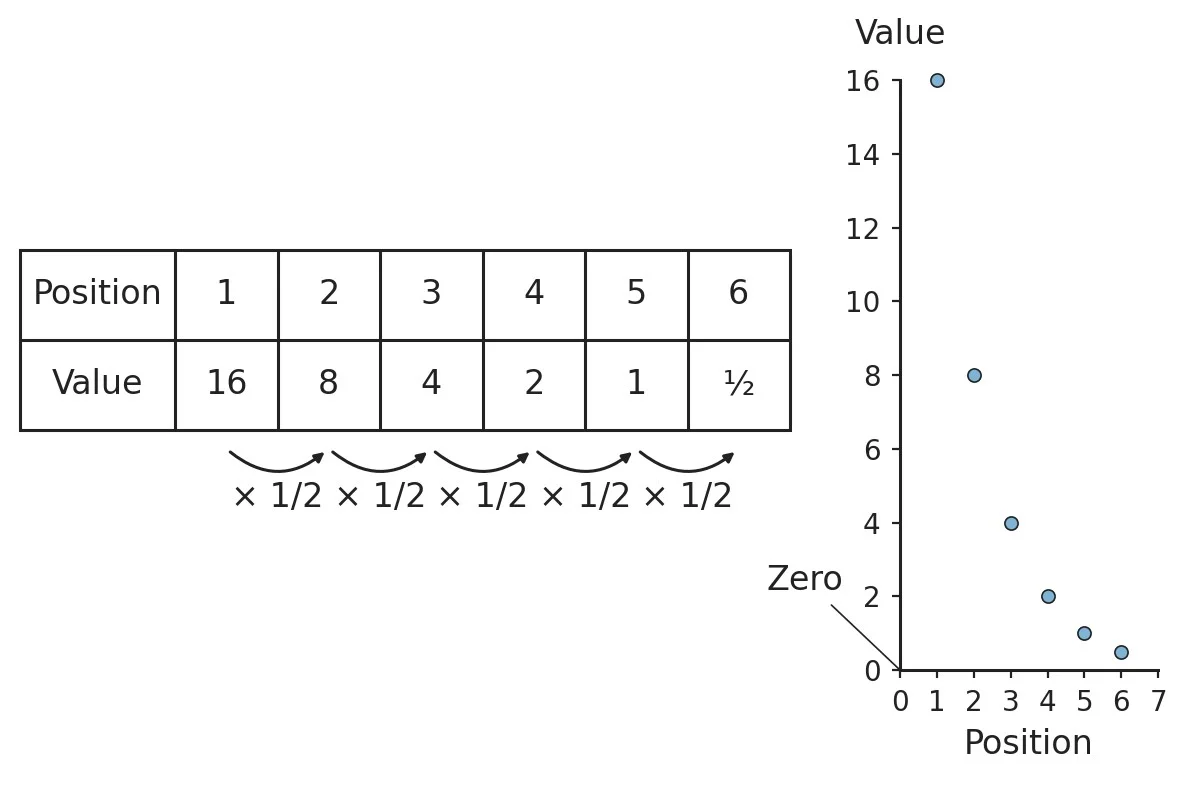
A halving table beside separate graph points approaching the horizontal axis.

8. Visualising a GP

A ratio between zero and one makes positive terms approach zero.

Show
Look at the diagram's table and follow the halving arrows. Match each position and value to its graph point. Compare the drops between neighbouring points.
Ask
If these values keep halving, will any later point reach zero?
Say
The points approach zero without reaching it: halving a positive value always leaves something positive. Their shrinking drops keep these points from lying on a straight line.
Used in
Halving paper makes equal pieces for sharing.
If your child says…“Enough halvings will make the value exactly zero.”
Ask
What happens when you halve any positive value that still remains?
What’s true
Every finite number of exact halvings leaves a positive value.

A real problem

Logarithm tables made multiplication easier.

Napier published his explanation of logarithms in 1614.

His method paired an increasing arithmetic progression with a decreasing geometric progression.

The tables replaced laborious multiplication with simpler addition.

University of St AndrewsBrown University LibraryOpen University

Open logarithm-table book beside a pencil and handwritten calculations.

Concept Lab · Common misconception

The tempting mistake in Predicting What Comes Next: Exploring Sequences and Progressions

Open standalone misconception page →

Does an increasing sequence always add the same number?

Wrong

2, 4, 8, 16 is arithmetic because every term is larger than the previous one.

Why it feels right. The regular increase looks like equal steps.

Right

An arithmetic progression has a constant difference. A geometric progression has a constant ratio.

Worked example

Term 12
Term 24
Term 38
Term 416
Term 532
Each term doubles. The rising heights make the changing differences visible.
  1. The differences are 2, 4 and 8, while the ratios are all 2.
  2. The terms double, so the pattern gives 32 as the next term.

Ask your child eight quick questions.

One per step. The answer and the reason are given.

  1. Before the swap, what is the value of the fourth term?

    3 The fourth position contains 3; its position number is not its value.

  2. Solving for a number's position gives 94.6. What does that tell you?

    It is not a term. A position must be a positive whole number.

  3. Which value must receive the next addition to find the third term?

    4 The previous term is 4; the requested position is not the input.

  4. How many additions of the common difference take you from the first term to the fourth?

    Three The first term needs no addition.

  5. What fare belongs in the first position of this sequence?

    ₹240 The first kilometre adds ₹40 to the ₹200 booking fee.

  6. What must you do to the rectangle's count to find one triangular total?

    Halve it. The rectangle contains two copies of the same triangular total.

  7. Which number is cubed when calculating this fourth term?

    2 There are three factors of 2, but only one starting factor of 3.

  8. After any finite number of exact halvings, what remains of a positive value?

    A positive value Each multiplication uses a positive fraction, so none produces zero.

15 more questions with answers