Skip to content

Teach Introduction to Linear Polynomials in six steps.

For each idea: show it, ask before you tell, then say one line.

Gather paper, squared paper, a pencil, a ruler and 10 unlit matchsticks.

Common misconceptions & worked visual for this chapter · 15 practice questions with answers

How to teach it

Read and use expressions

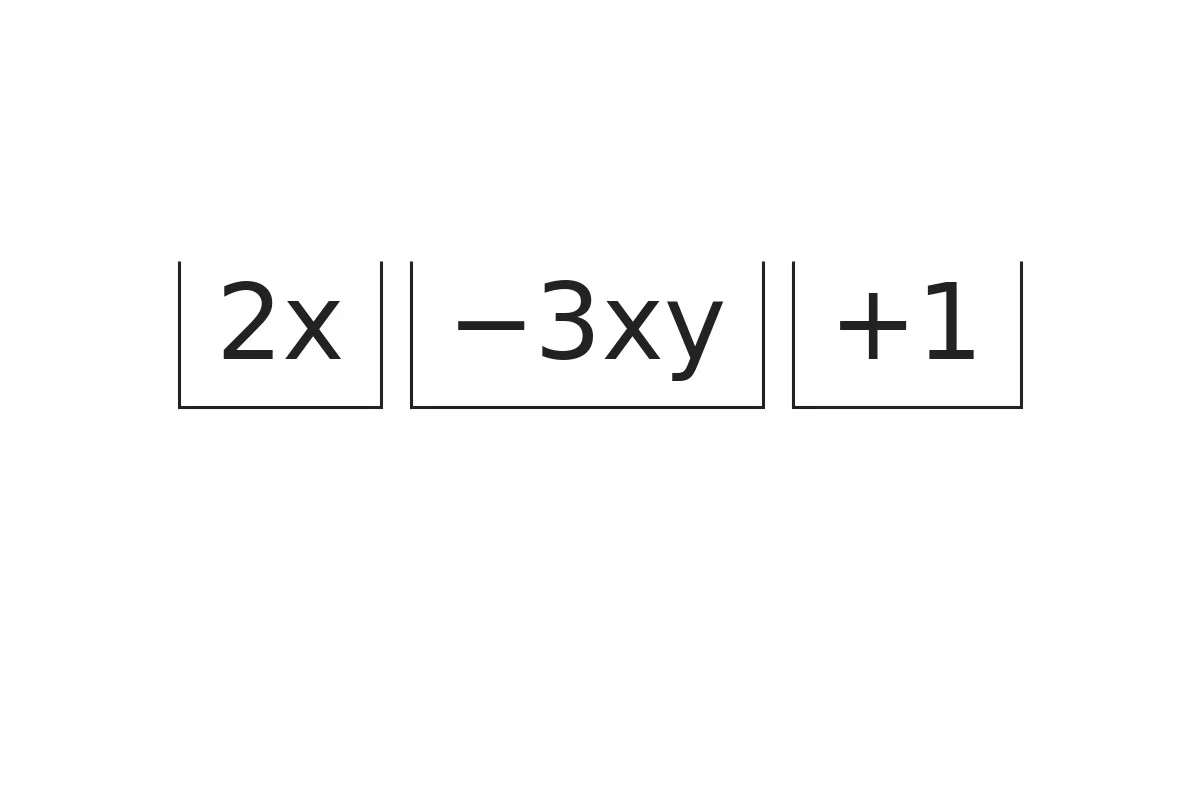
Expression diagram with a bracket beneath each signed term.

1. Terms, Coefficients and Constants

Terms keep signs, coefficients multiply letters, and constants have no letters.

Show
Read the diagram: two times x, minus three times x times y, plus one. Find the three bracketed terms. Notice the sign inside each bracket.
Ask
What coefficient will you write beneath the middle term?
Say
Multiplication keeps the middle term together, with coefficient −3. Label 2 and −3 as coefficients, and 1 as the constant.
Used in
Bills separate fixed and quantity-based charges, making each part of the total visible.
If your child says…“The middle coefficient is 3.”
Ask
Does the middle term add three times x times y, or subtract it?
What’s true
Subtracting three times x times y means adding a term whose coefficient is −3.
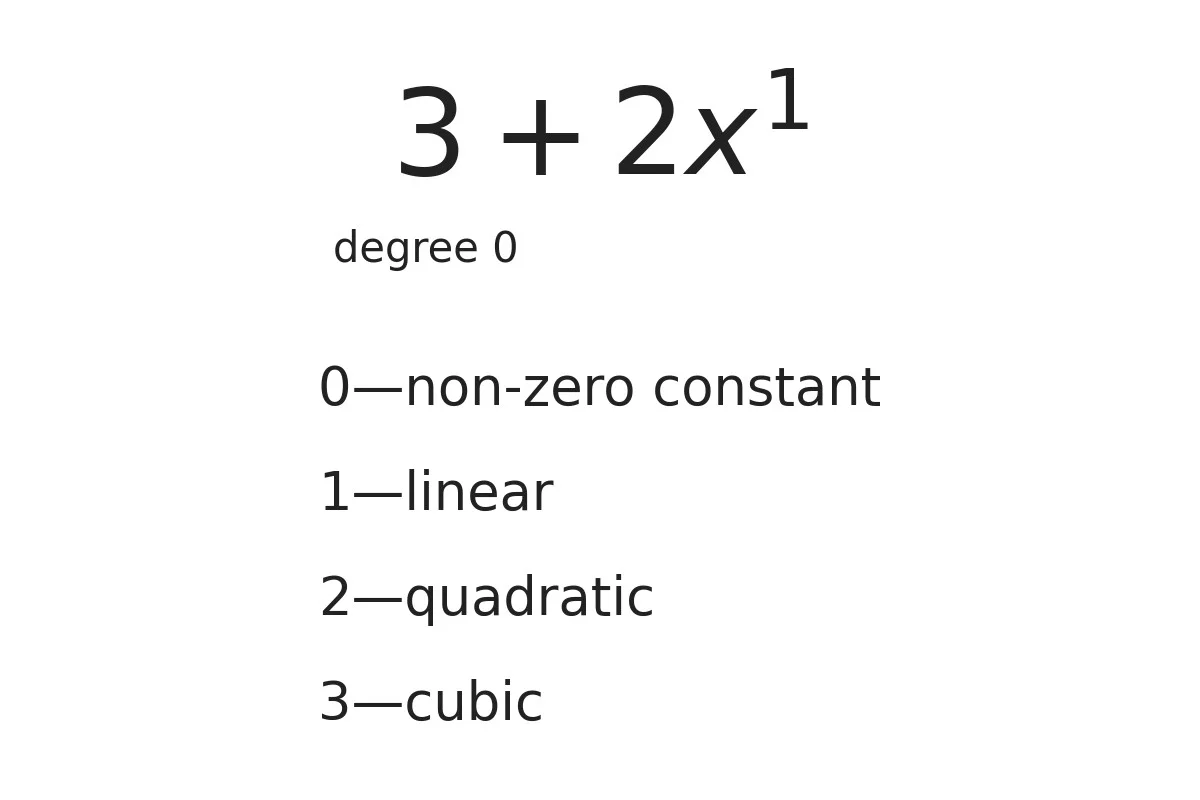
Polynomial diagram with its constant’s degree marked and a small degree-name key.

2. Degree of a Polynomial and Linear Polynomials

Degree is the highest power; degree one means linear.

Show
Look at the diagram: three plus twice x. Compare the powers, then read the degree-name key. After predicting, circle the highest power.
Ask
What degree and name will you give it?
Say
Degree one makes it linear.
Used in
A square’s linear perimeter rule helps calculate the border needed.
If your child says…“The first term decides the degree.”
Ask
Which power stays highest if you move the constant to the end?
What’s true
The highest power decides the degree wherever its term appears.

p(x)=2x+3p(x)=2x+3

p(−1)=2(−1)+3p(-1)=2(-1)+3

p(−1)=−2+3p(-1)=-2+3

3. Evaluating a Polynomial

Replace each variable with its value, then calculate.

Show
Write these lines. Say, “x is the input. p of x names the output.” Keep negative one together in parentheses.
Ask
What output will this polynomial give for an input of negative one?
Say
The output is one: p(−1)=1p(-1)=1. Multiplying gives minus two, and adding three gives one.
Used in
Putting a purchase quantity into a cost rule gives the amount to pay.
If your child says…“I can leave out the input’s minus sign.”
Ask
Are you multiplying two by negative one or by positive one?
What’s true
The minus sign stays attached to the input during substitution.

Build patterns and read their lines

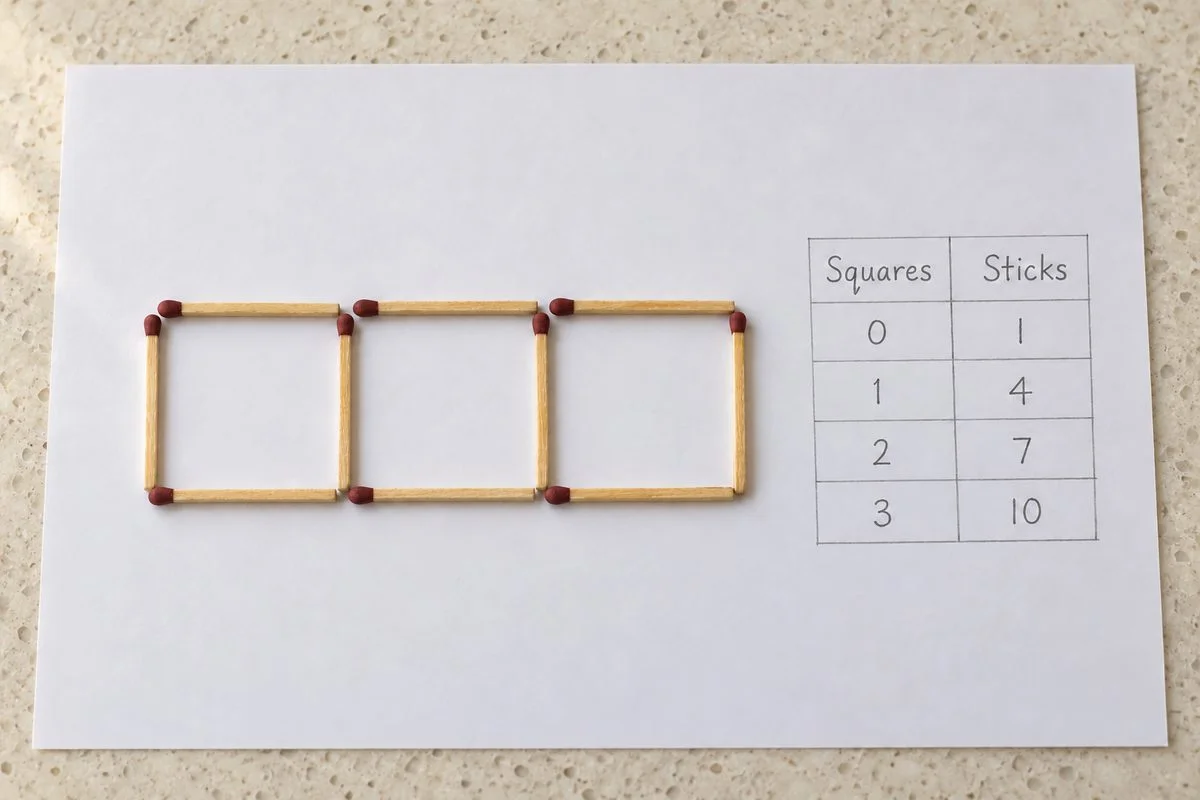
Three adjoining matchstick squares sharing their upright sides.

4. Exploring Linear Patterns

Equal additions give a rule: starting amount plus step times count.

Show
Lay one unlit matchstick upright and record 1 for no squares. Add three sticks per square, making three adjoining squares. Record totals 4, 7 and 10 beside square counts 1, 2 and 3.
Ask
If n counts squares, what rule will count all the sticks?
Say
Each square adds three sticks to the original one, giving 3n+13n+1. The starting value counts sticks before any square exists.
Used in
Regular savings additions give a rule for planning a future balance.
If your child says…“The starting value is 4.”
Ask
How many sticks were there before the first square?
What’s true
The starting value is 1, before any square has been built.
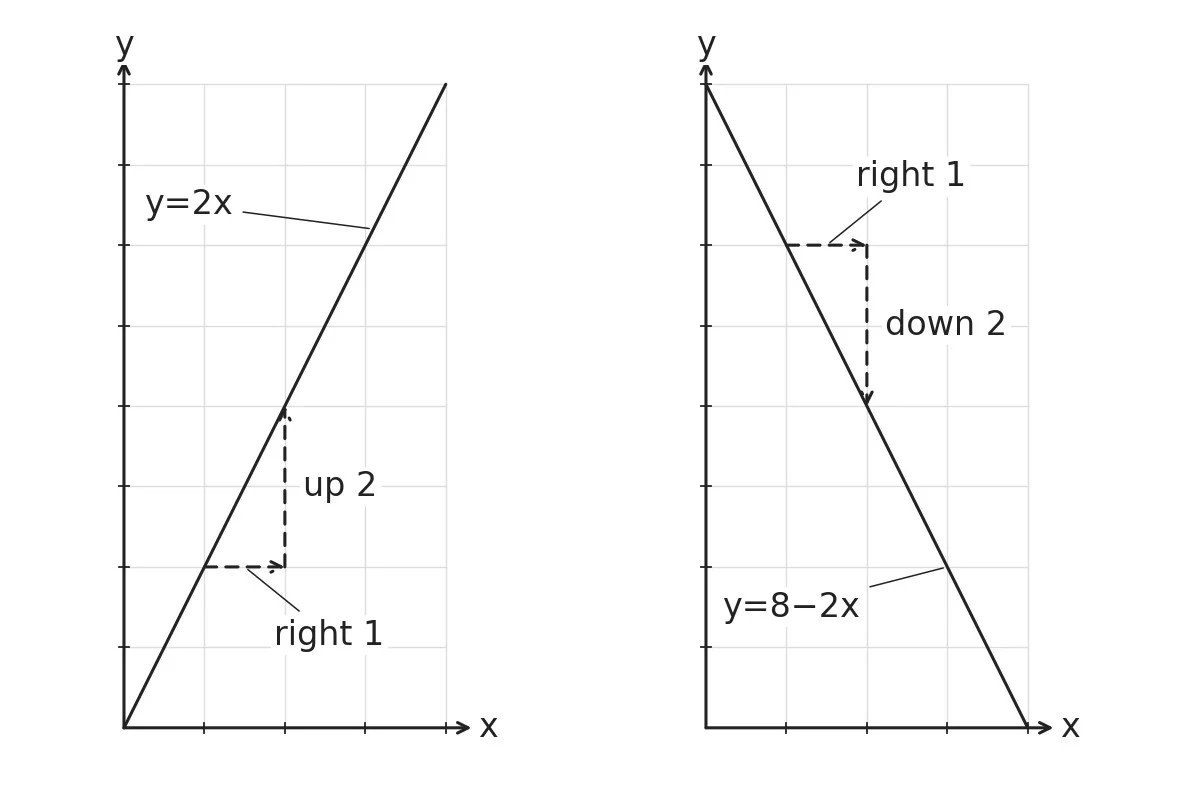
Equally scaled graphs show equal rises and falls for each unit right.

5. Linear Growth and Linear Decay

Slope gives rise or fall for each unit increase in input.

Show
Look at the diagram. Follow each line’s arrows right, then up or down.
Ask
As x increases by one, how much will y change on each graph?
Say
Rising by two gives slope positive two. Falling by two gives slope negative two. Equal changes make them equally steep.
Used in
Fixed daily spending helps predict when money runs out.
If your child says…“The falling line has positive slope because y is still positive.”
Ask
On the falling line, does y increase or decrease as x increases?
What’s true
The direction of change decides the slope’s sign, regardless of the output’s sign.
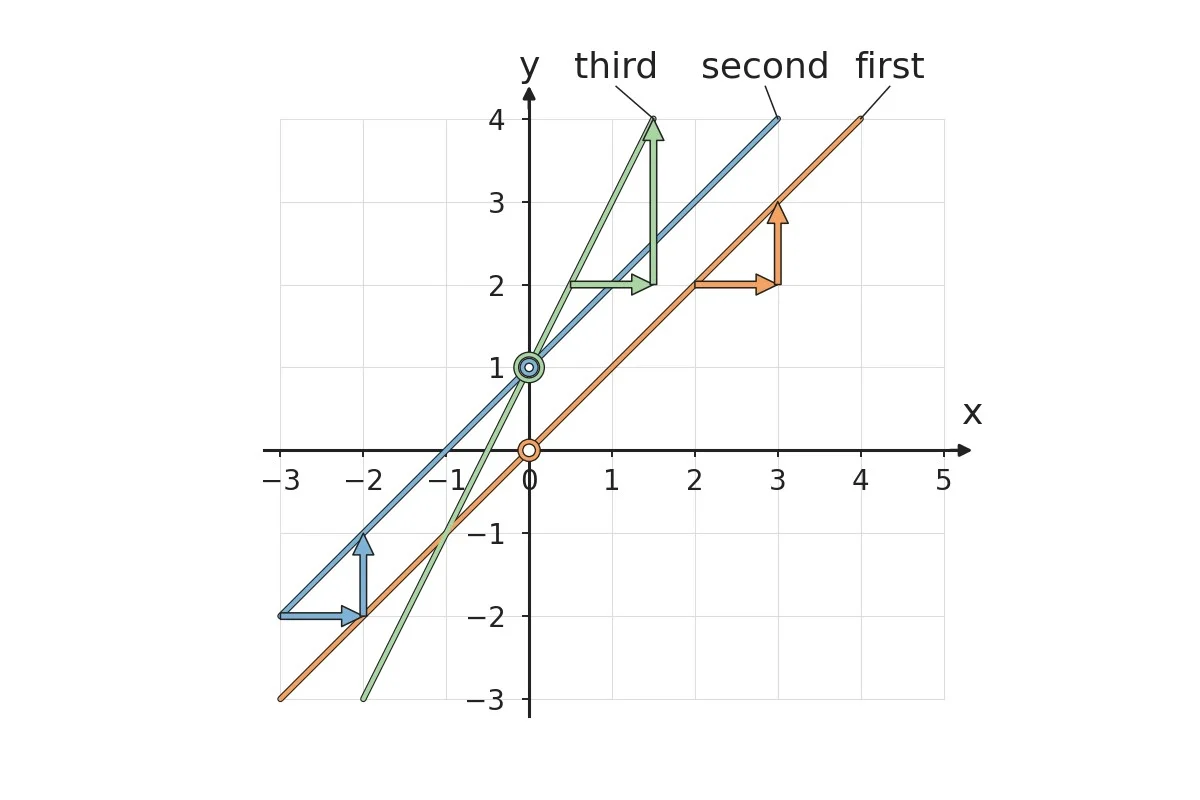
Three labelled lines, with two parallel and two sharing a vertical-axis crossing.

6. Visualising Linear Relationships: Slope and Y-intercept

Slope measures change per unit right; y-intercept locates the vertical-axis crossing.

Show
Read the diagram together: x is the input and y is the output. Compare each line’s rise for one square right. Find where each line crosses the vertical axis.
Ask
Which pair will remain parallel?
Say
Equal rises make the first pair parallel.
Used in
Comparing fixed charges and rates helps explain why service bills differ.
If your child says…“Lines are parallel when their added numbers match.”
Ask
Do the lines sharing a vertical-axis crossing also rise by the same amount?
What’s true
Different lines are parallel when their slopes match, even with different y-intercepts.

A real problem

A temperature scale built on a linear relationship.

Celsius developed his scale in 1742 after finding existing thermometers and scales unreliable.

Mercury’s expansion is approximately linear with temperature, providing the basis for a linear thermometer scale.

The Celsius scale became widely used around the world.

Uppsala UniversityDeutsches MuseumPurdue University

Glass room thermometer with a visible liquid column and evenly spaced scale ticks.

Concept Lab · Common misconception

The tempting mistake in Introduction to Linear Polynomials

Open standalone misconception page →

Can a variable in a denominator be linear?

Wrong

1/x + 2 is a linear polynomial.

Why it feels right. I see only a single x symbol.

Right

A linear polynomial has the form ax + b with a nonzero constant a.

Worked example

The dots show three equally spaced x-values. The drop is 1/2 first and 1/6 next. The dashed line shows equal drops for comparison.
  1. For x = 1, 2 and 3, the outputs of 1/x + 2 are 3, 2.5 and 2⅓.
  2. Equal x steps give unequal changes.

Ask your child six quick questions.

One per step. The answer and the reason are given.

  1. In x squared plus three times x minus five, what is the constant term?

    −5. The minus sign belongs to the constant term.

  2. Consider five times x plus twice x to the fourth power minus one. What is its degree?

    4. The highest power is four, although its term comes second.

  3. What is two times the input negative one?

    −2. Multiplying a positive number by a negative number gives a negative result.

  4. What amount does each extra square add to the stick total?

    3 sticks. Each new square shares an existing side and needs three new sticks.

  5. What is the falling line’s slope while y is still positive?

    −2. Each unit right lowers y by two, even above the horizontal axis.

  6. Which of your other lines stays parallel to y equals x?

    y=x+1y=x+1. Both rise one unit for each unit right, despite crossing at different heights.

15 more questions with answers