Skip to content

Teach I'm Up and Down, and Round and Round in eight steps.

For each idea: show it, ask before you tell, then say one line.

Gather paper, a round plate, pencil, ruler, school compass and scissors.

An adult cuts the paper and handles the compass point.

Common misconceptions & worked visual for this chapter · 15 practice questions with answers

How to teach it

Circles and their centres

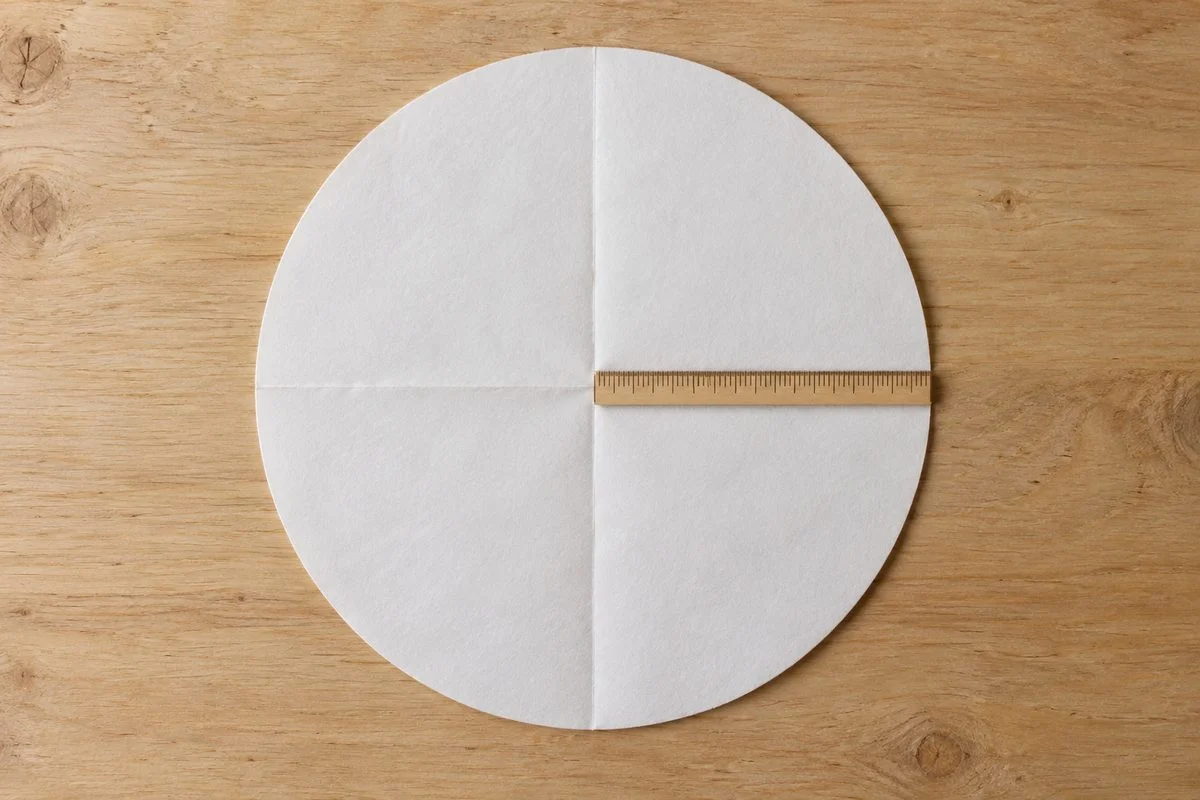
Paper disc with crossing creases and a ruler reaching its edge.

1. Circle and its symmetry

A fixed-distance boundary with a symmetry line through every diameter.

Show
An adult traces a plate and cuts out the disc. Fold matching edges twice, in different directions. Measure from the creases’ crossing to several edge points.
Ask
Will another fold through the centre also match the edges?
Say
The circle is only the boundary, one radius from its centre. Every diameter gives a matching fold.
Used in
A compass keeps its radius fixed, making circular borders even.
If your child says…“A circle has only two symmetry lines.”
Ask
What prevents a matching fold between your existing creases?
What’s true
Every direction through the centre gives a symmetry line, so there are infinitely many.
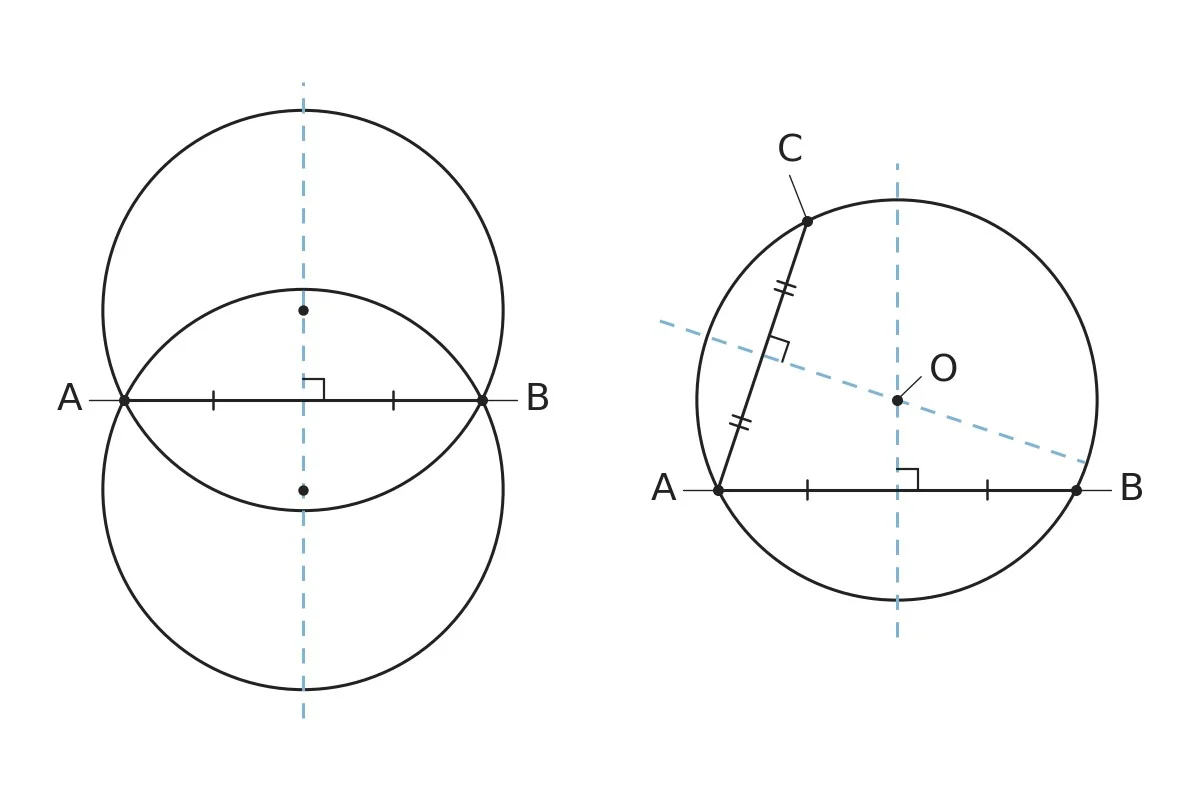
Shared circle points and perpendicular bisectors locating a centre through three points.

2. Circles through two and three points

Three points off one line fix a circle.

Show
Look at the diagram’s two shared dots and centres along their perpendicular bisector. Follow the perpendicular bisector of AC to its crossing with the bisector of AB.
Ask
Will each circle reach both original dots?
Say
Each circle reaches both original dots. Three non-collinear points force one centre where the bisectors cross.
Used in
Surviving edge marks let damaged circular patterns be restored.
If your child says…“Only one circle can pass through two points.”
Ask
Do both circles pass through your original points?
What’s true
Every position along their perpendicular bisector provides a possible centre.
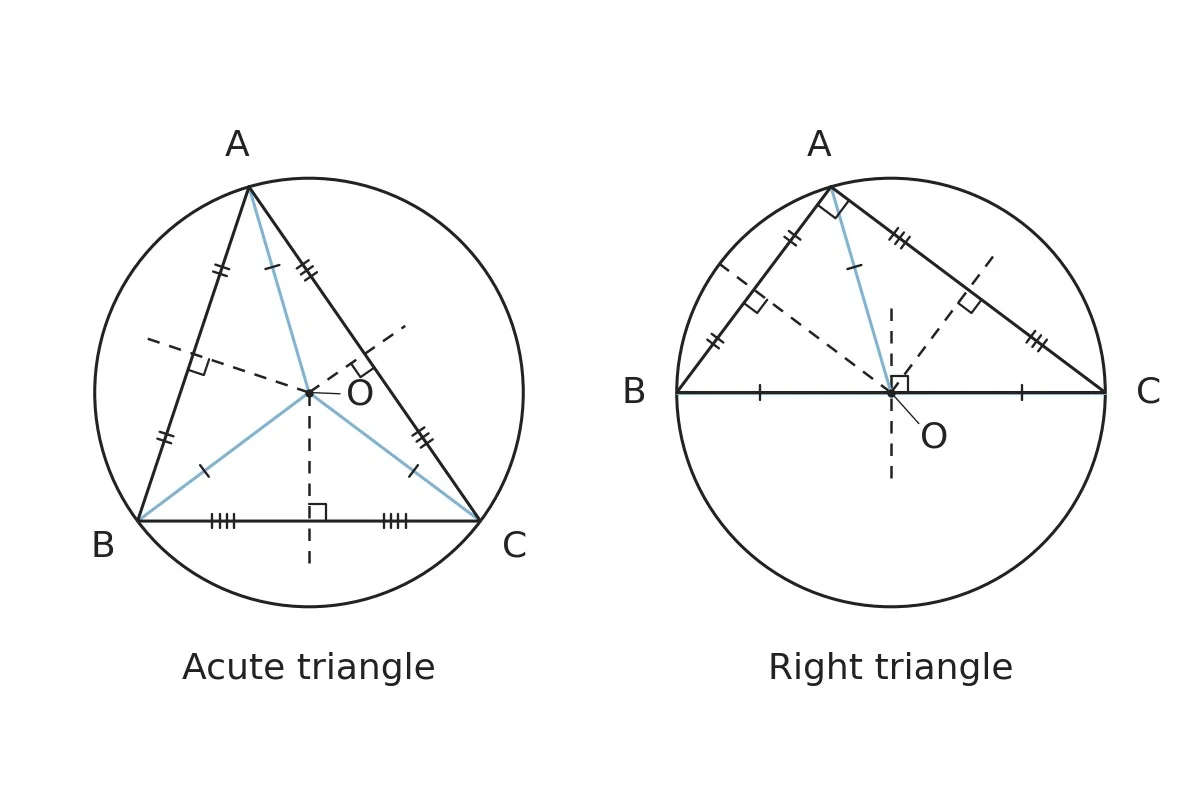
Acute and right triangles with circumcircles and perpendicular bisectors meeting at their centres.

3. Circumcentre and circumcircle

The circumcentre centres a circle through all three triangle corners.

Show
Look at the diagram’s acute triangle. Follow the side perpendicular bisectors to O. Compare O’s position in the right triangle.
Ask
Where should the circle’s centre go to reach all three corners?
Say
The bisectors meet at O, equally far from all three corners. O centres the circle through them. In the right triangle, O lies halfway along the hypotenuse.
Used in
The circumcentre positions a circular border through a triangular design’s corners.
If your child says…“The circumcentre is always inside the triangle.”
Ask
In the right triangle, is O inside the triangle or on its edge?
What’s true
A right triangle’s circumcentre sits on its longest side, at that side’s midpoint.

Chords and distances

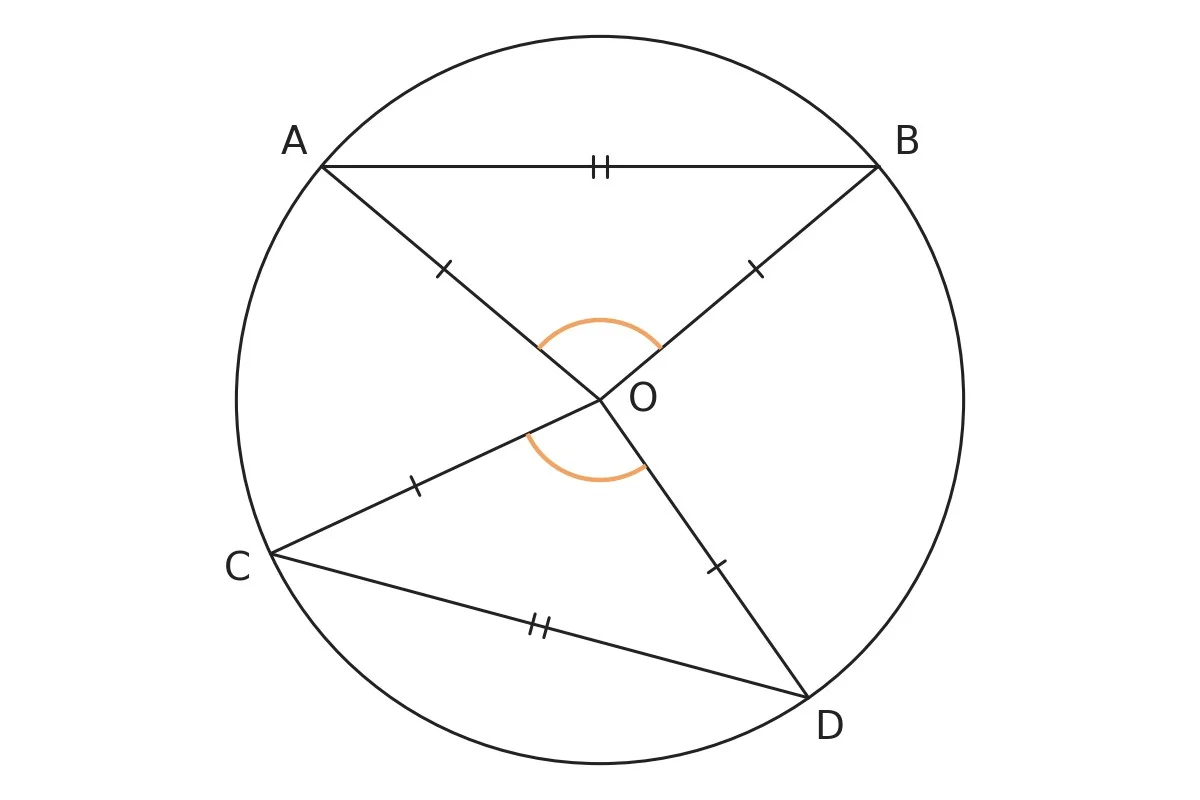
Equal chords and four radii form matching triangles within one circle.

4. Equal chords and angles at the centre

Within one circle, equal chords and equal centre angles imply each other.

Show
Look at the diagram’s equal chords AB and CD. Follow their endpoints to O. Compare the three sides of the two triangles.
Ask
Must these equal chords make equal angles at O?
Say
Their centre angles match because the triangles have three matching sides.
Used in
Equal chords between successive holes space those holes evenly around a circular rim.
If your child says…“Turning a chord changes its centre angle.”
Ask
Which triangle lengths change when the chord turns around the centre?
What’s true
Within one circle, turning a chord changes neither its length nor its centre angle.
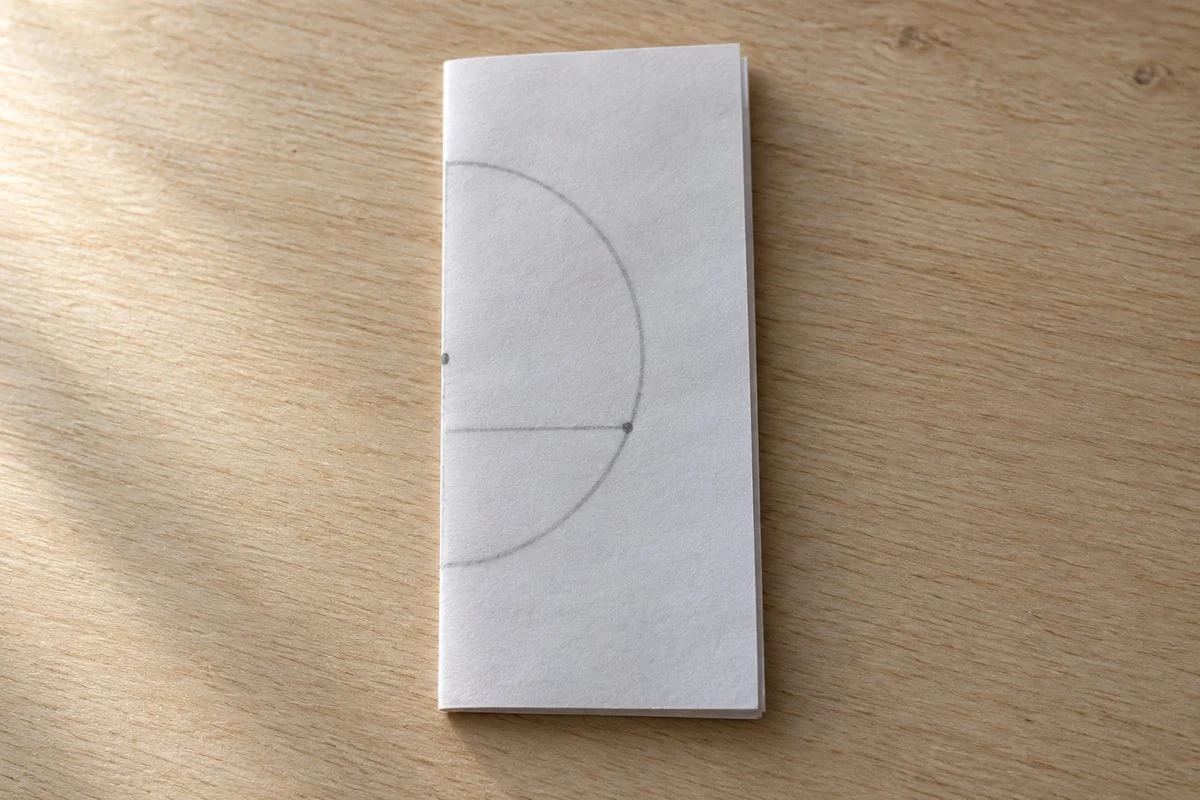
Sheet folded to bring a circle chord’s endpoints together.

5. Perpendicular from the centre to a chord

The centre’s perpendicular halves a chord.

Show
Draw a circle, its centre and an off-centre chord. Fold the endpoints together. After predicting, unfold; compare halves and adjoining angles.
Ask
Will the crease cross the centre?
Say
Equal endpoint distances put the centre on this crease. It halves the chord at right angles.
Used in
Perpendicular bisectors of nonparallel chords locate a circular tabletop’s centre for its support.
If your child says…“Any line from the centre halves a chord.”
Ask
Does a sloping line through the centre meet the chord where your crease does?
What’s true
For a chord away from the centre, only the perpendicular from the centre halves it.

x2+32=52x^2+3^2=5^2

x=52−32=4 cmx=\sqrt{5^2-3^2}=4\text{ cm}

6. Distance of chords from the centre

A right triangle links radius, distance and half-chord.

Show
Write these lines. Say, “The radius is 5 cm; the perpendicular distance is 3 cm. Half-chord x completes the right triangle.”
Ask
With this radius and perpendicular distance, what chord length do you predict?
Say
Doubling gives 8 cm.
Used in
Chord calculations determine shelf widths inside circular alcoves.
If your child says…“The 4 cm answer is the whole chord.”
Ask
What must you do to the calculated half-chord to find the whole length?
What’s true
The perpendicular splits the chord, so the right triangle contains only half its length.

Angles on a circle

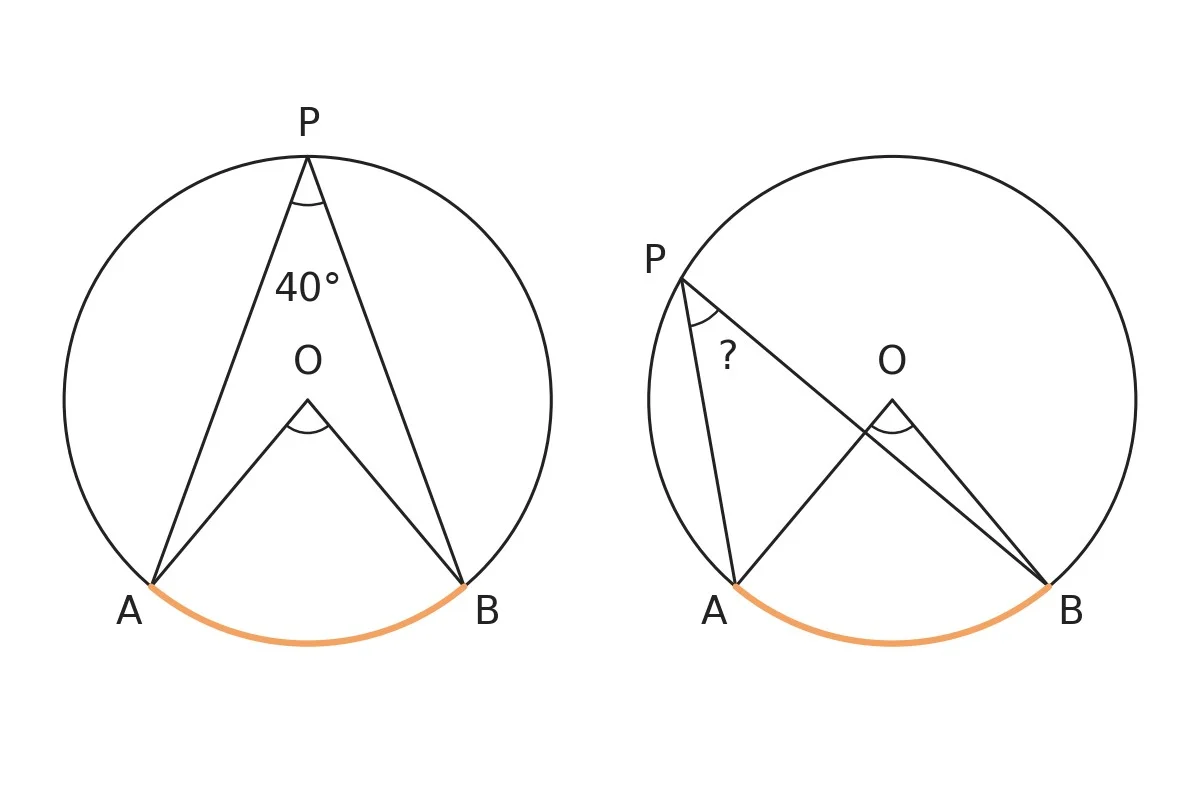
The same highlighted arc viewed from the centre and two positions on the remaining circle.

7. Angle subtended by an arc

The centre angle doubles the corresponding boundary angle.

Show
Look at the diagram’s highlighted arc AB. Follow its endpoints to O, then to P. Compare P’s positions in the two circles.
Ask
If P moves to the second position, what happens to its 40° angle?
Say
It stays 40° because both positions face the same arc. The centre angle is twice the boundary angle, so it is 80°.
Used in
Semicircle constructions help draw square corners.
If your child says…“The centre angle is half the edge angle.”
Ask
If the centre angle is twice 40°, can it be smaller than 40°?
What’s true
Any point on the remaining circle gives half the angle that arc makes at the centre.
Opposite quadrilateral angles match coloured central sectors that together fill the circle.

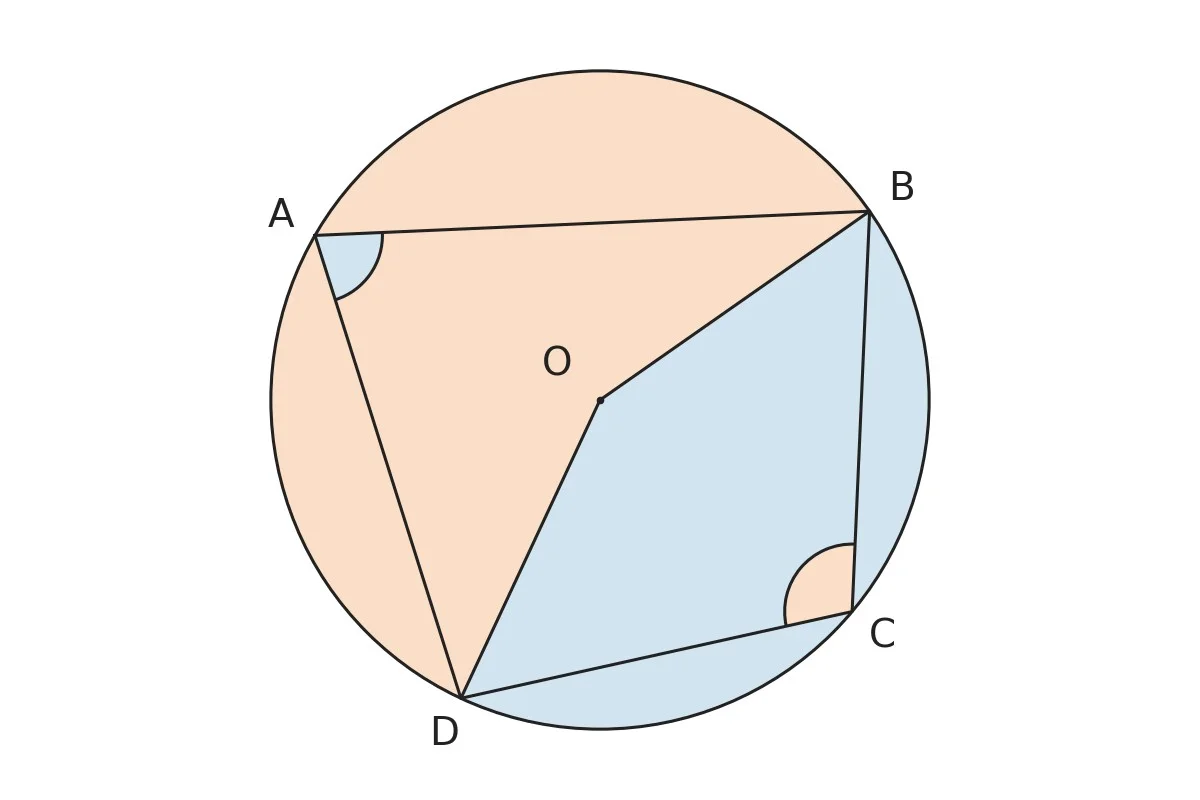
8. Concyclic points and cyclic quadrilaterals

Concyclic points share a circle; cyclic quadrilaterals connect four such points.

Show
Look at the diagram’s four corners on one circle. Match angles A and C with their coloured centre angles. Follow those centre angles around O.
Ask
What must opposite angles A and C total when their centre angles complete a full turn?
Say
They total 180° because each takes half its corresponding centre angle. Together, those centre angles make a full turn.
Used in
Cyclic frames allow angle checks using opposite corners.
If your child says…“Opposite angles in a cyclic quadrilateral are equal.”
Ask
Do A and C face equal arcs, or arcs that together complete the circle?
What’s true
Opposite angles total 180° and are equal only when both are 90°. Conversely, opposite angles totalling 180° guarantee a circle through all four corners.

Concept Lab · Common misconception

The tempting mistake in I'm Up and Down, and Round and Round

Open standalone misconception page →

Does every chord cross the centre?

Wrong

A chord must go through the centre of a circle.

Why it feels right. The diameter is the chord I remember best.

Right

A chord joins two points on a circle. A diameter is a chord through the centre.

Worked example

The short chord joins two points on the rim. Only a diameter is required to pass through the centre.
  1. Join two nearby points on the rim.
  2. The short chord stays near the rim, away from the centre.

Ask your child eight quick questions.

One per step. The answer and the reason are given.

  1. How many symmetry lines can a circle have?

    Infinitely many. A diameter in any direction folds the boundary onto itself.

  2. How many circles can pass through the same two distinct points?

    Infinitely many. Their centres can occupy any position along the perpendicular bisector.

  3. Where is the circumcentre of a right triangle?

    At the hypotenuse midpoint. That point is equally far from all three corners.

  4. A chord makes 40° at the centre. What angle remains after rotating it around the centre?

    40°. Rotation preserves the chord and both radii.

  5. A chord misses the centre. A line from the centre meets it at 70°. Does it halve the chord?

    No. The line must meet the chord at a right angle to halve it.

  6. A circle has radius 5 cm. Its centre is 3 cm perpendicularly from a chord. How long is the chord?

    8 cm. The chord has two equal halves, each 4 cm long.

  7. An arc makes 40° at a point on the remaining circle. What angle does it make centrally?

    80°. The centre angle is twice the angle on the remaining circle.

  8. One corner of a cyclic quadrilateral is 70°. What is its opposite corner?

    110°. Opposite angles total 180°; they need not match.

15 more questions with answers, 2 with pictures