Skip to content

Teach Orienting Yourself: The Use of Coordinates in eight steps.

For each idea: show it, ask before you tell, then say one line.

Gather squared paper, thin paper, a pencil and a ruler.

Common misconceptions & worked visual for this chapter · 15 practice questions with answers

How to teach it

Locating a point

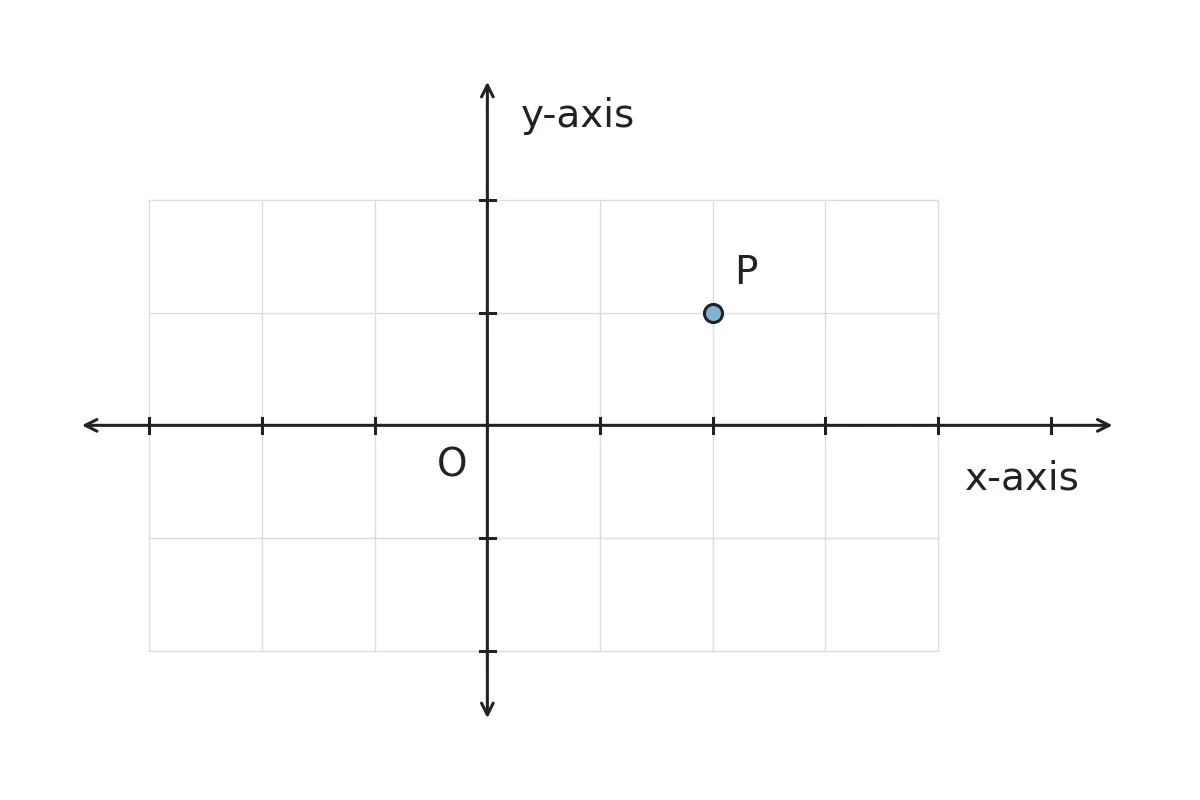
Coordinate axes with P two units right and one unit above O.

1. The 2-D Cartesian Coordinate System

Two perpendicular number lines let us describe a point’s position.

Show
Find O and both axes in the diagram. Find P, two squares right of O.
Ask
Will ‘two squares right’ locate P exactly?
Say
We need its height too. The crossing is the origin, with coordinates (0, 0).
Used in
Map coordinates pinpoint places so others can find them.
If your child says…“One number tells you exactly where I am.”
Ask
Could another point be higher while staying two squares right?
What’s true
Several positions can share the same horizontal coordinate.
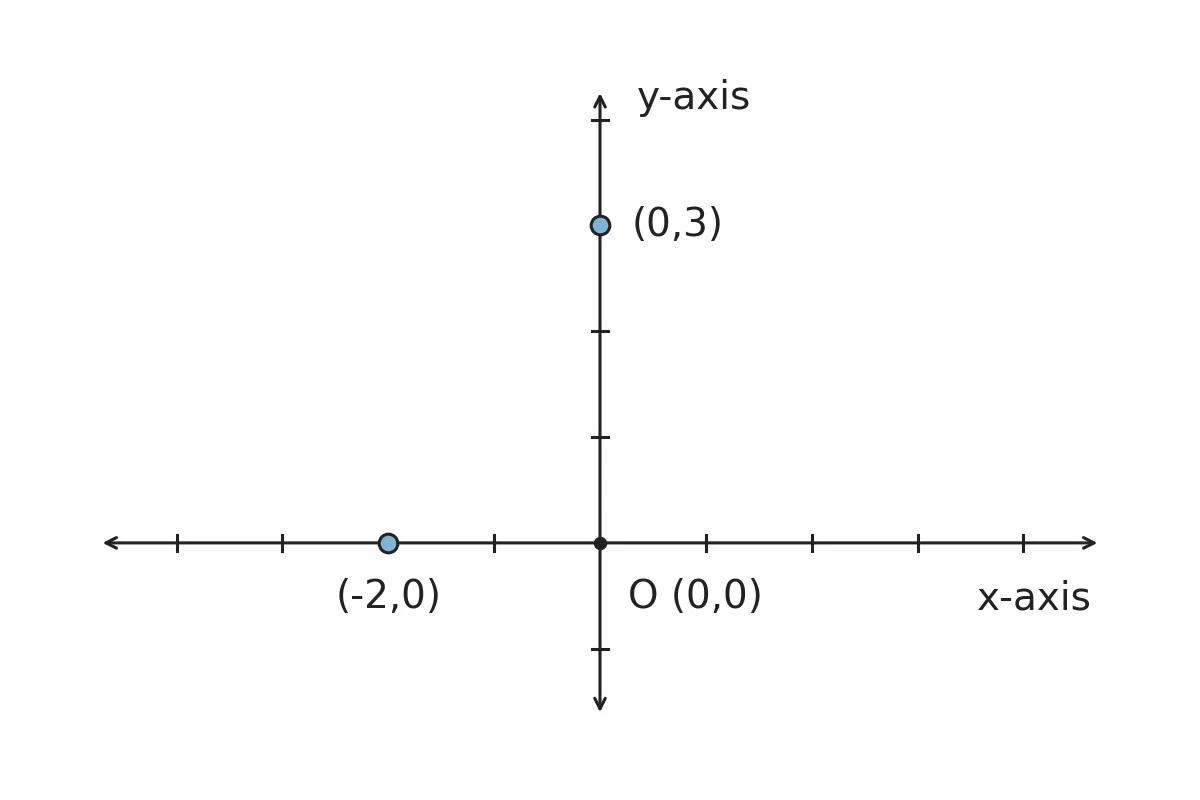
Coordinate axes with points left of the origin, above it, and at the crossing.

2. Points on the Coordinate Axes

An axis point has at least one coordinate equal to zero.

Show
In the diagram, find each marked axis point, then O.
Ask
Will reaching the marked point (0, 3) from O need any horizontal movement?
Say
Zero horizontal movement means a zero first coordinate. Zero vertical movement means a zero second coordinate. At O, both are zero.
Used in
A position on a room plan’s reference wall has zero distance from that wall.
If your child says…“The zero always comes second on an axis.”
Ask
Directly above O, how far right or left have you gone?
What’s true
The zero’s position tells us which axis contains the point.
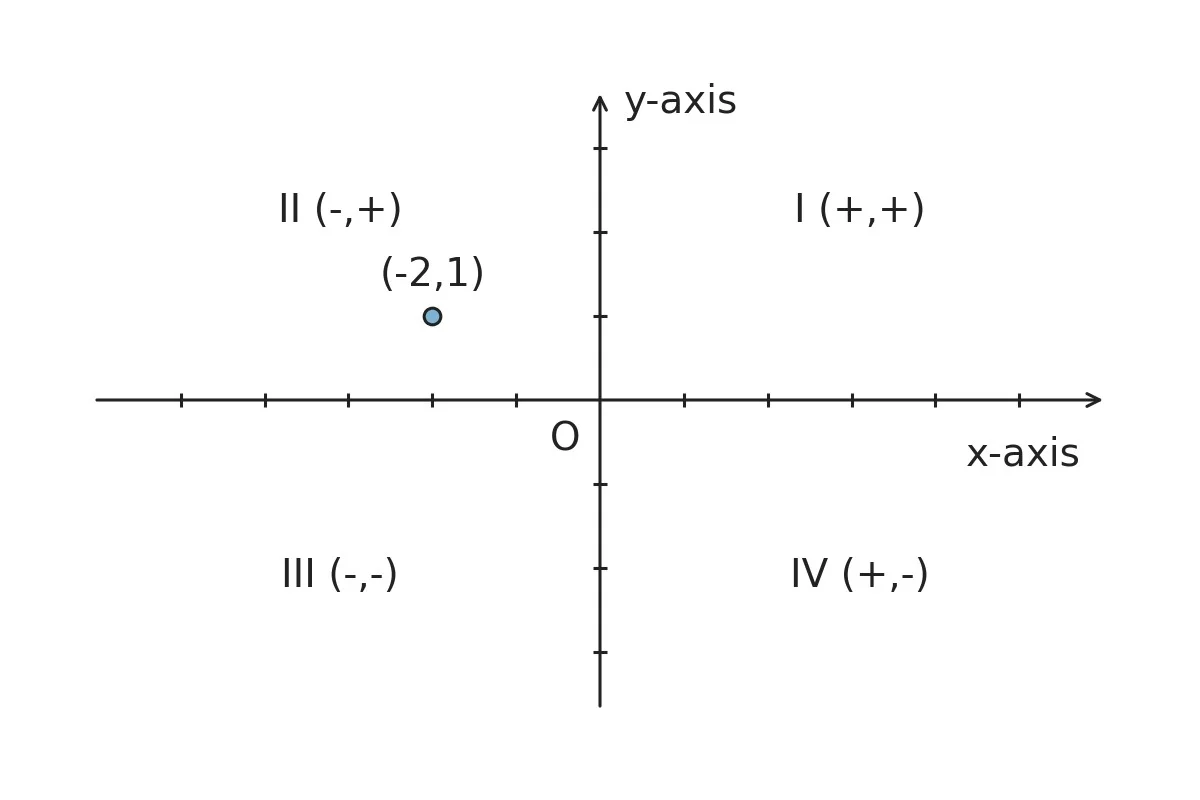
Four quadrants with sign pairs and a point in the upper-left region.

3. Quadrants

Both coordinate signs identify a region between the axes.

Show
Look at the diagram. Find the axes, then read the signs in (-2, 1).
Ask
Which quadrant will these two signs select?
Say
The signs select Quadrant II: left and above.
Used in
Positions on a game board need both directions to identify the correct region.
If your child says…“A negative first number always means Quadrant III.”
Ask
Which two quadrants lie left of the y-axis?
What’s true
Negative x allows Quadrants II and III, or the x-axis when y is zero.
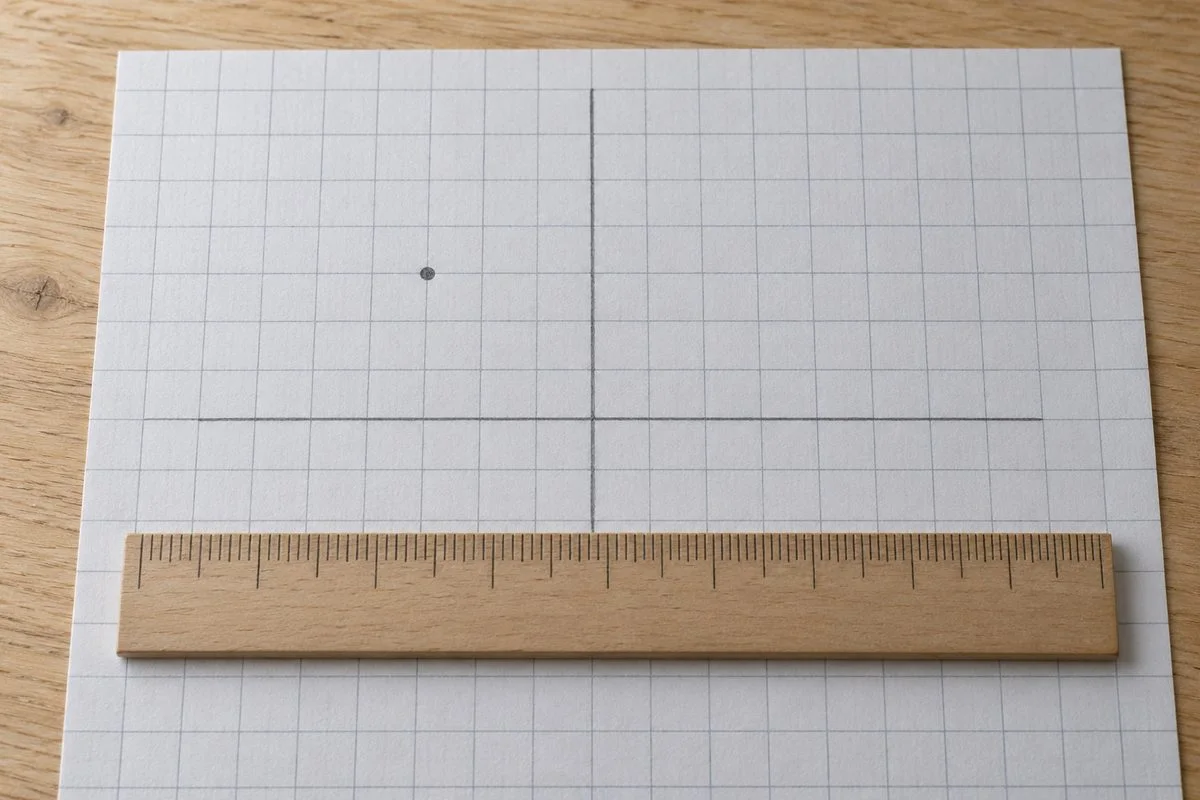
Ruler beside a grid point left and above the axes’ crossing.

4. x-coordinate and y-coordinate

Coordinates give horizontal and vertical positions, including direction.

Show
Use a grid with 1 cm units. Mark (-3, 2). After the prediction, measure horizontally to the y-axis and vertically to the x-axis.
Ask
What horizontal distance will the ruler show for a first coordinate of −3?
Say
It measures 3 cm; the minus means left. Horizontal distance reaches the y-axis; vertical distance reaches the x-axis.
Used in
Wall plans locate fittings by their distances from a corner’s vertical and horizontal edges.
If your child says…“The distance is minus three centimetres.”
Ask
Does the ruler measure a negative length?
What’s true
The sign shows direction; the distance measures a nonnegative length.
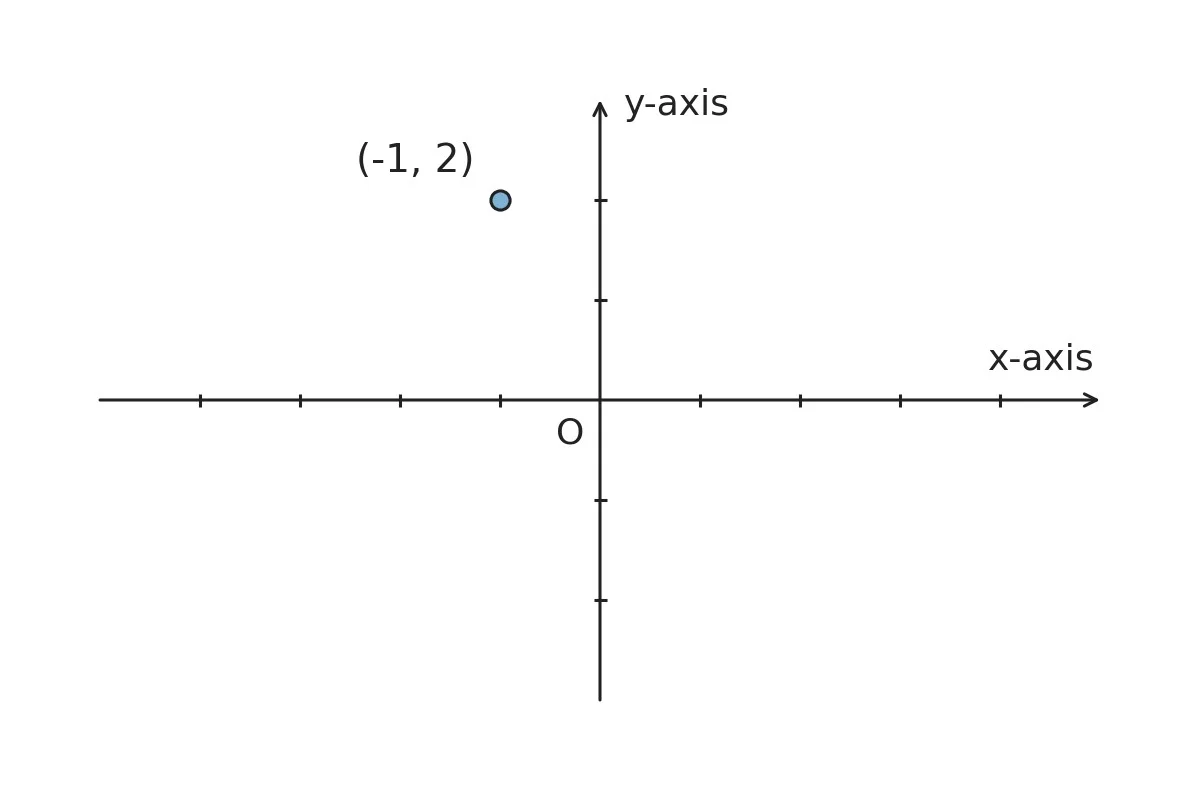
Coordinate diagram with one labelled dot above and left; lower-right region empty.

5. Coordinates (x, y)

Read horizontal position first and vertical position second.

Show
Find (-1, 2) in the diagram. After predicting, locate (2, -1) by reading the grid. Compare the positions.
Ask
Where will the dot land when we exchange the numbers?
Say
It lands right and below because the numbers exchange jobs.
Used in
A seating chart’s row and seat numbers have different jobs, helping visitors find their seats.
If your child says…“The numbers are unchanged, so it is the same point.”
Ask
Does moving left and up take you where moving right and down does?
What’s true
Exchanging unequal coordinates changes the position.

Measuring and reflecting

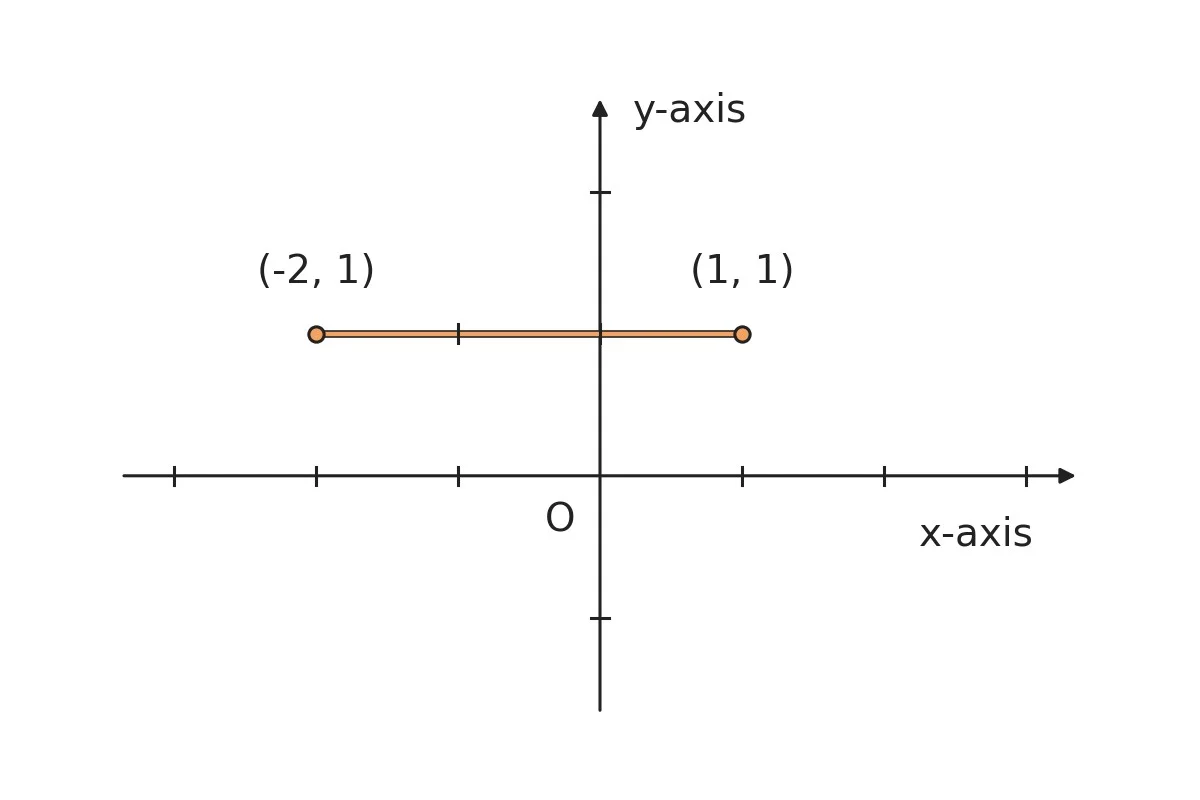
Coordinate diagram with a horizontal segment joining labelled endpoints across three unit intervals.

6. Distance Between Two Points

Along an axis direction, length is the gap between changing coordinates.

Show
Find the endpoints (-2, 1) and (1, 1) in the diagram. After predicting, count the unit intervals between them.
Ask
How many unit intervals will we count between these endpoints?
Say
Subtract the changing coordinates and ignore the result’s sign: that gives the absolute difference. Here, ∣1−(−2)∣=3|1-(-2)|=3.
Used in
Room plans use coordinate gaps to show the space available between furniture.
If your child says…“Both second coordinates are one, so the length is zero.”
Ask
Do these endpoints overlap, or is there a gap?
What’s true
Equal second coordinates mean no vertical change, but the horizontal gap remains.

d2=(4−1)2+(5−1)2d^2=(4-1)^2+(5-1)^2

d2=32+42d^2=3^2+4^2

Adding these squares gives 25.

d=25d=\sqrt{25}

7. Distance Between Two Points in the 2-D Plane

Straight distance comes from a right triangle’s horizontal and vertical sides.

Show
Join (1, 1), (4, 5) and (4, 1) on squared paper. Say, ‘Call the straight distance d. Coordinate changes give the right triangle’s shorter sides.’ Then write these lines.
Ask
What is the next line giving the straight distance d?
Say
The Baudhayana-Pythagoras theorem gives distance squared. Taking its positive square root gives five units.
Used in
A garden plan’s straight path can be measured from its endpoints’ coordinates.
If your child says…“Three across and four up means seven units straight.”
Ask
Does the straight segment follow both shorter sides?
What’s true
Adding across and up measures the bent route along the shorter sides.
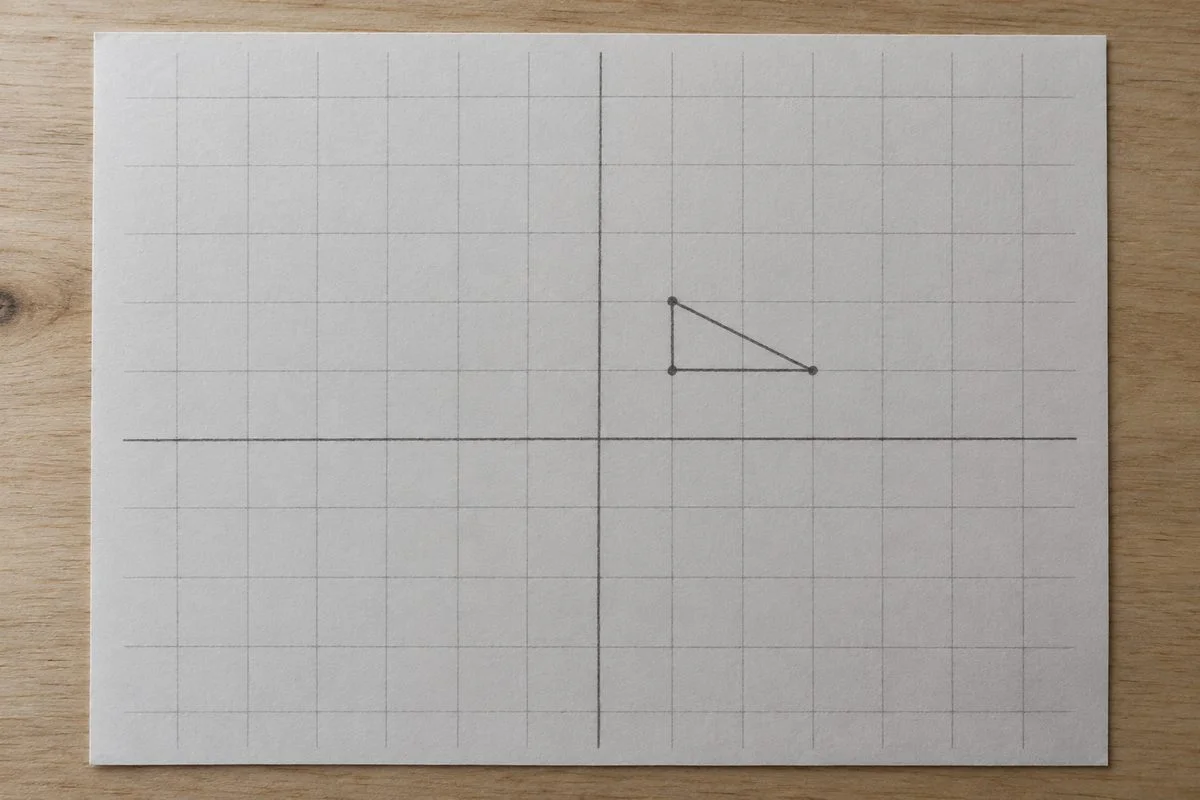
Thin paper with a triangle above and right of crossing axes.

8. Reflection

Reflection mirrors positions across an axis. Points on that axis stay fixed.

Show
On thin paper, draw axes and join (1, 1), (3, 1), (1, 2). After the prediction, fold along the y-axis. Trace against daylight, then unfold.
Ask
Which coordinate will change sign in the traced triangle?
Say
The fold preserves lengths and reverses only the first coordinate’s sign.
Used in
Folded paper patterns produce matching halves for symmetrical decorations.
If your child says…“Both signs change in a reflection.”
Ask
Does folding along a vertical line change a corner’s height?
What’s true
Across the y-axis, heights stay unchanged while horizontal positions reverse.

A real problem

A mouse connected movement to screen positions

Engelbart publicly introduced the computer mouse in 1968.

His mouse used wheels to track horizontal and vertical movement, which controlled the screen pointer.

The mouse let users interact with a graphical screen through hand movements.

SRI InternationalUniversity of AucklandZKM

A computer mouse beside a screen showing a pointer.

Concept Lab · Common misconception

The tempting mistake in Orienting Yourself: The Use of Coordinates

Open standalone misconception page →

Does the order of coordinates matter?

Wrong

(2, 5) and (5, 2) give the same point.

Why it feels right. I see the same two numbers.

Right

The first coordinate controls horizontal position and the second vertical position.

Worked example

The two routes swap the horizontal and vertical steps. Their endpoints land at different coordinates.
  1. From the origin, go 2 right and 5 up.
  2. Now go 5 right and 2 up.
  3. The two routes end at different grid points.

Ask your child eight quick questions.

One per step. The answer and the reason are given.

  1. What extra position must you give after saying ‘two squares right’?

    How far above or below. The horizontal position alone leaves many possible heights.

  2. What coordinates describe a point four units directly above O?

    (0, 4). There is no horizontal displacement, so zero comes first.

  3. Where does (-5, 3) lie?

    Quadrant II. Negative x means left; positive y means above.

  4. A point has coordinates (-3, 2). How far is it from the y-axis?

    3 units. The first coordinate measures horizontal position; its minus sign gives direction.

  5. What pair results when you exchange the coordinates of (4, 4)?

    (4, 4). Exchanging equal numbers leaves both position instructions unchanged.

  6. What is the length from (2, 5) to (9, 5)?

    7 units. Only the first coordinates change, and their gap is seven.

  7. What does 25 measure in the third line?

    The square of the distance. Taking the square root gives the length itself.

  8. Where does (3, 4) land after reflection across the y-axis?

    (-3, 4). The horizontal position reverses while the height stays four.

15 more questions with answers, 2 with pictures