Skip to content

Teach The World of Numbers in eight steps.

For each idea: show it, ask before you tell, then say one line.

Gather paper and a pencil.

Common misconceptions & worked visual for this chapter · 15 practice questions with answers

How to teach it

Zero, signs and fractions

4÷0=x4\div0=x

0×x=40\times x=4

0×x=00\times x=0

1. Zero

Zero counts none; division by zero has no defined answer.

Show
Say: “Call a proposed answer x. Division must undo multiplication.” Then write the line.
Ask
Can four divided by zero pass this multiplication check?
Say
It would require zero to equal four, so no number passes.
Used in
Stock records use zero to show that nothing remains available.
If your child says…“Dividing by zero gives zero.”
Ask
What happens when you multiply your proposed answer by zero?
What’s true
Division by zero has no unique answer that reverses multiplication.
(−1)×(1+(−1))=0(-1)\times(1+(-1))=0

−1+(−1)×(−1)=0-1+(-1)\times(-1)=0

(−1)×(−1)=0+1(-1)\times(-1)=0+1

2. Brahmagupta’s Laws

Signed arithmetic keeps track of fortunes and debts.

Show
Say: “One plus negative one is zero. Multiplying this sum by negative one gives zero. Multiply each part by negative one.” Then write the line.
Ask
What must negative one times negative one equal?
Say
The product is positive one because it cancels negative one.
Used in
Account books use signed calculations to update balances after borrowing or repayment.
If your child says…“Two negative factors give a negative answer.”
Ask
What must cancel negative one to leave zero?
What’s true
Multiplying two negative numbers gives a positive result.
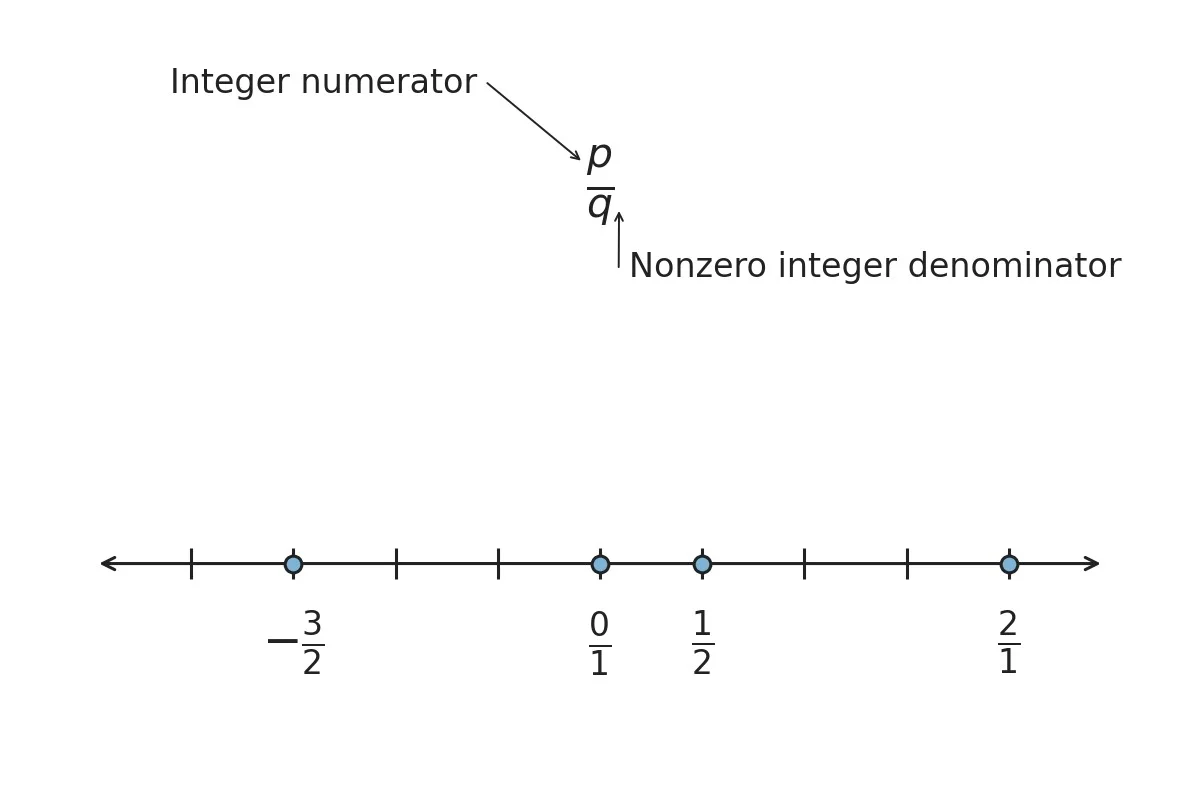
Number line showing a negative fraction, zero, a positive fraction and an integer.

3. Rational Numbers

Numbers expressible as an integer divided by a nonzero integer.

Show
Look at the diagram’s marked numbers, from left to right. Read each as one integer divided by another. Compare the numbers below the fraction bars.
Ask
Can zero and two belong to the same number family as these fractions?
Say
Yes: each marked number can be written using integer top and bottom numbers. The bottom number must never be zero.
Used in
Fractional food portions make equal sharing possible when whole pieces would be too large.
If your child says…“Seven is not rational because it isn't written as a fraction.”
Ask
What happens to seven when you divide it by one?
What’s true
A number can be rational without already having a fraction bar.
A sheet folded into quarters, with pencil shading on top.

4. Equivalent Fractions and Lowest Terms

Equivalent fractions match. Simplified numerators and denominators share no factor above one.

Show
Fold paper in half, open it, and shade one half. Fold it into quarters and leave it folded.
Ask
When we open it, will the shaded amount have changed?
Say
Open it: two shaded quarters still make one half.
Used in
Equivalent fractions let recipes describe the same ingredient amount using different measuring divisions.
If your child says…“Different top and bottom numbers mean different amounts.”
Ask
Did making more folds add any shading?
What’s true
Multiplying or dividing both parts by the same nonzero number preserves the fraction’s value.

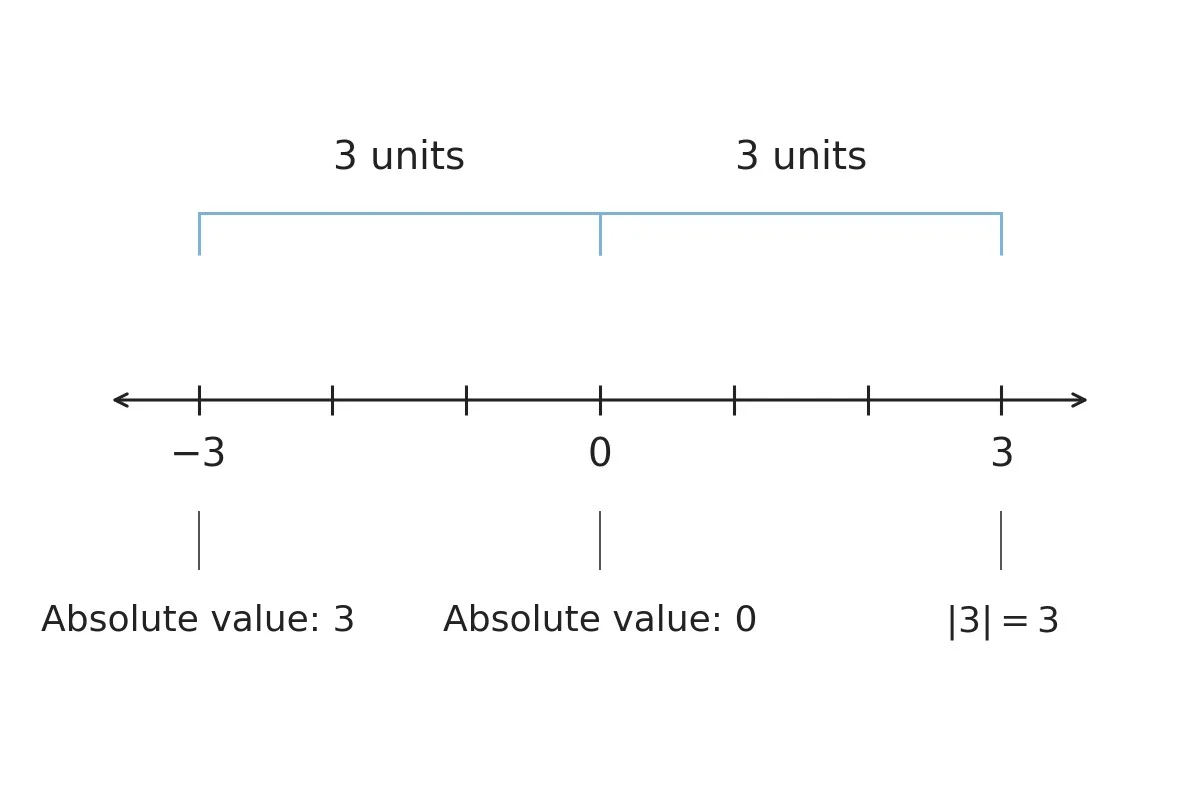
Distances and numbers between

Equal distance brackets connect negative three and positive three to zero.

5. Absolute Value

Absolute value measures how far a number lies from zero.

Show
Look at the diagram. Find negative three, zero and three, then compare the distance brackets.
Ask
How far from zero will each outer point be?
Say
Both are three units from zero, so both have absolute value three. Zero itself has absolute value zero.
Used in
Temperature differences measure the size of a change, whether warming or cooling.
If your child says…“Absolute value always flips the sign.”
Ask
How far from zero is positive three?
What’s true
Positive numbers keep their value because their distances from zero are already nonnegative.

m=1+322m=\frac{1+\frac32}{2}

m=22+322m=\frac{\frac22+\frac32}{2}

m=52×12m=\frac52\times\frac12

6. The Density of Rational Numbers

Another rational number always fits between two distinct rational numbers.

Show
Say: “Call the halfway number m. Add one and three-halves, then halve the total.” Then write the line.
Ask
What fraction will the next line give for m?
Say
Halving the sum, five-halves, gives five-quarters.
Used in
Fractional measurements describe lengths between ruler marks, allowing finer measurement when suitable tools are available.
If your child says…“Eventually, there won't be any fractions left between them.”
Ask
What would stop us adding the new endpoints and halving again?
What’s true
Every pair of distinct rational numbers has another rational number halfway between.

Irrational numbers and decimals

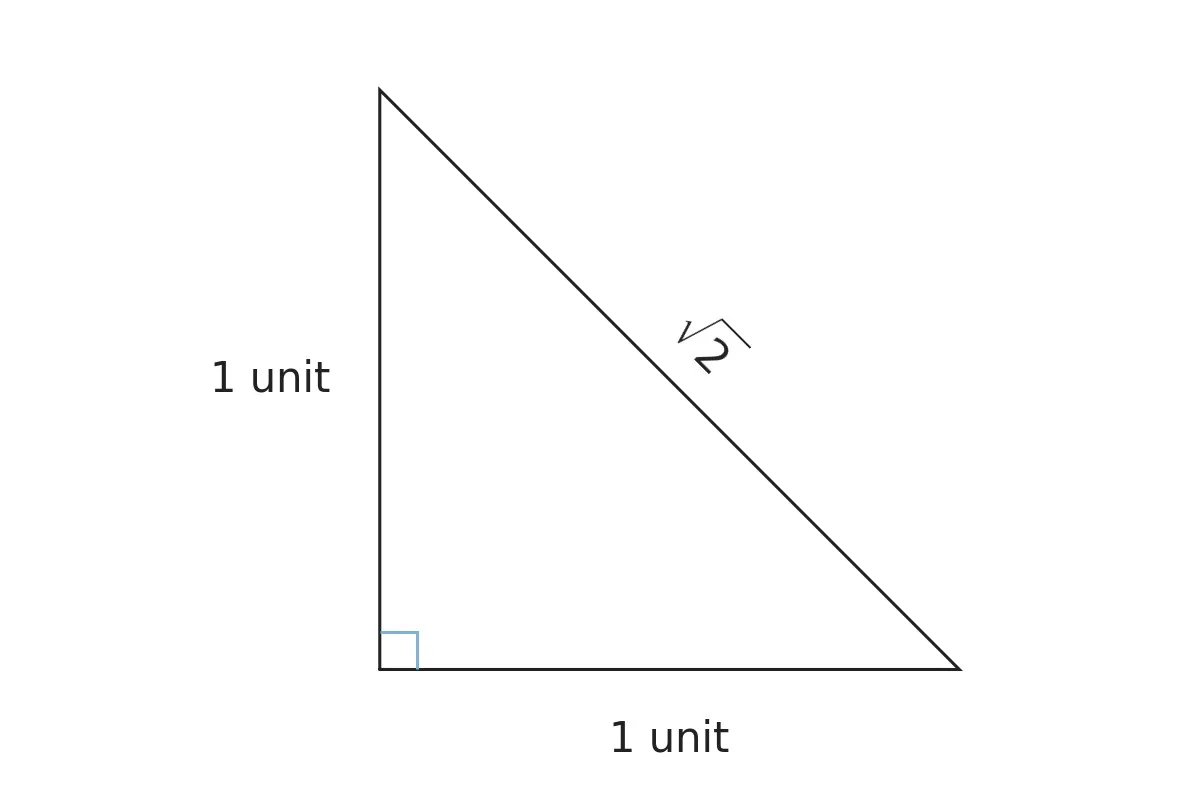
Right triangle with two unit sides and a hypotenuse labelled square root of two.

7. Irrational Numbers

Their decimals never end or settle into a repeating block.

Show
Look at the diagram’s unit sides. Pythagoras gives the sloping length: the square root of two.
Ask
Can a fraction of integers give this sloping length exactly?
Say
No. Squaring a lowest-terms fraction would force its numerator, then its denominator, to be even. Both share two, contradicting lowest terms.
Used in
Square roots give exact square diagonals, which builders approximate when measuring.
If your child says…“Every square root is irrational.”
Ask
Which whole number multiplied by itself gives 81?
What’s true
A root sign alone cannot decide whether a number is rational.

x=0.3‾x=0.\overline3

10x=3.3‾10x=3.\overline3

10x−x=310x-x=3

9x=39x=3

8. Rational Decimals: Terminating and Repeating

Rational decimals stop or repeat; matching repeating tails can cancel.

Show
Say: “Call zero point three repeating x. Ten times x is three point three repeating. Subtracting cancels the matching tails.” Then write the line. Say: “Nine times x is three.”
Ask
What fraction will the next line give for x?
Say
Dividing by nine gives one-third.
Used in
Repeating decimals show when an equal money share needs rounding.
If your child says…“The number of digits shown tells me how far to shift.”
Ask
Would writing more threes change the repeating block?
What’s true
The repeating block’s length determines the shift needed to align the endless tails.

A real problem

A mathematics book tackled currency conversion.

Fibonacci’s Liber Abaci first appeared in 1202.

It addressed merchants’ need to convert between currencies used around the Mediterranean.

It also explained how to change between different representations of fractions.

University of St AndrewsWikipedia

Coins from different countries beside an open handwritten account book.

Concept Lab · Common misconception

The tempting mistake in The World of Numbers

Open standalone misconception page →

Can a calculator's finite display prove a number is rational?

Wrong

√2 is rational because a calculator displays 1.414213562, a terminating decimal.

Why it feels right. I treat the display as the exact value.

Right

A calculator can show a rounded decimal for an irrational number.

Worked example

Rounded to three decimals
1.414→Square→1.999396
Exact number
√2→Square→2
Squaring a shortened display gives a value close to 2. The exact square root is defined by squaring to exactly 2.
  1. The displayed digits describe an approximation.
  2. Squaring 1.414 gives 1.999396, close to 2.
  3. The exact √2 is the number whose square is exactly 2, and it is irrational.

Ask your child eight quick questions.

One per step. The answer and the reason are given.

  1. What number multiplied by zero gives four?

    None. Every number multiplied by zero gives zero.

  2. What sign does negative three times negative four have?

    Positive. Two negative factors give a positive product.

  3. How can you write seven as a fraction with denominator one?

    71\frac71 Dividing an integer by one preserves its value.

  4. Which is larger: one-half or two-quarters of the same sheet?

    Neither; they are equal. The extra fold changes the divisions, while the shaded amount stays unchanged.

  5. What is the absolute value of positive three?

    Three. Absolute value measures distance, so a positive number stays positive.

  6. How many rational numbers lie between 1 and 54\frac54?

    Infinitely many. Taking another halfway number can continue without end.

  7. Is the square root of 81 rational or irrational?

    Rational. Its value is 9, which can be written over one.

  8. For 0.45454… with 45 repeating, which smallest power of ten above one aligns the tails?

    100. The two-digit block needs a two-place shift so the tails match.

15 more questions with answers