Skip to content

Teach Chemical Bonding and Molecular Structure in eight steps.

For each idea: show it, ask before you tell, then say one line.

Gather paper and a pencil.

Common misconceptions & worked visual for this chapter · 15 practice questions with answers

How to teach it

Electrons and bonds

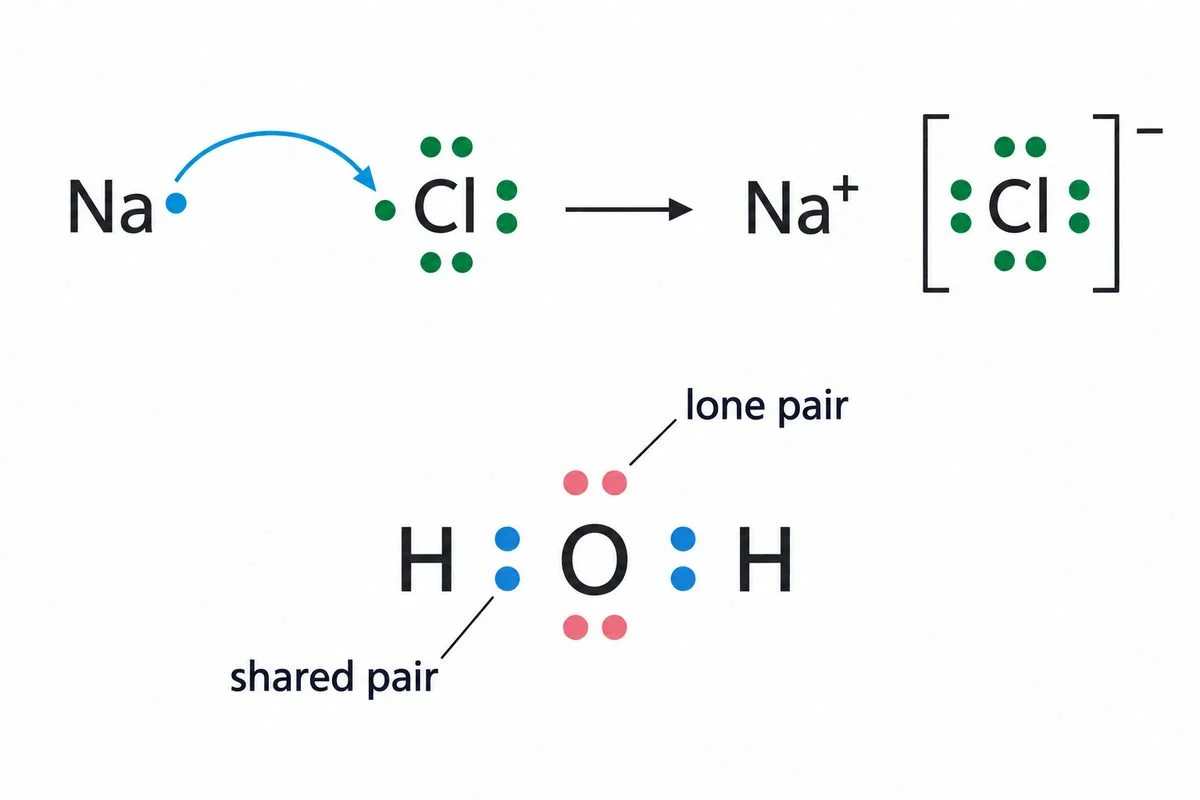
Lewis diagrams show electron transfer to chlorine and shared electron pairs in water.

1. Kössel–Lewis Approach to Chemical Bonding

Atoms transfer or share outer electrons; some electrons remain unshared.

Show
In the diagram, follow sodium’s electron to chlorine. Below, find water’s shared pairs and oxygen’s lone pairs.
Ask
How many electrons will each atom count when water’s shared pairs count for both partners?
Say
Oxygen counts eight outer electrons, and each hydrogen counts two. Each shared pair makes a covalent bond.
Used in
Lewis drawings track atom connections when chemists make useful substances.
If your child says…“One bond line means one electron.”
Ask
How many dots lie between oxygen and each hydrogen?
What’s true
A single bond line represents two shared electrons.
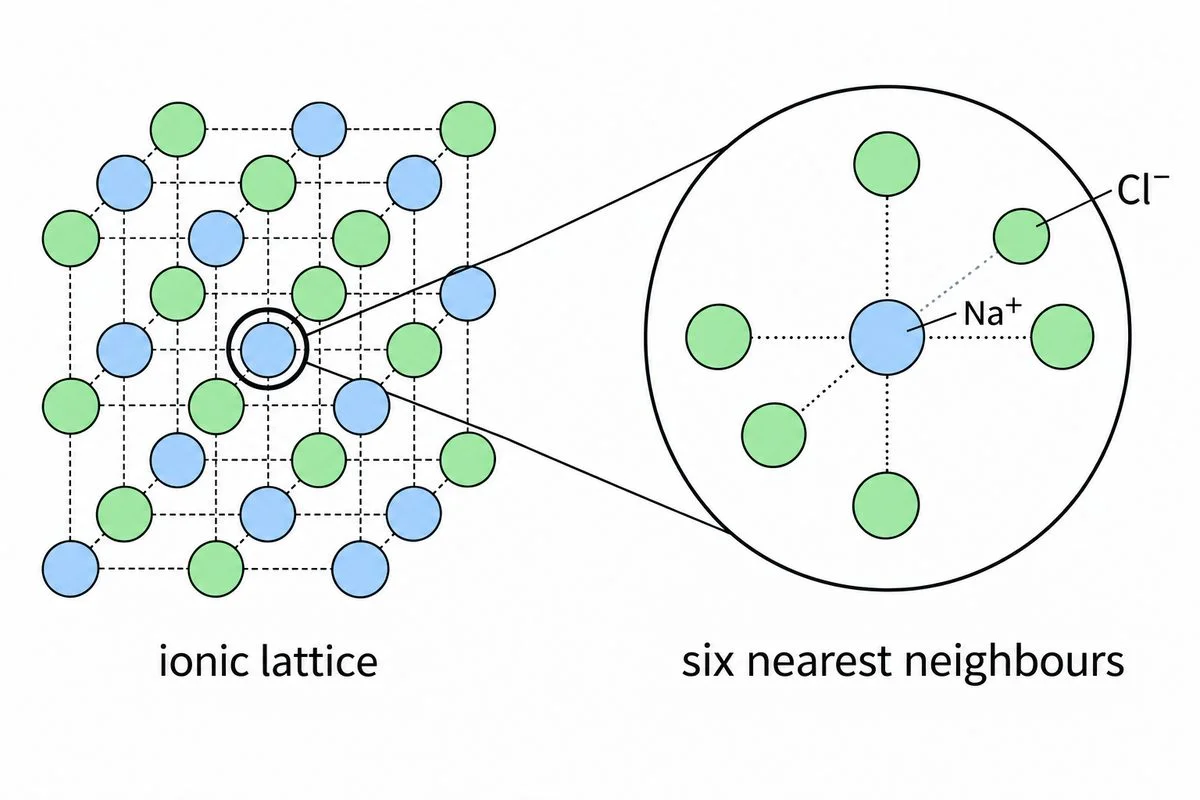
A sodium chloride lattice enlarges to show one sodium ion’s six nearest chloride neighbours.

2. Ionic or Electrovalent Bond

Oppositely charged ions attract throughout a crystal.

Show
In the diagram, find the highlighted sodium ion. Follow the enlargement and count its nearest chloride neighbours.
Ask
Would removing this sodium ion separate it from just one chloride neighbour?
Say
No; each sodium ion has six nearest chloride neighbours.
Used in
Lattice attraction keeps table salt solid for storage and handling.
If your child says…“Each sodium ion has just one chloride partner.”
Ask
How many chloride neighbours surround the highlighted sodium ion?
What’s true
An ionic crystal extends in three dimensions, with attractions acting in many directions.
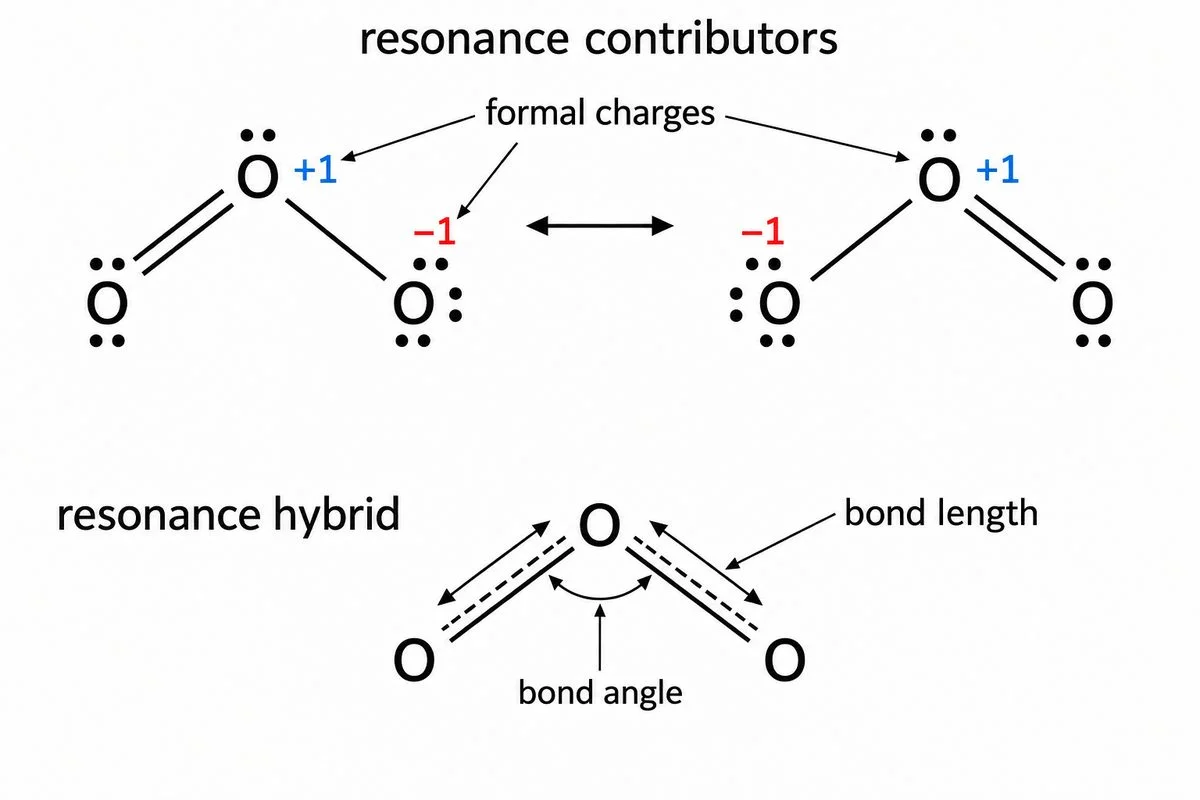
Ozone’s Lewis contributors sit above its resonance hybrid with equal bonds and a marked angle.

3. Bond Parameters and Resonance Structures

Bond measurements describe structure; resonance drawings describe shared, spread-out electrons.

Show
In the diagram, find ozone’s equal bond lengths and central angle. Compare the electron placements above.
Ask
Will either Lewis drawing alone explain both bonds having the same length?
Say
Neither drawing alone shows ozone’s equal bonds. Electrons spread across one structure, so the molecule does not switch between drawings.
Used in
Bond enthalpies help estimate the energy fuels release for heating.
If your child says…“Ozone keeps switching between the drawings.”
Ask
Which contributor alone shows the two equal bonds found in the hybrid?
What’s true
The drawings describe one stabilised structure, rather than molecules taking turns.
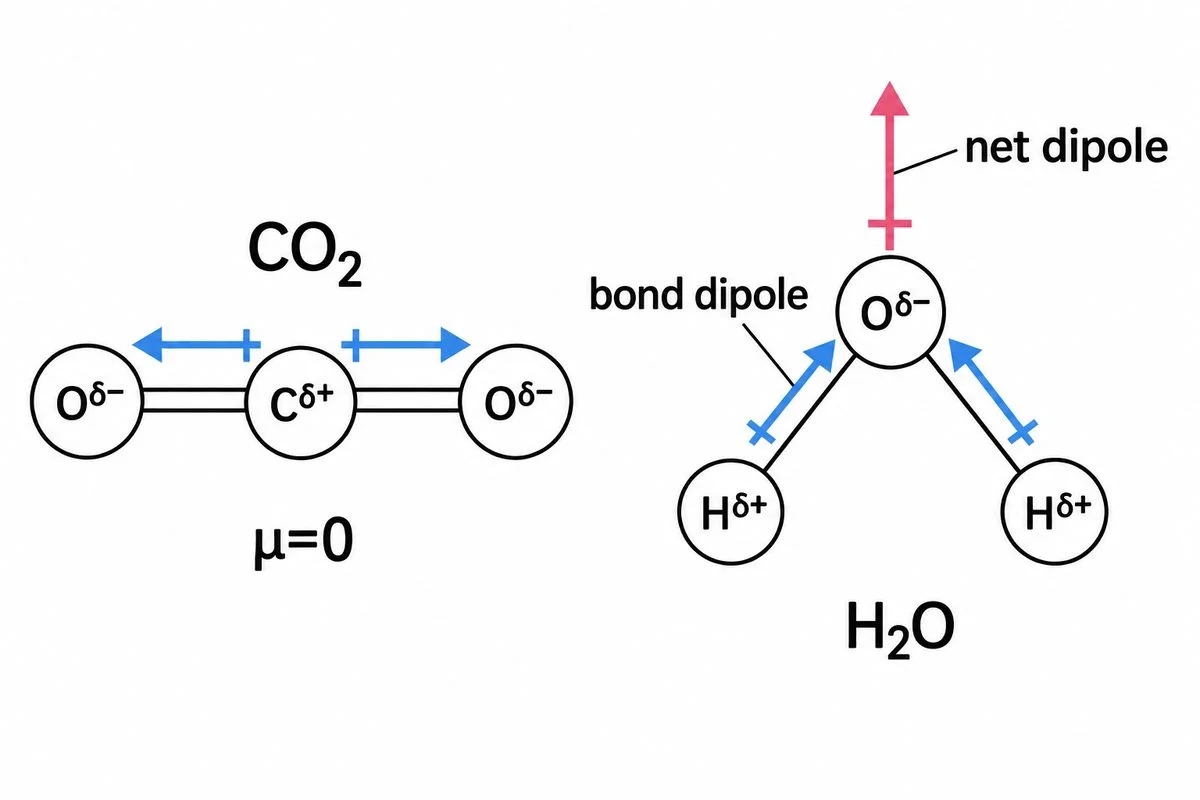
Opposite bond dipoles cancel in carbon dioxide; bent water retains a net dipole.

4. Polarity of Bonds

Unequal sharing creates bond dipoles; their directions determine cancellation.

Show
In the diagram, compare straight carbon dioxide with bent water. Delta, δ, marks partial charge; mu, μ, names dipole moment. Follow arrows towards oxygen; μ=0\mu=0 means no net dipole.
Ask
Which molecule will retain a net dipole when its bond arrows combine?
Say
Oxygen pulls shared electrons towards itself, making these bonds polar. Carbon dioxide’s equal, opposite bond dipoles cancel. Water’s bent shape prevents cancellation, leaving a net dipole.
Used in
Water’s polarity helps dissolve salts for plant roots.
If your child says…“Polar bonds always make a polar molecule.”
Ask
What overall arrow remains when two equal arrows point in opposite directions?
What’s true
The whole molecule’s dipole depends on both the size and direction of its bond contributions.

Molecular shapes and orbitals

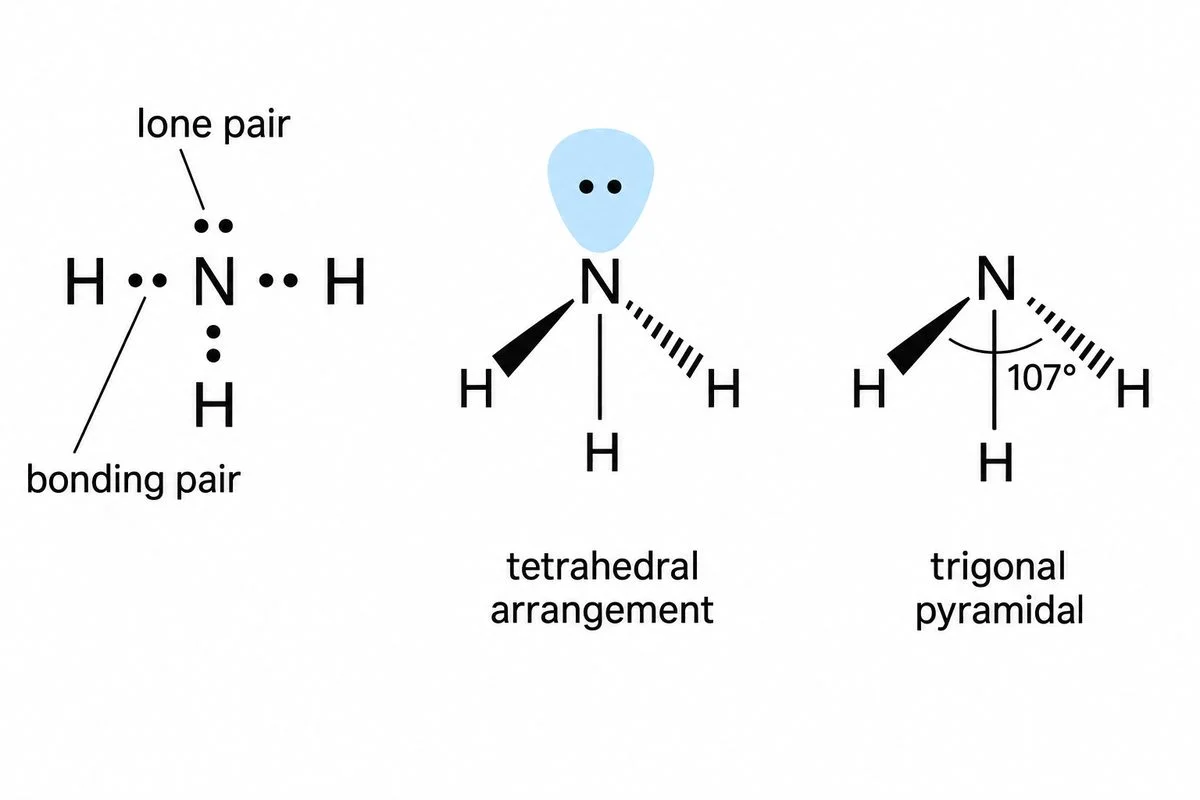
Ammonia’s four electron regions give a tetrahedral arrangement, while its atoms form a pyramid.

5. Valence Shell Electron Pair Repulsion Theory

Electron regions spread apart; molecular shape describes atom positions.

Show
In the diagram, count nitrogen’s bonding pairs and lone pair. Follow their arrangement to the atom-only view.
Ask
How will the lone pair affect whether ammonia’s atoms lie flat?
Say
Four electron regions spread into a roughly tetrahedral arrangement. The lone pair pushes the bonding pairs closer together. The atoms form a trigonal pyramid, with bond angles near 107°.
Used in
Molecular shapes explain how medicines fit their targets.
If your child says…“Ammonia’s atoms make a tetrahedron because nitrogen has four electron regions.”
Ask
Is there an atom at the end of the lone-pair region?
What’s true
Electron geometry includes lone pairs, but molecular shape counts only the positions of atoms.
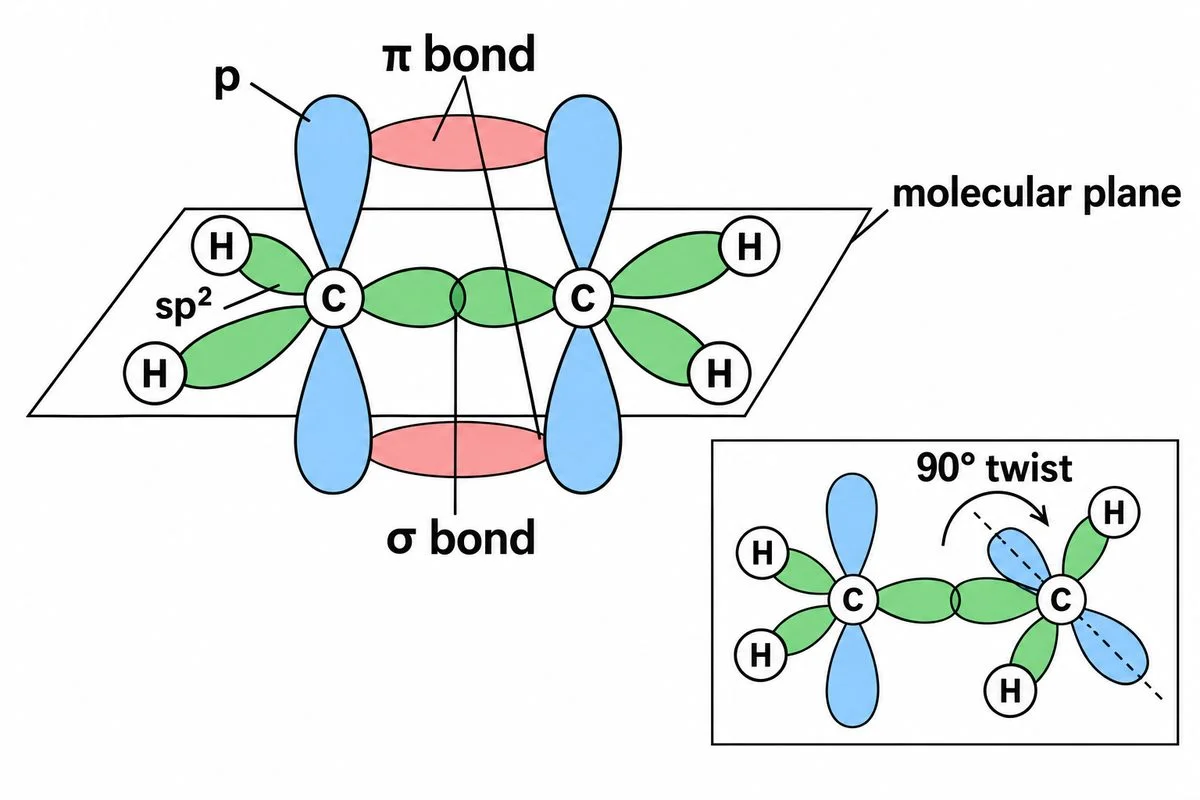
Ethene’s planar sigma framework and parallel p orbitals contrast with disrupted overlap after twisting.

6. Valence Bond Theory and Hybridisation

Orbital mixing sets directions; bonding overlap needs suitable phases and directions.

Show
In the diagram, find ethene’s flat sigma framework. Locate the parallel p orbitals, then the twisted inset.
Ask
What will happen to sideways overlap if one end of this flat molecule twists?
Say
Each carbon’s three sp² orbitals form sigma bonds in one plane. Parallel p orbitals overlap sideways, adding one pi bond. Twisting disrupts that overlap, so the double bond cannot rotate freely.
Used in
Restricted double-bond rotation preserves distinct shapes in oils.
If your child says…“Both lines of a double bond are sigma bonds.”
Ask
Which overlap would twisting disrupt while the head-on overlap stays aligned?
What’s true
Ethene’s carbon–carbon bond combines one sigma overlap with one pi overlap from the remaining p orbitals.
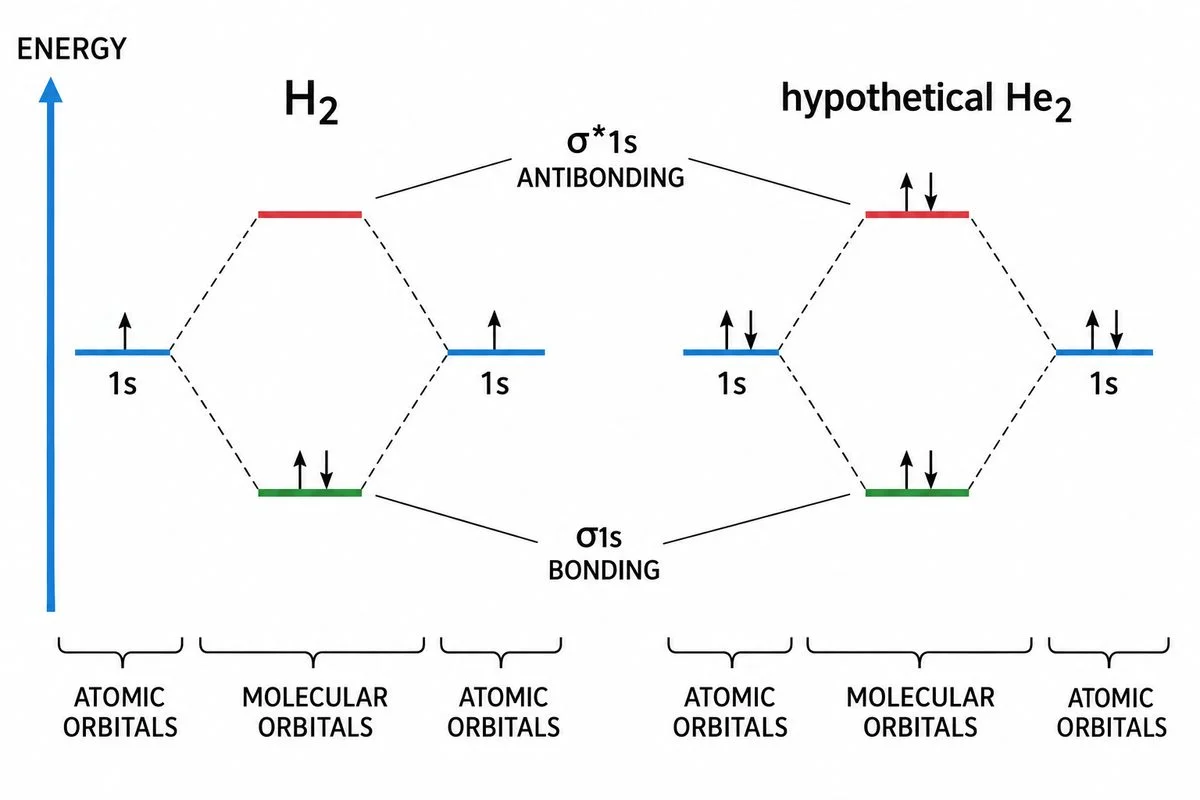
Hydrogen fills only its bonding level; hypothetical helium fills bonding and antibonding levels.

7. Molecular Orbital Theory

Molecule-wide orbitals can support or oppose bonding.

Show
In the diagram, find the lower bonding and upper antibonding levels. Compare their electrons in hydrogen and helium.
Ask
Which arrangement will retain net bonding after the antibonding electrons are counted?
Say
Hydrogen’s electrons fill only the bonding level, giving bond order one. Helium would fill both levels, cancelling the bonding contribution. Its zero bond order means no stable covalent bond in this model.
Used in
Magnetic measurements reveal unpaired electrons, explaining oxygen’s magnetic attraction.
If your child says…“Only the bonding orbital forms.”
Ask
Does hydrogen’s empty upper level mean that orbital has disappeared?
What’s true
The antibonding orbital also forms, even when it contains no electrons.

Hydrogen bonding

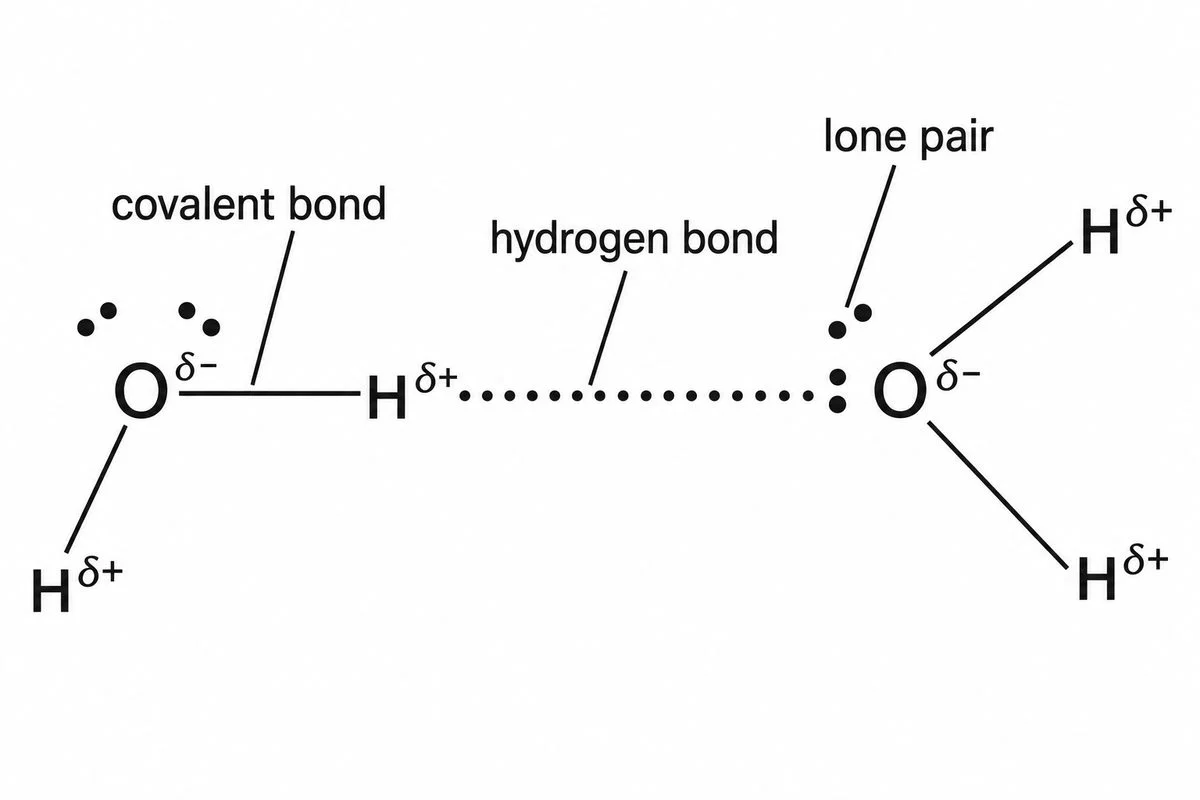
Two water molecules have solid covalent bonds and a dotted hydrogen bond between them.

8. Hydrogen Bonding

Suitably bonded hydrogen attracts a nearby lone pair.

Show
In the diagram, find the solid bonds within each water molecule. Follow the dotted connection between molecules.
Ask
How will the dotted attraction affect the energy needed to separate these water molecules?
Say
A partly positive hydrogen attracts a neighbouring oxygen’s lone pair. This attraction increases the energy needed to separate these water molecules.
Used in
Hydrogen bonding helps keep cooking water liquid.
If your child says…“The solid O–H connection is the hydrogen bond.”
Ask
Which connection can separate while each water molecule stays intact?
What’s true
The solid connection is covalent, while the dotted connection marks a weaker attraction.

A real problem

Collagen’s molecular rope supports tissues

Ramachandran and Kartha proposed a rope-like, coiled-coil model for collagen in 1955.

Hydrogen bonds help hold its protein chains together.

Collagen strengthens tendons and supports skin and internal organs.

Indian Academy of SciencesColorado State UniversityRCSB Protein Data Bank

Twisted rope illustrating a coiled structure.

Concept Lab · Common misconception

The tempting mistake in Chemical Bonding and Molecular Structure

Open standalone misconception page →

Do polar bonds always give a polar molecule?

Wrong

CO₂ is polar because its C=O bonds are polar.

Why it feels right. I check the bonds one at a time.

Right

The net molecular dipole depends on both bond dipoles and geometry.

Worked example

Equal bond dipoles point in opposite directions along the molecule. The net dipole is zero.
  1. Draw the two equal C=O dipole arrows in linear CO₂.
  2. They point in opposite directions and cancel.

Ask your child eight quick questions.

One per step. The answer and the reason are given.

  1. How many electrons does one O–H bond line count?

    Two electrons. One line records one shared electron pair.

  2. Does a sodium ion attract only one chloride ion in solid salt?

    No. Each ion attracts several oppositely charged neighbours.

  3. What changes between ozone’s resonance drawings?

    Electron placement. The nuclei retain their positions while the drawings describe electrons differently.

  4. Why does carbon dioxide have zero overall dipole despite its polar bonds?

    Its equal bond dipoles cancel. The two contributions point in opposite directions along the straight molecule.

  5. What molecular shape does ammonia have?

    Trigonal pyramidal. The lone pair affects the arrangement but is excluded when naming atom positions.

  6. What two bond types make ethene’s carbon–carbon double bond?

    One sigma and one pi. Head-on overlap forms sigma, and sideways overlap adds pi.

  7. How many molecular orbitals form when two suitable atomic orbitals combine?

    Two molecular orbitals. Both a bonding and an antibonding combination form.

  8. Which connections mainly separate when water boils?

    Hydrogen bonds between molecules. Boiling separates water molecules without breaking their internal covalent bonds.

15 more questions with answers