Skip to content

Teach Organic Chemistry – Some Basic Principles and Techniques in eight steps.

For each idea: show it, ask before you tell, then say one line.

Gather dough, paper bond connectors, pencil, absorbent kitchen paper, washable black pen, bowl, teaspoon and water.

Keep chemical reactions and detection tests on paper or in models. Never taste materials or mix cleaners.

Common misconceptions & worked visual for this chapter · 15 practice questions with answers

How to teach it

Structures and names

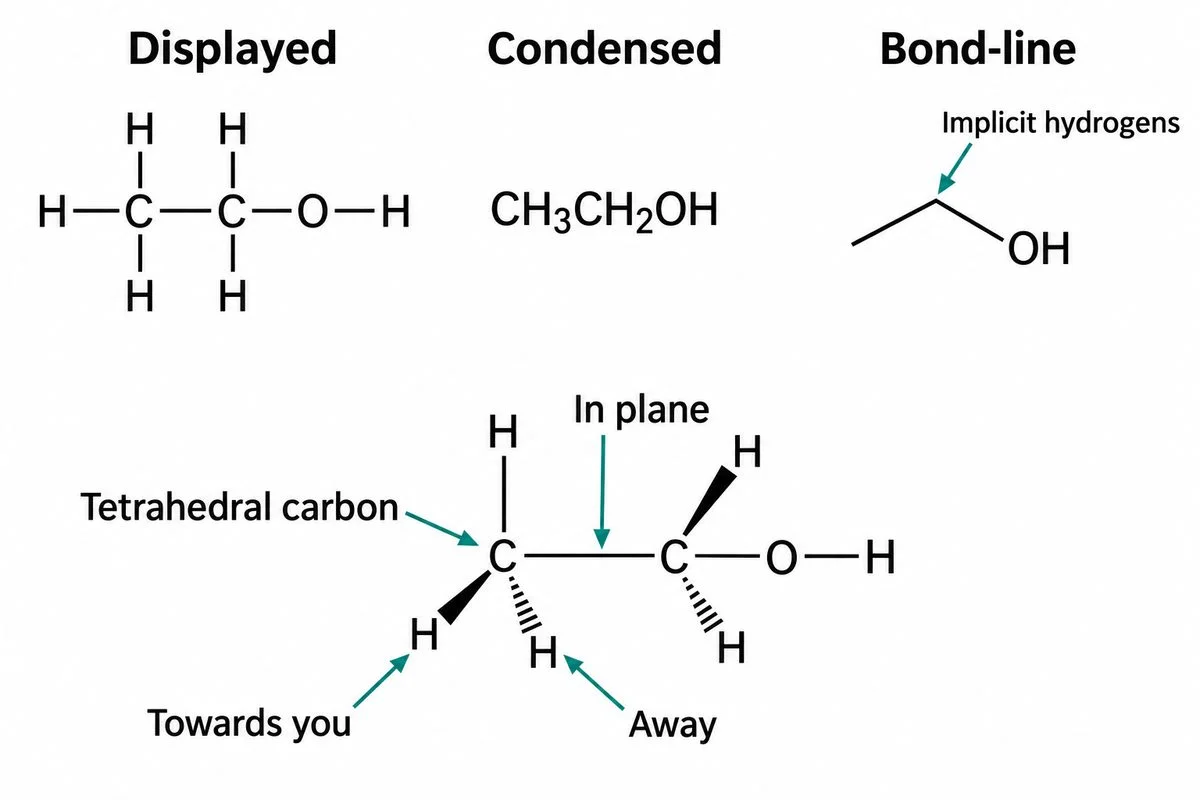
Three ethanol representations above a wedge-and-dash drawing showing tetrahedral carbon centres.

1. Tetravalence of Carbon: Shapes of Organic Compounds; Structural Representations

Drawings record atoms, bonds and molecular shape using different shorthand.

Show
Compare the diagram’s three ethanol formulas. Below, follow the wedges around each carbon.
Ask
Will all three formulas contain the same atoms?
Say
Yes; unlabelled corners and ends mean carbon, with hydrogens completing four bonds. OH stays written. Wedges show tetrahedral bond directions.
Used in
Structural drawings let medicine makers specify the compound they need.
If your child says…“The corners stand for hydrogen.”
Ask
Which atoms in the displayed formula match the bond-line corner and unlabelled end?
What’s true
Unlabelled corners and ends mean carbon, with enough attached hydrogens to complete four bonds.
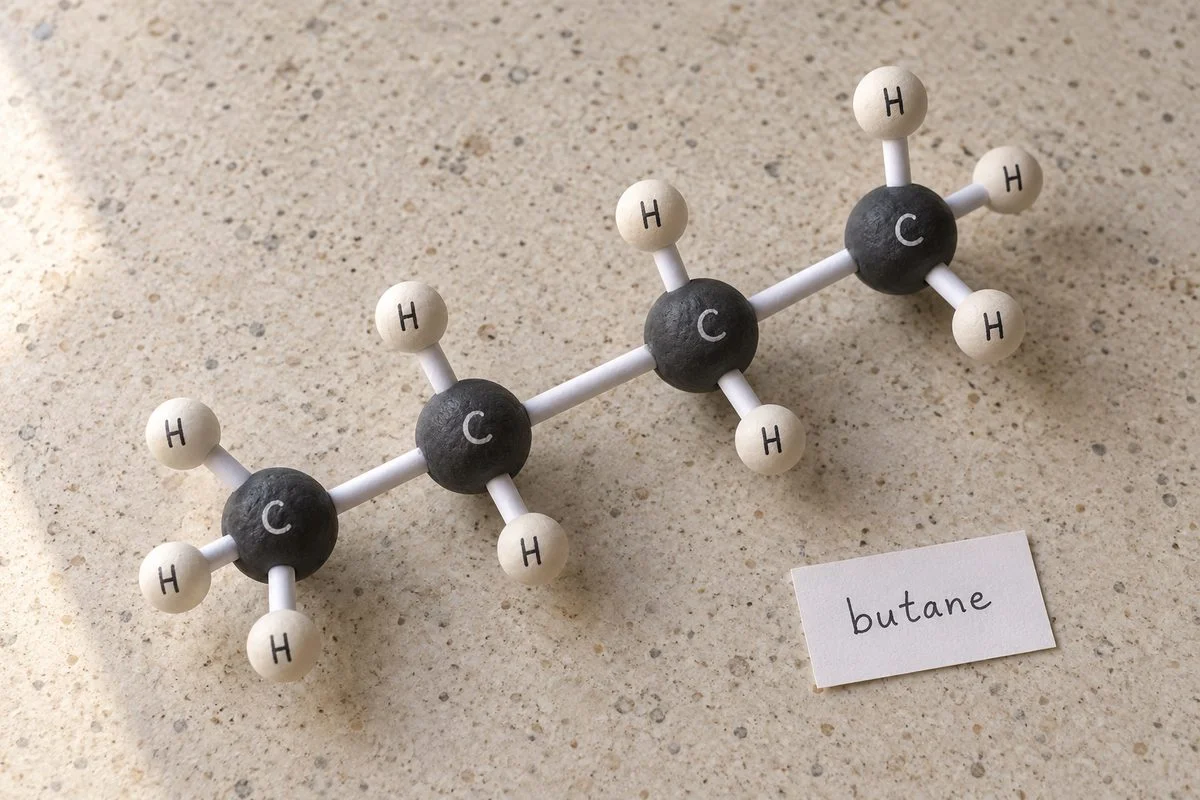
Straight-chain butane dough model with labelled atoms and the name butane beside it.

2. Nomenclature of Organic Compounds; Isomerism

Names describe structures; matching atom totals can hide different connections.

Show
Build butane: four carbons in a chain, ten hydrogens. Turn it. After predicting, reconnect it into a three-carbon chain with a middle carbon branch.
Ask
Will reconnecting change its name?
Say
It becomes 2-methylpropane. These structural isomers have matching atom totals but different connections.
Used in
Systematic chemical names help laboratories distinguish compounds that share a molecular formula.
If your child says…“Turning the model makes a structural isomer.”
Ask
Which atoms gained different neighbours when you merely turned the model?
What’s true
Turning preserves connections; structural isomerism requires different connections.

Electrons and reactions

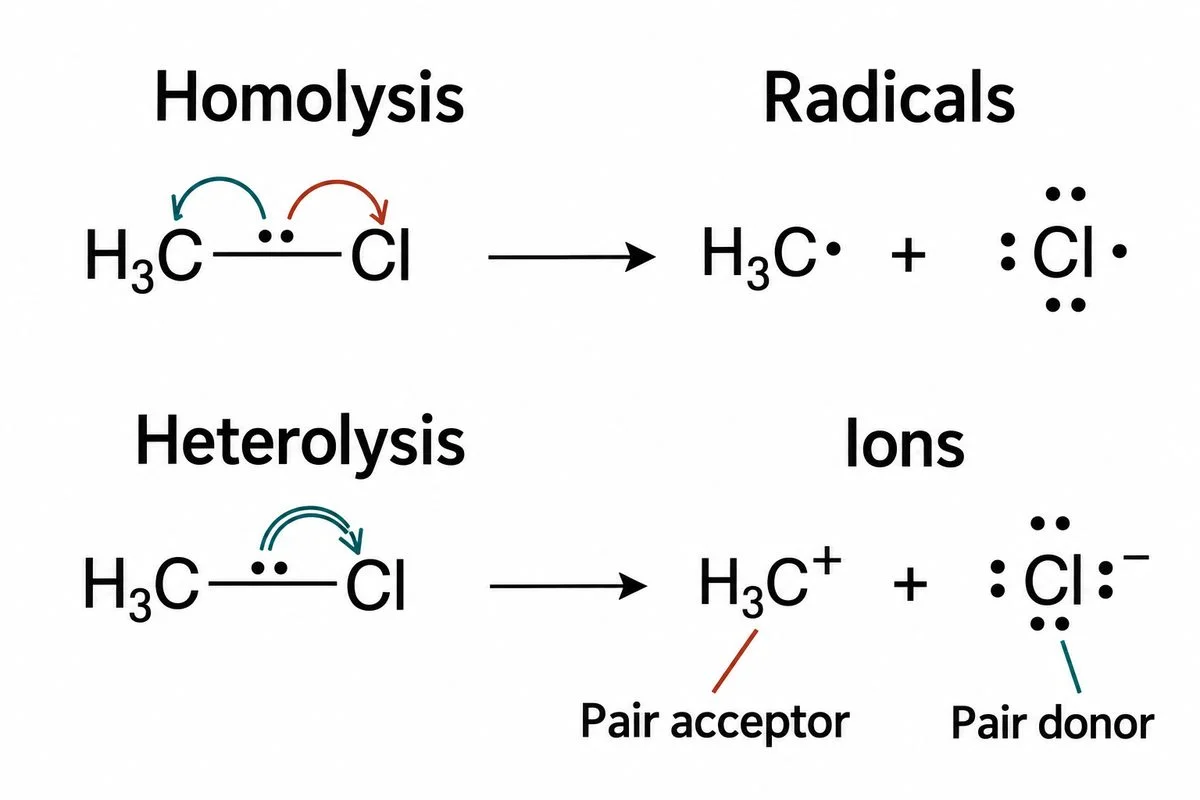
Equal and unequal carbon–chlorine bond splitting, with electron arrows, radicals and charged fragments.

3. Fission of a Covalent Bond; Nucleophiles and Electrophiles

Bond electrons determine the fragments and their ability to react.

Show
Follow the diagram’s electron arrows. These track electrons, not how readily bonds break.
Ask
Where do the electrons go in each split?
Say
Equal sharing produces radicals; chlorine taking both produces ions.
Used in
Electron arrows help chemists follow bond changes when planning the preparation of medicines.
If your child says…“An equal split makes a positive ion and a negative ion.”
Ask
If each fragment keeps one electron, which has taken the whole pair?
What’s true
Equal splitting of this bond leaves each fragment with an unpaired electron.
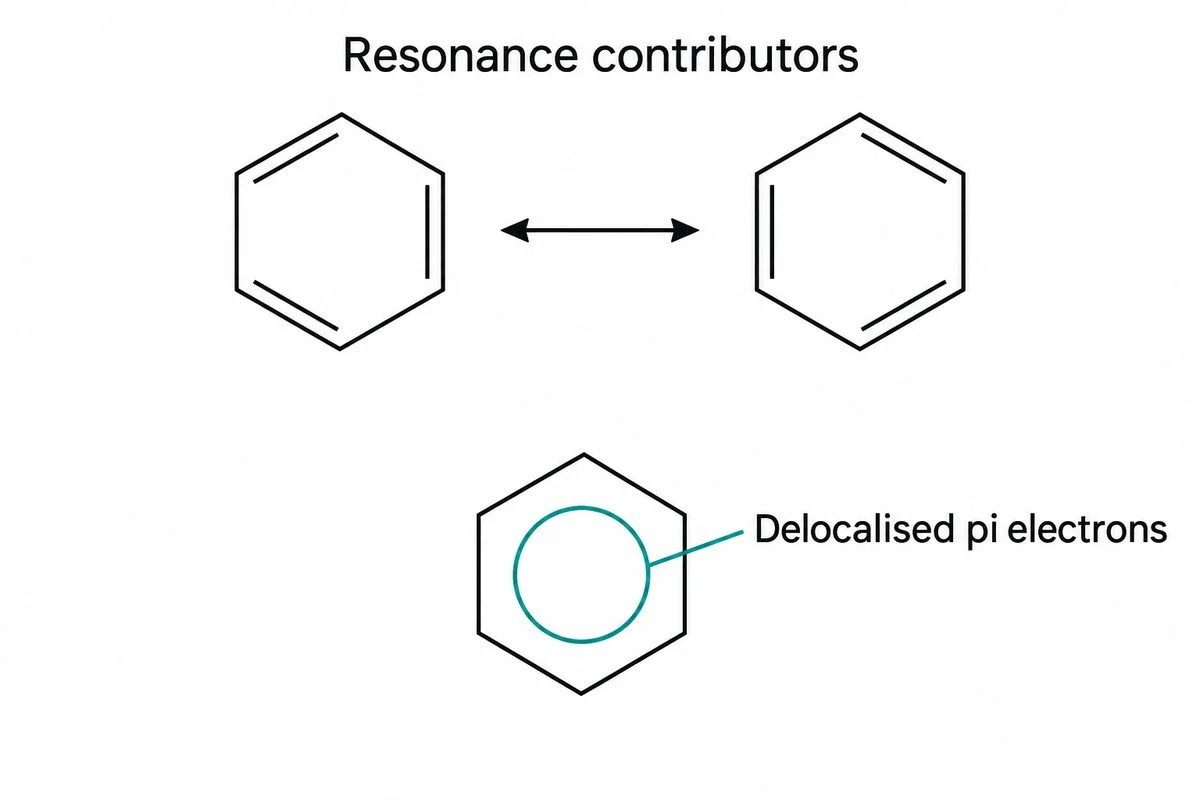
Two benzene contributors above a circle-in-hexagon representation of delocalised pi electrons.

4. Electron Displacement Effects in Covalent Bonds

Electron distribution affects where reactions happen and which intermediates remain stable.

Show
Look at the diagram’s two benzene drawings. Compare the double-bond marks and unchanged atom positions. After predicting, inspect the circle inside the third hexagon.
Ask
Will shifting the drawn double bonds describe a separate benzene molecule?
Say
Both drawings describe one molecule with spread-out electrons: resonance.
Used in
Electron effects help chemists predict which part of a compound will react.
If your child says…“Benzene keeps switching between two separate molecules.”
Ask
Which atoms changed neighbours between these drawings?
What’s true
Resonance drawings keep the nuclei unchanged and describe one shared electron distribution.
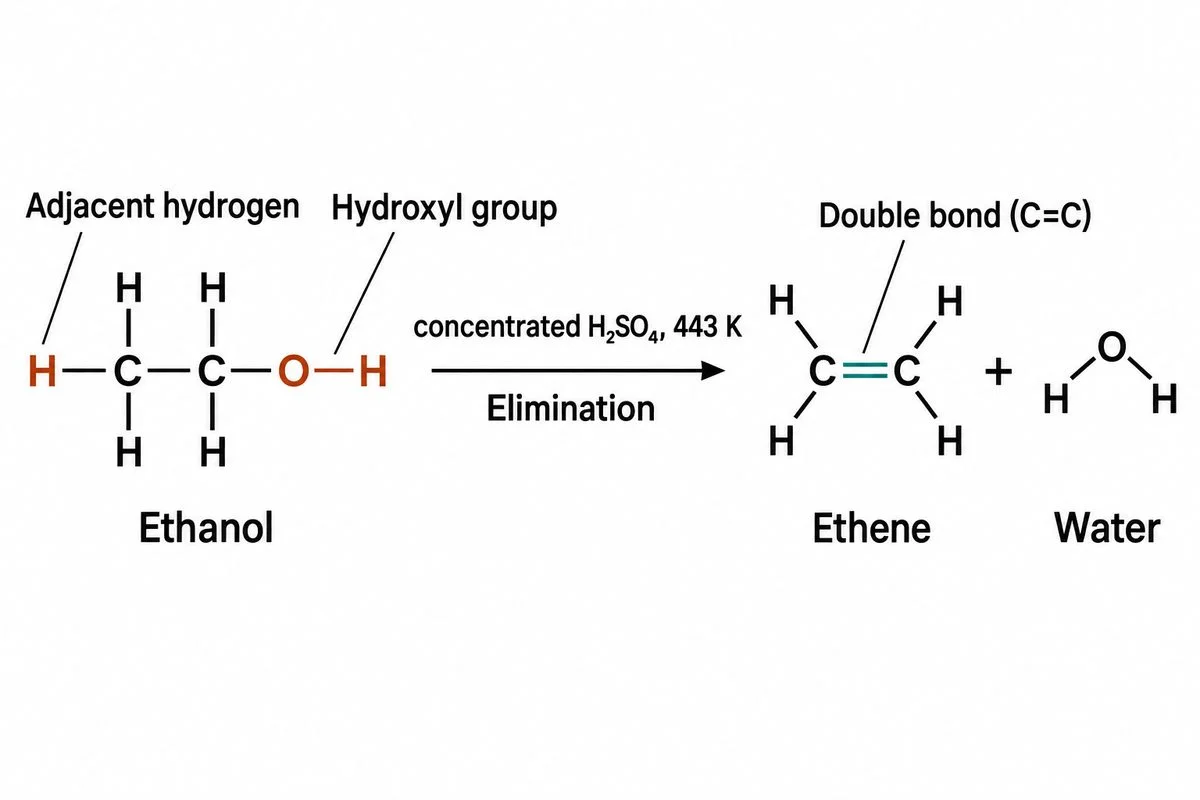
Ethanol changing into ethene and water, with departing groups and the double bond highlighted.

5. Types of Organic Reactions

Classify reactions by changes in atom connections and multiple bonds.

Show
Find ethanol’s highlighted groups in the diagram. Compare its carbon–carbon bond with ethene’s.
Ask
What carbon–carbon bond will form when these groups leave as water?
Say
A double bond forms, identifying elimination. The diagram shows the overall change, not individual reaction steps.
Used in
Elimination can produce alkenes used as starting materials for making plastics.
If your child says…“Anything leaving makes the reaction elimination.”
Ask
What changed between the carbons besides the departure of groups?
What’s true
A departing group can instead be replaced, making the reaction substitution.

Separating and identifying substances

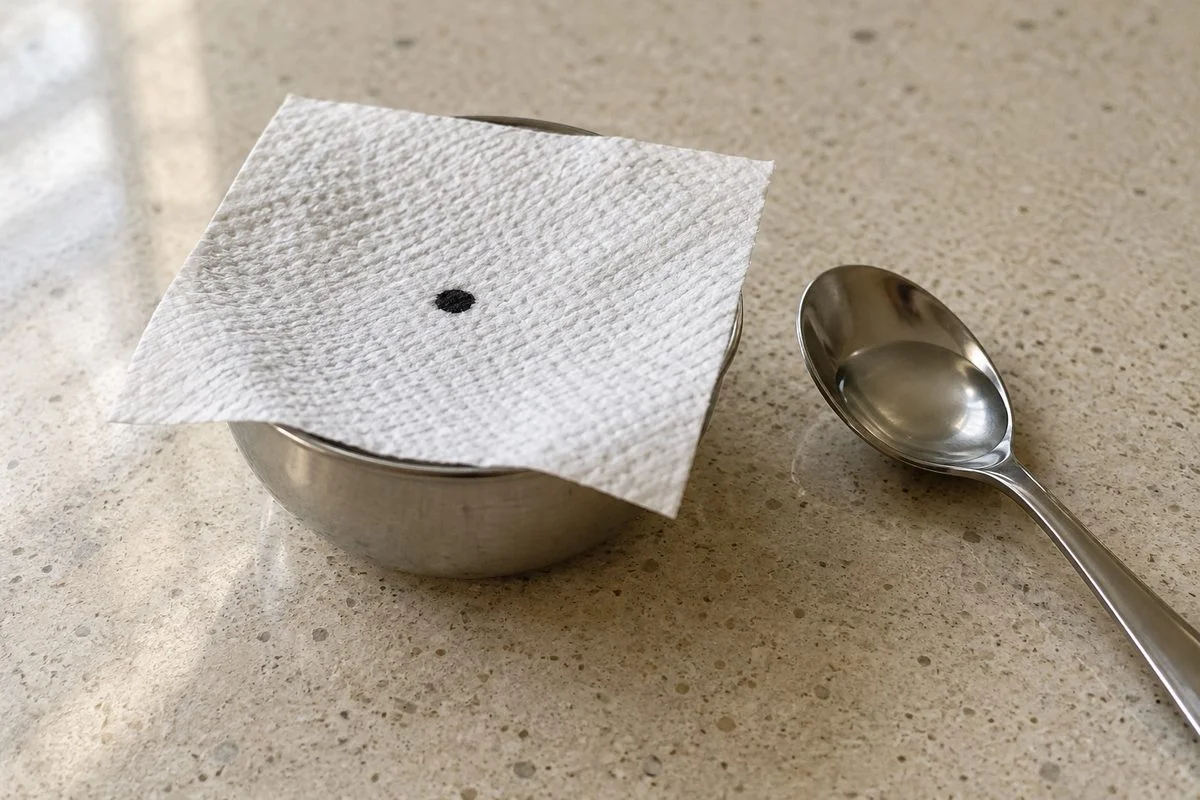
Dry black ink spot on paper across a bowl, with water ready nearby.

6. Methods of Purification of Organic Compounds

Differences in physical properties help separate mixed substances.

Show
Spot black ink on kitchen paper across a bowl. After predicting, add water onto the ink spot, one drop at a time. Let each drop spread. Watch for colours spreading; some inks will not separate visibly.
Ask
Will all dyes travel equally far?
Say
Not necessarily. Different attractions to water and paper can separate dyes by chromatography. Some dyes may travel together.
Used in
Chromatography helps laboratories separate food colours so individual dyes can be identified.
If your child says…“The dye held most strongly by the paper travels farthest.”
Ask
How can a dye move far if it spends more time held by the paper?
What’s true
Under the same conditions, stronger retention usually means less travel with the water.
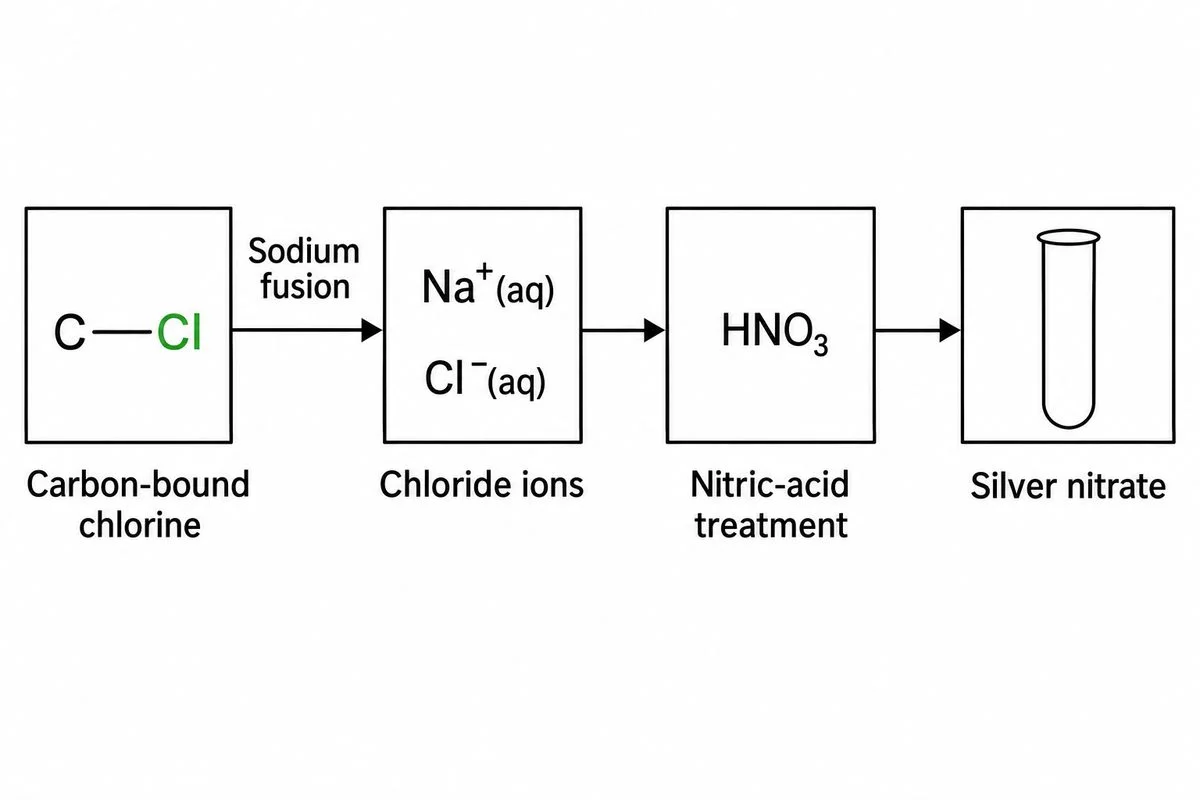
Four chlorine-detection stages show sodium fusion and nitric-acid treatment before silver nitrate.

7. Qualitative Analysis of Organic Compounds

Convert bound elements into forms that give identifying chemical tests.

Show
Read the diagram’s four boxes from left to right. Find where sodium fusion changes bound chlorine into chloride ions. Say, ‘Boiling with nitric acid removes cyanide and sulphide interference before silver nitrate is added.’
Ask
Will this test detect chlorine before conversion?
Say
Free chloride ions give white silver chloride. Fusion prepares these ions.
Used in
Element tests help laboratories narrow down the identity of an unknown organic compound.
If your child says…“Silver nitrate detects chlorine wherever it is attached.”
Ask
Which stage changes the chlorine into the ions this test needs?
What’s true
Carbon-bound chlorine is not automatically available as chloride ions.

mC=1244×0.44 g=0.12 gm_{\mathrm C}=\frac{12}{44}\times0.44\,\mathrm{g}=0.12\,\mathrm{g}

%C=0.120.30×100=40%\%\mathrm C=\frac{0.12}{0.30}\times100=40\%

8. Quantitative Analysis

Measured products reveal how much of each element the sample contains.

Show
Write these lines. Say, ‘Burning 0.30 g completely gives 0.44 g carbon dioxide.’ Name carbon mass mCm_{\mathrm C} and carbon percentage %C\%\mathrm C.
Ask
Will counting all carbon dioxide as carbon overestimate its percentage?
Say
Yes; carbon makes up 40% of the original sample. The collected carbon dioxide also contains oxygen.
Used in
Element percentages help laboratories check whether a prepared compound matches its proposed composition.
If your child says…“All the carbon dioxide’s mass is carbon.”
Ask
Which other element contributes to the mass of carbon dioxide?
What’s true
Only the carbon share of the collected product counts towards the sample’s carbon mass.

A real problem

Extraction and chromatography helped isolate an effective malaria treatment.

Tu Youyou’s team obtained pure artemisinin on November 8, 1972.

The team switched to extraction with ether, a solvent that boils at lower temperatures.

Chromatography separated the plant extract’s components.

Artemisinin proved highly effective against malaria parasites in animals and humans.

Lasker FoundationPeking UniversityTIME

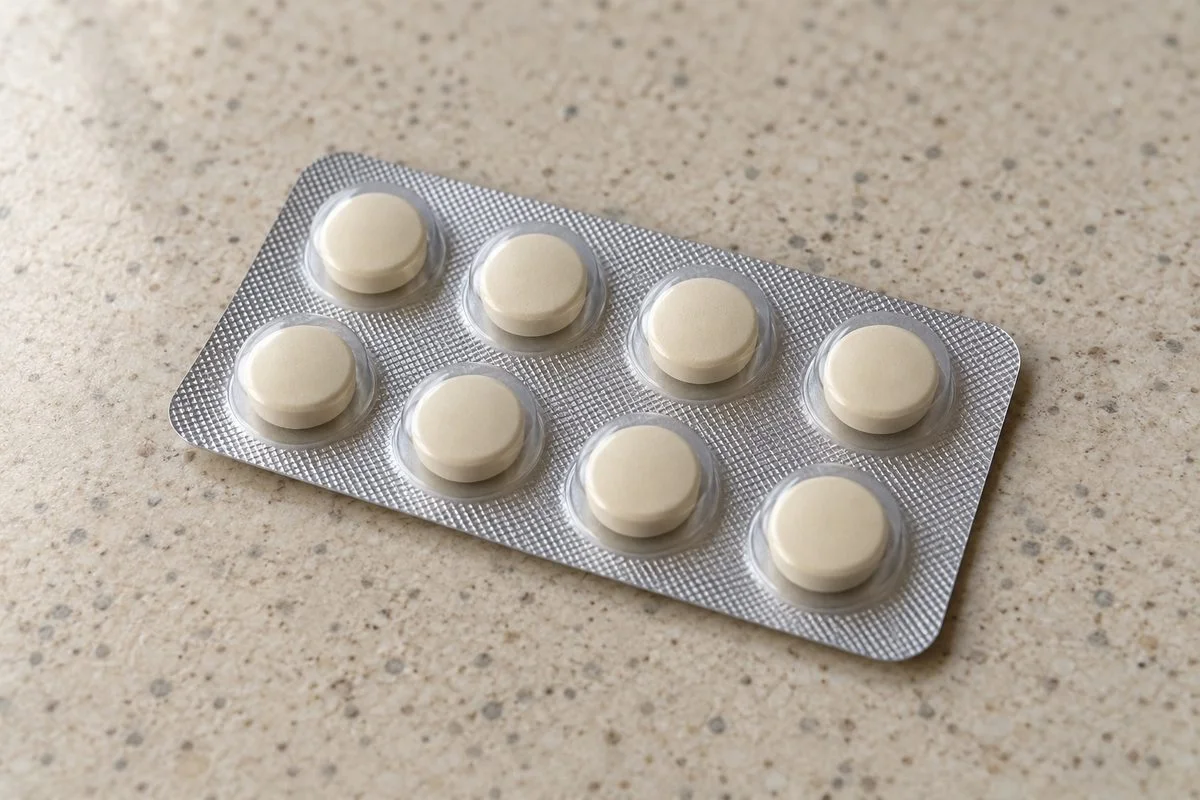
An unbranded blister pack of antimalarial tablets on a pharmacy counter.

Concept Lab · Common misconception

The tempting mistake in Organic Chemistry – Some Basic Principles and Techniques

Open standalone misconception page →

Does bond breaking always split the electrons evenly?

Wrong

When a C–Cl bond breaks, each atom always gets one shared electron.

Why it feels right. Sharing the pair seems to imply a fair split.

Right

Heterolytic cleavage sends both bonding electrons to one fragment.

Worked example

Before
C••Cl
After
C⁺
Cl⁻••
The chlorine side receives both bonding electrons in this heterolytic cleavage.
  1. In a heterolytic C–Cl cleavage that forms a carbocation, chloride takes the bonding pair.
  2. Carbon is left with a positive charge.

Ask your child eight quick questions.

One per step. The answer and the reason are given.

  1. What does the unlabelled corner in this ethanol drawing represent?

    A carbon atom. Unlabelled corners represent carbon atoms whose attached hydrogens are understood.

  2. How are your straight and branched four-carbon models related?

    Structural isomers. They have the same molecular formula but different atom connections.

  3. What forms when each fragment keeps one bonding electron?

    Radicals. Each fragment has an unpaired electron instead of gaining or losing the whole pair.

  4. Are benzene’s pi electrons confined to the three double bonds shown?

    No. Their pi electrons spread around the ring rather than staying between particular carbons.

  5. Which new feature identifies elimination in this diagram?

    A carbon–carbon double bond. Neighbouring groups leave while an additional bond forms between their carbons.

  6. Under identical conditions, how does stronger retention by paper affect a dye’s travel?

    It travels less far. The dye spends less time moving with the water.

  7. What form of chlorine does silver nitrate detect in this test?

    Free chloride ions. Covalently attached chlorine must first be converted into a testable ionic form.

  8. How much carbon is present in the collected 0.44 g of carbon dioxide?

    0.12 g. The remaining product mass belongs to oxygen.

15 more questions with answers