Skip to content

Teach Equilibrium in eight steps.

For each idea: show it, ask before you tell, then say one line.

Gather paper, a pen and a fizzy drink already being opened during ordinary use.

Use written examples for chemical reactions; taste nothing and never mix cleaning products.

Common misconceptions & worked visual for this chapter · 15 practice questions with answers

How to teach it

Understanding equilibrium

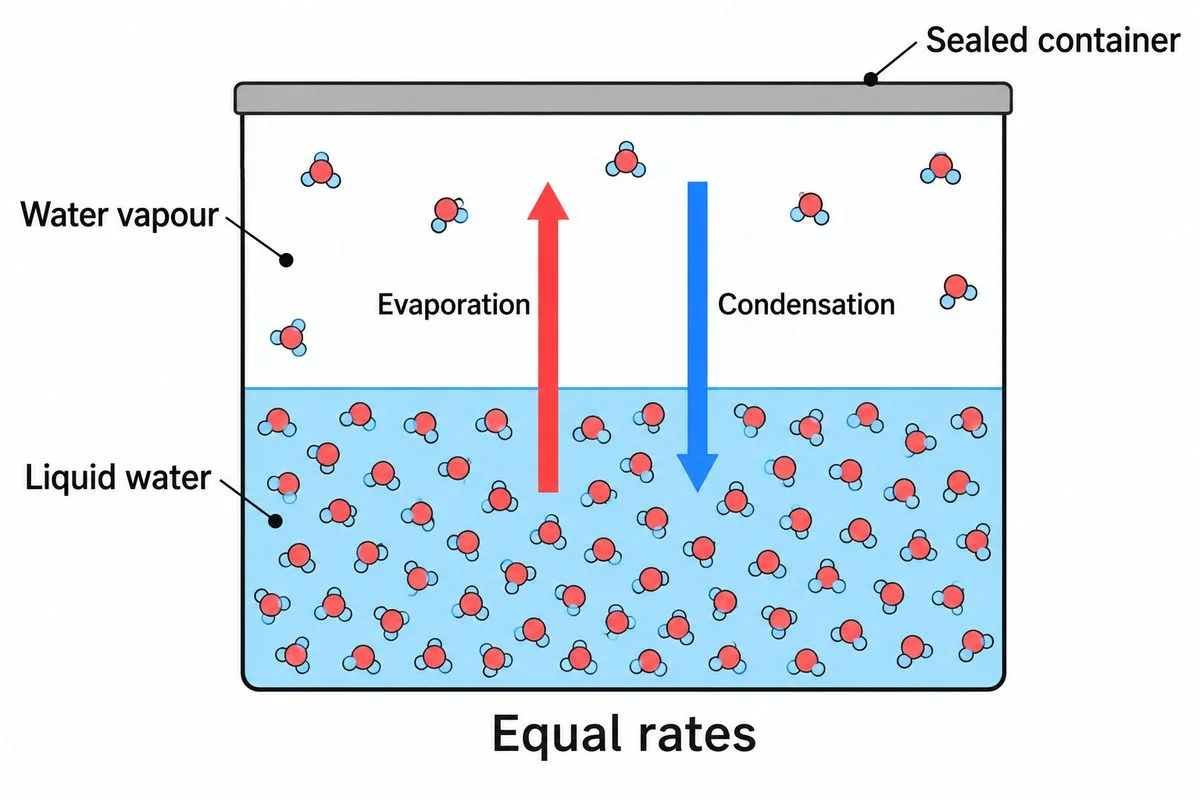
Molecules cross a sealed container’s liquid surface both ways at equal rates.

1. Dynamic equilibrium

Opposite changes continue equally fast, leaving visible amounts steady.

Show
Look at the sealed-container diagram. Find liquid below and vapour above. Follow both arrows across the surface.
Ask
Will the liquid amount keep decreasing when evaporation and condensation rates match?
Say
Water keeps evaporating and condensing at equal rates. The liquid amount stays steady because returning molecules replace departing molecules.
Used in
Sealed perfume bottles limit evaporation losses, preserving their contents.
If your child says…“The level stays still, so the molecules have stopped.”
Ask
Could equal amounts leave and return without changing the level?
What’s true
An unchanged appearance cannot show whether molecules are moving.
CaCO3(s)⇌CaO(s)+CO2(g)\mathrm{CaCO_3(s)\rightleftharpoons CaO(s)+CO_2(g)}

Kc=[CO2]eqK_c=[\mathrm{CO_2}]_{\mathrm{eq}}

Kp=pCO2,eqK_p=p_{\mathrm{CO_2,eq}}

2. Equilibrium constant and heterogeneous equilibria

Pure solids contribute no variable concentration terms.

Show
Write these lines. Say: “Brackets mean equilibrium molar concentration; p means equilibrium partial pressure. Both solids remain present.”
Ask
Why does only carbon dioxide appear in these constants?
Say
Each pure solid’s contribution stays constant. Only carbon dioxide contributes a variable term.
Used in
Lime manufacture controls carbon dioxide pressure to help limestone decompose.
If your child says…“Both solids need concentration terms too.”
Ask
Would adding another lump change the concentration within a pure solid?
What’s true
Pure-solid factors are absorbed into the constant, which depends on temperature.

H2(g)+I2(g)⇌2HI(g)\mathrm{H_2(g)+I_2(g)\rightleftharpoons 2HI(g)}

Qc=[HI]2[H2][I2]Q_c=\frac{[\mathrm{HI}]^2}{[\mathrm{H_2}][\mathrm{I_2}]}

Qc=221×1=4Q_c=\frac{2^2}{1\times1}=4

3. Applications of equilibrium constants

Comparing current and equilibrium reaction ratios predicts the direction of change.

Show
Write these lines. Say: “Qc uses current concentrations in mol per litre. Kc is 50 at this temperature.”
Ask
Will more hydrogen iodide form?
Say
More hydrogen iodide forms because 4 is below 50. This raises the ratio towards equilibrium.
Used in
Manufacturers calculate equilibrium yields to plan production.
If your child says…“A large equilibrium constant means a fast reaction.”
Ask
Where does this calculation tell us how long the reaction takes?
What’s true
The constant describes equilibrium composition, while speed also depends on energy barriers.
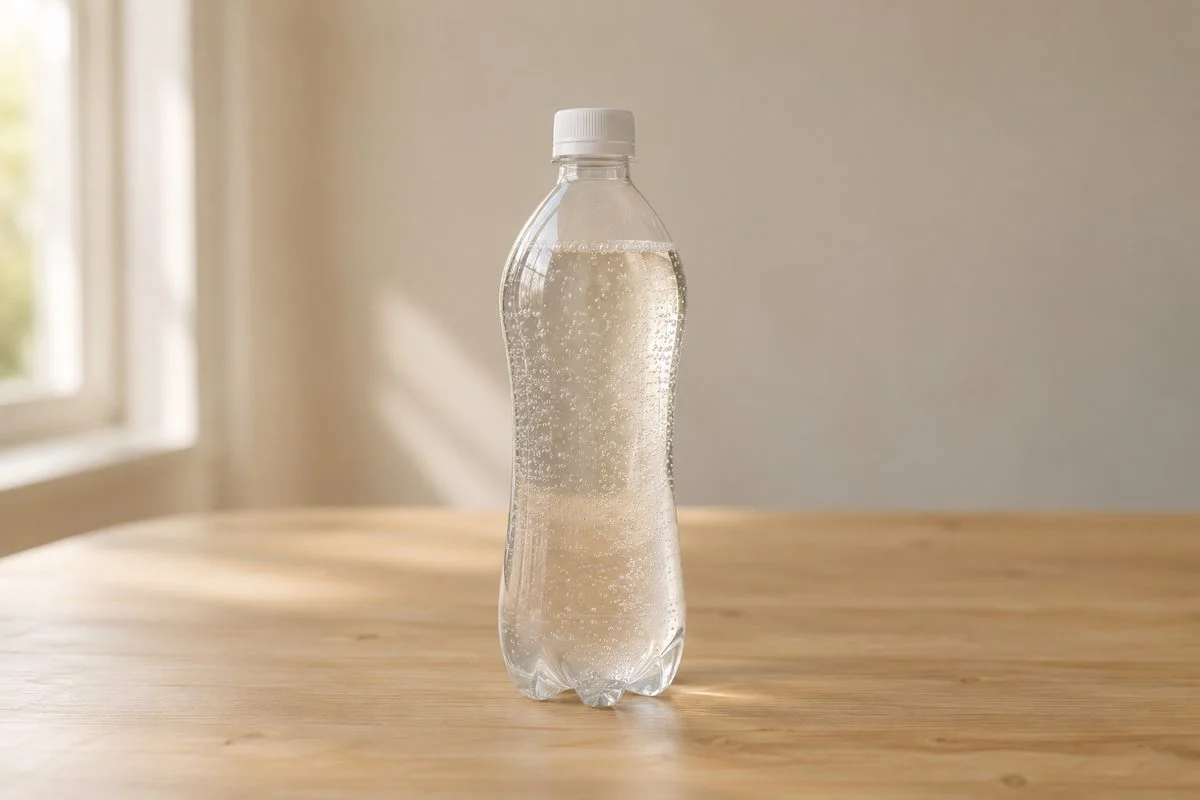
Transparent fizzy-drink bottle with its cap still on, before opening.

4. Le Chatelier’s principle

A disturbed equilibrium shifts to partly oppose the disturbance.

Show
Watch a fizzy drink already being opened during ordinary use. Predict before the cap comes off.
Ask
What will happen to dissolved gas when the cap comes off?
Say
Opening lowers carbon dioxide pressure above the drink, so dissolved carbon dioxide escapes.
Used in
Ammonia factories use higher pressure to favour ammonia formation for fertilisers.
If your child says…“Removing gas should push the reaction back towards dissolved gas.”
Ask
Which change would replace the gas that escaped?
What’s true
Removing carbon dioxide above the drink favours its replacement from the liquid.

Equilibrium involving ions

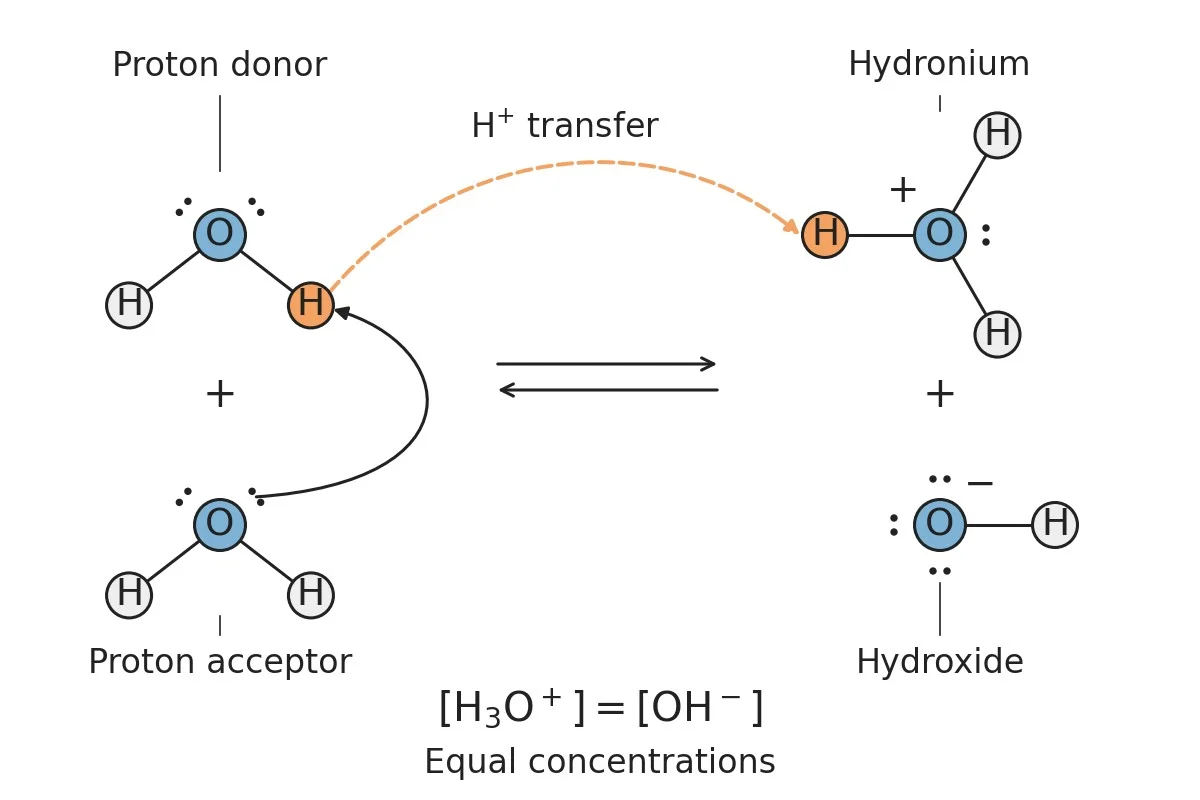
Water transfers a proton, producing equal amounts of hydronium and hydroxide.

5. Acids, bases and ionization of water

Neutral water contains equal hydronium and hydroxide concentrations.

Show
Look at the water molecules in the diagram. Follow the transferred proton from donor to acceptor. Find the resulting hydronium and hydroxide ions.
Ask
Will forming these ions make pure water acidic?
Say
The proton donor acts as an acid; the acceptor acts as a base. Equal hydronium and hydroxide concentrations keep pure water neutral.
Used in
Water testing checks acidity before household supply.
If your child says…“Neutral water always has pH seven.”
Ask
If warming increases both concentrations equally, does either become more abundant than the other?
What’s true
Neutrality requires equal hydronium and hydroxide concentrations; the corresponding pH depends on temperature.
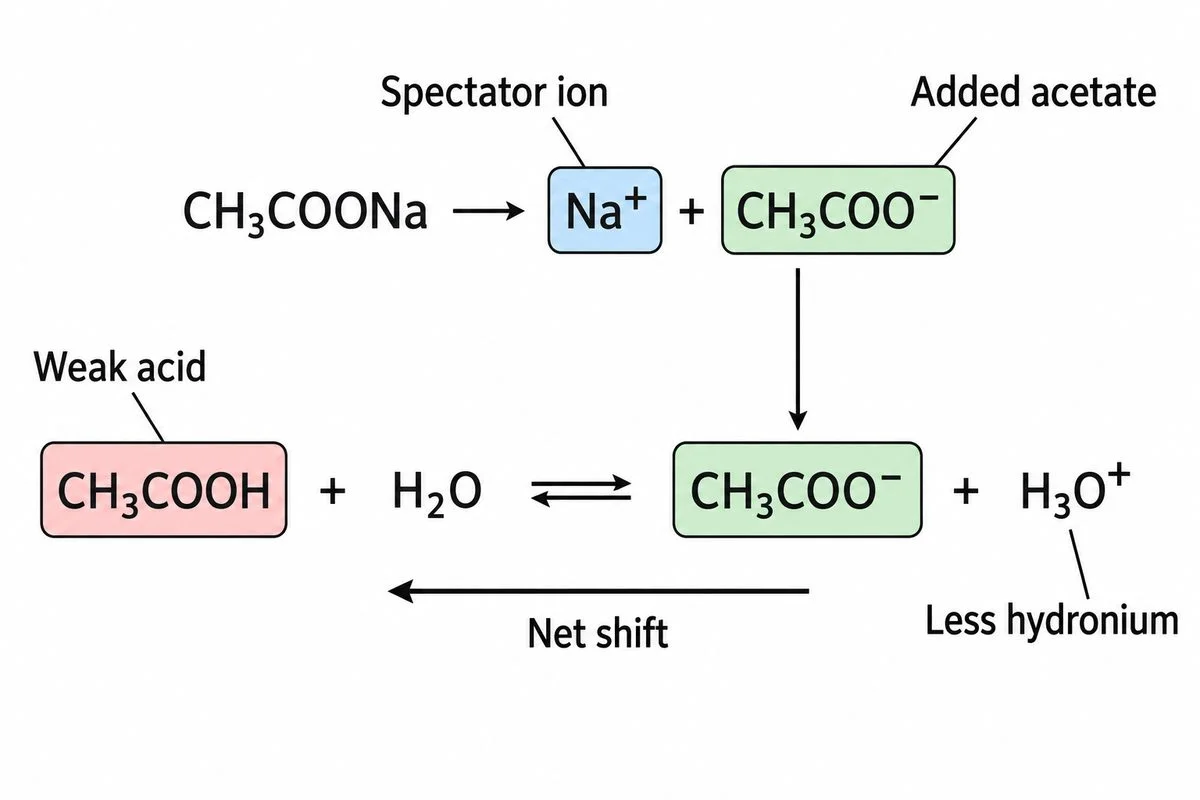
Added acetate enters the product side of acetic acid’s ionization equilibrium.

6. Ionization of weak acids and bases

A common ion suppresses weak-acid ionization.

Show
Find acetic acid and its ions in the diagram. Say: “Most acid remains as molecules.” Follow added acetate down to the product side.
Ask
Will adding acetate make a larger or smaller fraction of the acid ionize?
Say
Added acetate favours recombination, leaving less hydronium and a smaller fraction of acid ionized.
Used in
Weak acids preserve food through acidity that slows microbial growth.
If your child says…“Adding acetate makes more acid molecules split into ions.”
Ask
Which direction uses up some of the added acetate?
What’s true
An added product ion favours the reverse change.
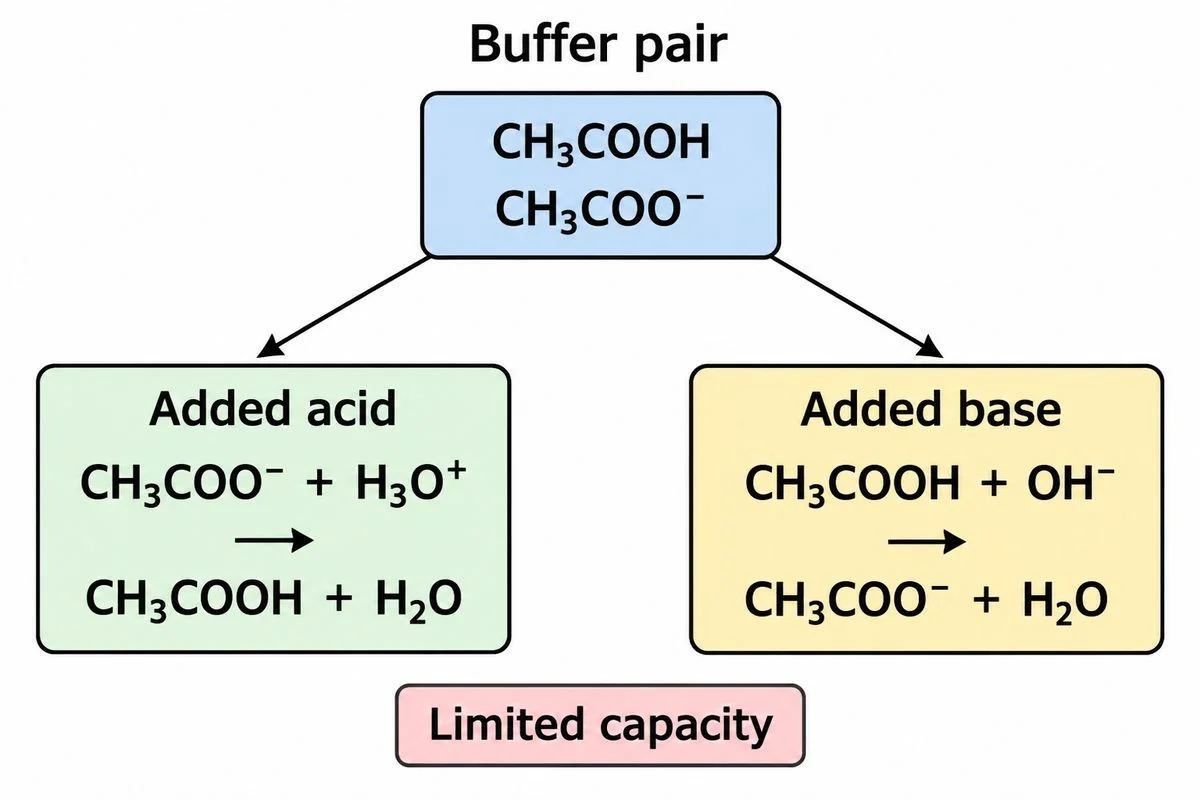
Acetate removes added acid, while acetic acid removes added base.

7. Hydrolysis of salts and buffer solutions

Salt ions can affect acidity; buffers limit changes within their capacity.

Show
Find acetic acid and acetate in the diagram’s centre. Follow the added-acid branch, then the added-base branch.
Ask
How will this pair respond if a little acid or base is added?
Say
Acetate consumes added hydronium; acetic acid consumes added hydroxide. Small additions change pH only slightly while enough of both components remain.
Used in
Buffers in eye drops help keep their acidity suitable for use.
If your child says…“A buffer keeps its pH unchanged however much acid I add.”
Ask
What happens when repeated acid additions use up the available acetate?
What’s true
A buffer has a limited supply of proton-accepting and proton-donating components.

AgCl(s)⇌Ag+(aq)+Cl−(aq)\mathrm{AgCl(s)\rightleftharpoons Ag^+(aq)+Cl^-(aq)}

Qsp=[Ag+][Cl−]Q_{sp}=[\mathrm{Ag^+}][\mathrm{Cl^-}]

Qsp=(1.0×10⁻⁴)2=1.0×10⁻⁸Q_{sp}=(1.0\times10^{-4})^2=1.0\times10^{-8}

8. Solubility product

Exceeding the saturation ion product favours precipitation.

Show
Write these lines. Say: “Qsp multiplies ion concentrations after mixing, in mol per litre. Ksp is 1.6×10−101.6\times10^{-10} at this temperature.”
Ask
Will silver chloride form?
Say
Silver chloride forms because the ion product exceeds the saturation value. Removing dissolved ions lowers their product.
Used in
Water treatment precipitates salts for removal.
If your child says…“A solid forms when the ion product is below the saturation value.”
Ask
Would removing dissolved ions into a solid lower their product or raise it?
What’s true
Precipitation is favoured when the current ion product exceeds the saturation value.

A real problem

Solvay’s process separates sodium bicarbonate.

The earlier Leblanc process was costly, complicated and needed heavy labour.

Sodium bicarbonate’s low solubility in ammonia solution lets it separate as a solid.

The new process made soda-ash production cheaper and less polluting.

Science History InstituteFrench Academy of SciencesWikipedia

Plain glass bottles on a wooden kitchen shelf.

Concept Lab · Common misconception

The tempting mistake in Equilibrium

Open standalone misconception page →

Does chemical equilibrium mean the reactions stop?

Wrong

The forward and reverse reactions stop at equilibrium.

Why it feels right. Concentrations stay constant, so nothing seems to be happening.

Right

At equilibrium, forward and reverse rates are equal.

Worked example

Ten molecules convert in each direction per second. Both totals stay steady while exchange continues.
  1. Imagine ten molecules converting each way per second.
  2. The totals remain constant even though molecules keep changing form.

Ask your child eight quick questions.

One per step. The answer and the reason are given.

  1. What must match for the liquid level to remain steady?

    Evaporation and condensation rates. Equal opposing rates keep the amount steady without stopping molecular exchange.

  2. Which substance contributes the variable pressure term in this reaction?

    Carbon dioxide. The calcium compounds are pure solids, whose factors are included in the constant.

  3. What does this calculation tell us about reaction speed?

    It does not determine speed. A concentration ratio predicts direction, without describing the reaction’s energy barriers.

  4. After pressure above the drink falls, where does dissolved carbon dioxide move?

    Out of the liquid. Lower carbon dioxide pressure favours gas leaving the drink.

  5. Warming increases both ion concentrations equally in pure water. What happens to its neutrality?

    It remains neutral. Hydronium and hydroxide concentrations remain equal, even though neutral pH changes.

  6. What happens to the fraction of acetic acid ionized when acetate is added?

    It decreases. The shared product ion favours recombination into acid molecules.

  7. What limits how much added acid this buffer can absorb?

    The available acetate. The buffer’s supply of proton-accepting acetate is finite.

  8. What forms when this mixture’s ion product exceeds its solubility product?

    Solid silver chloride. Precipitation removes dissolved ions, lowering their product towards the saturation value.

15 more questions with answers