Skip to content

Teach Hydrocarbons in eight steps.

For each idea: show it, ask before you tell, then say one line.

Gather paper and a pencil.

Common misconceptions & worked visual for this chapter · 15 practice questions with answers

How to teach it

Carbon chains

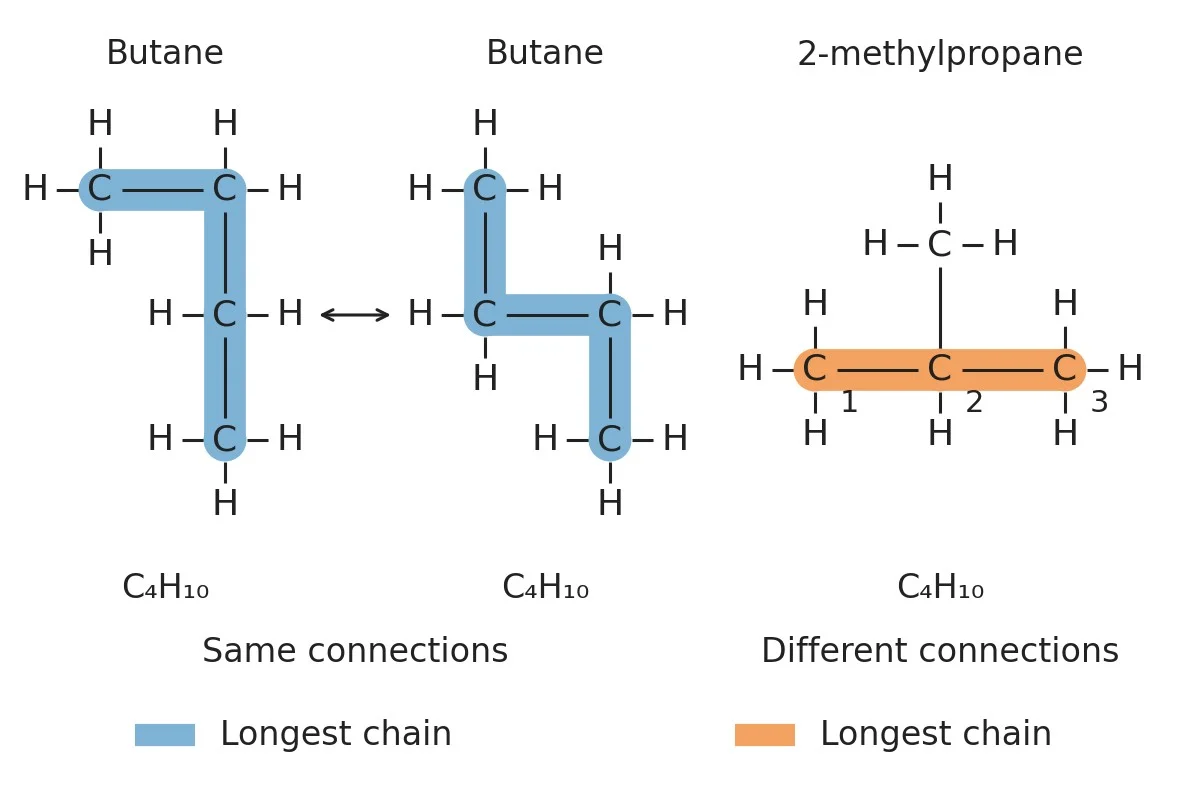
Two butane drawings beside branched 2-methylpropane, with longest chains highlighted.

1. Classification, nomenclature and isomerism

Hydrocarbons contain only carbon and hydrogen; connections distinguish their structures.

Show
Look at the diagram. Trace each highlighted longest chain. Count the carbons and hydrogens in each structure.
Ask
Will straightening these bent chains make all three drawings represent the same compound?
Say
There are two: turning butane preserves connections, while branching changes them. Both are saturated, open-chain hydrocarbons. In 2-methylpropane, the longest chain has three carbons, with methyl attached at carbon two.
Used in
Systematic names on chemical labels help buyers identify the substance.
If your child says…“Turning it makes another isomer.”
Ask
Which carbon has different neighbours in the two butane drawings?
What’s true
Structural isomers need different connections, while keeping the same formula.
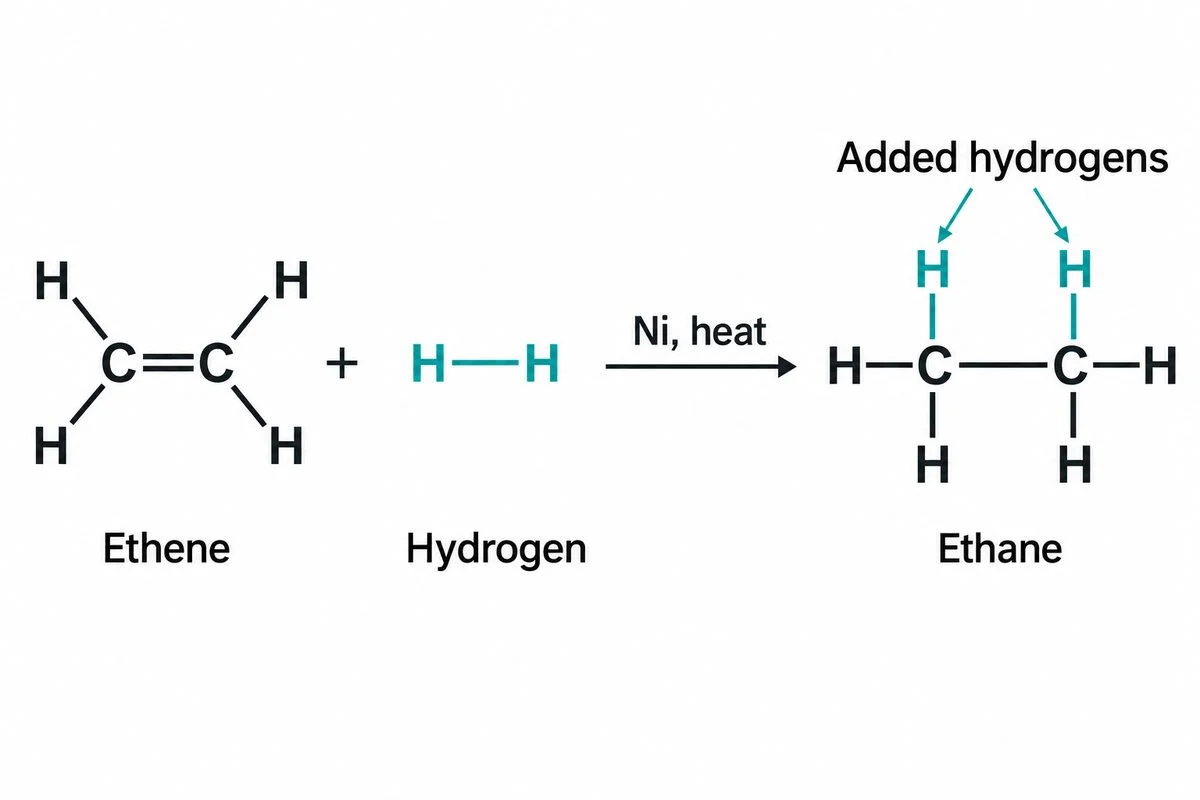
Ethene gains two highlighted hydrogen atoms, forming ethane without changing carbon connections.

2. Preparation of alkanes

Hydrogen addition changes multiple bonds without rearranging the carbon chain.

Show
Look at the diagram. Find ethene and hydrogen on the left. Follow the added hydrogens into ethane.
Ask
Which bonds must change to turn ethene into ethane?
Say
The hydrogen–hydrogen bond breaks. The carbon–carbon double bond becomes single, and two carbon–hydrogen bonds form.
Used in
Hydrogenation hardens vegetable oils to make solid cooking fats.
If your child says…“Adding hydrogen rearranges the carbon chain.”
Ask
Which carbon has gained a different carbon neighbour?
What’s true
Ordinary hydrogenation preserves the carbon framework.
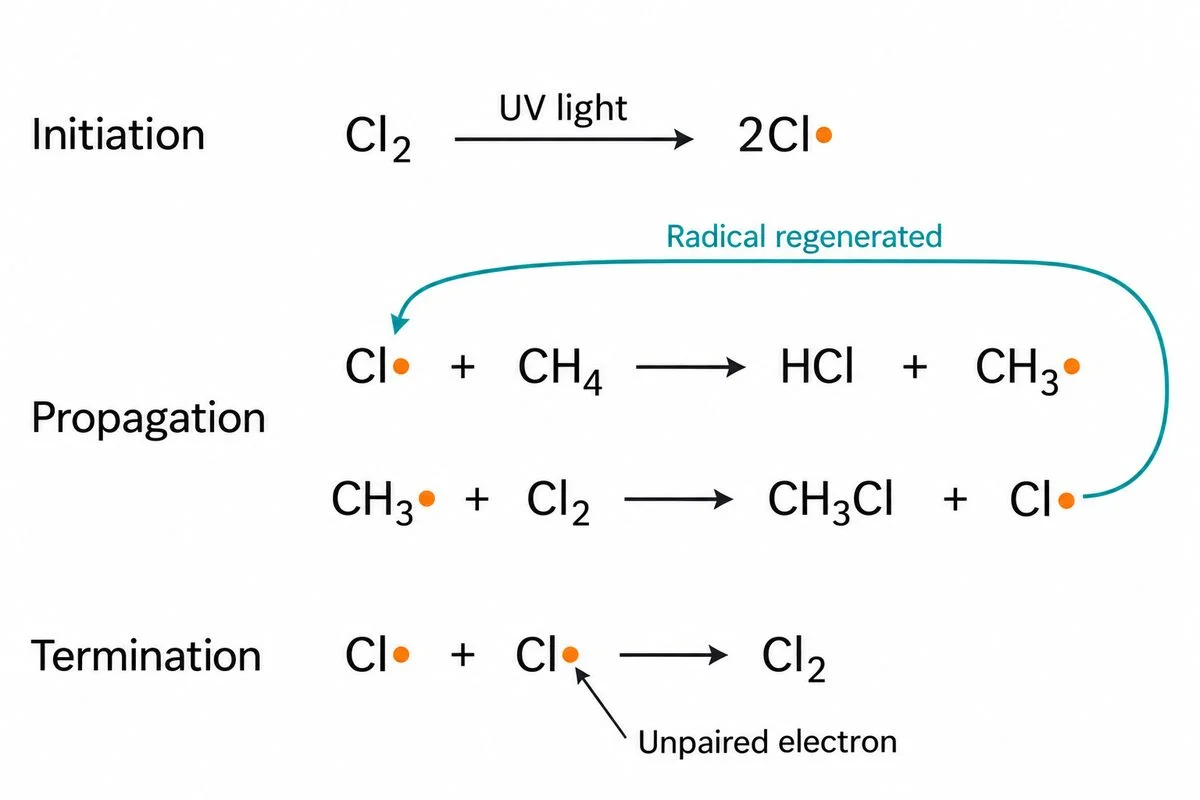
Methane chlorination scheme tracks radical formation, regeneration and removal.

3. Chemical properties of alkanes

Radical substitution replaces hydrogen through reactions that regenerate radicals.

Show
Look at the diagram. Follow the dots through initiation and propagation, then down to termination. Each dot marks an unpaired electron.
Ask
Will this regenerated chlorine radical react with another methane molecule?
Say
Yes, propagation regenerates chlorine radicals. When two radicals combine, neither remains to continue that chain.
Used in
Radical chlorination makes chlorinated compounds used as starting materials for manufacturing other chemicals.
If your child says…“Every repeating step needs more ultraviolet light.”
Ask
Where did the new chlorine radical come from?
What’s true
The repeating steps regenerate radicals, which have an unpaired electron.

Multiple bonds

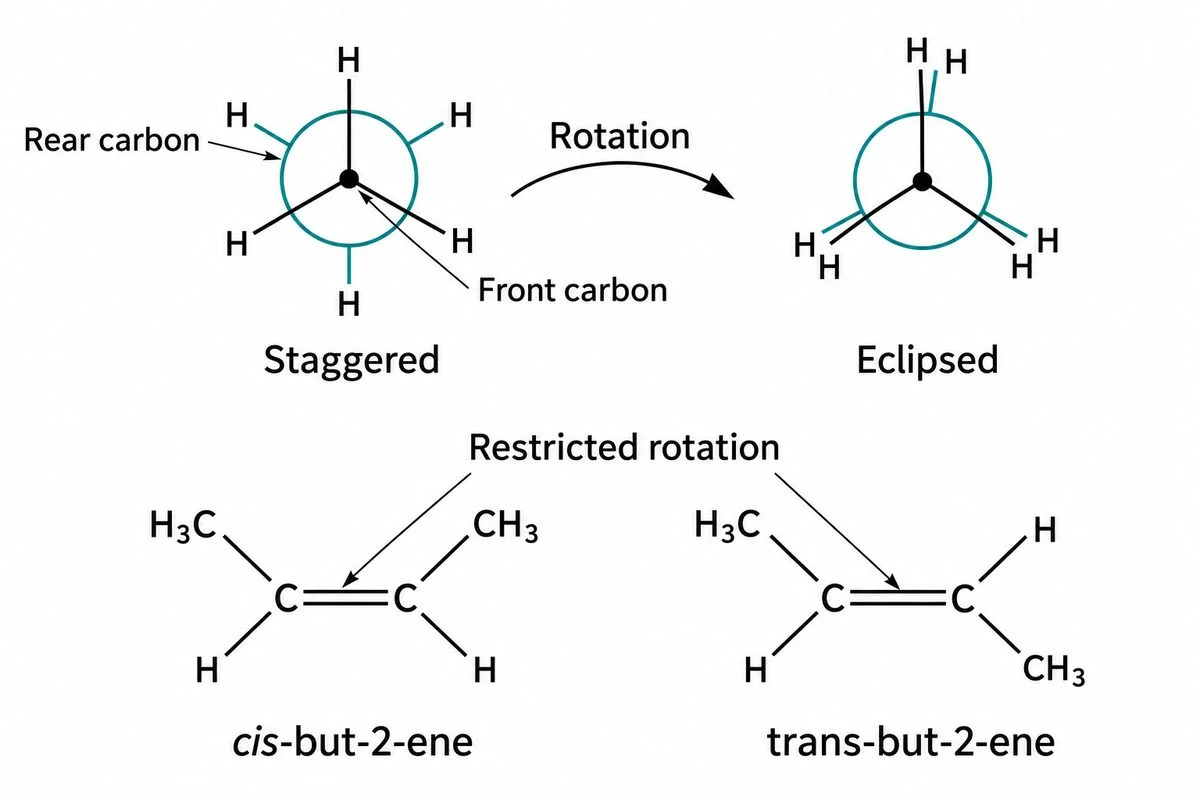
Ethane conformations above cis and trans arrangements of but-2-ene.

4. Conformations and geometrical isomerism

Single bonds allow rotation; intact double bonds restrict it.

Show
In the diagram, compare ethane’s views above, then methyl positions below.
Ask
Which pair interconverts with its bonding intact?
Say
Ethane rotates; staggered ethane has less repulsion. Twisting but-2-ene disrupts pi overlap.
Used in
Double-bond arrangements affect fat packing, helping determine whether a fat is solid or liquid.
If your child says…“A double bond turns freely too.”
Ask
Can the sideways overlap survive when one end turns?
What’s true
Twisting a double bond disrupts its sideways pi overlap.

CH3CH=CH2+HBr⟶CH3CH+CH3+Br−\mathrm{CH_3CH{=}CH_2+HBr\longrightarrow CH_3CH^{+}CH_3+Br^{-}}

CH3CH+CH3+Br−⟶?\mathrm{CH_3CH^{+}CH_3+Br^{-}\longrightarrow}\boxed{?}

5. Electrophilic addition and Markovnikov’s rule

Without peroxide, hydrogen bromide mainly adds hydrogen to propene’s terminal carbon.

Show
Write these lines, leaving the product blank. Say HBr means hydrogen bromide, and plus and minus mark charges. There is no peroxide.
Ask
Which main product forms when bromide joins this middle-carbon intermediate?
Say
Bromide joins the middle carbon, mainly making 2-bromopropane. This secondary carbocation has two carbon neighbours, which stabilise its positive charge.
Used in
Adding water to ethene makes ethanol, which is used as a solvent.
If your child says…“Bromine goes on the end carbon without peroxide.”
Ask
Which carbon carries the positive charge in the line you wrote?
What’s true
Without peroxide, propene mainly forms 2-bromopropane through the more stable carbocation.
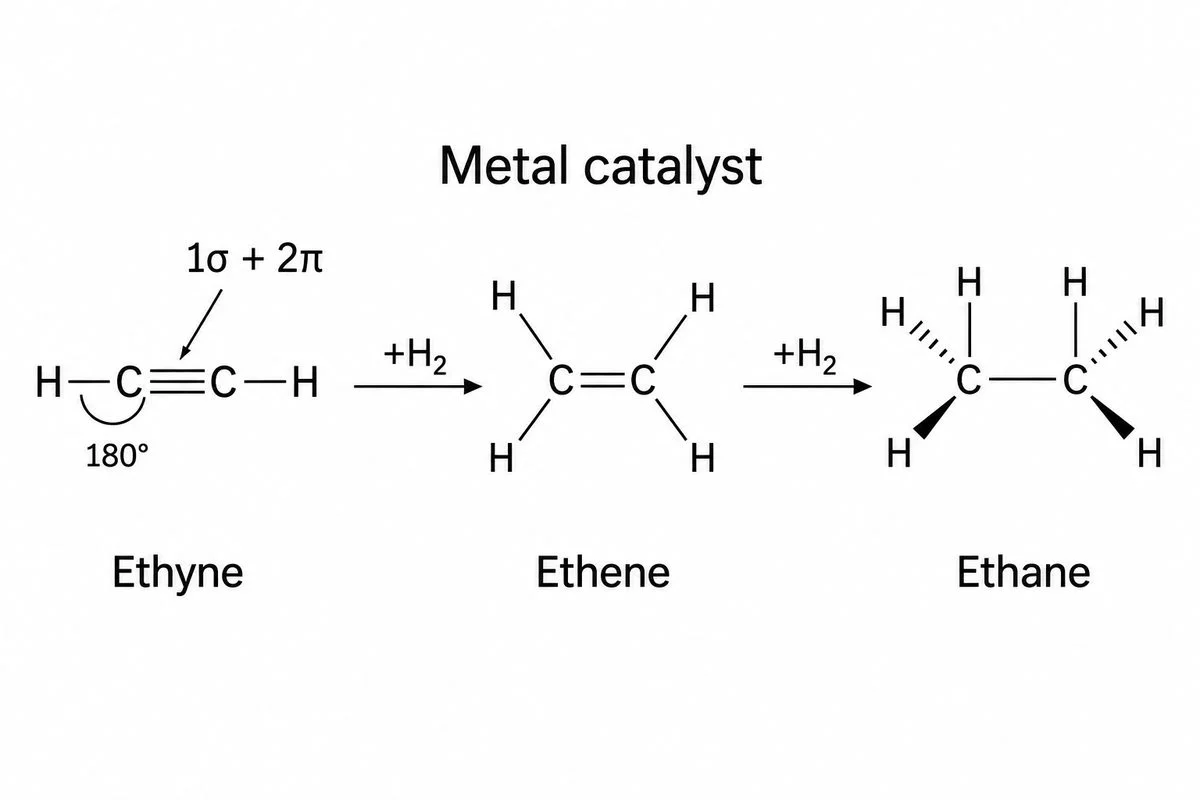
Ethyne becomes ethene, then ethane, with hydrogen added at each stage.

6. Alkynes

Triple-bond carbons lie straight and can accept hydrogen in two stages.

Show
Look at the diagram. Find straight ethyne and its triple bond: one sigma and two pi bonds. Follow both hydrogen additions.
Ask
From these bonds, how many hydrogen molecules will ethyne need to become ethane?
Say
Ethyne needs two hydrogen molecules because its triple bond becomes double, then single.
Used in
Ethyne fuels welding flames that join metal parts.
If your child says…“One hydrogen pair turns ethyne into ethane.”
Ask
After the first addition, which bond still accepts hydrogen?
What’s true
Complete hydrogenation adds two hydrogen molecules across each triple bond.

Aromatic rings

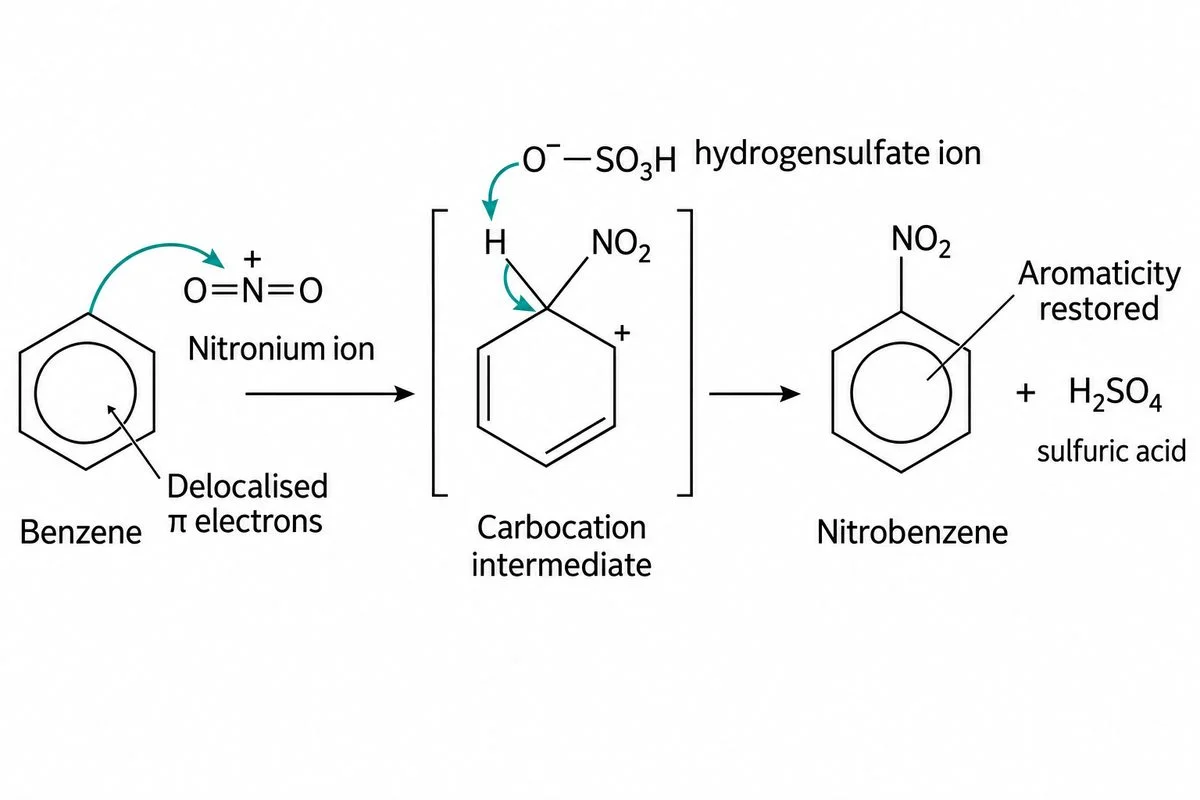
Benzene nitration shows temporary disruption and restoration of electron sharing around the ring.

7. Benzene: resonance and electrophilic substitution

Benzene shares electrons around its ring; substitution restores that sharing.

Show
Look at the diagram. Follow nitronium attachment, then proton removal. Trace the carbon–hydrogen bond’s electron pair back into the ring.
Ask
What will happen to aromaticity when this carbon–hydrogen electron pair returns to the ring?
Say
Nitronium attachment interrupts electron sharing around the ring. When hydrogen leaves as a proton, its bond electrons restore that sharing.
Used in
Benzene substitution makes starting materials for dyes used to colour products.
If your child says…“Substitution permanently destroys the ring’s aromatic stability.”
Ask
Where do the carbon–hydrogen bond’s electrons go when the proton leaves?
What’s true
The final substitution product regains continuous electron sharing around the ring.
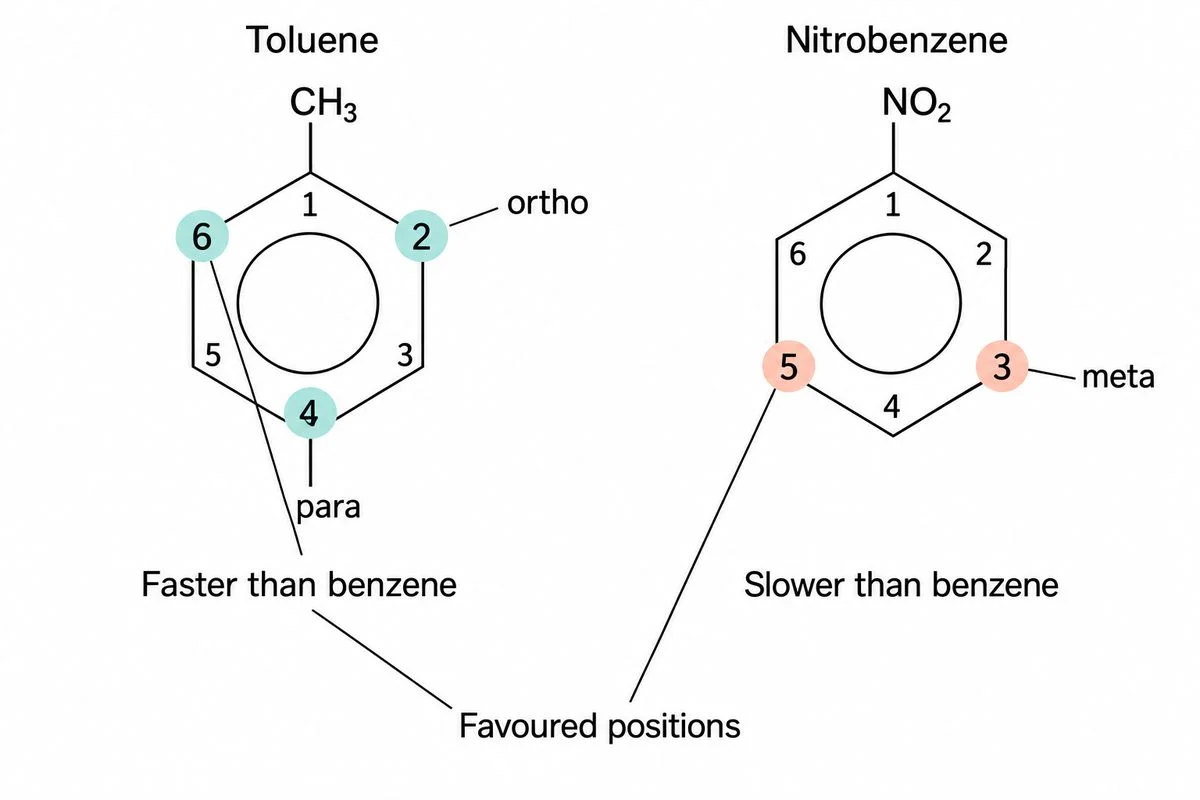
Toluene and nitrobenzene show different preferred substitution positions and reactivity compared with benzene.

8. Directive influence of a functional group in monosubstituted benzene

An attached group affects substitution speed and the next attachment position.

Show
Look at the diagram. Find each attached group at carbon one. Locate neighbouring ortho, next-neighbour meta and opposite para positions.
Ask
How will replacing methyl with nitro change the next substitution?
Say
Methyl supplies electron density, favouring ortho and para positions. Nitro withdraws electron density, favouring meta positions.
Used in
Controlling substitution positions helps factories make the intended ingredient with fewer unwanted products.
If your child says…“A nitro group makes the ring react faster.”
Ask
Does withdrawing electrons make this ring more attractive to an electron-seeking attacker?
What’s true
Nitro withdraws electron density, making the ring less reactive toward electrophiles.

A real problem

Delhi’s bus fleet became diesel-free.

Delhi’s entire bus fleet became diesel-free on December 1, 2002.

Compressed natural gas, or CNG, consists mainly of methane.

CNG can reduce some exhaust pollutants compared with petrol or diesel. Results depend on the vehicle.

A Delhi study found CNG cars emitted less carbon monoxide and hydrocarbons than petrol cars.

GTZ Sustainable Urban Transport ProjectEnergy EducationThe Times of India

Delhi city bus connected to a CNG refuelling dispenser.

Concept Lab · Common misconception

The tempting mistake in Hydrocarbons

Open standalone misconception page →

Does a benzene ring react like three independent double bonds?

Wrong

Benzene should readily add bromine like an alkene.

Why it feels right. Its alternating-bond drawing resembles three alkene bonds.

Right

Benzene has a delocalised aromatic system and commonly undergoes substitution under suitable conditions.

Worked example

Alkene
Br₂ adds across C=C→Two new C–Br bonds
Benzene
Br₂ with catalyst→H replaced by Br→Aromatic ring retained
Bromine adds across an alkene double bond. Under suitable catalytic conditions benzene instead exchanges H for Br.
  1. An alkene can add bromine across C=C.
  2. Benzene bromination with a suitable catalyst replaces one hydrogen and preserves aromaticity in the product.

Ask your child eight quick questions.

One per step. The answer and the reason are given.

  1. Does drawing butane backwards produce another compound?

    No. Every atom keeps the same neighbours.

  2. Which alkane forms when but-1-ene undergoes ordinary hydrogenation?

    Butane. Hydrogen adds across the double bond without creating a branch.

  3. What keeps the chlorination chain going after light starts it?

    Regenerated radicals. Propagation produces another radical that can react again.

  4. Which bonding component prevents free rotation in but-2-ene?

    The pi bond. Turning would disrupt the sideways overlap that forms this bond.

  5. What is propene’s main product with hydrogen bromide without peroxide?

    2-bromopropane. The more stable intermediate has its positive charge on the middle carbon.

  6. After ethyne adds one hydrogen molecule, which hydrocarbon forms?

    Ethene. One addition leaves a double bond requiring another hydrogen molecule.

  7. What happens to aromaticity when the substitution intermediate loses its proton?

    It is restored. The carbon–hydrogen bond’s electrons restore continuous sharing around the ring.

  8. Which reacts more slowly during nitration: benzene or nitrobenzene?

    Nitrobenzene. Its nitro group withdraws electron density, making electrophilic attack harder.

15 more questions with answers