Skip to content

Teach Classification of Elements and Periodicity in Properties in eight steps.

For each idea: show it, ask before you tell, then say one line.

Gather paper and a pencil.

Common misconceptions & worked visual for this chapter · 15 practice questions with answers

How to teach it

Find the pattern

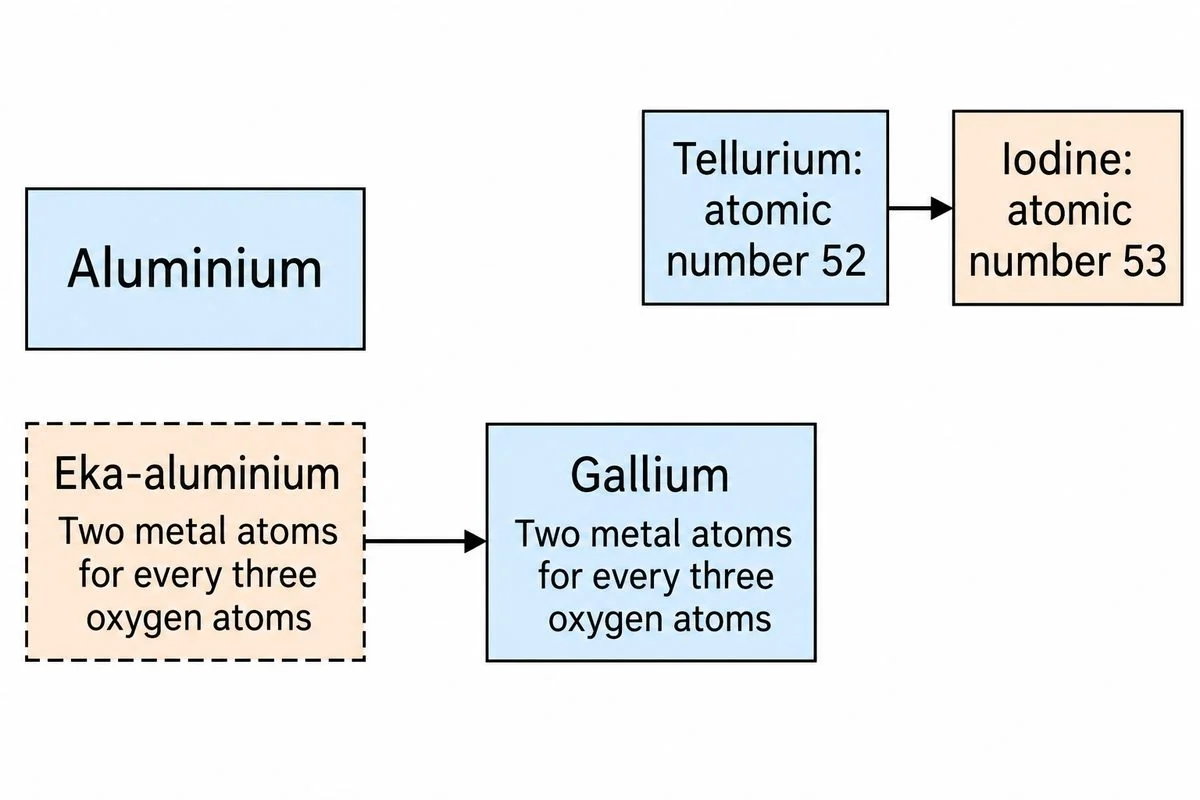
A predicted element gap leads to gallium; atomic numbers order tellurium before iodine.

1. Genesis of Periodic Classification and Modern Periodic Law

Element families help predict properties.

Show
Find the gap below aluminium in the diagram. Follow its arrow to gallium. Compare the oxide compositions, then follow tellurium to iodine.
Ask
What could aluminium’s family reveal about the missing element before its discovery?
Say
Similar properties let Mendeleev predict the missing element’s oxide. Gallium’s oxide matched the prediction.
Used in
Chemical families help manufacturers predict substitute materials.
If your child says…“The modern table puts elements in atomic-mass order.”
Ask
Which does modern ordering count: an atom’s protons or its mass?
What’s true
Atomic number determines modern ordering, while Mendeleev used mass alongside chemical similarities.
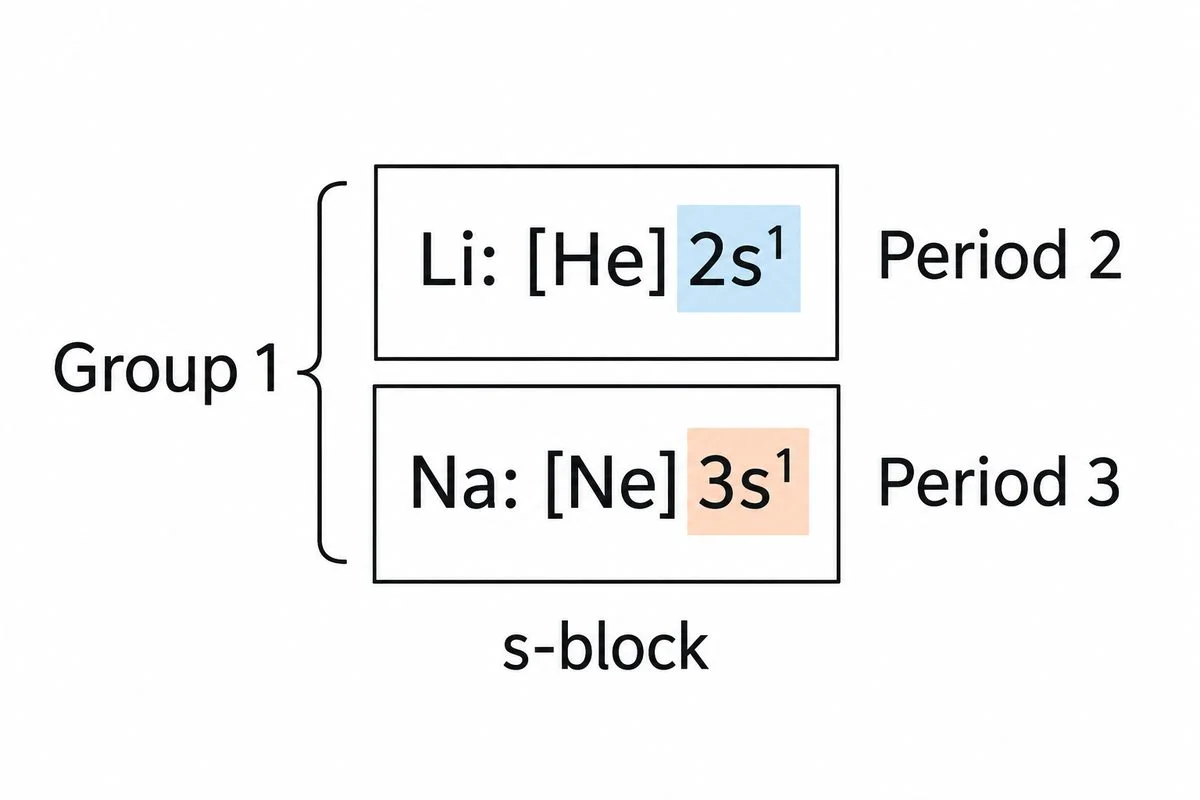
Lithium and sodium share an outer s-electron pattern but occupy different periods.

2. Electronic Configurations and Types of Elements

Electron arrangements explain rows, families and blocks.

Show
Find lithium above sodium in the diagram. Compare their highlighted outer electrons, then read their period labels.
Ask
Would these different electron arrangements put lithium and sodium in the same family?
Say
Both have one outer s electron, giving similar behaviour in group 1. Their highest occupied shells place lithium in period 2 and sodium in period 3.
Used in
Lithium’s outer electron helps explain rechargeable battery chemistry.
If your child says…“Elements in the same row behave alike.”
Ask
Do these matching outer arrangements require equal numbers of occupied shells?
What’s true
Similar outer arrangements recur down columns; they change as we move along rows.

Compare elements

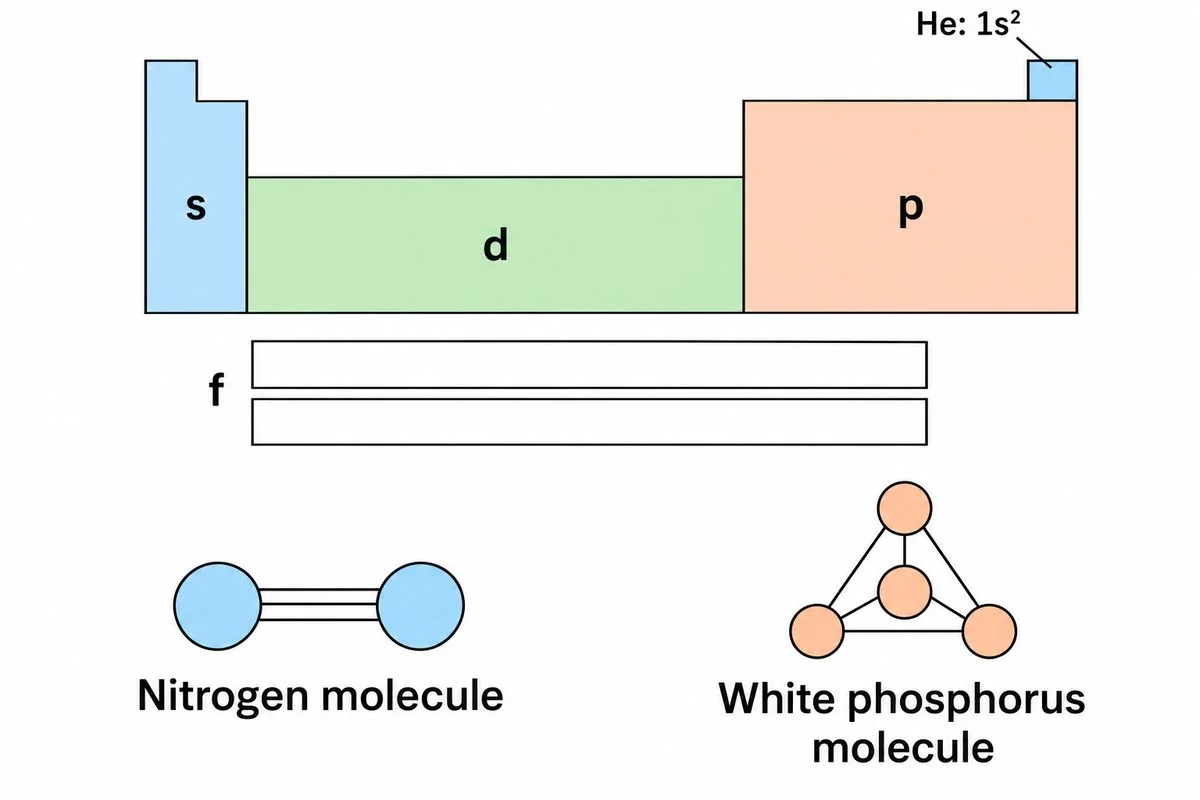
Four periodic blocks above nitrogen’s triple bond and phosphorus’s tetrahedral structure.

3. s-, p-, d-, f-Block Elements and Anomalous Properties of Second Period Elements

Blocks follow subshell filling; second-period elements can differ from heavier relatives.

Show
Find the blocks in the diagram. Compare the molecules below.
Ask
Would these group members form identical structures?
Say
Blocks identify filling subshells. Small nitrogen atoms form strong triple bonds; phosphorus forms single bonds here.
Used in
Transition-metal catalysts speed up chemical manufacturing.
If your child says…“The first element in a group behaves just like all the others.”
Ask
Do nitrogen and phosphorus use the same bonds in these structures?
What’s true
Small second-period atoms often form strong multiple bonds and differ from heavier group members.
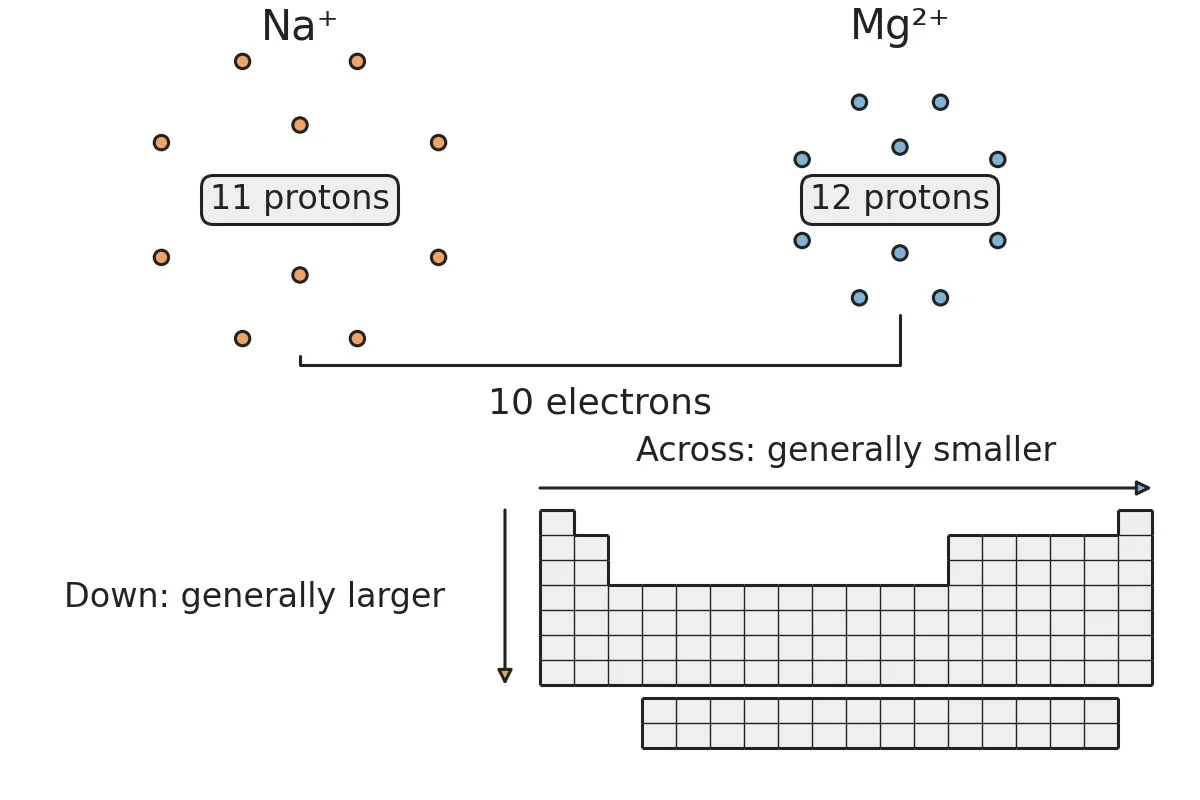
Equal-electron ions have different sizes; arrows show atomic-size trends across and down.

4. Atomic Radius and Ionic Radius

Atoms usually shrink across periods and grow down groups.

Show
Find both ions in the diagram. Compare their proton counts and shared electron count. Follow the size arrows below.
Ask
Would having ten electrons each make these ions equally large?
Say
Magnesium’s ion is smaller because its extra proton pulls the same electron arrangement closer.
Used in
Ion sizes help predict packing in salts.
If your child says…“Equal numbers of electrons mean equal sizes.”
Ask
Are the two nuclei equally positive?
What’s true
With equal electron counts, greater nuclear charge produces a smaller ion.
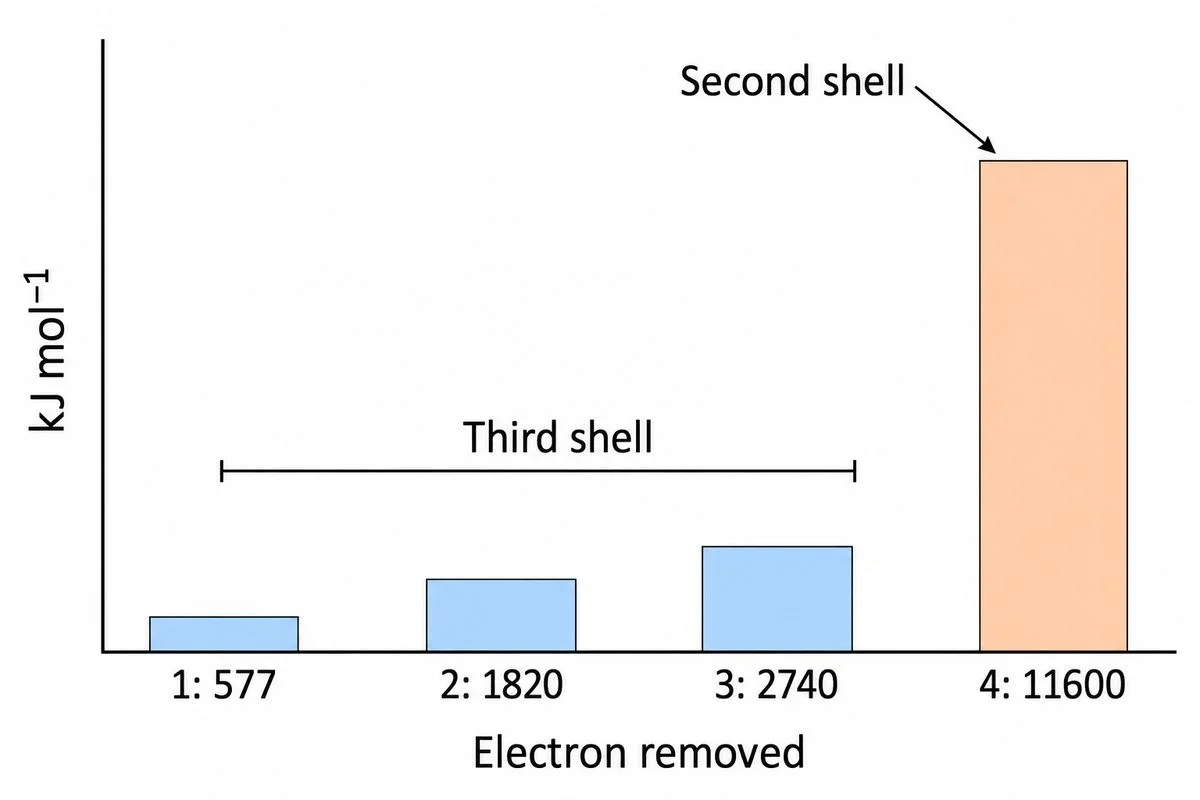
Aluminium’s fourth electron removal requires far more energy than its first three.

5. Ionization Enthalpy

Removing electrons from gaseous atoms or ions requires energy.

Show
Find aluminium’s four successive removals in the diagram. Compare the first three bars with the fourth.
Ask
After the three outer-shell removals shown, would removing an inner electron need more energy?
Say
The first three removals empty aluminium’s outer shell. The fourth reaches an inner shell, where electrons are held much more tightly. Each bar gives the energy needed per mole of gaseous atoms or ions.
Used in
Gas-filled lamps use energy to free electrons, enabling current and light.
If your child says…“Once one electron leaves, the others come off more easily.”
Ask
After the three outer electrons leave, which shell must supply the next electron?
What’s true
Each removal leaves a more positive ion that holds its remaining electrons more tightly.
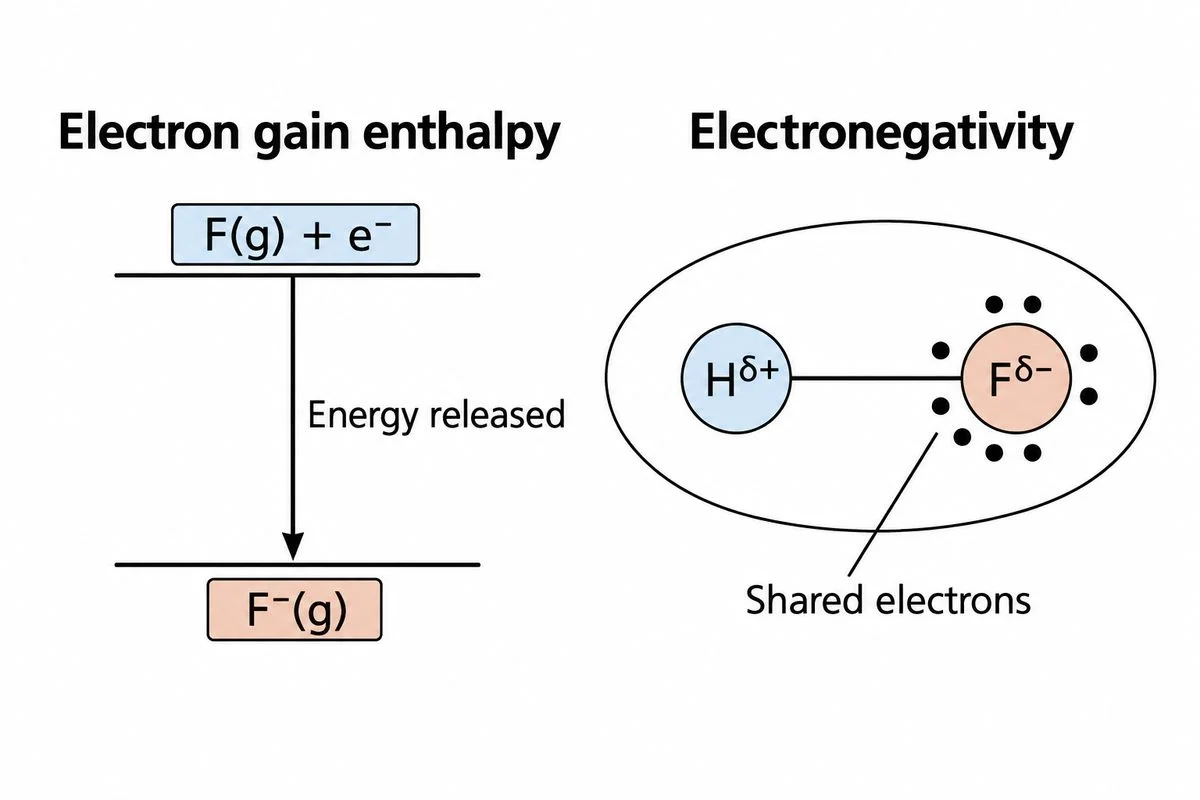
Gaseous fluorine releases energy gaining an electron. Bonded fluorine attracts shared electrons towards itself.

6. Electron Gain Enthalpy and Electronegativity

Electron gain changes energy; electronegativity compares attraction within bonds.

Show
Compare electron addition on the diagram’s left with sharing on its right.
Ask
Would fluorine’s stronger attraction within bonds guarantee more energy released on electron addition?
Say
No. Chlorine releases more energy on electron addition. Fluorine’s compact shell repels incoming electrons more strongly.
Used in
Unequal sharing helps explain water’s dissolving power.
If your child says…“Electronegativity is the energy released when an atom gains an electron.”
Ask
In H–F, are the bonding electrons arriving from outside, or already shared?
What’s true
Electronegativity compares attraction within bonds, has no energy unit, and varies with the bonding situation.

Predict compounds and reactions

x+2(−1)=0x+2(-1)=0

x−2=0x-2=0

7. Periodicity of Valence or Oxidation States

Oxidation states assign charges; valence describes an atom’s combining capacity.

Show
Write this line. Say, ‘Oxygen difluoride contains one oxygen atom and two fluorine atoms. Let x represent oxygen’s oxidation state; fluorine gets −1.’ Explain that fluorine attracts bonding electrons more strongly. The neutral compound’s total is zero.
Ask
What must x equal in the next line?
Say
Oxygen is +2 because its assigned charge balances the two fluorines.
Used in
Correct compound formulas let manufacturers calculate ingredient amounts without wasting materials.
If your child says…“Oxygen always has oxidation state −2.”
Ask
Would oxygen at −2 make the total zero here?
What’s true
Fluorine attracts bonding electrons more strongly than oxygen, making oxygen positive in oxygen difluoride.

A real problem

Lithium-ion batteries made lightweight portable power practical.

Electronics manufacturers needed batteries that were lightweight and rechargeable.

Lithium’s readiness to release its outer electron helped make lithium batteries possible.

Akira Yoshino created the first commercially viable lithium-ion battery in 1985.

These developments provided lightweight power sources for portable electronics.

Royal Swedish Academy of SciencesChemical & Engineering NewsAssociated Press via Phys.org

Unbranded mobile phone connected to a charging cable on a wooden desk.

Concept Lab · Common misconception

The tempting mistake in Classification of Elements and Periodicity in Properties

Open standalone misconception page →

Does an atom get bigger as electrons are added across a period?

Wrong

A chlorine atom is larger than a sodium atom because it has more electrons.

Why it feels right. I assume each extra electron adds another layer.

Right

Across Period 3, added valence electrons enter the same main shell as nuclear charge increases.

Worked example

Both drawings represent Period 3 atoms. The smaller outline represents chlorine's smaller atomic radius.
  1. Sodium and chlorine both have their outermost electrons in the third shell.
  2. The greater effective nuclear attraction in chlorine pulls that shell closer, so chlorine has a smaller atomic radius.

Ask your child eight quick questions.

One per step. The answer and the reason are given.

  1. Which number determines the order of elements in the modern periodic table?

    Its atomic number. Modern ordering follows proton count, rather than atomic mass.

  2. Sodium has arrangement 2,8,1. Which period contains it?

    Period 3. Three occupied shells determine its period; one outer electron does not.

  3. What type of bond joins the two nitrogen atoms shown?

    A triple bond. Small nitrogen atoms form a strong triple bond, shown by three parallel lines.

  4. Which is smaller, Na⁺ or Mg²⁺, when both contain ten electrons?

    Mg²⁺. More protons pull its ten electrons closer.

  5. Why does aluminium’s fourth electron require much more removal energy?

    It occupies an inner shell. The first three removals have already emptied the outer shell.

  6. Which has no energy unit: electron gain enthalpy or electronegativity?

    Electronegativity. It compares attraction for shared electrons rather than measuring an energy change.

  7. What is oxygen’s oxidation state in oxygen difluoride?

    +2. Two fluorines contribute −2, so oxygen must contribute +2.

  8. Aluminium oxide reacts with hydrochloric acid. How does it behave towards a strong base?

    It also reacts. Aluminium oxide is amphoteric, so it reacts with both acids and bases.

15 more questions with answers