Skip to content

Teach Structure of Atom in eight steps.

For each idea: show it, ask before you tell, then say one line.

Gather paper and a pencil.

Common misconceptions & worked visual for this chapter · 15 practice questions with answers

How to teach it

Particles and the nucleus

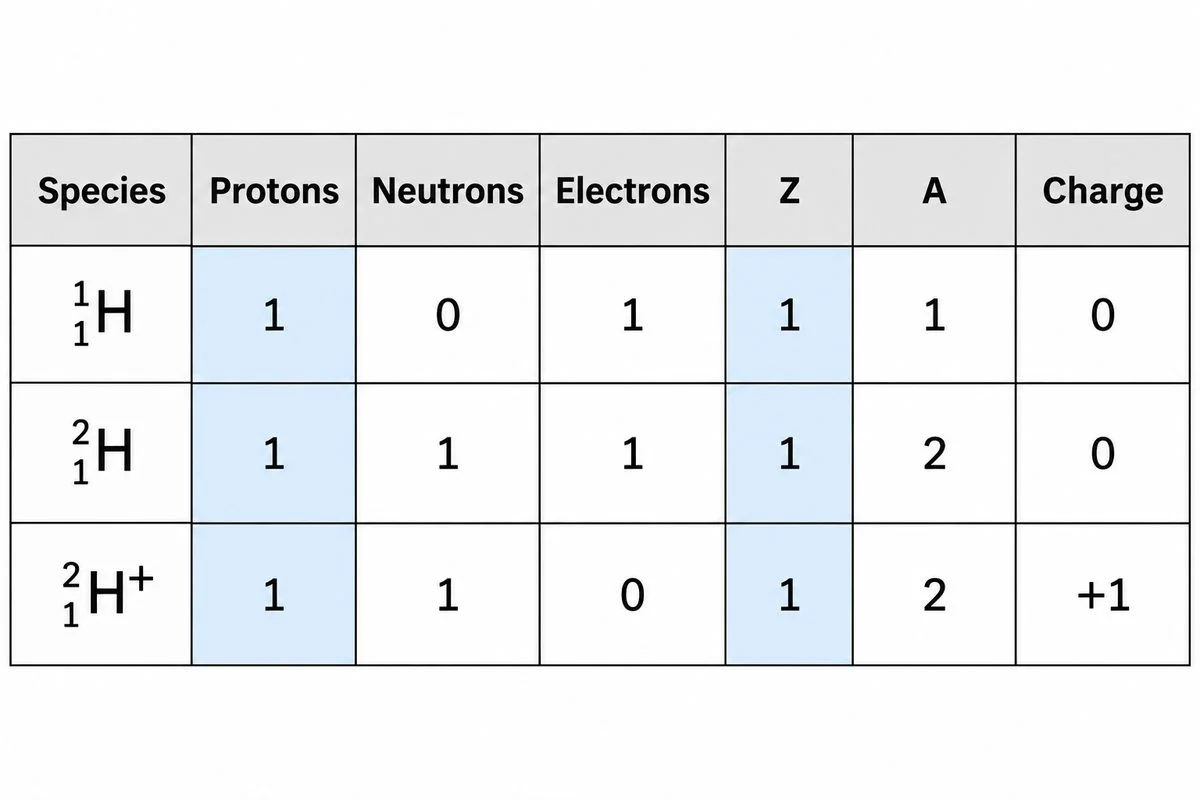
Hydrogen table comparing proton, neutron and electron counts, atomic numbers, mass numbers and charges.

1. Sub-atomic Particles, Atomic Number, Isotopes and Ions

Protons identify elements, neutrons distinguish isotopes, and electron changes produce ions.

Show
Look at the diagram’s table. Compare proton counts first, then neutron and electron counts. Read Z as atomic number and A as mass number.
Ask
Will changing neutrons or electrons make any row a different element?
Say
All remain hydrogen because each has one proton. Neutrons change the mass number; losing an electron makes the ion positive.
Used in
Moving ions carry charge through a battery’s contents, helping complete its circuit.
If your child says…“Making an ion changes its protons.”
Ask
Which count changes between hydrogen-2 and its ion: protons or electrons?
What’s true
An atom becomes an ion through electron gain or loss, leaving its proton count unchanged.
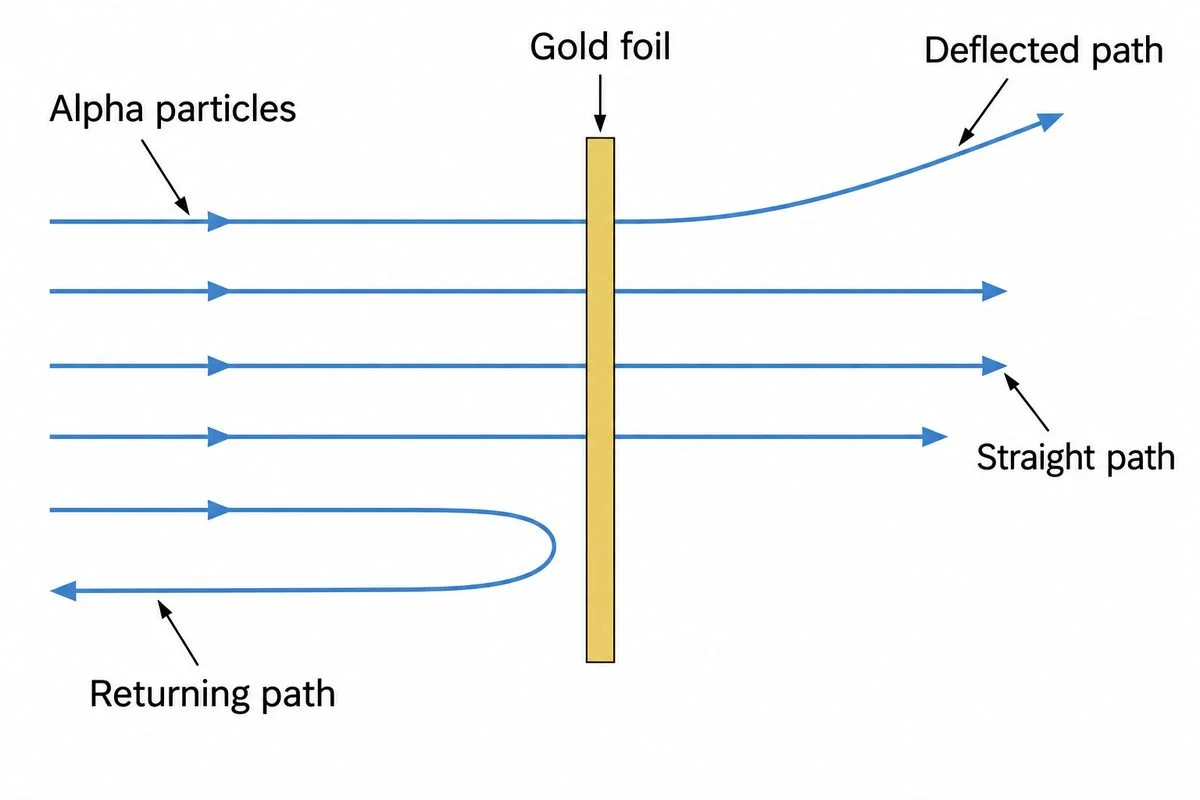
Diagram showing mostly straight paths through foil and one returning path.

2. Thomson Model and Rutherford’s Nuclear Model of Atom

Scattering revealed concentrated positive charge inside a mostly empty atom.

Show
Find the straight paths and the rare returning path in the diagram. Say these are positive alpha particles: most passed straight through, while returns were very rare.
Ask
Would spread-out positive charge explain the returning path?
Say
No; rare returns reveal a tiny, massive positive nucleus, unlike Thomson’s spread-out charge.
Used in
Nuclear power stations release energy from nuclei to generate electricity.
If your child says…“Electrons bounced the alpha particles back.”
Ask
Could something so light account for such a large change in the heavy particle’s motion?
What’s true
Electrons are too light to cause the observed returns of heavy alpha particles.

Light, energy and matter waves

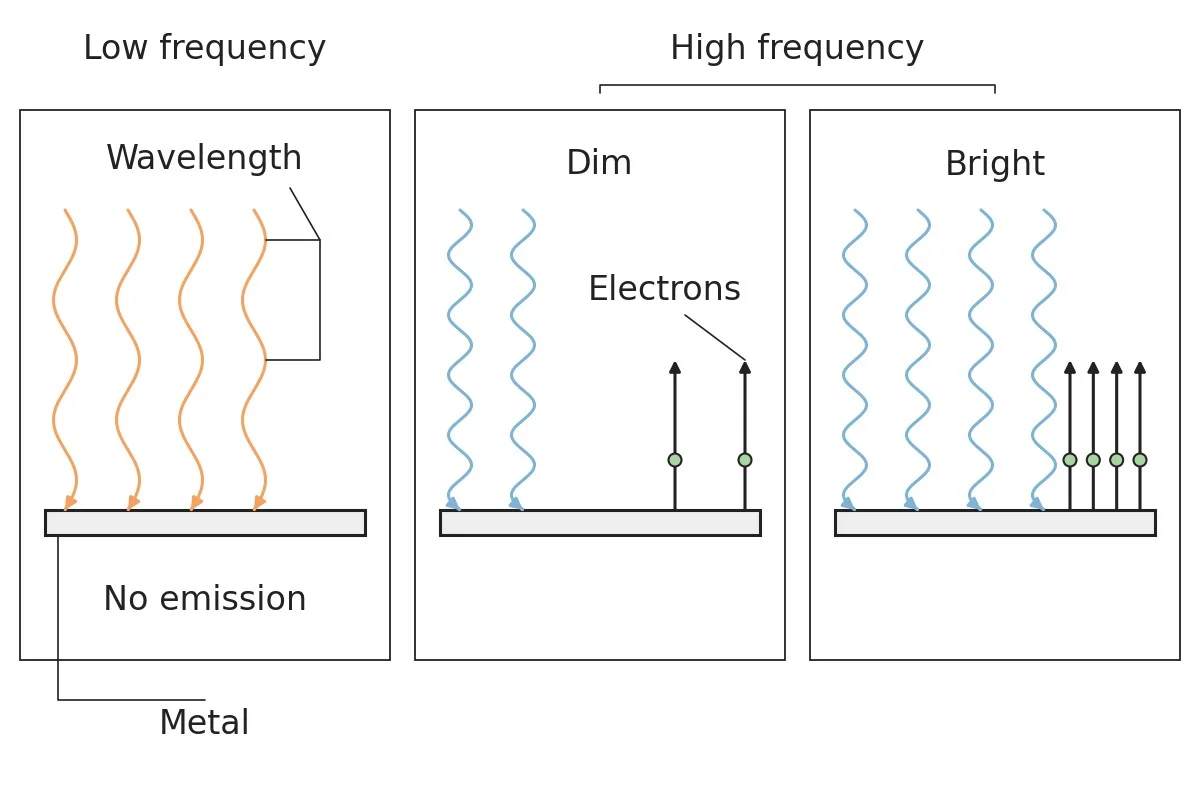
Identical metals under different light frequencies and brightnesses, with contrasting electron emission.

3. Wave Nature of Electromagnetic Radiation, Planck’s Quantum Theory and Photoelectric Effect

Frequency sets each photon’s energy.

Show
Look at the diagram’s identical metal surfaces. Compare wave spacing first, then brightness and outgoing electrons.
Ask
Will making the low-frequency light brighter eventually release electrons from this metal?
Say
Closer wave crests mean higher frequency and more energy per photon. Below the threshold frequency, brightness cannot free electrons. Above it, brightness increases electron numbers.
Used in
Solar cells use photon energy to free charge carriers and produce electricity.
If your child says…“Brighter light gives each photon more energy.”
Ask
Between the two high-frequency panels, does brightness change wave spacing or the number of electrons?
What’s true
At a fixed frequency, greater brightness supplies more photons without changing their individual energy.
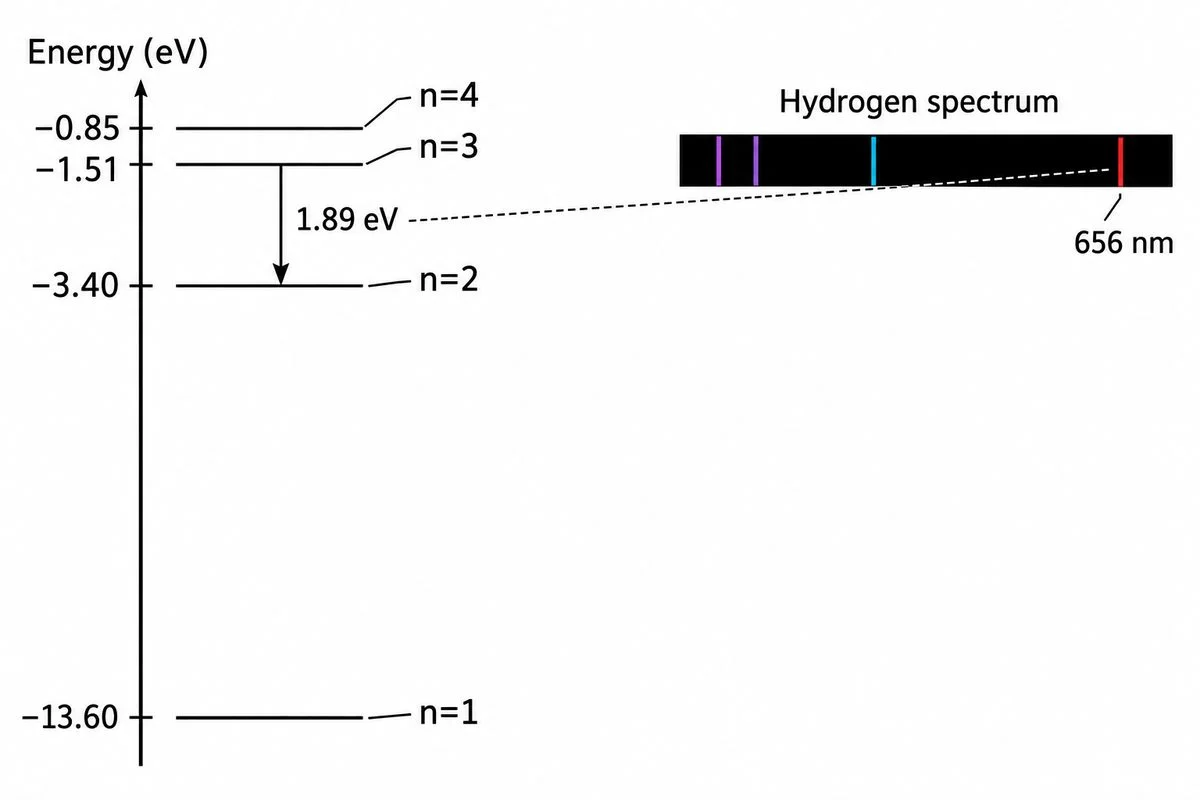
Hydrogen’s downward energy transition connected to its red spectral line.

4. Line Spectrum of Hydrogen and Bohr’s Model for Hydrogen Atom

Allowed energy gaps produce distinct wavelengths rather than a continuous spectrum.

Show
Find hydrogen’s downward arrow in the diagram. Follow it to the red line.
Ask
Will this particular drop produce one colour or every colour?
Say
This energy drop produces one colour: 656 nm. Its photon carries the 1.89 eV gap.
Used in
Atomic spectral lines identify elements in starlight without collecting material from stars.
If your child says…“An electron moves upwards when the atom emits light.”
Ask
Does this downward move require energy or release it?
What’s true
In Bohr’s one-electron model, emission accompanies a drop between allowed energy levels.

λ=hmv\lambda=\frac{h}{mv}

λ=6.626×10⁻³⁴(9.11×10⁻³¹)(1.00×10⁷) m\lambda=\frac{6.626\times10^{-34}}{(9.11\times10^{-31})(1.00\times10^{7})}\,\mathrm{m}

5. Dual Behaviour of Matter and Heisenberg’s Uncertainty Principle

Matter has waves; position and momentum have linked uncertainties.

Show
Write these lines. Say lambda means wavelength and h means Planck’s constant. Here, m means mass and v means speed.
Ask
Will this electron’s wavelength be comparable to an atom’s 10−1010^{-10} m size, or much smaller?
Say
Its wavelength is 7.27×10−117.27\times10^{-11} m, comparable to atomic size.
Used in
Electron microscopes use electron waves to reveal details ordinary light microscopes cannot resolve.
If your child says…“Perfect instruments could remove the uncertainty.”
Ask
If the limit belongs to nature, could replacing the instrument remove it?
What’s true
Position and momentum uncertainties have a joint lower limit set by nature.

Orbitals and electron arrangements

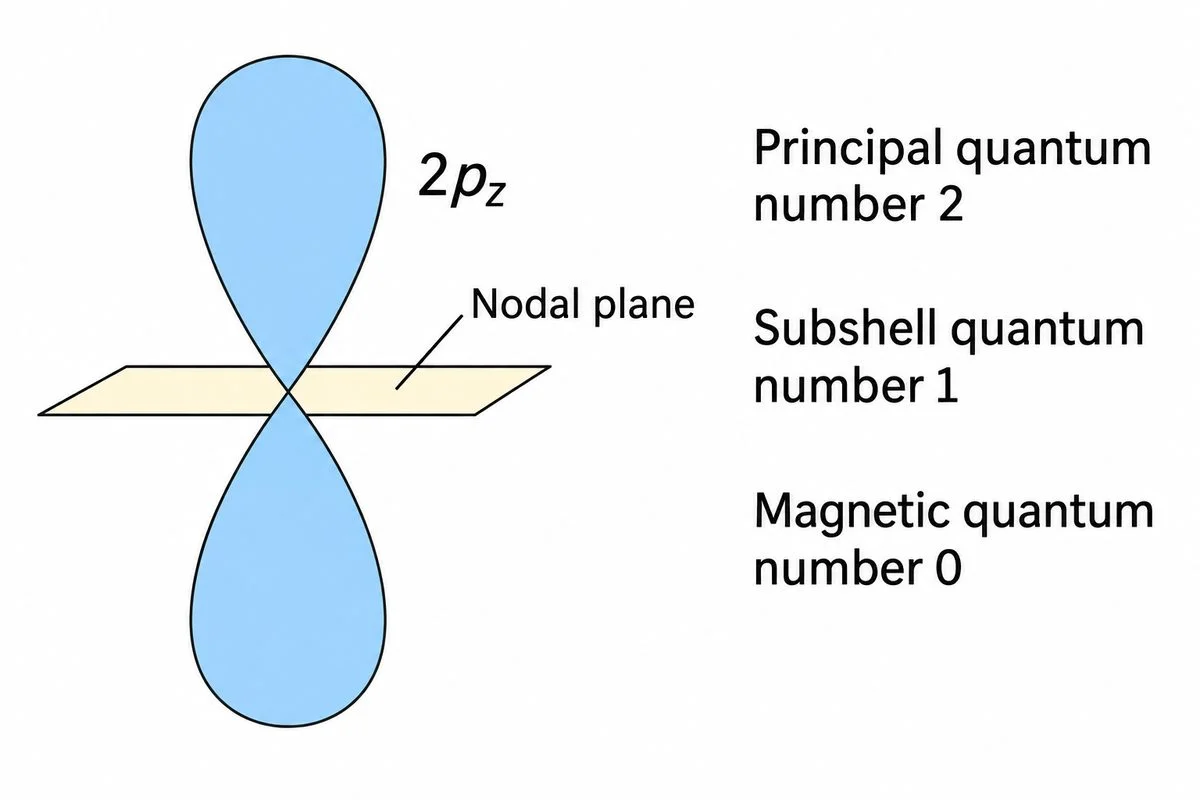
Two shaded orbital lobes above and below a central nodal plane.

6. Quantum Mechanical Model of Atom, Quantum Numbers and Shapes of Atomic Orbitals

Orbitals describe electron probability; quantum numbers identify their states.

Show
Find both lobes and the plane between them in the diagram. Read the three quantum-number labels. An electron in this orbital can have spin quantum number +½ or −½.
Ask
Could one electron be found in either lobe?
Say
Yes; both lobes describe one orbital. The plane has zero probability density.
Used in
Orbital shapes help chemists explain bond directions and predict molecular shapes.
If your child says…“Each lobe is an electron.”
Ask
With just one electron present, would either half of its probability distribution disappear?
What’s true
Both lobes describe one orbital, which can contain up to two electrons altogether.
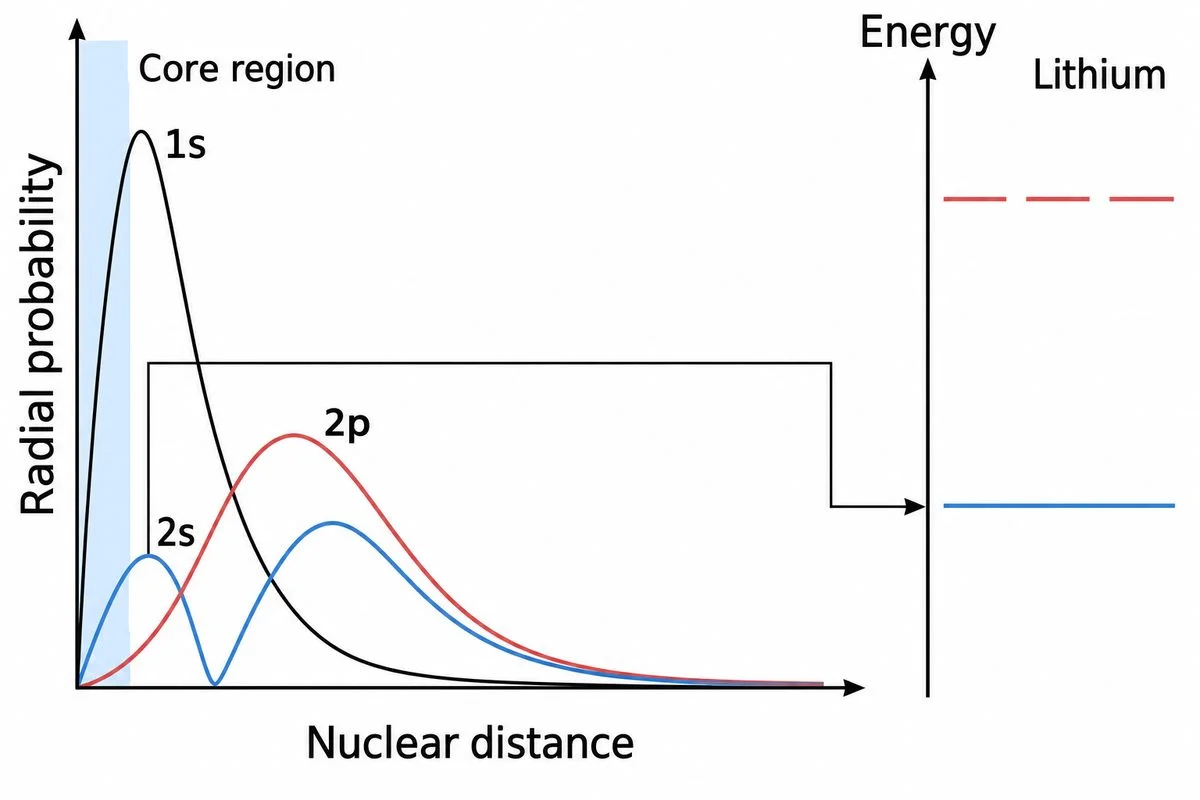
Lithium’s inner 2s probability peak linked to its lower energy than 2p.

7. Energies of Orbitals

Shielding and penetration affect orbital energies in atoms with several electrons.

Show
Find the inner 2s peak in the diagram. Follow its arrow to lithium’s lower 2s level.
Ask
Which orbital should have lower energy if its electron reaches closer to the nucleus?
Say
The penetrating 2s electron experiences less shielding, lowering its energy.
Used in
Shielding helps chemists predict reactivity when choosing materials for chemical containers.
If your child says…“Inner electrons make the nucleus pull harder.”
Ask
Do the negative inner electrons attract or repel the negative outer electron?
What’s true
Shielding reduces the effective nuclear charge experienced by an outer electron.
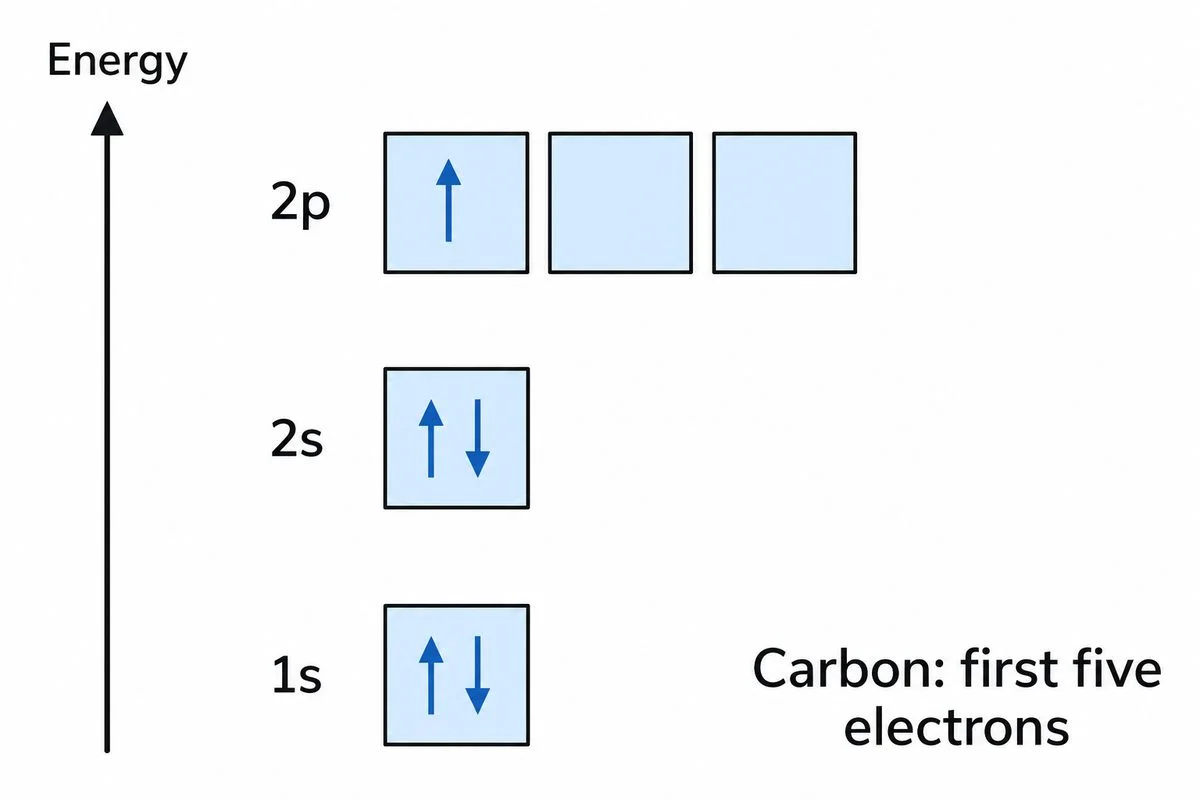
Carbon’s first five electrons in orbital boxes, ready for predicting the sixth.

8. Filling of Orbitals and Electronic Configurations of Atoms

Electrons fill orbitals by energy, capacity and spin.

Show
Look at the diagram. Read the filled 1s and 2s boxes, then the single 2p arrow.
Ask
Will carbon’s sixth electron pair here or enter an empty 2p box?
Say
The sixth electron enters another 2p box with matching spin, since equal-energy orbitals fill singly.
Used in
Electronic configurations help predict bonding when chemists design new materials.
If your child says…“Finish filling one p box before starting another.”
Ask
Why pair here while another orbital at the same energy remains empty?
What’s true
Equal-energy orbitals receive single electrons with matching spins before electrons pair.

A real problem

Scattered light can identify a substance.

Raman discovered the effect in February 1928.

When a material gains energy during scattering, the scattered light loses that energy.

The resulting spectrum provides a fingerprint for identifying the substance.

American Physical SocietyCarleton CollegeAmerican Chemical Society

Clear glass vial containing a liquid sample on a laboratory bench.

Concept Lab · Common misconception

The tempting mistake in Structure of Atom

Open standalone misconception page →

Is an orbital a path drawn around the nucleus?

Wrong

An electron travels on the line shown for its orbital.

Why it feels right. The diagram looks like a planet’s orbit.

Right

An orbital describes the electron’s quantum state and spatial probability distribution.

Worked example

The nested regions suggest higher probability density nearer the centre of a 1s orbital. They are not electron paths.
  1. A 1s picture uses a cloud or boundary to represent where the electron is likely to be found.
  2. It supplies no track for a moving point.

Ask your child eight quick questions.

One per step. The answer and the reason are given.

  1. Which particle count must change to make hydrogen a different element?

    The proton count. Electron changes alter charge, while proton changes alter elemental identity.

  2. Which part of the atom caused the rare backward deflections?

    The positive nucleus. Its concentrated positive charge strongly repels approaching alpha particles.

  3. At unchanged frequency, how does brighter light change photon arrivals per second?

    More photons arrive. Frequency sets each photon’s energy; brightness changes how many arrive.

  4. During light emission, does the electron finish at a higher or lower energy?

    A lower energy. The released photon carries away the energy difference.

  5. What happens to minimum momentum uncertainty when position uncertainty becomes smaller?

    It becomes larger. Their product cannot fall below nature’s lower limit.

  6. For one electron in this orbital, which lobes describe where it may be found?

    Both lobes. The lobes are parts of one probability distribution, not separate electrons.

  7. Does shielding make the effective nuclear attraction on an outer electron stronger or weaker?

    Weaker. Inner electrons reduce the effective attraction experienced by the outer electron.

  8. How many 2p orbitals contain electrons in ground-state carbon?

    Two. Its two p electrons occupy separate equal-energy orbitals before pairing.

15 more questions with answers, 1 with pictures