Skip to content

Teach Thermodynamics in eight steps.

For each idea: show it, ask before you tell, then say one line.

Gather paper, a pencil, an ice cube and a saucer.

Common misconceptions & worked visual for this chapter · 15 practice questions with answers

How to teach it

Track energy transfers

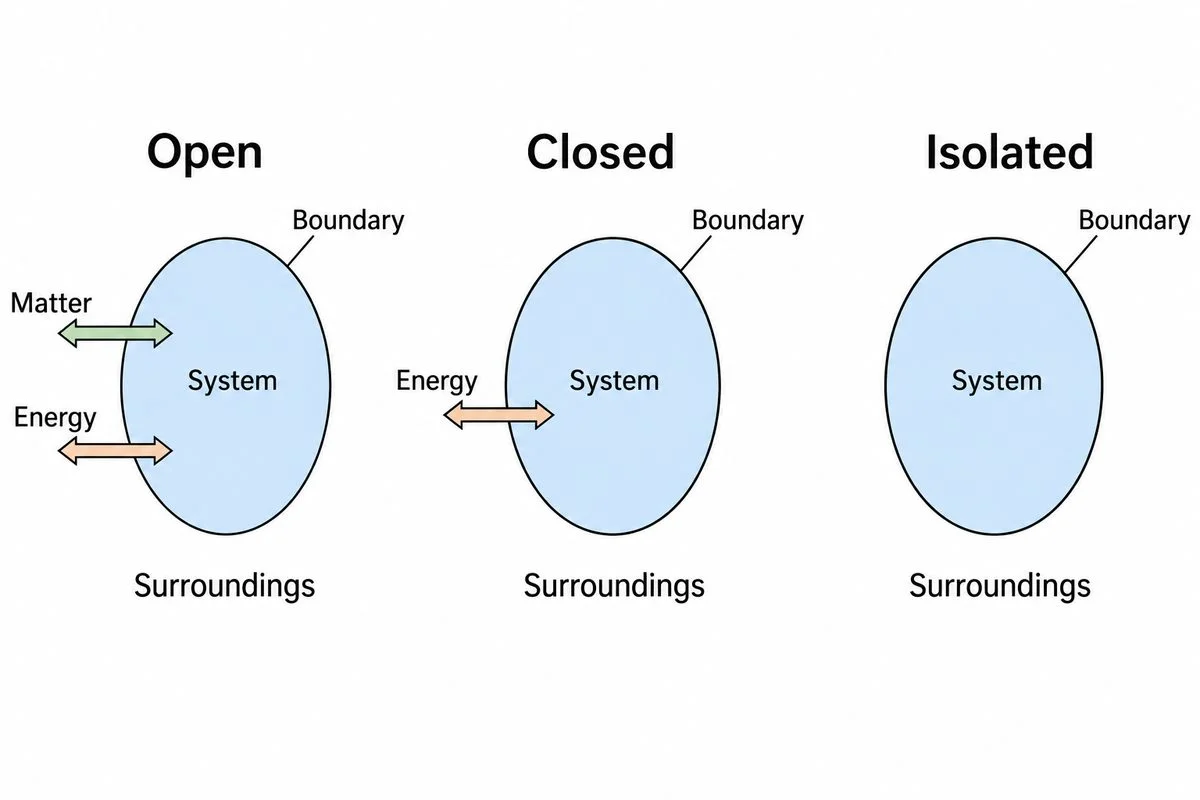
Three system boundaries show whether matter and energy can cross.

1. The system and the surroundings

Choose what to study, then track exchanges across its boundary.

Show
Find each system inside its boundary in the diagram. Follow the matter and energy arrows across.
Ask
Which boundary will keep matter inside while allowing energy to cross?
Say
The closed system keeps matter inside but allows energy exchange.
Used in
A vacuum flask reduces energy exchange, keeping drinks warm longer.
If your child says…“A closed system can let matter escape.”
Ask
Which arrow crosses the closed system’s boundary?
What’s true
A closed system allows energy exchange across its boundary, but no matter exchange.
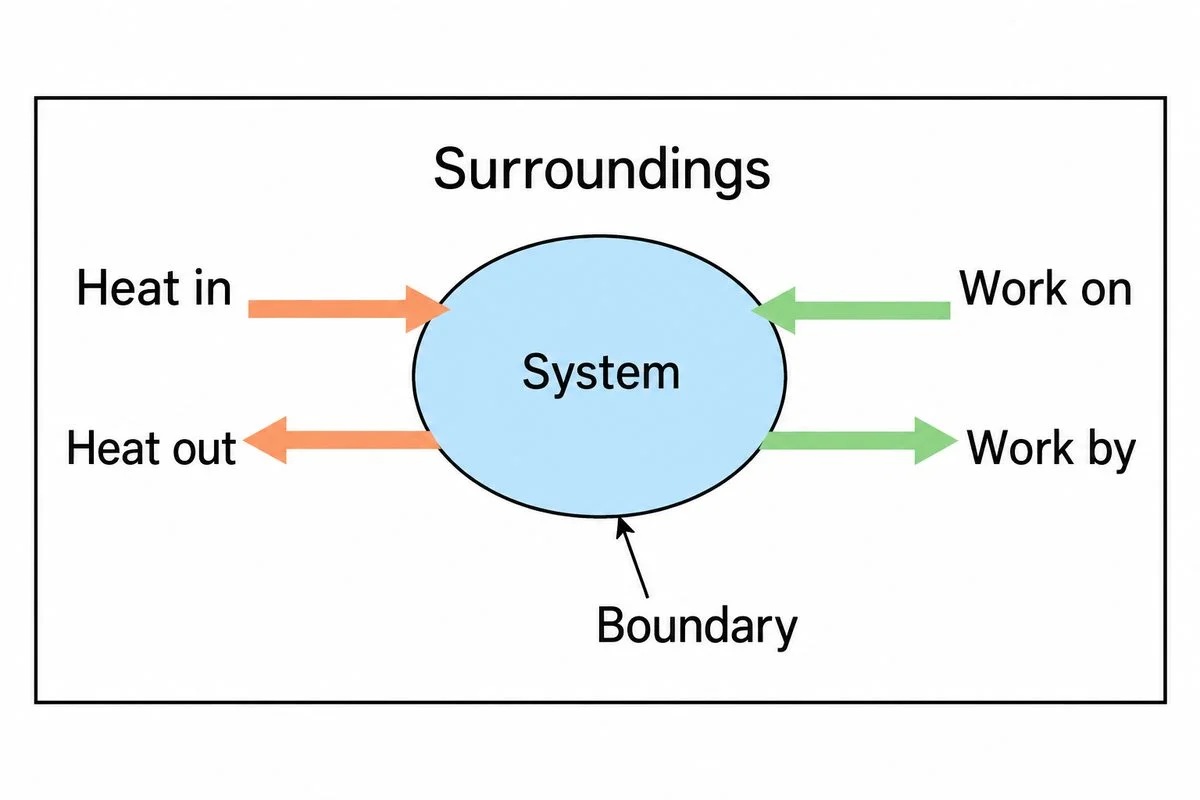
Heat and work arrows show energy entering and leaving a system.

2. Internal energy, work and the first law of thermodynamics

Heat and work change internal energy.

Show
Find the system in the diagram. Trace heat arrows first, then work arrows.
Ask
If energy enters through both inward arrows, what happens to the system’s internal energy?
Say
The system’s internal energy increases. Heat q and work w count positive entering. Their sum gives internal energy change: ΔU=q+w\Delta U=q+w.
Used in
Compressed air powers tools that drive nails.
If your child says…“Expanding gas does work, so its work must be positive.”
Ask
When gas pushes its surroundings, which side receives energy?
What’s true
Expansion against outside pressure transfers energy away from the gas, giving work a negative sign.
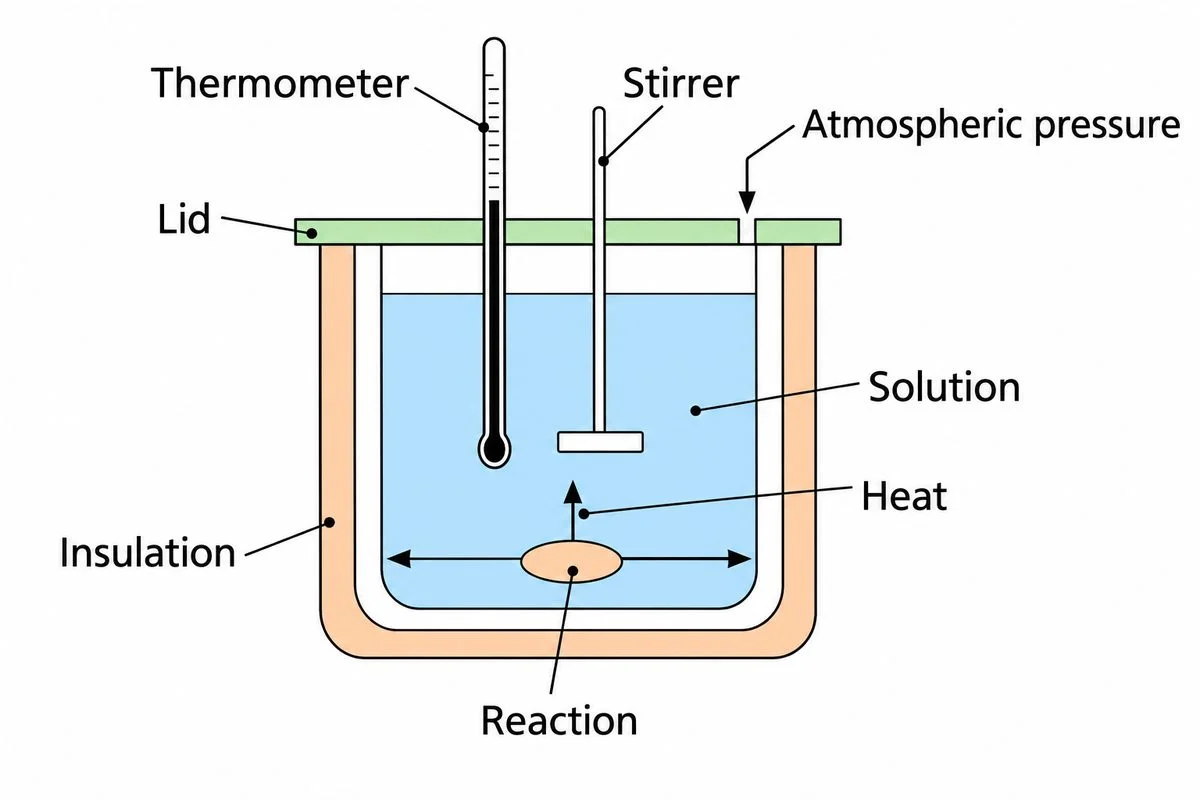
Solution calorimeter shows a thermometer and heat passing into solution and cup walls.

3. Enthalpy and calorimetry

Enthalpy adds pressure times volume to internal energy.

Show
Find the diagram’s thermometer, solution and cup walls. Follow heat from the reaction.
Ask
If this solution and cup warm more, what happens to their combined heat gain?
Say
Their combined heat gain increases as they warm more. Multiply solution mass, specific heat and temperature rise to find its heat gain.
Used in
Calorimeters measure energy released by fuels, helping compare their heating value.
If your child says…“The insulated cup absorbs no heat.”
Ask
If the cup warms too, where does its energy come from?
What’s true
Insulation reduces outside heat exchange, but the cup itself can warm and absorb heat.

Find reaction heat

H2(g)+12O2(g)→H2O(l)\mathrm{H_2(g)+\tfrac12 O_2(g)\rightarrow H_2O(l)}

qp=nΔfH∘[H2O(l)]q_p=n\Delta_{\mathrm f}H^\circ[\mathrm{H_2O(l)}]

qp=(2 mol)(−286 kJ mol−1)q_p=(2\,\mathrm{mol})(-286\,\mathrm{kJ\,mol^{-1}})

4. Thermochemical equations and standard enthalpy of formation

Enthalpy change when a mole forms from elements in reference states.

Show
Write these lines at 298 K and 1 bar. Say that qpq_p means heat absorbed at constant pressure. Here, n counts moles of water formed, and ΔfH∘\Delta_{\mathrm f}H^\circ means standard formation enthalpy.
Ask
What heat change belongs to two moles?
Say
Doubling the amount doubles the heat released: qp=−572 kJq_p=-572\,\mathrm{kJ}.
Used in
Reaction heat values help calculate fuel requirements.
If your child says…“Doubling the reaction leaves its heat change unchanged.”
Ask
If each mole releases heat, where would the second mole's contribution go?
What’s true
The enthalpy change belongs to the stated amount, so doubling that amount doubles the change.
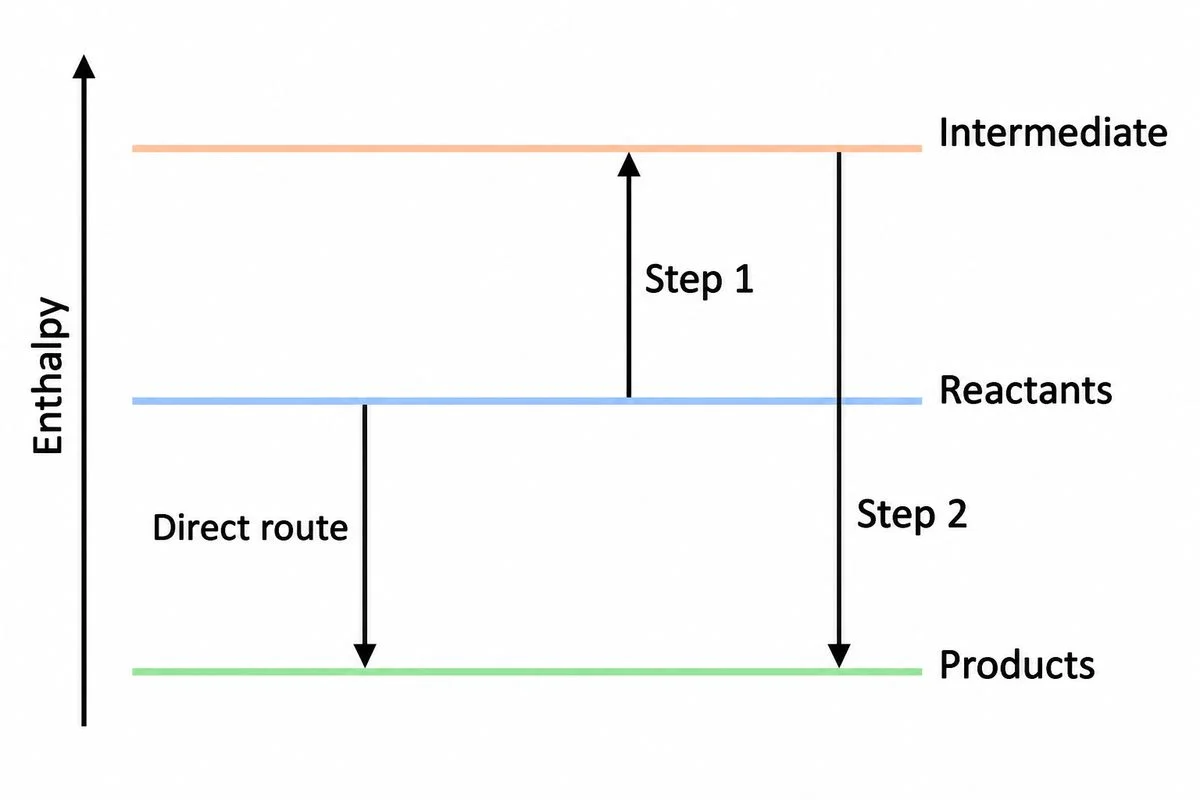
Direct and intermediate reaction routes connect the same initial and final enthalpy levels.

5. Hess’s law of constant heat summation

Different routes between identical states give equal total enthalpy changes.

Show
Find reactants and products in the diagram. Trace the direct route, then both steps through the intermediate.
Ask
If we take the route through this intermediate, will the total enthalpy change differ?
Say
The total enthalpy change will not differ. Both routes span the same difference between starting and finishing enthalpy levels.
Used in
Reaction cycles supply otherwise inaccessible heat values, helping assess industrial reactions.
If your child says…“Different reaction routes must give different total heat changes.”
Ask
Which starting or finishing level changes when you take the route through the intermediate?
What’s true
Identical starting and finishing states give the same enthalpy change, whatever the route.

Predict the direction of change

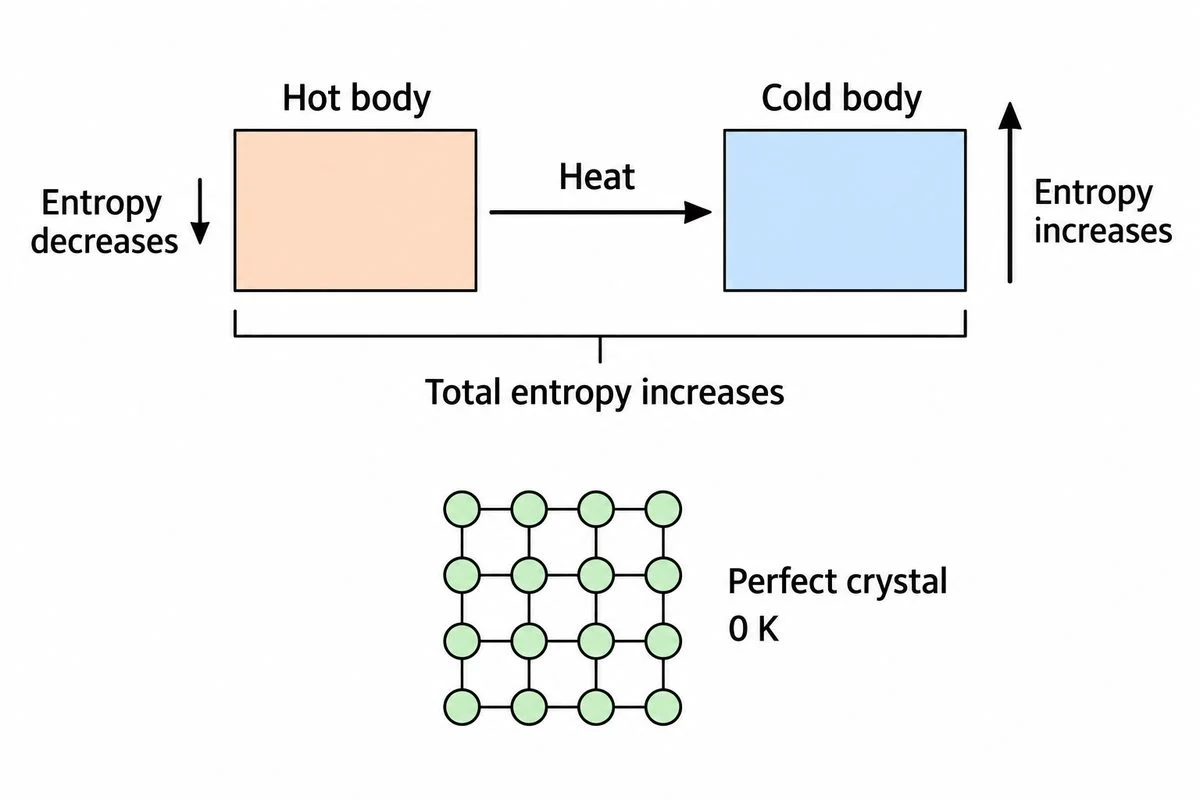
Heat flows hot to cold; entropy gains exceed losses, beside a perfect-crystal inset.

6. Spontaneity, entropy, and the second and third laws

Spontaneous changes increase total entropy of the system and its surroundings.

Show
Follow the diagram’s heat arrow, then compare the entropy arrows. Find the separate perfect-crystal inset.
Ask
Which way will heat flow between these blocks if their combined entropy must increase?
Say
The colder block’s entropy gain exceeds the hotter block’s loss. Increasing combined entropy makes this direction spontaneous. A pure, perfect crystal has zero entropy at 0 K.
Used in
Heat exchangers transfer energy from hotter fluids to colder fluids, recovering useful heat.
If your child says…“Both blocks’ entropy must increase for heat to flow naturally.”
Ask
Which entropy arrow is larger: the gain or the loss?
What’s true
One block’s entropy can decrease while their combined entropy increases.
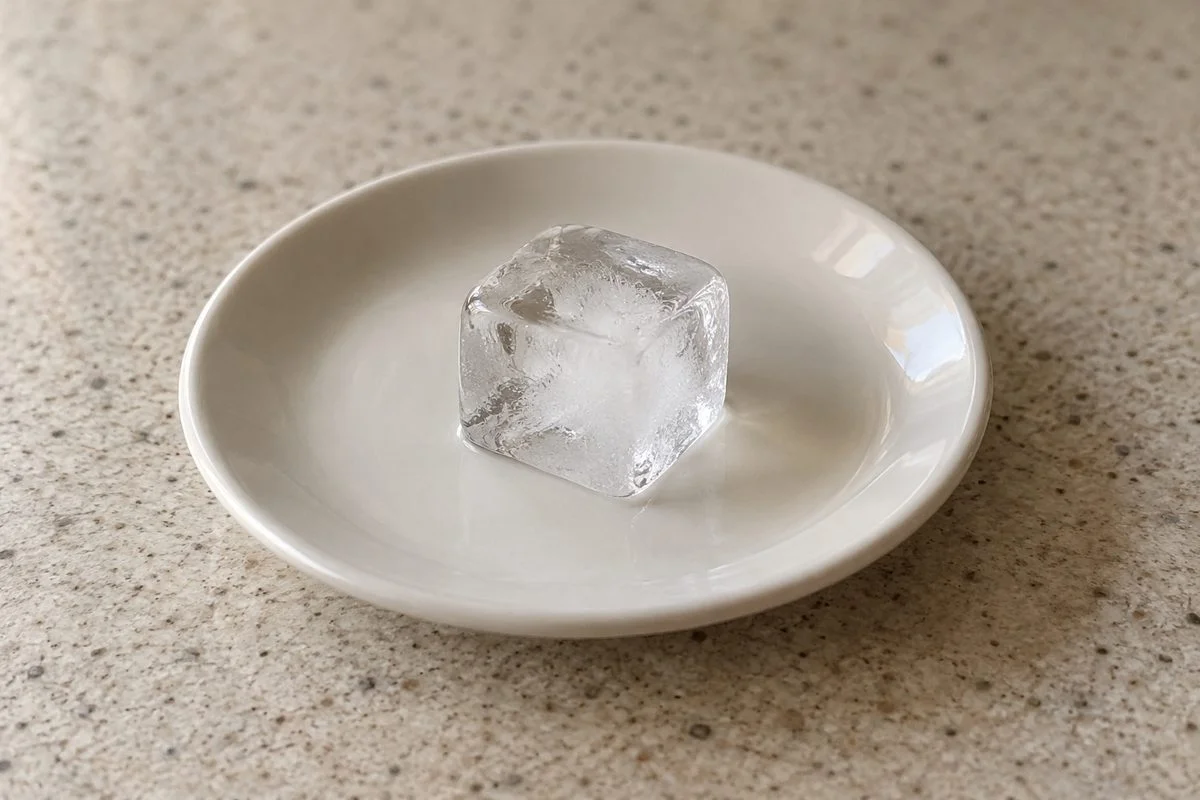
Fresh ice cube on a plain saucer before melting.

7. Gibbs energy and spontaneity

Gibbs energy predicts direction at constant temperature and pressure.

Show
Place an ice cube on a saucer in a room above freezing. Predict, then watch for a puddle. Use kelvin and matching energy units when combining enthalpy and entropy.
Ask
Will the ice melt even though melting needs heat?
Say
Above melting point, ice melts because the entropy contribution outweighs absorbed heat, making melting's Gibbs energy change negative.
Used in
Freezers maintain conditions that favour freezing, keeping food frozen.
If your child says…“A negative Gibbs energy change means equilibrium.”
Ask
If melting is still favoured, has the ice-water system reached equilibrium?
What’s true
At constant temperature and pressure, a negative reaction Gibbs energy change favours the forward change. A zero value means equilibrium.

ΔrG∘=−RTln⁡K\Delta_{\mathrm r}G^\circ=-RT\ln K

ΔrG∘=−(8.314)(298)ln⁡(10) J mol−1\Delta_{\mathrm r}G^\circ=-(8.314)(298)\ln(10)\,\mathrm{J\,mol^{-1}}

ΔrG∘≈−5.70 kJ mol−1\Delta_{\mathrm r}G^\circ\approx-5.70\,\mathrm{kJ\,mol^{-1}}

8. Gibbs energy and equilibrium

At equilibrium, only actual Gibbs energy change must be zero.

Show
Write these lines, naming standard reaction Gibbs energy change. Name gas constant R, kelvin temperature T and equilibrium constant K. Read ln as natural logarithm.
Ask
With this negative standard value, what will the actual change be at equilibrium?
Say
The actual reaction Gibbs energy change is zero because neither direction is favoured. The standard change stays negative here.
Used in
Equilibrium constants help estimate product yield.
If your child says…“The standard Gibbs energy change is zero at every equilibrium.”
Ask
What happens to the logarithm if the equilibrium constant differs from one?
What’s true
The standard change is zero only when the equilibrium constant equals one.

A real problem

The Bessemer process used reaction heat to reduce fuel needs.

Bessemer publicly announced the steelmaking process in 1856.

Carbon oxidation supplied enough heat that the converter needed no extra fuel during its air blow.

The process made large quantities of steel available at affordable prices.

Encyclopædia Britannica via WikisourceScience Museum Group

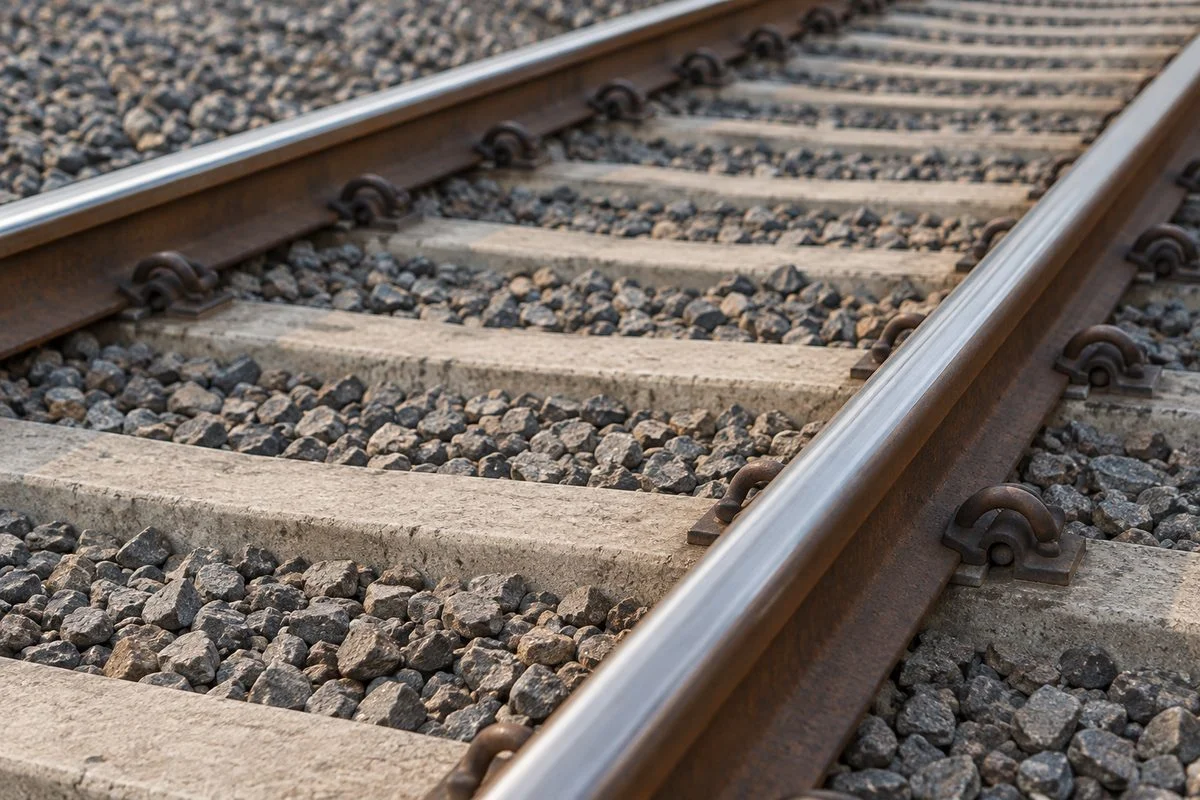
Steel railway tracks resting on sleepers and ballast.

Concept Lab · Common misconception

The tempting mistake in Thermodynamics

Open standalone misconception page →

Does an exothermic reaction always proceed spontaneously?

Wrong

A negative enthalpy change alone guarantees spontaneity.

Why it feels right. Releasing heat sounds like a favourable change.

Right

At constant temperature and pressure, Gibbs energy determines the thermodynamic direction.

Worked example

ΔG in kJ/mol
−10+15
+5
At 300 K, the +15 contribution from −TΔS outweighs the −10 contribution from ΔH.

If ΔH = −10 kJ/mol and ΔS = −50 J/(mol K), at 300 K the change ΔG = −10 + 15 = +5 kJ/mol.

Ask your child eight quick questions.

One per step. The answer and the reason are given.

  1. A sealed vessel loses heat without leaking. Which type of system is it?

    A closed system. Energy crosses its boundary, but matter stays inside.

  2. What sign does work have when gas expands against outside pressure?

    Negative. The gas transfers energy to its surroundings through work.

  3. Besides the solution, what absorbs heat when this calorimeter warms?

    The calorimeter itself. Its walls and parts also gain energy as their temperature rises.

  4. What happens to the heat released when the amount reacting doubles?

    It doubles. Each additional mole contributes the same heat under the same conditions.

  5. What happens to total enthalpy change when only the reaction route changes?

    It stays the same. The initial and final states determine the enthalpy change.

  6. Whose entropy decreases as heat passes between these blocks?

    The hotter block’s entropy. The colder block’s entropy gain exceeds the entropy lost by the hotter block.

  7. What is melting's Gibbs energy change at ice-water equilibrium?

    Zero. Neither melting nor freezing is favoured over the other at equilibrium.

  8. At equilibrium with K greater than one, which Gibbs energy change is zero?

    The actual change. The standard change is negative because the logarithm of K is positive.

15 more questions with answers