Skip to content

Teach Redox Reactions in eight steps.

For each idea: show it, ask before you tell, then say one line.

Gather paper and a pencil; find an existing rusty iron railing.

Common misconceptions & worked visual for this chapter · 15 practice questions with answers

How to teach it

Recognising redox

Rusty patch beside intact paint on an iron railing.

1. Oxidation and reduction

Electron loss and electron gain occur together, sometimes within one substance.

Show
Look at a rusty patch beside painted iron. Say: “Iron has combined with oxygen and lost electrons.”
Ask
If iron loses electrons, what must another substance do?
Say
Oxygen gains electrons and is reduced.
Used in
Protective coatings slow rusting, helping iron gates last longer.
If your child says…“Iron can lose electrons without anything gaining them.”
Ask
Where would the electrons leaving iron go?
What’s true
Electron transfer needs both a giver and a receiver.

3x+4(−2)=03x+4(-2)=0

x=+83x=+\frac{8}{3}

2. Oxidation number and Stock notation

Electron bookkeeping values can differ between atoms of the same element.

Show
Write these lines for iron(II,III) oxide. Say: “Oxygen gets −2; x is iron’s average oxidation number.”
Ask
Does each iron have this fractional value?
Say
No. One iron at +2 and two at +3 balance four oxygens at −2. The Roman numerals name iron’s oxidation states.
Used in
Stock names identify metal compounds on laboratory bottles.
If your child says…“Every iron atom has the average value.”
Ask
Which of +2 and +3 equals the calculated average?
What’s true
The fractional average combines whole-number assignments; it does not mean pieces of electrons were transferred.
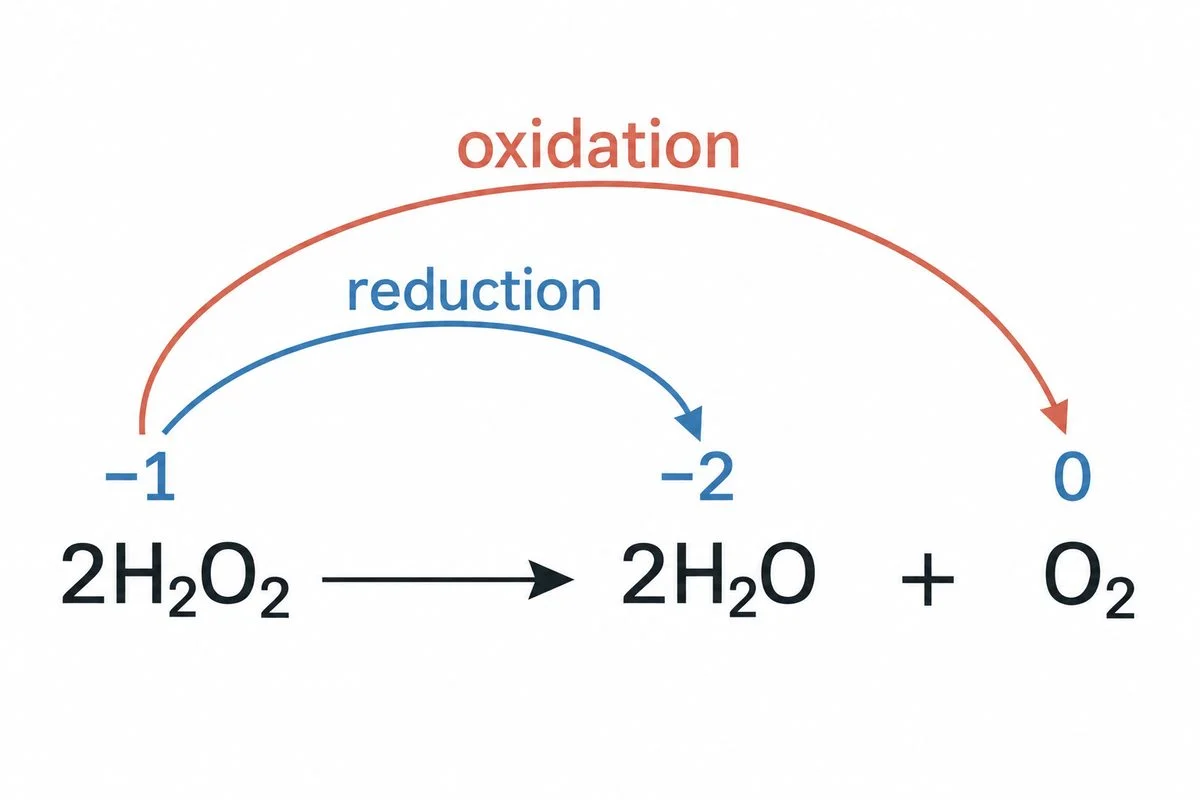
Peroxide oxygen changes from −1 to −2 in water and zero in oxygen gas.

3. Types of redox reactions: disproportionation

One starting oxidation state changes both upwards and downwards.

Show
Look at the diagram’s peroxide on the left. Follow oxygen’s −1 along both arrows to the product values.
Ask
From oxygen’s starting value of −1, can peroxide act as both oxidant and reductant?
Say
Oxygen falls from −1 to −2 in water and rises to zero in oxygen gas. Peroxide acts as both oxidising agent and reducing agent.
Used in
Hydrogen peroxide’s oxidising action helps bleach coloured stains.
If your child says…“Disproportionation needs two different elements.”
Ask
Did hydrogen change, or did oxygen reach two different states?
What’s true
One element changes both ways; its starting state must allow a rise and a fall.

Balancing electron transfer

Copper rises by two.

Each silver falls by one.

Two silver ions are needed.

4. Oxidation number method

Balance the total oxidation-number rise against the total fall.

Show
Write these lines. Say: “Compare copper’s oxidation-number rise with each silver ion’s fall.”
Ask
What balanced equation matches one copper atom’s electron loss with silver ions’ electron gain?
Say
Two silver ions accept the two electrons copper releases: Cu+2Ag+→Cu2++2Ag\mathrm{Cu+2Ag^+\rightarrow Cu^{2+}+2Ag}. Both sides have charge +2 and matching atom counts.
Used in
Balanced equations help calculate metal recovery without wasting reagents.
If your child says…“The electrons lost and gained need not match.”
Ask
Can one silver ion accept both electrons released by copper here?
What’s true
Every transferred electron needs a receiver, so the totals must match.

Fe2+→Fe3++e−\mathrm{Fe^{2+}\rightarrow Fe^{3+}+e^-}

Cl2+2e−→2Cl−\mathrm{Cl_2+2e^-\rightarrow 2Cl^-}

2Fe2+→2Fe3++2e−\mathrm{2Fe^{2+}\rightarrow 2Fe^{3+}+2e^-}

5. Half-reaction method

Balance each half’s atoms and charge before combining equal electron transfers.

Show
Write these lines. Say: “Iron(II) loses electrons; chlorine gains them. The third line doubles iron’s half-reaction.”
Ask
What equation remains when equal electron losses and gains cancel?
Say
Iron(II) ions supply the two electrons chlorine consumes: Cl2+2Fe2+→2Cl−+2Fe3+\mathrm{Cl_2+2Fe^{2+}\rightarrow 2Cl^-+2Fe^{3+}}. The combined equation conserves atoms and charge.
Used in
Half-reactions help calculate chemical amounts needed to treat oxidisable pollutants in wastewater.
If your child says…“Reduction puts electrons on the product side.”
Ask
Which half-reaction uses the electrons that iron releases?
What’s true
Reduction consumes electrons, so they belong with the reactants.

Measuring and using redox

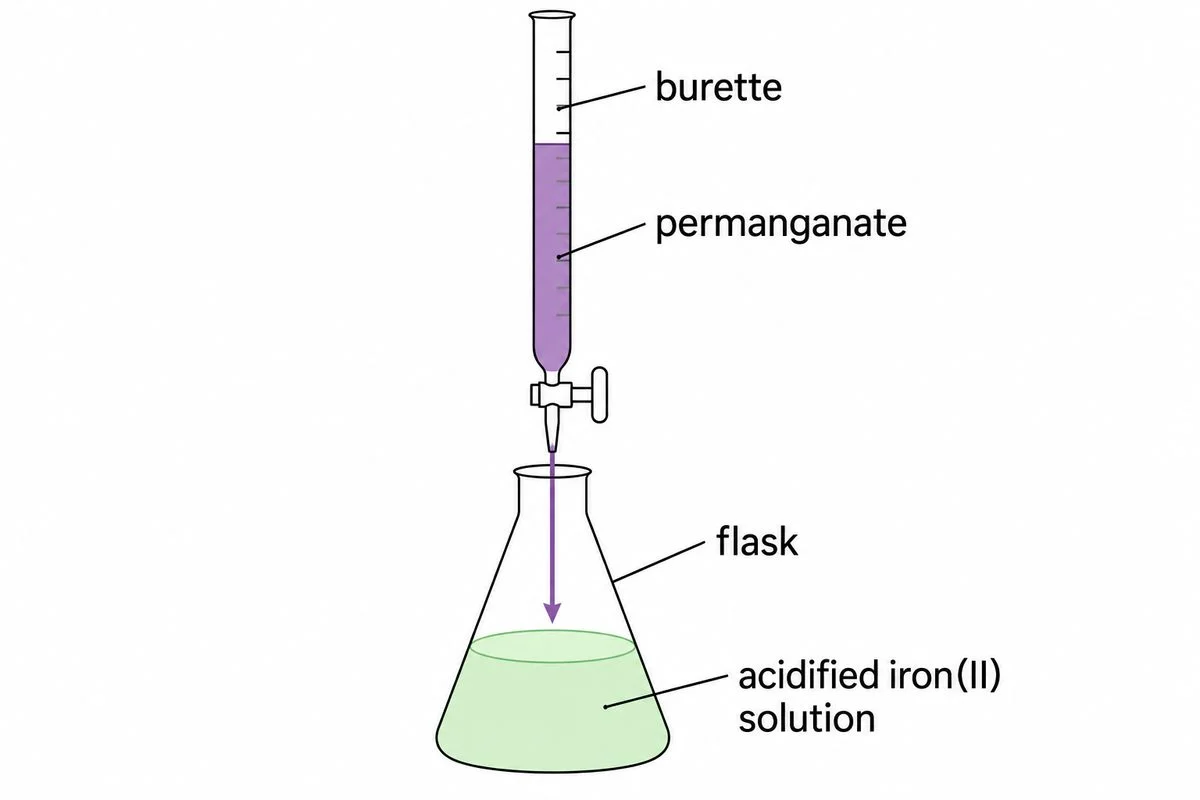
Burette containing permanganate above a flask of acidified iron(II) solution.

6. Redox reactions as the basis for titrations

A colour signal helps measure how much substance has reacted.

Show
Find the burette and flask in the diagram. Say: “Permanganate is added to acidified iron(II) solution.”
Ask
Will the next drop’s pink colour disappear after all the iron(II) has reacted?
Say
No. Lasting faint pink signals a little excess permanganate.
Used in
Redox titrations measure iron content, helping check a sample’s composition.
If your child says…“The colour means exactly enough permanganate was added.”
Ask
What leaves the pink colour when no iron(II) remains to react?
What’s true
Equivalence means the exact reacting ratio; the visible endpoint can require a small excess.
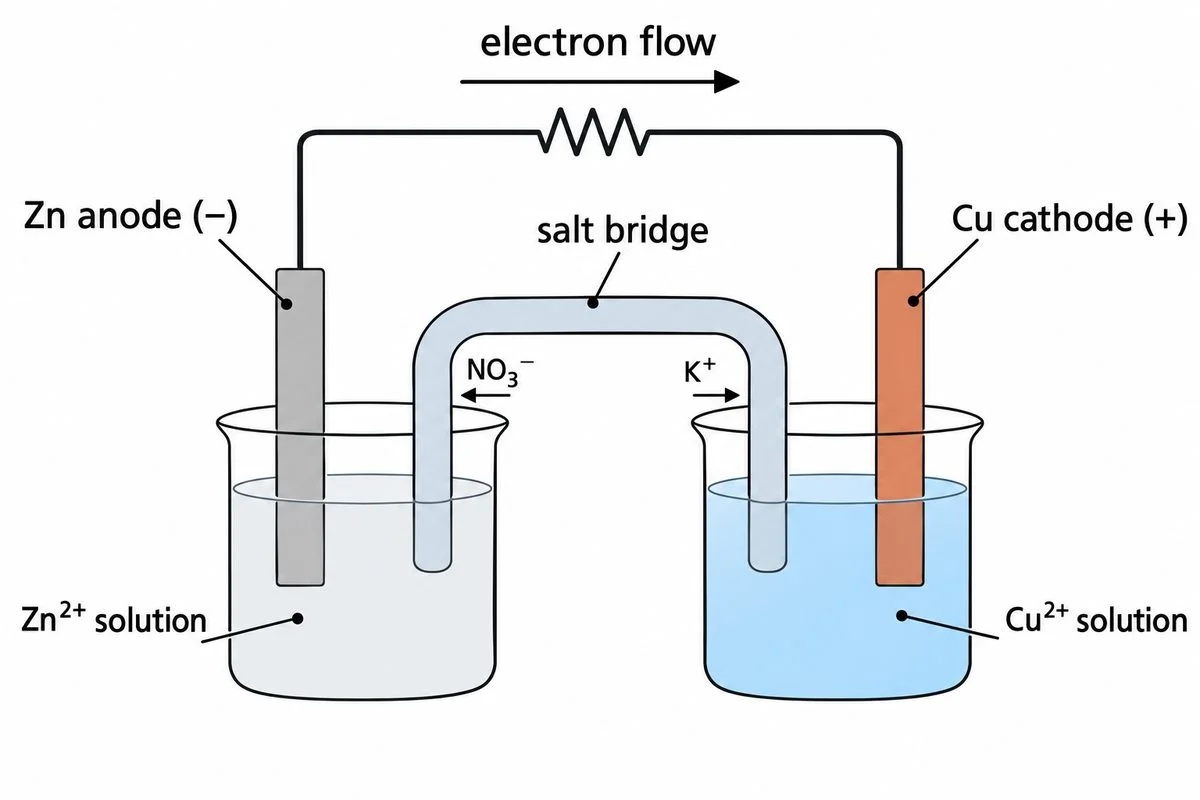
Daniell cell with separate arrows for electrons in the wire and ions in the bridge.

7. Redox reactions and electrode processes

Separate electron and ion paths let a cell supply current.

Show
Look at the diagram’s zinc electrode on the left, then copper on the right. Follow the wire arrow, then the arrows through the salt bridge.
Ask
Will the wire alone keep current flowing if the salt bridge is removed?
Say
Zinc releases electrons that copper ions receive through the wire. Bridge ions prevent charge buildup, so removing the bridge stops sustained current.
Used in
A torch switch breaks the circuit, preserving its cell.
If your child says…“Electrons can go through the salt bridge instead.”
Ask
Which particles follow the arrows through the bridge?
What’s true
Ions carry charge through the bridge; electrons travel along the external wire.
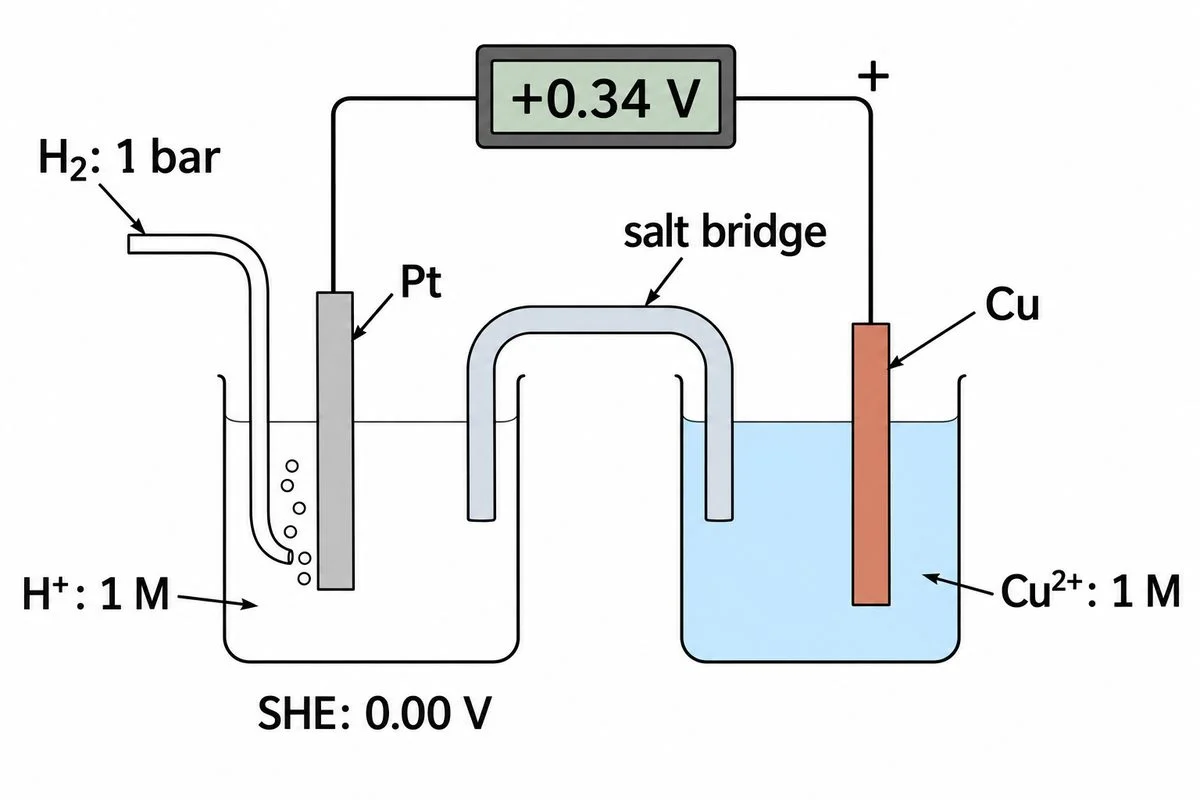
Copper half-cell connected to a hydrogen reference electrode and a voltmeter reading +0.34 V.

8. Standard electrode potential

Standard reduction potentials compare electron acceptance against a common reference.

Show
Look at the diagram’s hydrogen electrode, then copper and the voltmeter’s positive terminal. Read the meter. Say: “M means moles per litre; both half-cells are at 298 K.”
Ask
What potential can we assign copper when the hydrogen reference is set to zero?
Say
Copper’s standard reduction potential is +0.34 V because the hydrogen reference is assigned zero.
Used in
Comparing potentials helps select battery materials for useful voltage.
If your child says…“A more negative potential means stronger electron acceptance.”
Ask
With copper positive against hydrogen, which side accepts electrons in this cell?
What’s true
A more positive reduction potential indicates stronger electron acceptance under standard conditions.

A real problem

The Daniell cell avoided a cause of battery inefficiency.

John Frederic Daniell invented this cell in 1836.

It avoided efficiency loss caused by hydrogen collecting at a battery’s positive terminal.

As current flows, zinc dissolves and copper ions become copper metal.

Science Museum GroupBergamo Science MuseumUniversity of Malta

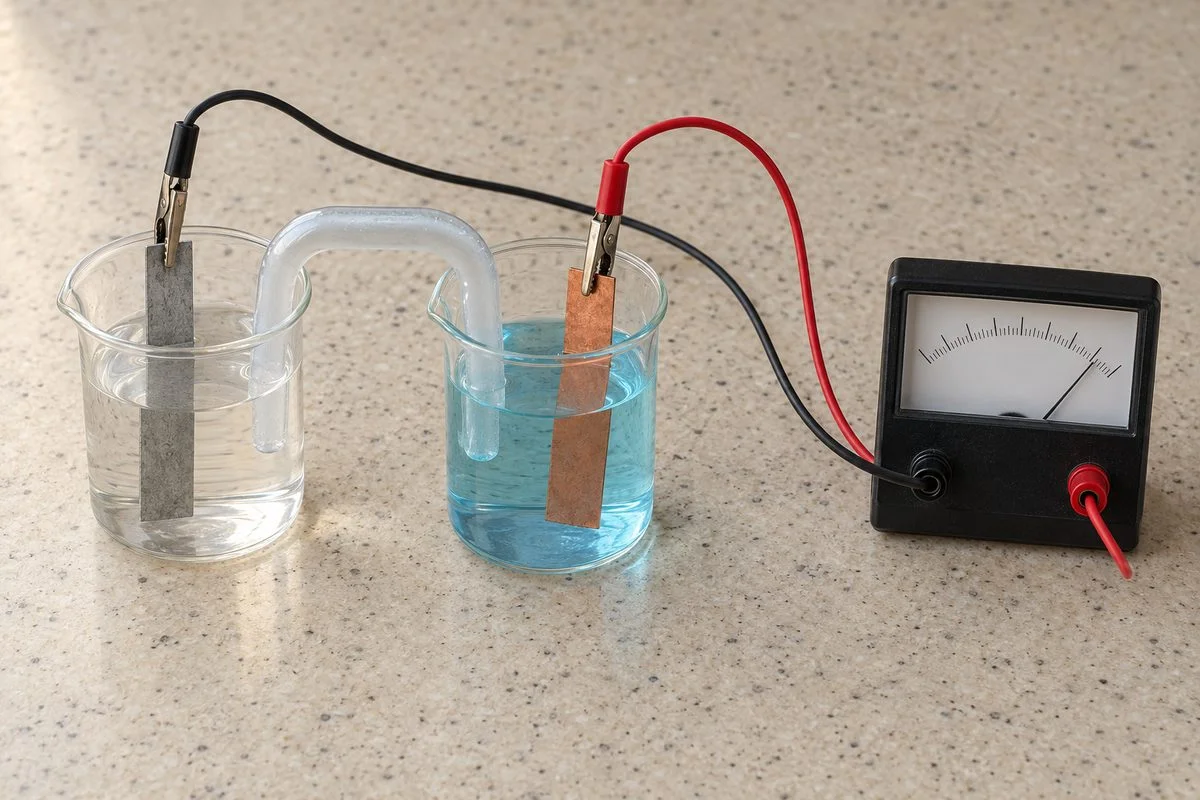
Copper-and-zinc laboratory cell connected to a meter.

Concept Lab · Common misconception

The tempting mistake in Redox Reactions

Open standalone misconception page →

Can something be oxidised without oxygen?

Wrong

Sodium cannot be oxidised in a reaction with chlorine because there is no oxygen.

Why it feels right. I recognise the oxygen in the word oxidation.

Right

Oxidation involves loss of electrons or an increase in oxidation number.

Worked example

Sodium
Na · oxidation number 0→Loses one electron per atom→Na⁺ · oxidation number +1
The sodium oxidation number rises even though the reaction uses chlorine and no oxygen.
  1. In 2Na + Cl₂ → 2NaCl, each sodium atom loses an electron and its oxidation number rises from 0 to +1.
  2. This is oxidation in an oxygen-free reaction.

Ask your child eight quick questions.

One per step. The answer and the reason are given.

  1. Which redox change does oxygen undergo during rusting?

    It is reduced. Receiving electrons is reduction, paired with iron’s electron loss.

  2. What does III tell you in iron(III)?

    Iron’s oxidation state is +3. The Roman numeral gives an oxidation state, rather than an atom count.

  3. Which element is both oxidised and reduced here?

    Oxygen. Its oxidation number falls in water and rises in oxygen gas.

  4. How many silver ions receive the electrons released by one copper atom here?

    Two silver ions. Copper releases two electrons, while each silver ion accepts one.

  5. Besides atoms, which electrical quantity must balance?

    Total charge. A balanced reaction conserves electrical charge as well as atoms.

  6. What causes the first lasting faint pink colour?

    A slight excess of permanganate. The iron(II) has been consumed, leaving some coloured permanganate unreacted.

  7. Which particles carry charge through a Daniell cell’s salt bridge?

    Ions. The bridge conducts by ion movement, while the external wire carries electrons.

  8. Which accepts electrons here: copper ions or hydrogen ions?

    Copper ions. Copper’s more positive reduction potential favours its reduction under these standard conditions.

15 more questions with answers