Skip to content

Teach Some Basic Concepts of Chemistry in eight steps.

For each idea: show it, ask before you tell, then say one line.

Gather ice, a bowl, a plate, a ruler, paper, pencils, rice, chickpeas, glasses, a jug, a spoon, cooled tea and water.

Taste nothing used in these activities. Use only cooled tea.

Common misconceptions & worked visual for this chapter · 15 practice questions with answers

How to teach it

Matter and measurement

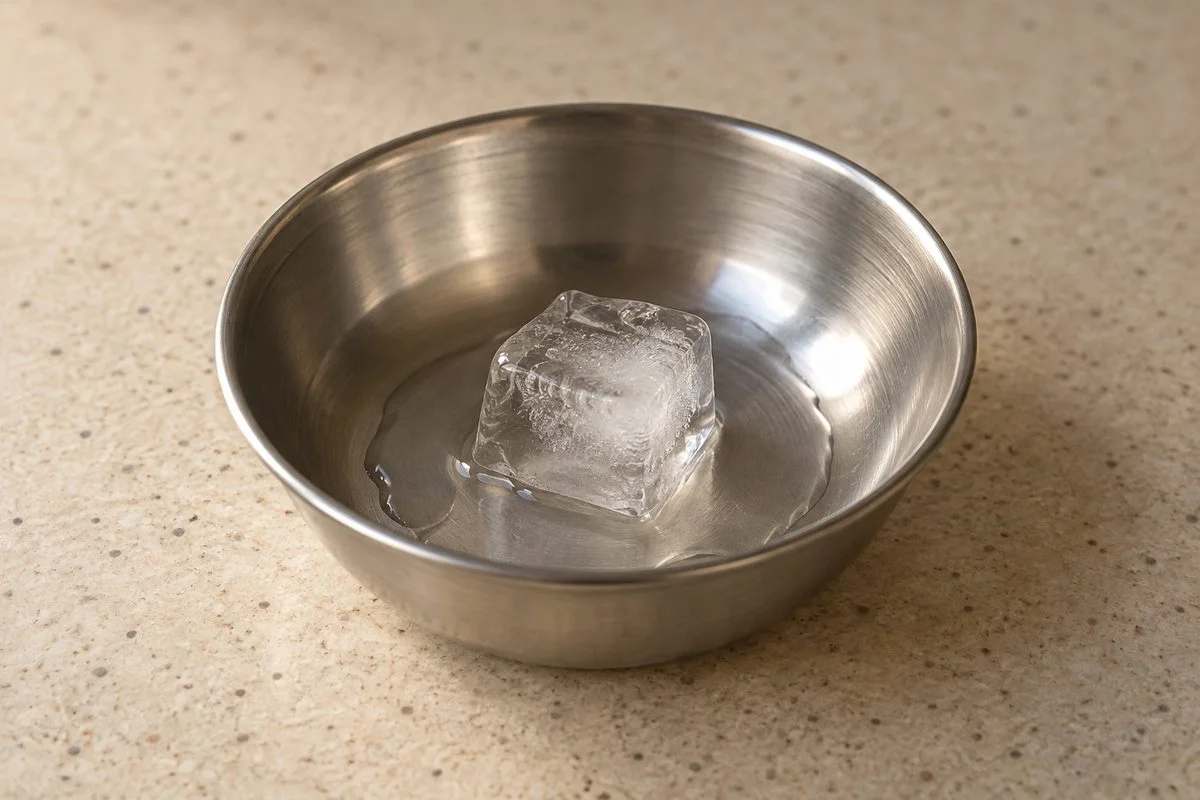
Partly melted ice cube surrounded by water in a steel bowl.

1. Nature of Matter

Chemistry studies matter, its properties and its changes.

Show
Put an ice cube in a bowl. Let a puddle form. After the prediction, tilt the bowl gently.
Ask
Will melting the remaining ice make a different substance?
Say
Both are water, a compound: melting changes its state.
Used in
Melting and casting let metalworkers change a metal's shape without changing its chemical identity.
If your child says…“Liquid particles are close together, so liquids should keep their shape.”
Ask
Which keeps its shape when we tilt the bowl: the ice or the water?
What’s true
Movement matters too: nearby liquid particles can move past each other.
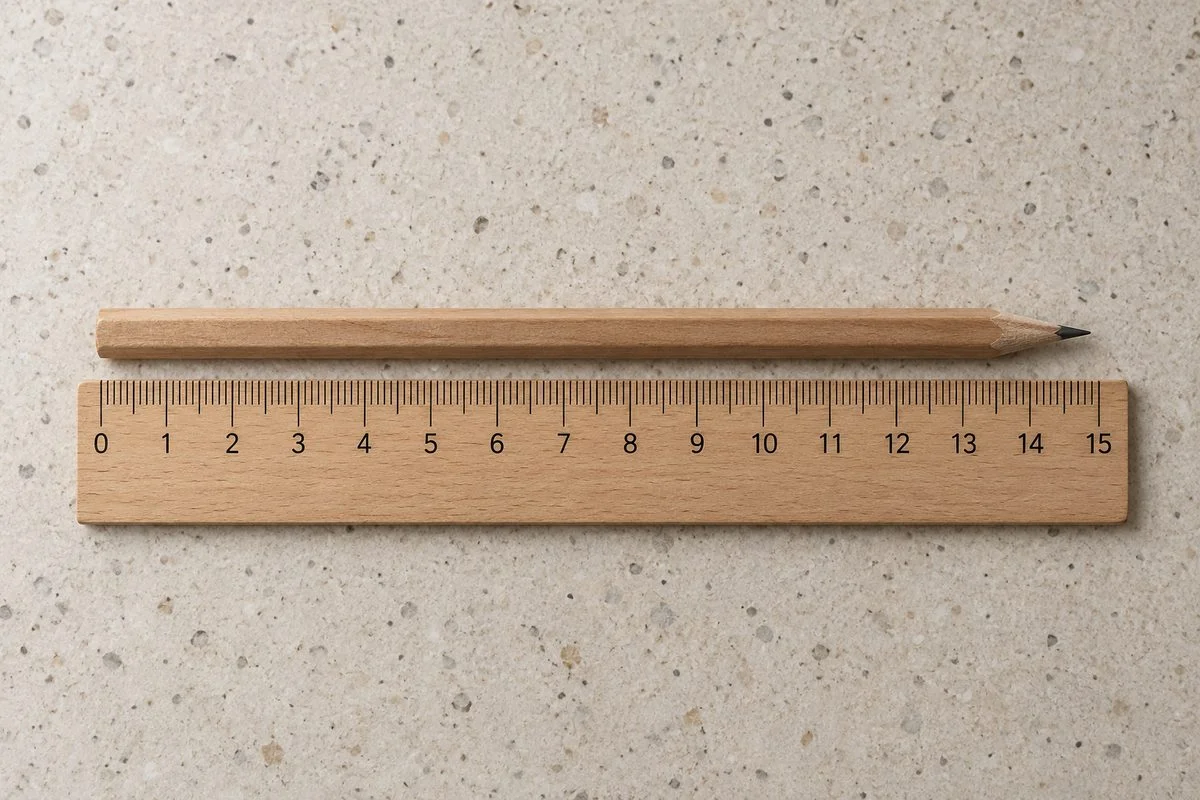
Pencil aligned with the start of a ruler's measuring scale.

2. Properties of Matter and Their Measurement; Uncertainty in Measurement

Length measurements need numbers, units and digits supported by the ruler.

Show
Align a pencil with the ruler's zero. Read the millimetre marks, then estimate one extra digit between adjacent marks. Measure twice and record the units. Read the length in centimetres and millimetres.
Ask
Will matching readings guarantee that the ruler is accurate?
Say
Matching readings show precision; accuracy needs comparison with a trusted value. Changing units changes the number, not the pencil's length.
Used in
Medicine makers measure ingredient amounts to keep each batch consistent.
If your child says…“Our readings agree, so they must be accurate.”
Ask
Would repeating a measurement reveal that the ruler's markings were stretched?
What’s true
A faulty ruler can give matching readings that all miss the true length.

Atoms, masses and counting

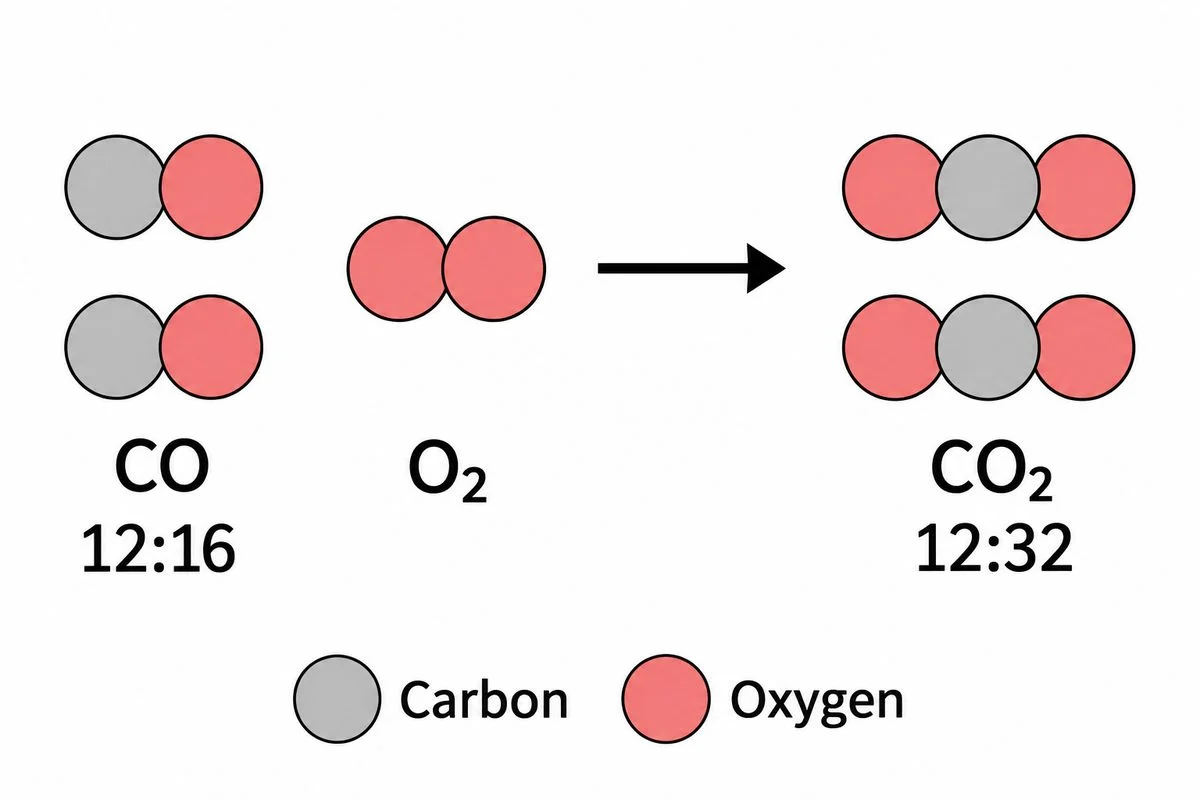
Carbon monoxide and oxygen form carbon dioxide, conserving atoms while oxygen per carbon doubles.

3. Laws of Chemical Combinations and Dalton’s Atomic Theory

Atoms rearrange, preserving total mass and giving compounds fixed proportions.

Show
In the diagram, count atoms across the arrow. Compare the carbon-to-oxygen mass ratios below.
Ask
Will regrouping these atoms change their total mass?
Say
Every atom remains, preserving total mass. Fixed atom ratios give each compound fixed mass proportions.
Used in
Factories track incoming and outgoing mass to detect losses.
If your child says…“Keeping the same total mass means the reactants must stay unchanged.”
Ask
Which changed here: the atoms present or their groupings?
What’s true
Reactants become products while the total mass of a closed reaction stays unchanged.

Average atomic mass≈(0.75×35+0.25×37) u\text{Average atomic mass}\approx(0.75\times35+0.25\times37)\,\mathrm{u}

Average atomic mass≈35.5 u\text{Average atomic mass}\approx35.5\,\mathrm{u}

4. Atomic and Molecular Masses

Atomic-scale masses account for atom identity, count and isotope abundance.

Show
Write these lines. Say, 'This rounded chlorine sample contains 75% chlorine-35 and 25% chlorine-37.'
Ask
What average mass follows for a two-atom chlorine molecule?
Say
It is 71.0 u: add both atoms' average contributions. More abundant isotopes influence the average more.
Used in
Water testing uses molar masses to convert moles into grams.
If your child says…“Just average the two isotope masses equally.”
Ask
Would equal weighting reflect the larger share of chlorine-35 atoms?
What’s true
Each isotope contributes according to its share of the atoms.
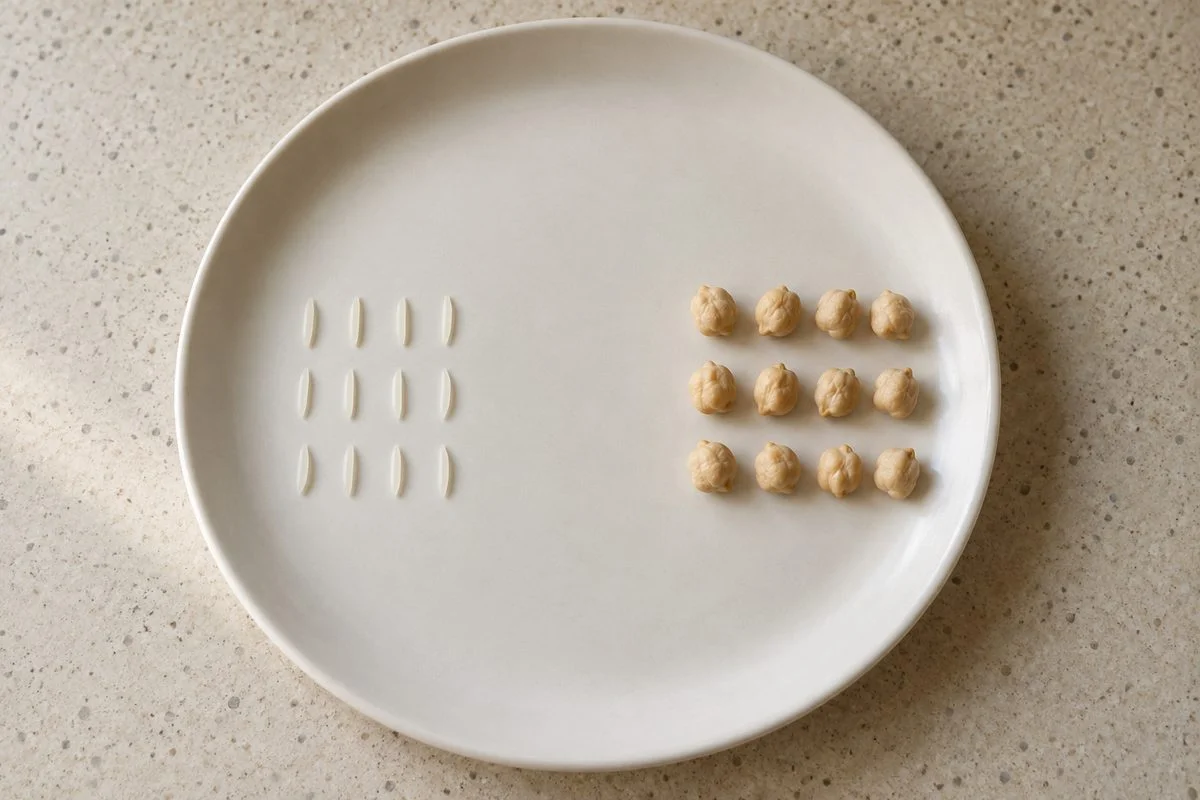
Separate groups of twelve rice grains and twelve chickpeas.

5. Mole Concept and Molar Masses

A mole fixes a particle count; its mass depends on identity.

Show
Count twelve rice grains and twelve chickpeas into separate groups. Say, 'These are dozens, not moles.'
Ask
Will equal counts make these groups equal in mass?
Say
Equal counts do not make these groups equal in mass. A dozen fixes the count.
Used in
Fertiliser production uses mole ratios to combine reacting substances in suitable amounts.
If your child says…“A mole always weighs the same.”
Ask
Does counting chickpeas and rice equally make their individual masses equal?
What’s true
Equal particle counts can have different masses because the particles differ.

Composition and reacting amounts

Water molar mass=(2×1+16) g mol−1\text{Water molar mass}=(2\times1+16)\,\mathrm{g\,mol^{-1}}

Hydrogen mass percentage=218×100%\text{Hydrogen mass percentage}=\dfrac{2}{18}\times100\%

6. Percentage Composition; Empirical and Molecular Formula

Convert percentages to mole ratios. Molar mass determines the formula's multiplier.

Show
Write these lines using rounded atomic masses: hydrogen 1 u, oxygen 16 u.
Ask
What percentage completes the calculation?
Say
Hydrogen supplies about 11.1% of water's mass. Divide its contribution by the whole mass.
Used in
Measured composition helps laboratories detect unwanted material in chemicals.
If your child says…“The simplest ratio always tells us the whole molecule.”
Ask
Does a simplest ratio alone tell us how many atoms the entire molecule contains?
What’s true
The molecular formula multiplies the empirical formula's atom counts to match the molar mass.

2H2(g)+O2(g)→2H2O(l)2\mathrm{H_2(g)}+\mathrm{O_2(g)}\rightarrow2\mathrm{H_2O(l)}

Maximum water=22×2 mol\text{Maximum water}=\dfrac{2}{2}\times2\,\mathrm{mol}

7. Stoichiometry and Stoichiometric Calculations; Limiting Reagent

Balanced mole ratios identify what runs out and the maximum product.

Show
Say, 'Start with two moles each of hydrogen and oxygen, which react to form water.' Here, g means gas and l means liquid. Then write this line. Count atoms on both sides.
Ask
What maximum amount of water completes the next line?
Say
At most 2 mol water forms; hydrogen runs out, leaving 1 mol oxygen.
Used in
Factories use reacting ratios to reduce leftovers and predict output.
If your child says…“A finished reaction uses up every reactant.”
Ask
How much oxygen does the equation require for our hydrogen supply?
What’s true
The balanced equation gives mole ratios, so equal starting amounts need not be consumed equally.
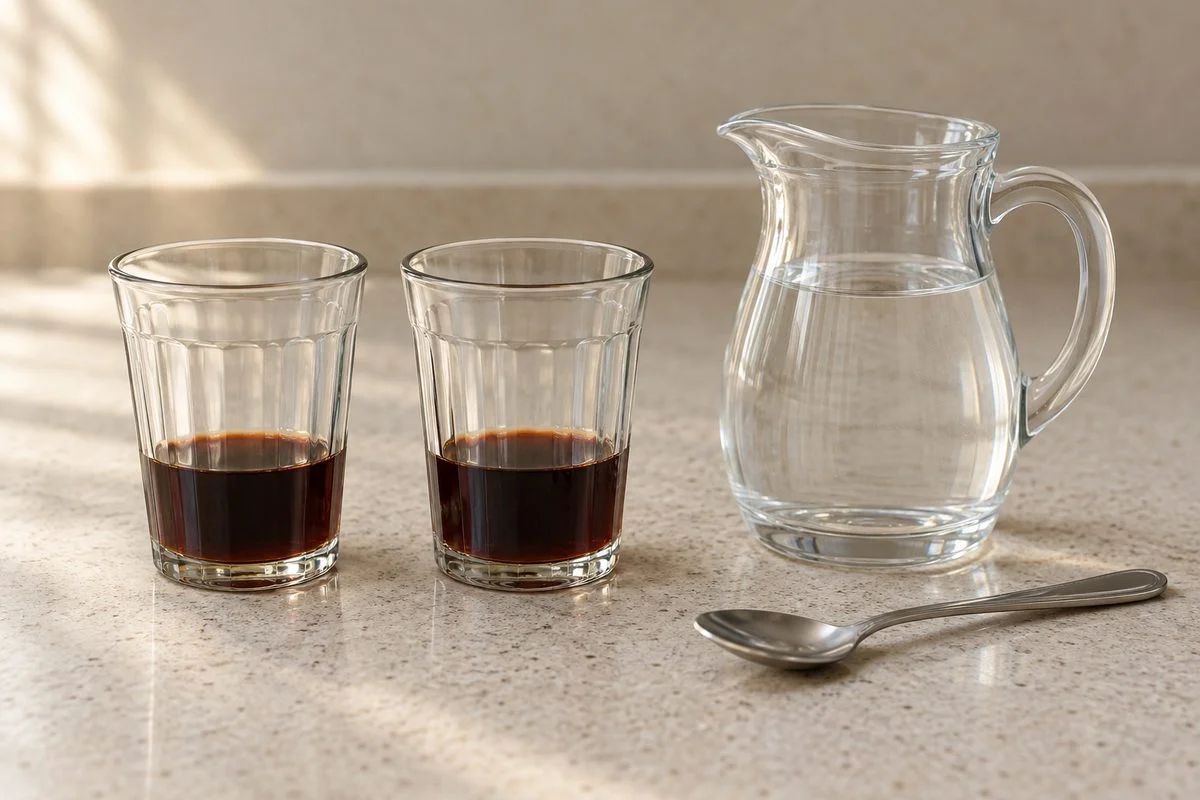
Equal amounts of black tea in identical glasses beside water and a spoon.

8. Reactions in Solutions

Concentration compares a solute amount with a mixture or solvent amount.

Show
Put equal spoonfuls of cooled tea in identical glasses. After predicting, dilute one with water; stir.
Ask
Will adding water remove dissolved material?
Say
Adding only water keeps the dissolved amount constant.
Used in
Diluting concentrated squash spreads its dissolved ingredients through more liquid, making a weaker drink.
If your child says…“Adding water leaves less dissolved material.”
Ask
What dissolved material left the glass when we added only water?
What’s true
Adding only water lowers concentration without changing the amount of dissolved material already present.

A real problem

An improvised adapter made extra carbon-dioxide removal chemicals usable.

Apollo 13 launched on April 11, 1970.

The lunar lander lacked enough lithium hydroxide canisters to remove the crew's exhaled carbon dioxide.

An improvised adapter let the crew use additional canisters from the command module.

PBS NOVAWikipediaNASA

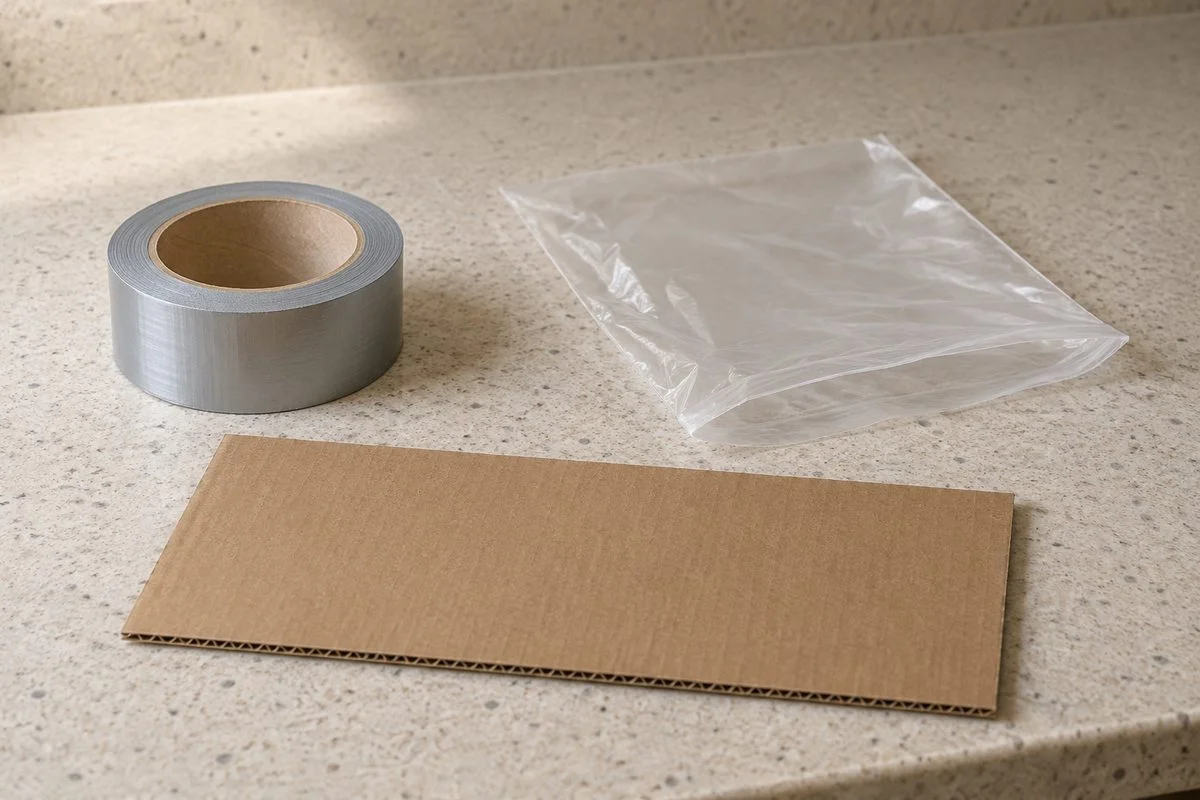
Duct tape, a plastic bag and cardboard arranged on a workbench.

Concept Lab · Common misconception

The tempting mistake in Some Basic Concepts of Chemistry

Open standalone misconception page →

Do equal masses contain equal numbers of molecules?

Wrong

18 g of water and 18 g of CO₂ contain the same number of molecules.

Why it feels right. The samples have the same mass on a scale.

Right

The number of molecules depends on the amount in moles, which is mass divided by molar mass.

Worked example

H₂O6.02 × 10²³
CO₂2.46 × 10²³
Both samples weigh 18 g. The water sample has about 2.4 times as many molecules.
  1. 18 g of water is about 1 mol, or about 6.02 × 10²³ molecules.
  2. 18 g of CO₂ is about 18 ÷ 44 = 0.41 mol, or about 2.46 × 10²³ molecules.

Ask your child eight quick questions.

One per step. The answer and the reason are given.

  1. Why can the water change shape while the ice keeps its shape?

    Liquid particles move past neighbours. Close spacing alone does not determine whether matter keeps its shape.

  2. A stretched ruler gives matching readings. What do those readings show?

    Precision, without guaranteed accuracy. Repeating the same error can give closely agreeing measurements.

  3. How does total mass before the arrow compare with total mass after it?

    It stays the same. All the original atoms remain, although their groupings change.

  4. Which isotope contributes more to this sample's average atomic mass?

    Chlorine-35. Its greater abundance gives it more weight in the average.

  5. Why can equal molecule counts of water and carbon dioxide have different masses?

    Their molecules have different masses. Equal counts give equal total masses only when the individual entities have equal masses.

  6. What extra measurement identifies the molecular formula from an empirical formula?

    The molar mass. It determines which whole-number multiple gives the molecule's actual atom counts.

  7. After all this hydrogen reacts, how much oxygen remains?

    1 mol oxygen. The equation requires only 1 mol oxygen for 2 mol hydrogen.

  8. What happens to the amount of dissolved material when only water is added?

    It stays the same. Water increases the solution volume without removing the dissolved material.

15 more questions with answers