Skip to content

Teach Amines in five steps.

For each idea: show it, ask before you tell, then say one line.

Gather paper and a pencil.

Common misconceptions & worked visual for this chapter · 15 practice questions with answers

How to teach it

Recognise and prepare amines

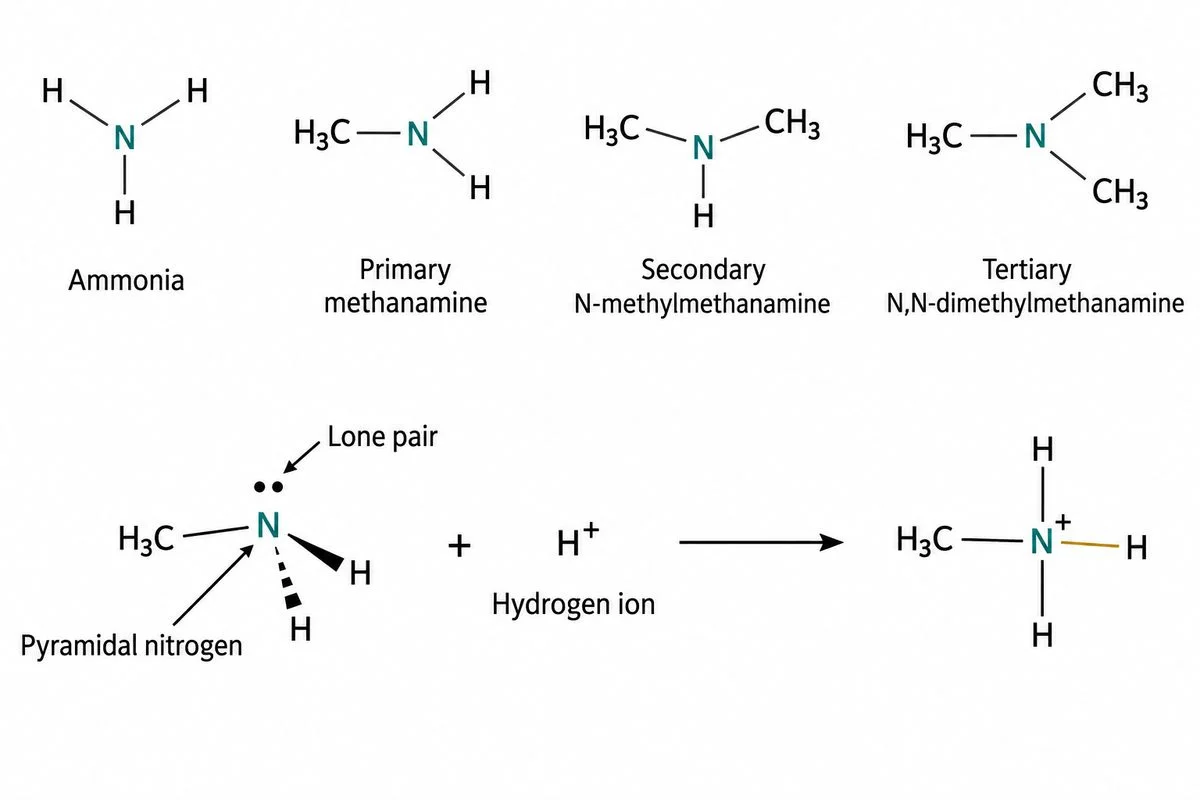
Amine classes and names above pyramidal methanamine accepting a hydrogen ion.

1. Structure, classification and nomenclature of amines

Nitrogen’s attachments determine class; its lone pair accepts hydrogen ions.

Show
Compare the diagram’s nitrogen attachments. Below, find methanamine’s pyramidal shape and lone pair.
Ask
If methyl replaces one nitrogen-bound hydrogen in methanamine, which amine class will form?
Say
A secondary amine will form; two carbon groups on nitrogen mean a secondary amine.
Used in
Converting amine medicines into salts can help them dissolve in water.
If your child says…“The carbon’s class tells me the amine’s class.”
Ask
How many methyl groups touch nitrogen in N-methylmethanamine?
What’s true
An amine’s class depends on how many carbon groups bond directly to nitrogen.
CH3Br+NH3⟶CH3NH3++Br−\mathrm{CH_3Br + NH_3 \longrightarrow CH_3NH_3^+ + Br^-}

CH3NH3++NH3⇌CH3NH2+NH4+\mathrm{CH_3NH_3^+ + NH_3 \rightleftharpoons CH_3NH_2 + NH_4^+}

2. Preparation of amines: ammonolysis of alkyl halides

Ammonia replaces a halogen to produce an amine.

Show
Write this line. Say, “This laboratory reaction uses heated ethanolic ammonia. Bromomethane reacts with excess ammonia to form methylamine and ammonium bromide.”
Ask
What further reaction could methylamine undergo if bromomethane remains?
Say
Methylamine can gain another methyl group.
Used in
Preparing amines supplies starting materials for making synthetic dyes.
If your child says…“Ammonia always produces only a primary amine.”
Ask
Does the product still have a nitrogen lone pair that could react?
What’s true
The amine product can react further, so excess ammonia helps limit additional alkylation.

Change an amine

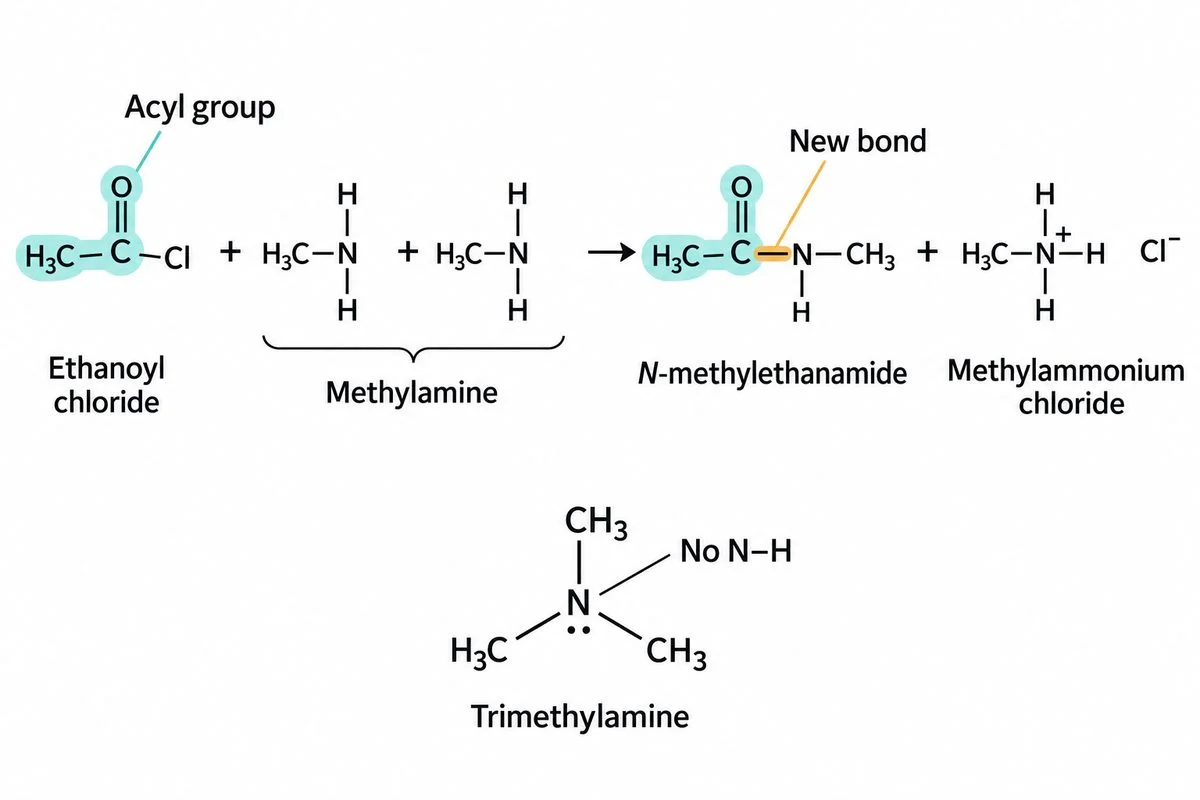
Acylation forms an amide and salt; trimethylamine below lacks a nitrogen-bound hydrogen.

3. Chemical reactions of amines: acylation

An acyl group replaces nitrogen’s hydrogen, forming an amide.

Show
Follow the diagram from methylamine to the new carbon–nitrogen bond. Below, find trimethylamine’s nitrogen attachments.
Ask
Could trimethylamine form an amide by the same hydrogen replacement?
Say
Methylamine’s nitrogen loses a hydrogen and bonds to the acyl group, forming an amide. No; trimethylamine lacks the needed nitrogen-bound hydrogen.
Used in
Acylation helps chemists build amide groups found in medicines.
If your child says…“Every amine can form an amide this way.”
Ask
Where is the replaceable hydrogen when nitrogen already holds three carbon groups?
What’s true
A tertiary amine has no nitrogen-bound hydrogen for this replacement.

Use diazonium salts

NaNO2+HCl⟶HNO2+NaCl\mathrm{NaNO_2 + HCl \longrightarrow HNO_2 + NaCl}

C6H5NH2+HNO2+HCl→273–278 KC6H5N2+Cl−+2H2O\mathrm{C_6H_5NH_2 + HNO_2 + HCl \xrightarrow{273\text{–}278\,K} C_6H_5N_2^+Cl^- + 2H_2O}

4. Diazonium salts: preparation and replacement reactions

Diazonium salts form cold. Their diazonium groups can be replaced.

Show
Write this line. Say, “Sodium nitrite and hydrochloric acid make nitrous acid, which reacts with aniline. At 273–278 kelvin, benzenediazonium chloride forms. The overall reaction also produces sodium chloride and water.”
Ask
What do you predict will happen to the diazonium group when warmed with water?
Say
Warming with water replaces that group with hydroxyl, forming phenol and releasing nitrogen gas.
Used in
Diazonium reactions help chemists prepare substituted aromatic compounds for medicine research.
If your child says…“Warming is fine while making the diazonium salt.”
Ask
If warming converts the intermediate into phenol, when should warming happen?
What’s true
Cold conditions preserve the diazonium intermediate during preparation; warming with water promotes its conversion to phenol.
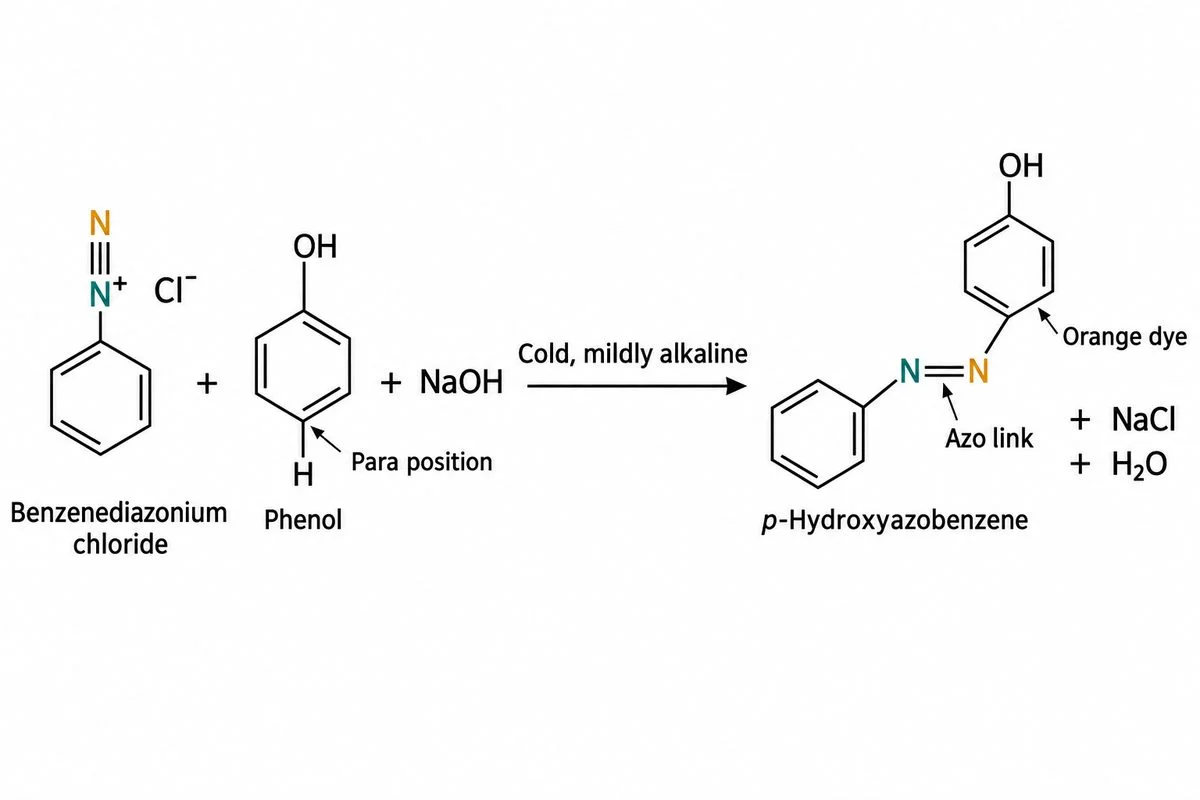
Diazonium nitrogen atoms remain in an azo link attached opposite phenol’s hydroxyl group.

5. Coupling reactions

Two nitrogen atoms join aromatic rings through an azo linkage.

Show
Find the nitrogen pair in the diagram. Read the arrow’s cold, mildly alkaline conditions.
Ask
Will these nitrogen atoms leave as gas or link the rings?
Say
Both nitrogen atoms stay, forming an azo link between the rings. The link attaches opposite phenol’s hydroxyl group.
Used in
Azo dyes provide colour in printing inks.
If your child says…“Coupling releases nitrogen gas, just like replacement does.”
Ask
Which atoms must remain to connect the rings through the nitrogen double bond?
What’s true
Coupling keeps both nitrogen atoms in the product.

A real problem

A synthetic dye made purple colouring cheaper.

William Henry Perkin discovered mauveine in 1856.

It became the first commercialised synthetic dye.

His experiment with aniline produced a black precipitate.

His mauve dye cost less than traditional natural purple dyes.

Science History InstituteOpen UniversityScience Museum Group

Purple silk scarf loosely folded on a pale tabletop.

Concept Lab · Common misconception

The tempting mistake in Amines

Open standalone misconception page →

Do carbon atoms determine the amine class?

Wrong

Ethylamine is secondary because its ethyl group has two carbons.

Why it feels right. I count carbons rather than the groups directly attached to nitrogen.

Right

Primary, secondary and tertiary amines have one, two and three carbon groups bonded to nitrogen, respectively.

Worked example

Ethylamine
NC₂H₅
1 carbon group
Dimethylamine
NCH₃CH₃
2 carbon groups
Count carbon groups bonded directly to the nitrogen. The ethyl group counts once even though it contains two carbons.
  1. In CH₃CH₂NH₂, nitrogen bonds to one ethyl group.
  2. In (CH₃)₂NH, it bonds to two methyl groups.
  3. Only the second amine is secondary.

Ask your child five quick questions.

One per step. The answer and the reason are given.

  1. Which amine class does N-methylmethanamine belong to?

    Secondary amines. Two methyl groups bond directly to its nitrogen.

  2. Which reactant should be in excess to favour the primary amine?

    Ammonia. Excess ammonia helps limit further alkylation of the amine product.

  3. Which amine class lacks the nitrogen-bound hydrogen needed here?

    Tertiary amines. Their nitrogen already carries three carbon groups.

  4. Which stage needs 273–278 K: making the salt or converting it into phenol?

    Making the diazonium salt. Cold preparation preserves the intermediate before its later reaction with warm water.

  5. Where are the original diazonium nitrogen atoms after coupling?

    Between the two aromatic rings. Both remain in the azo linkage instead of leaving as nitrogen gas.

15 more questions with answers