Skip to content

Teach Chemical Kinetics in five steps.

For each idea: show it, ask before you tell, then say one line.

Gather paper and a pencil.

Common misconceptions & worked visual for this chapter · 15 practice questions with answers

How to teach it

Measuring reaction speed

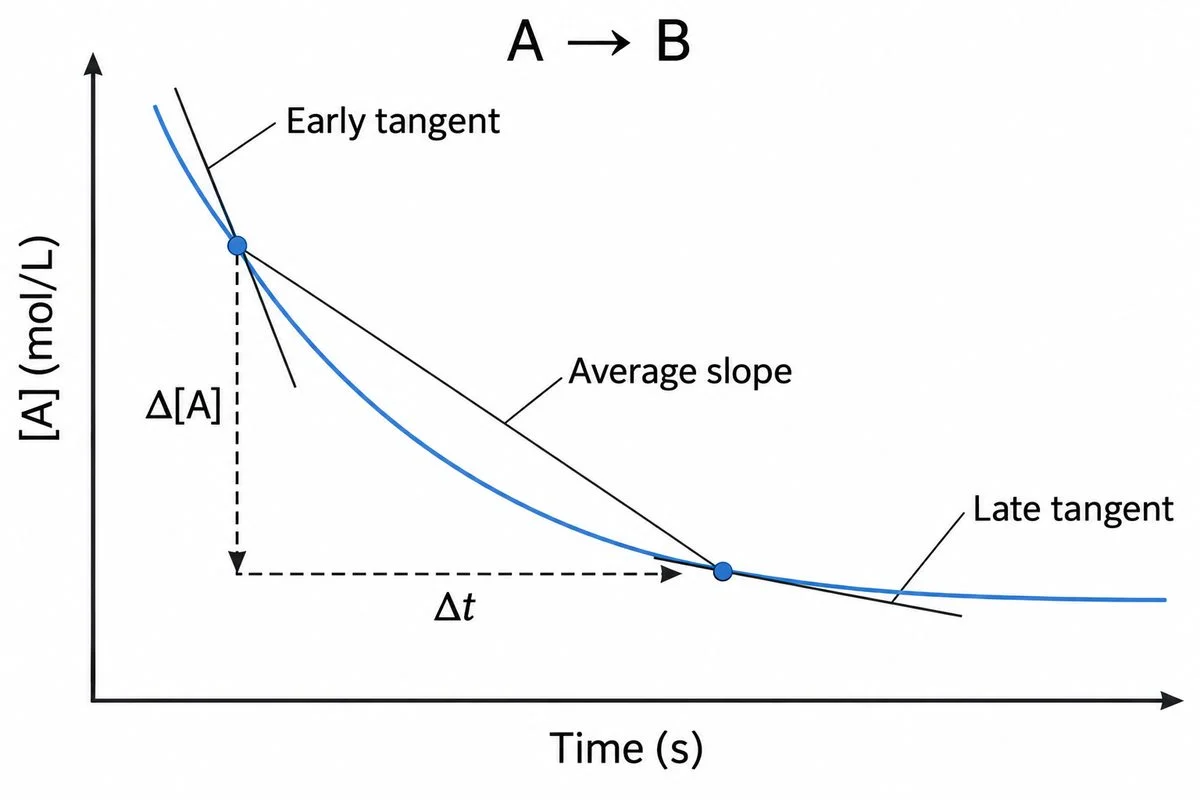
Falling concentration curve with interval markers, a secant, and early and late tangents.

1. Rate of a Chemical Reaction

Concentration change over time measures how quickly a reaction proceeds.

Show
Find concentration and time on the constant-volume diagram. Compare the early and late tangents.
Ask
Which tangent predicts slower reaction?
Say
Flatter tangents mean slower instantaneous rates.
Used in
Food processing uses reaction rates to help set cooking times.
If your child says…“Using up a reactant makes the reaction rate negative.”
Ask
What sign results when you put a minus before a negative concentration change?
What’s true
A falling reactant concentration gives a positive disappearance rate after its sign is reversed.
r2r1=([A]2[A]1)m\dfrac{r_2}{r_1}=\left(\dfrac{[A]_2}{[A]_1}\right)^m

2=2m2=2^m

2. Rate Law, Order and Molecularity

Overall order sums powers; molecularity counts particles reacting in one elementary step.

Show
Write these lines. Say: 'Doubling concentration doubles the measured rate here. Other conditions stay fixed. Here, m is the concentration's power in the rate law.'
Ask
What value of m fits?
Say
The power is one.
Used in
Factories adjust reactant concentrations to control production speed.
If your child says…“Doubling concentration leaves the rate unchanged.”
Ask
Which power makes the measured doubling agree with this line?
What’s true
For this measured first-order relationship, doubling concentration doubles rate while other conditions stay fixed.

Predicting reaction progress

t=ln⁡([A]0/[A]t)kt=\dfrac{\ln([A]_0/[A]_t)}{k}

t=ln⁡(2/1)0.693 min−1t=\dfrac{\ln(2/1)}{0.693\,\mathrm{min}^{-1}}

t≈0.6930.693 mint\approx\dfrac{0.693}{0.693}\,\mathrm{min}

3. Integrated Rate Equations and Half-Life

Equations predict remaining concentration and how long halving takes.

Show
Write these lines. Say: 'This calculation applies to a first-order reaction. Its rate constant, k, is 0.693 per minute in this example. Halving makes the starting-to-remaining concentration ratio two. Here, t means time, and ln means natural logarithm.'
Ask
How many minutes does this halving take?
Say
Halving takes about one minute because the natural logarithm of two is approximately 0.693.
Used in
Shelf-life estimates track chemical breakdown to help determine suitable storage periods.
If your child says…“Doubling the starting concentration doubles every reaction's half-life.”
Ask
What happens to the concentration ratio when both starting and halfway concentrations double?
What’s true
Starting concentration affects zero-order half-life, but not first-order half-life at unchanged rate constant.

Explaining reaction speed

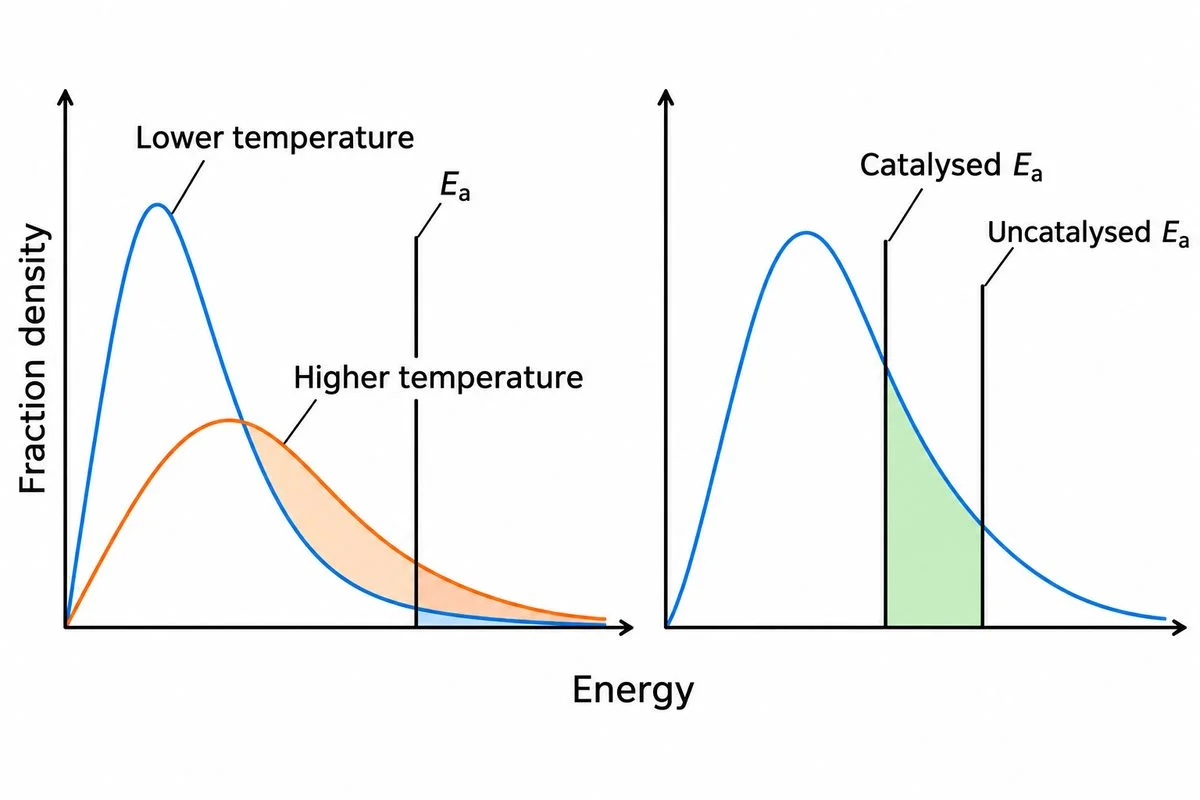
Energy distributions compare heating with lowering the activation-energy threshold using a catalyst.

4. Temperature Dependence of the Rate of a Reaction

Heating increases energetic encounters, while catalysts offer a lower activation barrier.

Show
Compare the diagram's left tails, then its right thresholds. Eₐ means activation energy.
Ask
Which change lets more molecules meet the energy requirement?
Say
Both do. Heating gives more molecules enough energy; catalysts lower the energy requirement.
Used in
Refrigeration slows food-spoilage reactions, helping food stay usable longer.
If your child says…“A catalyst cannot change reaction speed unless it heats the mixture.”
Ask
On the right, did the energy distribution change when the threshold moved left?
What’s true
A catalyst can increase reaction speed at unchanged temperature by providing a different pathway.
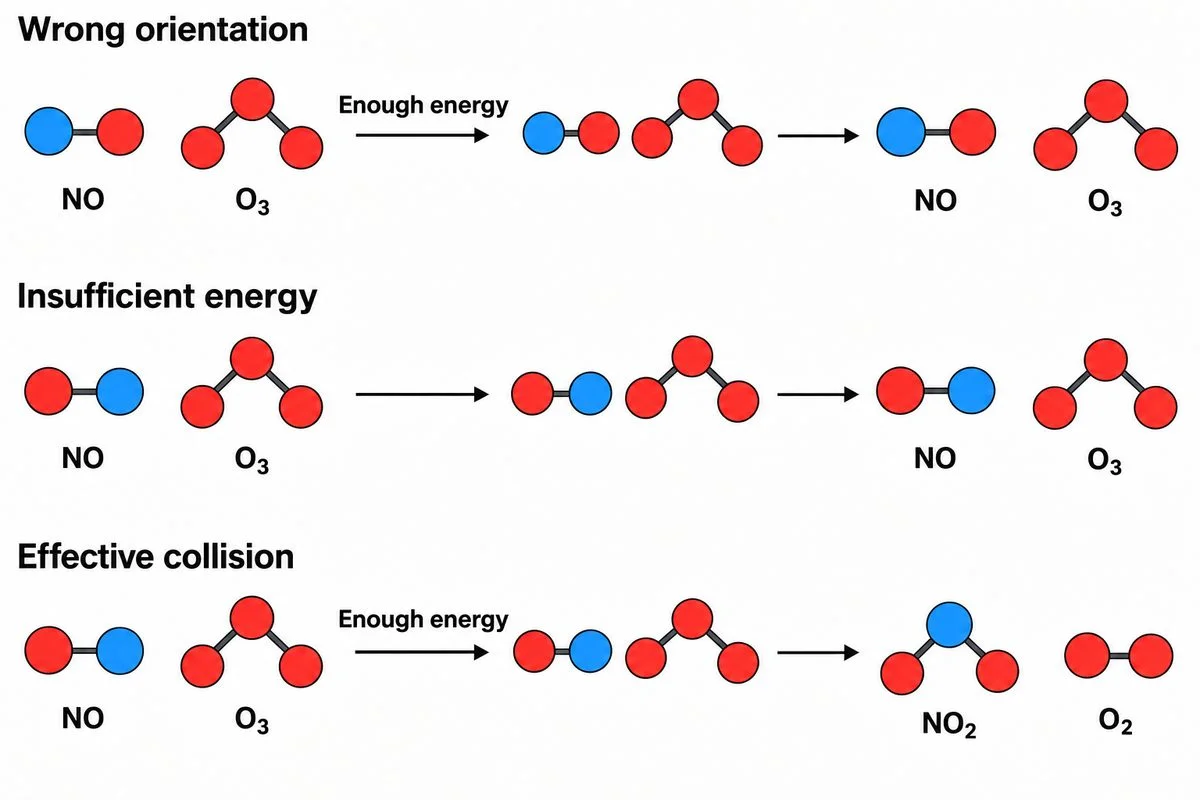
Three molecular collisions compare unsuitable orientation, insufficient energy, and successful oxygen transfer.

5. Collision Theory of Chemical Reactions

Effective collisions need enough energy and a suitable molecular orientation.

Show
Cover the outcomes on the diagram's right with paper. Compare the orientation and energy in each row.
Ask
Which collision will form products, although molecules meet in every row?
Say
Only the bottom collision forms products: it has enough energy and the suitable orientation.
Used in
Fuel burners mix fuel with air so reacting particles can meet and release heat.
If your child says…“Turning a molecule cannot change whether its collision works.”
Ask
Why does the top row fail even with enough energy?
What’s true
The same molecules can collide ineffectively when their reacting parts do not meet suitably.

A real problem

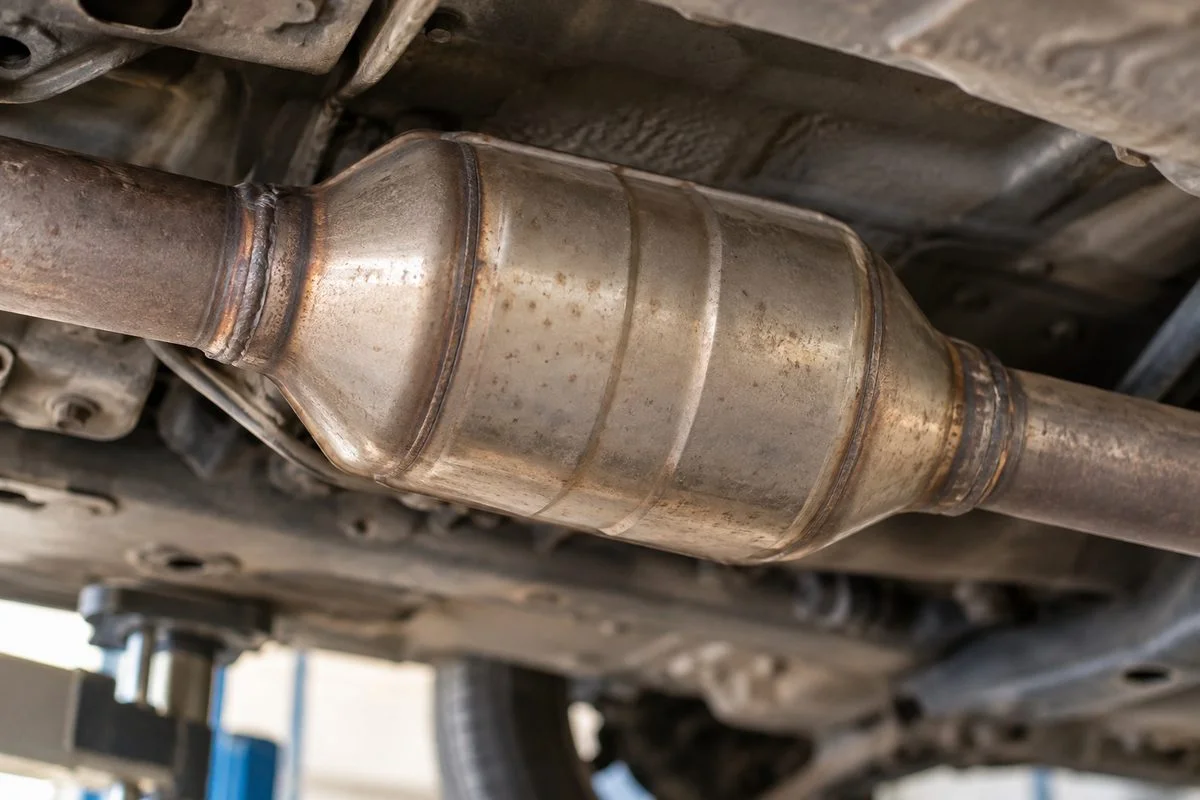
Catalytic converters help clean car exhaust.

In April 1995, four Indian metropolitan cities required converters in new petrol passenger cars.

The cities were Delhi, Calcutta, Mumbai and Chennai.

Converters help change exhaust pollutants into less harmful substances.

Their metal catalysts speed reactions without being permanently chemically changed.

SIAMChemical & Engineering NewsStanford University

Catalytic converter and exhaust pipe beneath a car raised on a garage lift.

Concept Lab · Common misconception

The tempting mistake in Chemical Kinetics

Open standalone misconception page (2 worked examples) →

Why are the rates for two reactants different?

Wrong

In 2A + B → products, A and B disappear at the same rate.

Why it feels right. A and B are part of the same reaction, so I expect a shared rate to mean equal losses.

Right

Each reaction event consumes twice as much A as B. Divide each disappearance rate by its coefficient to obtain the reaction rate.

Worked example

In the same second, two units of A disappear for each one of B.
  1. If 2 mmol of A and 1 mmol of B disappear each second in the same vessel, the disappearance rates differ.
  2. Dividing by 2 for A and 1 for B gives the same normalised amount rate of 1 mmol/s.

Ask your child five quick questions.

One per step. The answer and the reason are given.

  1. At constant volume, a reactant loses 0.2 mol/L in 10 seconds. What is its average disappearance rate?

    +0.02 mol/L per second. Reverse the negative concentration change, then divide by elapsed time.

  2. For this relationship, what happens to rate when concentration halves and other conditions stay fixed?

    It halves. Rate changes in the same proportion as concentration for this first-order relationship.

  3. For this first-order reaction, how does doubling starting concentration change half-life at unchanged k?

    It stays the same. The concentration ratio for halving remains two, so starting concentration cancels.

  4. How does a catalyst change the activation barrier at unchanged temperature?

    It lowers it. An alternative pathway has a lower activation barrier without changing equilibrium.

  5. What else must a suitably oriented molecular collision have to produce a reaction?

    Sufficient energy. Suitable orientation alone does not overcome the activation barrier.

15 more questions with answers