Skip to content

Teach The d- and f-Block Elements in six steps.

For each idea: show it, ask before you tell, then say one line.

Gather paper, a pencil and a partly rusted iron nail.

Hold the nail by its blunt end, and leave the rust untouched.

Common misconceptions & worked visual for this chapter · 15 practice questions with answers

How to teach it

Transition elements

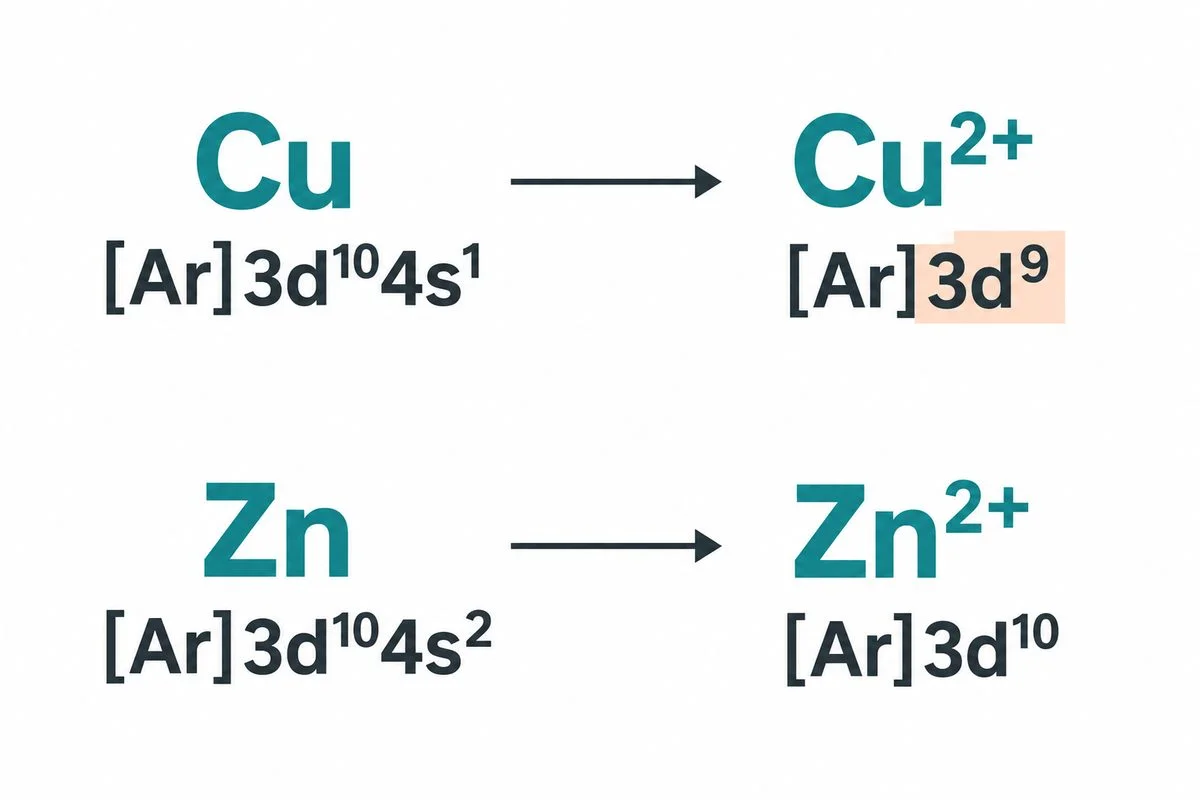
Copper and zinc configurations compared with their doubly charged ions.

1. Position in the Periodic Table and Electronic Configurations

Electron arrangements help identify transition elements.

Show
Follow the diagram’s atom-to-ion arrows. Compare the d electron counts.
Ask
Which element qualifies through its ion?
Say
Copper qualifies through its ion’s incomplete d subshell. Zinc’s shown d subshells are full.
Used in
Copper carries electricity through household wiring.
If your child says…“A full d subshell in the atom rules out a transition element.”
Ask
Does copper’s d subshell stay full when this ion forms?
What’s true
An element can qualify through a common ion with an incomplete d subshell.
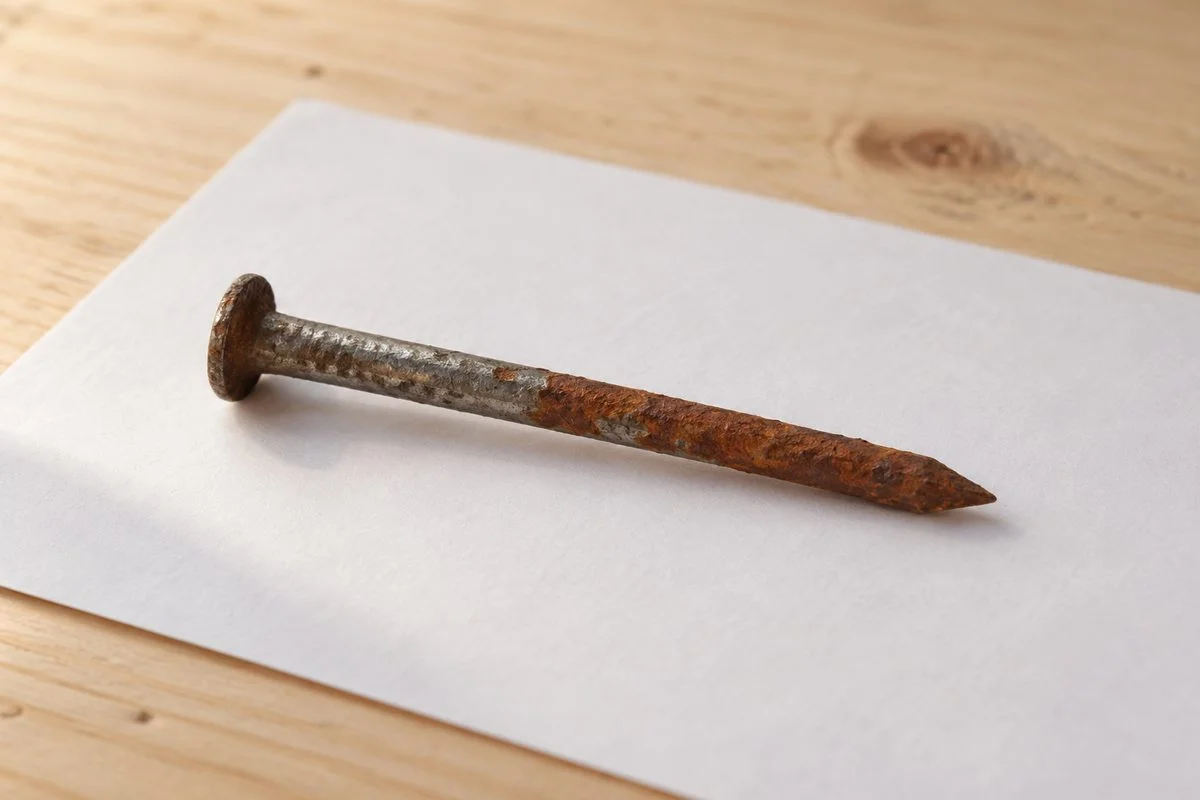
A partly rusted nail has exposed metal beside a brown coating.

2. General Properties of the Transition Elements

Electron arrangements and bonding explain these metals’ varied properties.

Show
Place the nail on white paper without scraping it. Point to its exposed metal and brown coating.
Ask
Will the brown coating still contain iron?
Say
The brown coating is rust, which contains iron compounds. Iron’s oxidation state is zero in the metal and mainly +3 in rust.
Used in
Transition-metal catalysts speed reactions used to make fertilisers.
If your child says…“An element always has the same oxidation state.”
Ask
Does forming rust remove iron, or change what it is combined with?
What’s true
The same metal can form compounds with different oxidation states.

Two oxidising agents

Cr2O72−→2Cr3+\mathrm{Cr_2O_7^{2-}\rightarrow 2Cr^{3+}}

Cr2O72−→2Cr3++7H2O\mathrm{Cr_2O_7^{2-}\rightarrow 2Cr^{3+}+7H_2O}

Cr2O72−+14H+→2Cr3++7H2O\mathrm{Cr_2O_7^{2-}+14H^+\rightarrow 2Cr^{3+}+7H_2O}

3. Potassium Dichromate

Acid favours dichromate, which accepts electrons during reduction.

Show
Write this equation and update it in place. Say, “Chromium is balanced. Balance oxygen by adding seven water molecules on the right. Balance hydrogen by adding fourteen hydrogen ions on the left.”
Ask
How many electrons must go on which side of the equation?
Say
Add six electrons on the left: chromium changes from +6 to +3.
Used in
Dichromate acts as an oxidising agent in chemical analysis.
If your child says…“Once the atoms balance, the equation is finished.”
Ask
Before adding electrons, does the left-hand charge of +12 equal the right-hand charge of +6?
What’s true
A balanced ionic equation preserves charge as well as atoms.

MnO4−→Mn2+\mathrm{MnO_4^-\rightarrow Mn^{2+}}

MnO4−→Mn2++4H2O\mathrm{MnO_4^-\rightarrow Mn^{2+}+4H_2O}

MnO4−+8H+→Mn2++4H2O\mathrm{MnO_4^-+8H^+\rightarrow Mn^{2+}+4H_2O}

4. Potassium Permanganate

The reaction medium helps determine permanganate’s reduction product.

Show
Write this equation and update it in place. Say, “Manganese is balanced. Balance oxygen by adding four water molecules on the right. Balance hydrogen by adding eight hydrogen ions on the left.”
Ask
How many electrons must go on which side of the equation?
Say
Add five electrons on the left, balancing charge for manganese(II) formation in acid.
Used in
Permanganate oxidises impurities during water treatment.
If your child says…“Permanganate always forms manganese(II), whatever the solution.”
Ask
Where would this equation’s hydrogen ions come from in strongly alkaline solution?
What’s true
An acidic half-equation cannot simply be carried over to an alkaline solution.

The f-block elements

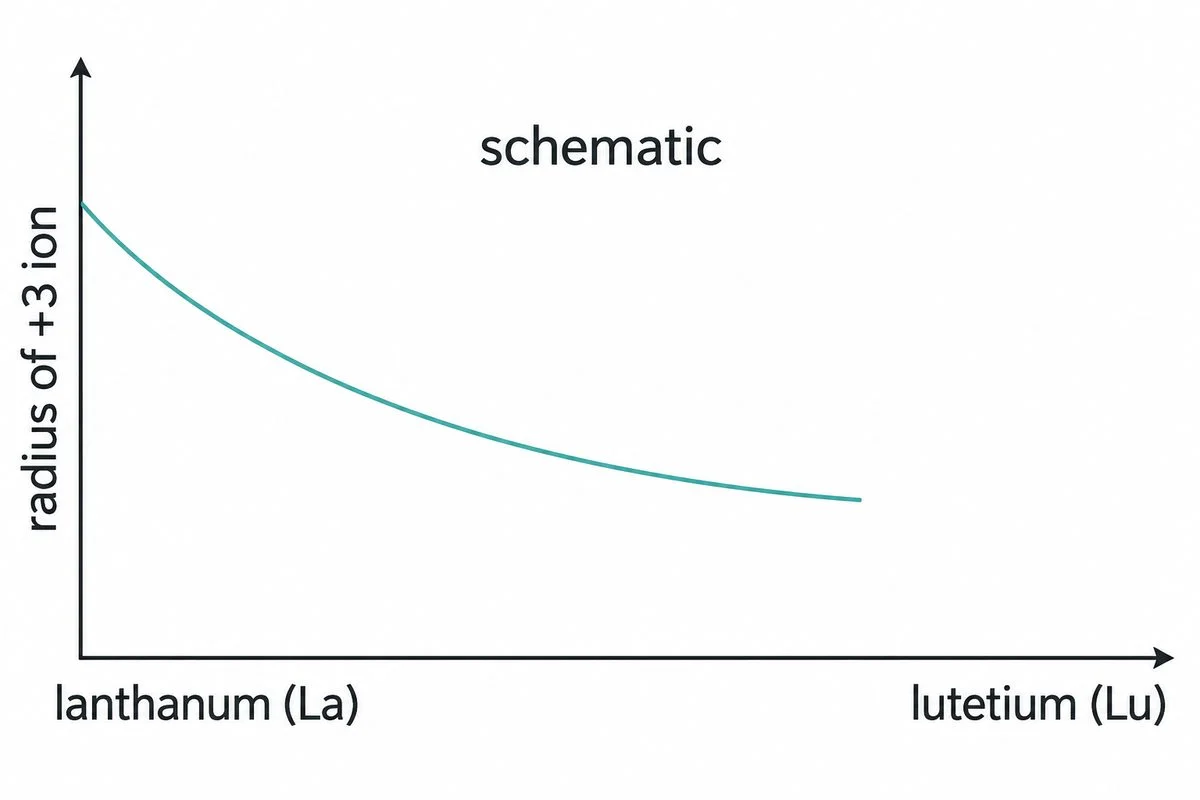
Labelled lanthanoid ion radius graph with a descending curve ending before lutetium.

5. The Lanthanoids — Lanthanoid Contraction

Comparable lanthanoid ions become smaller across the series.

Show
Follow the diagram’s +3 ion radius curve from lanthanum towards lutetium. Stop where the curve ends.
Ask
Will the curve’s next part rise or fall?
Say
It falls because added 4f electrons shield the growing nuclear charge poorly.
Used in
Magnets containing lanthanoids help loudspeakers produce sound.
If your child says…“Adding electrons always makes an ion larger.”
Ask
Does this curve rise as the nuclei gain protons?
What’s true
Increasing nuclear attraction can outweigh the size increase expected from adding electrons.
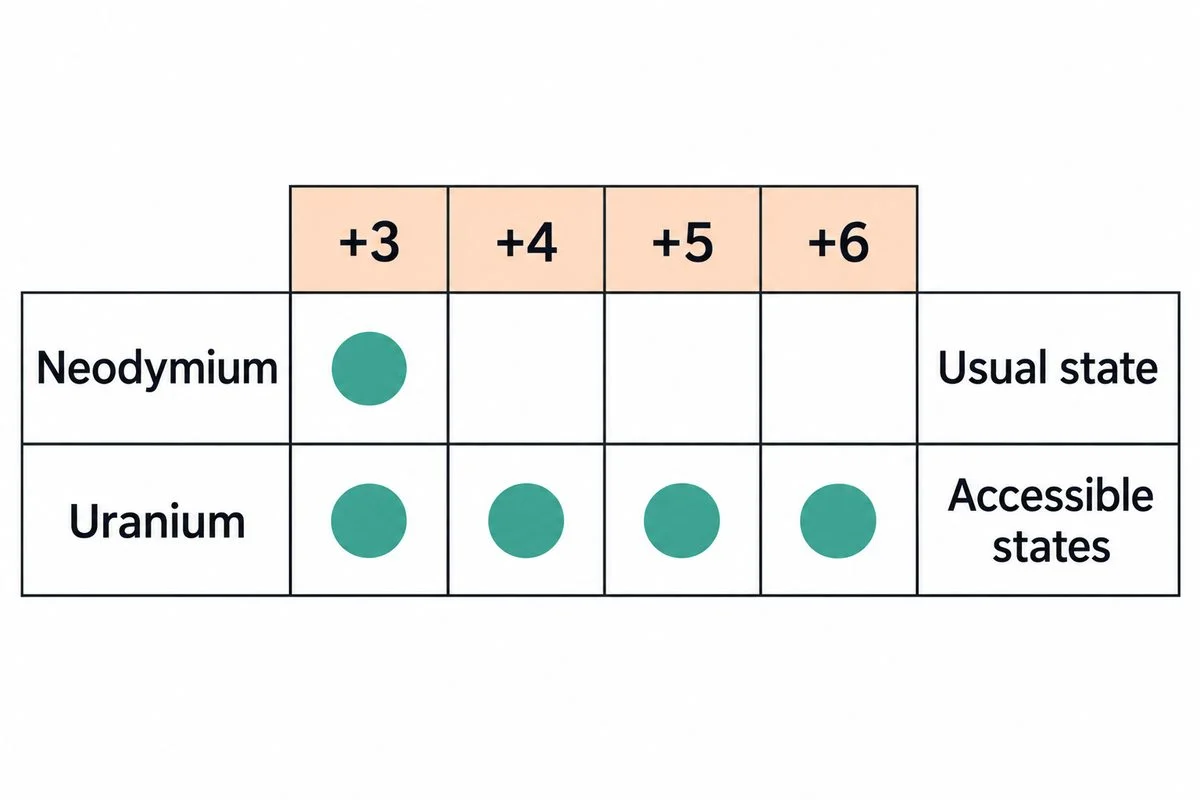
Neodymium’s usual oxidation state compared with uranium’s four accessible oxidation states.

6. The Actinoids

Radioactive 5f elements show varied oxidation states.

Show
Look at the diagram’s neodymium row, then its uranium row. Follow each row across the oxidation states.
Ask
From these rows, which element would form compounds in more oxidation states?
Say
Uranium has more possibilities because several outer orbitals have similar energies. Its 5f, 6d and 7s electrons can therefore participate in bonding.
Used in
Changing uranium’s oxidation state helps separate it during nuclear-fuel processing.
If your child says…“Actinoids behave just like lanthanoids.”
Ask
Which row has accessible states beyond +3?
What’s true
Early actinoids have more oxidation states because several outer orbitals have similar energies.

A real problem

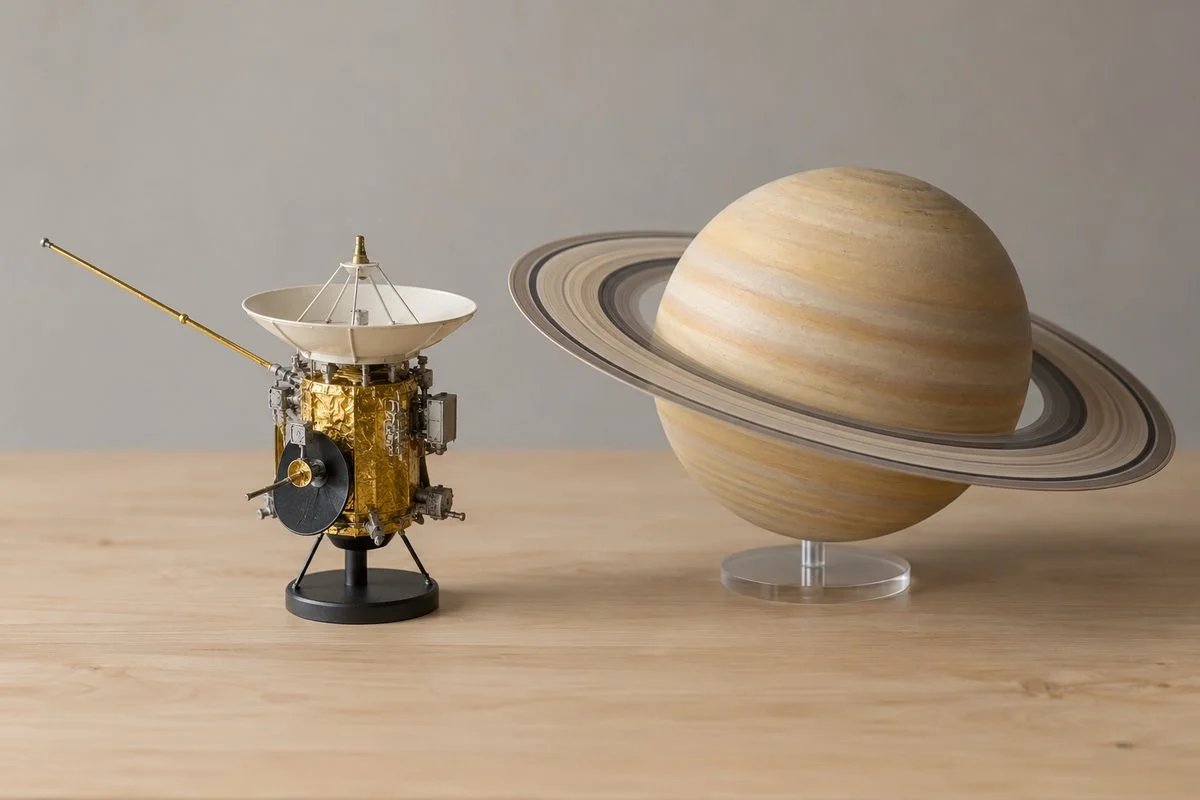
Cassini used radioactive decay to generate electricity.

Cassini launched on 15 October 1997.

Saturn’s distance from the Sun made solar arrays impractical for Cassini.

Its generators turned heat from plutonium’s radioactive decay into electricity.

Plutonium belongs to the actinoid series.

ESAWikipediaRoyal Society of Chemistry

A classroom Cassini model stands beside a model of ringed Saturn.

Concept Lab · Common misconception

The tempting mistake in The d- and f-Block Elements

Open standalone misconception page →

Is every d-block element a transition element?

Wrong

Zinc is a transition element because it sits in the d block.

Why it feels right. I use block membership as the definition.

Right

The usual school definition requires an incomplete d subshell in the atom or a cation it forms.

Worked example

Zn and Zn²⁺ · d¹⁰
↑↓
↑↓
↑↓
↑↓
↑↓
Fe²⁺ · d⁶
↑↓
↑
↑
↑
↑
Each box is a d orbital. The zinc examples have filled d subshells, while Fe²⁺ has an incomplete one.
  1. Zn has a filled 3d¹⁰ subshell and Zn²⁺ also has 3d¹⁰.
  2. Fe²⁺ has 3d⁶, so iron satisfies the criterion and zinc does not.

Ask your child six quick questions.

One per step. The answer and the reason are given.

  1. Which shown ion makes copper qualify as a transition element?

    The copper(II) ion. Copper(II) has nine d electrons, leaving its d subshell incomplete.

  2. What oxidation state does iron have in the unreacted metal?

    Zero. Iron has oxidation state zero here because it is an uncombined element.

  3. Which side needs electrons in this dichromate half-equation?

    The left side. Six negative electrons lower its charge from +12 to +6.

  4. What is permanganate’s usual reduction product in neutral solution?

    Manganese dioxide. The medium changes the usual product, so the acidic result does not apply.

  5. What happens to +3 ion size from La towards Lu?

    It generally decreases. Poor shielding lets the increasing nuclear charge pull electrons closer.

  6. Which element has more oxidation states in our chart?

    Uranium. Its row includes +4, +5 and +6 alongside +3.

15 more questions with answers