Skip to content

Teach Coordination Compounds in six steps.

For each idea: show it, ask before you tell, then say one line.

Gather paper and a pencil.

Common misconceptions & worked visual for this chapter · 15 practice questions with answers

How to teach it

Recognise, name and arrange

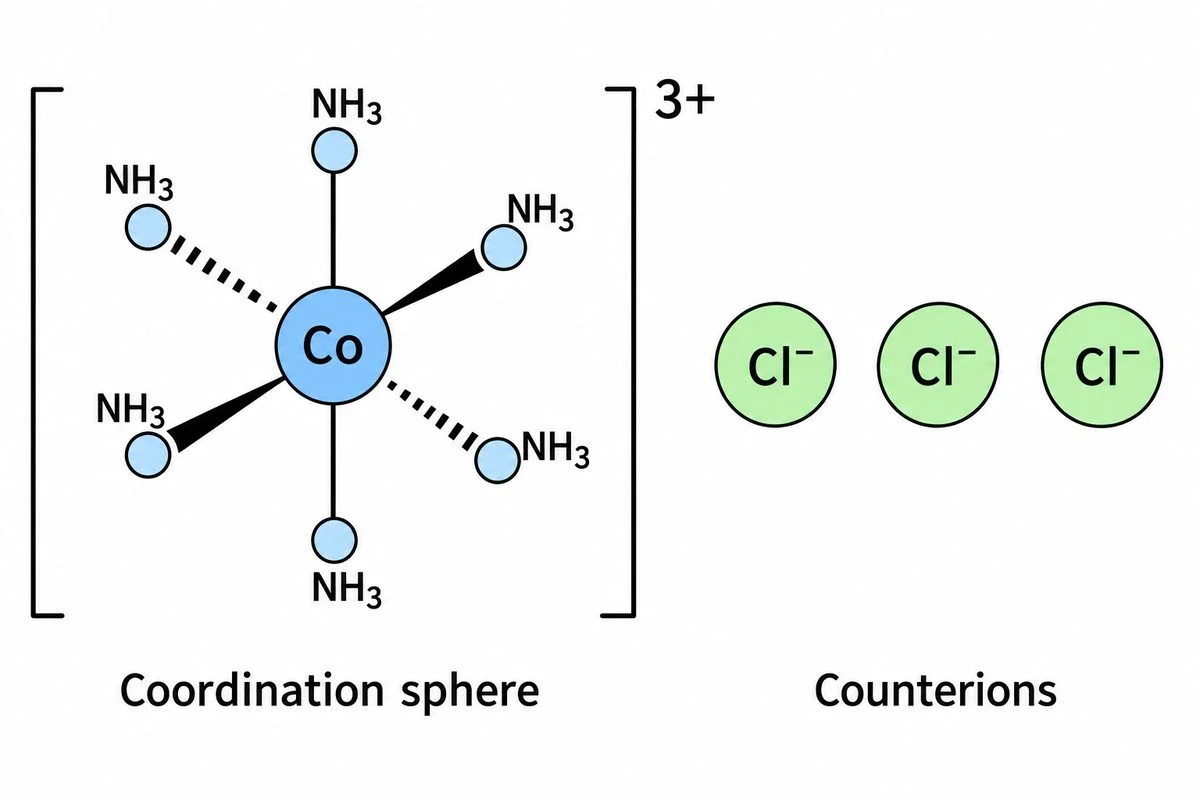
Six ammonia ligands surround cobalt inside brackets; three chloride counterions sit outside.

1. Werner’s theory and coordination terminology

Distinguish the metal’s oxidation state from its number of attached donors.

Show
Find cobalt, then count its attached nitrogen atoms in the diagram. Find the separate chloride ions. Say, 'Ammonia is neutral.'
Ask
Will six attached ammonia molecules mean cobalt’s oxidation state is plus six?
Say
Six nitrogen donors give secondary valency six. Three chloride counterions balance cobalt’s plus-three charge, giving primary valency three.
Used in
A metal held within haemoglobin helps blood carry oxygen.
If your child says…“Both valencies must be six.”
Ask
Do six neutral ammonia molecules cancel cobalt’s positive charge?
What’s true
Primary valency describes oxidation state; secondary valency counts directly attached donor atoms.
x+6(0)+3(−1)=0x+6(0)+3(-1)=0

x−3=0x-3=0

2. Nomenclature of coordination compounds

Names identify ligands, the metal and its oxidation state.

Show
Write this line. Say, 'Here, x is cobalt’s oxidation state. Ammonia is neutral; each chloride contributes minus one.'
Ask
Which Roman numeral will complete hexaamminecobalt(___) chloride?
Say
Cobalt is plus three, giving hexaamminecobalt(III) chloride.
Used in
Standard names help laboratories identify the correct compound before using it.
If your child says…“The Roman numeral gives the whole compound’s charge.”
Ask
Would a neutral compound need III if the numeral described its total charge?
What’s true
The Roman numeral records the metal’s oxidation state.
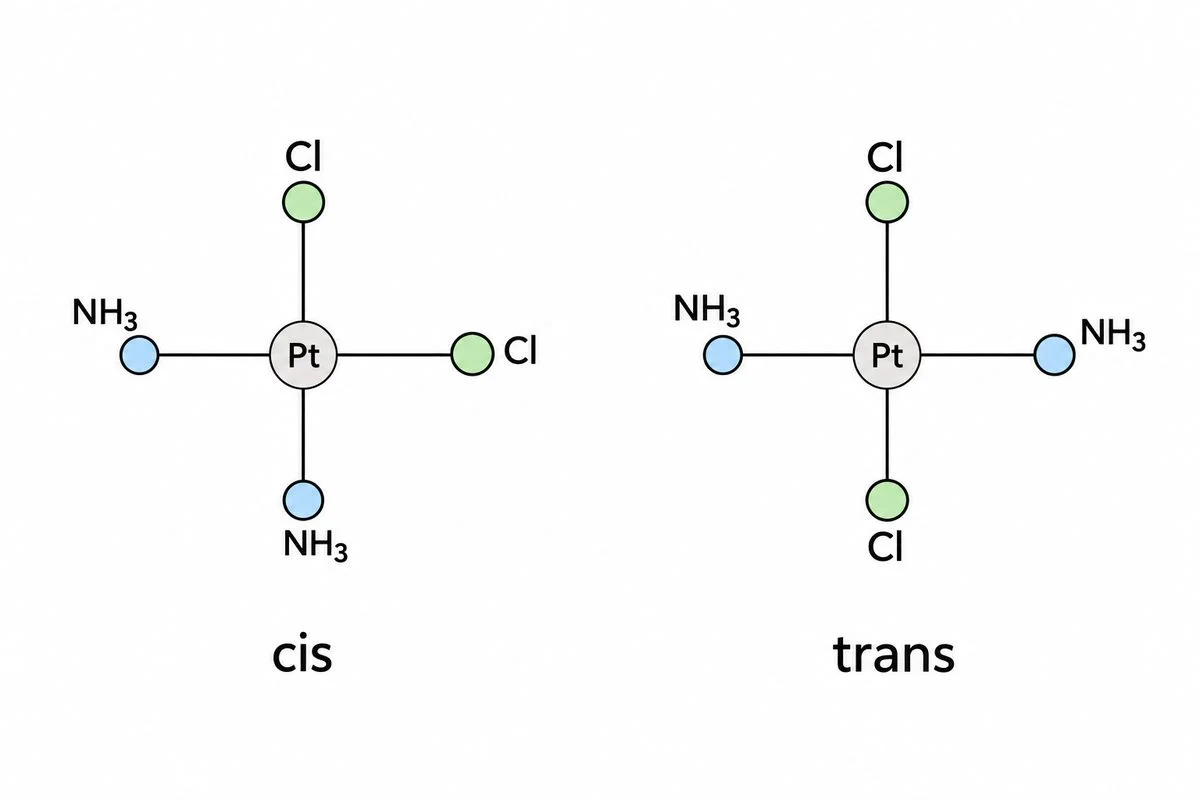
Platinum complexes with adjacent chlorides on the left and opposite chlorides on the right.

3. Isomerism in coordination compounds

Identical formulae can hide different attachments or spatial arrangements.

Show
Look at the diagram’s two platinum complexes. Count each kind of ligand, then compare the chloride positions.
Ask
Could turning the left structure make its chlorides opposite, as in the right structure?
Say
Turning preserves neighbours, so these arrangements cannot match by rotation. Cis has neighbouring chlorides, while trans has opposite chlorides.
Used in
Cisplatin helps treat cancer, while its trans isomer has no useful anticancer activity.
If your child says…“Cis and trans are just different viewing angles.”
Ask
When the whole diagram turns, do neighbouring chlorides stop being neighbours?
What’s true
Turning a whole complex preserves which ligands are neighbours.

Explain bonding and properties

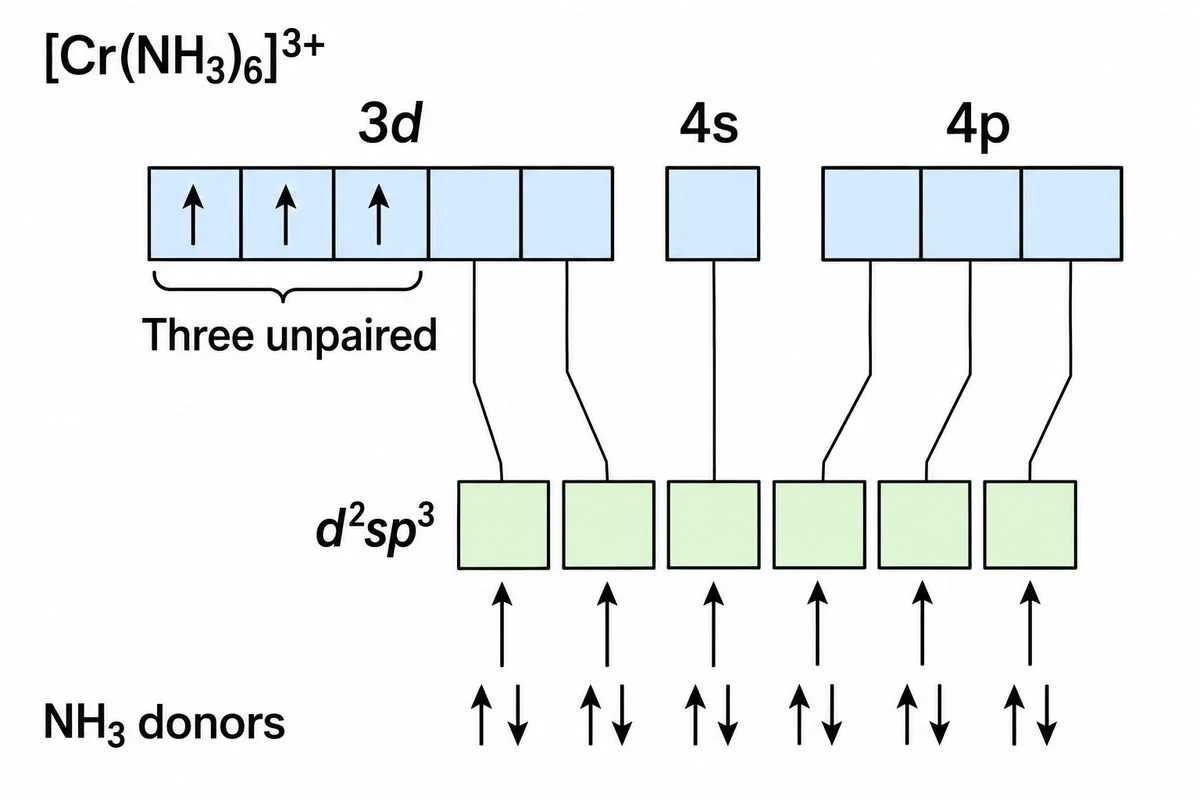
Three unpaired chromium electrons remain separate from six orbitals accepting ammonia pairs.

4. Valence bond theory and magnetic properties

Vacant metal orbitals accept ligand pairs; unpaired electrons explain paramagnetism.

Show
Find chromium’s three unpaired electrons in the diagram. Follow the six vacant orbitals into six hybrids. Find the incoming ammonia pairs.
Ask
After six ammonia pairs enter, how many chromium electrons will remain unpaired?
Say
Three remain unpaired, making this complex paramagnetic. Two inner d orbitals, one s and three p orbitals form six hybrids for ammonia pairs.
Used in
Magnetic measurements help laboratories investigate a complex’s electron arrangement.
If your child says…“Six paired bonds mean every electron is paired.”
Ask
Which incoming ammonia pair enters an already occupied chromium orbital?
What’s true
Paired bonding electrons can coexist with unpaired metal electrons in other orbitals.
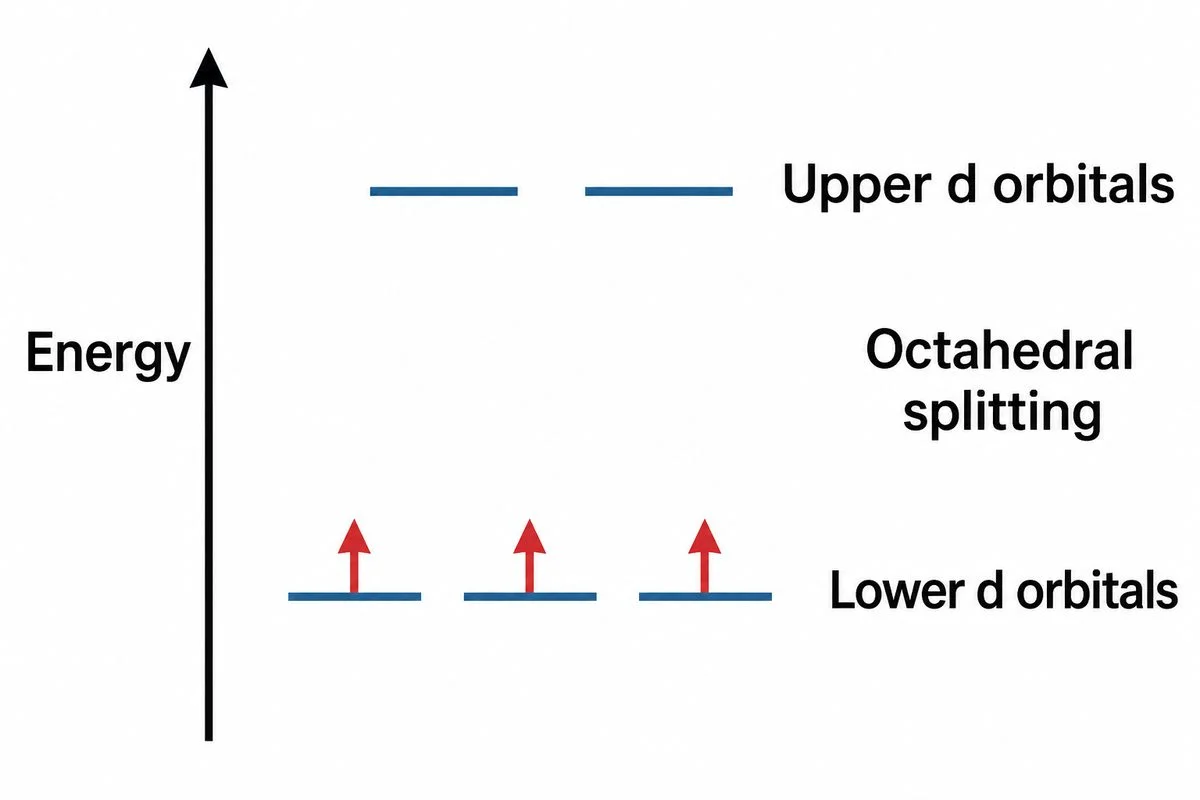
Octahedral energy diagram with three occupied lower orbitals and two empty upper orbitals.

5. Crystal field theory

Ligands split d-orbital energies, affecting electron pairing and light absorption.

Show
In this octahedral diagram, find three occupied lower orbitals and two empty upper orbitals. Other shapes have different splitting patterns. Say, 'Crossing this gap costs more energy than pairing.'
Ask
Where will the fourth electron go?
Say
It pairs below.
Used in
Some metal-complex pigments colour paints by absorbing selected visible wavelengths.
If your child says…“Electrons must fill every orbital before any pairing happens.”
Ask
Which costs less energy here: pairing below or moving above?
What’s true
Pairing is favoured when the orbital energy gap exceeds the pairing energy.
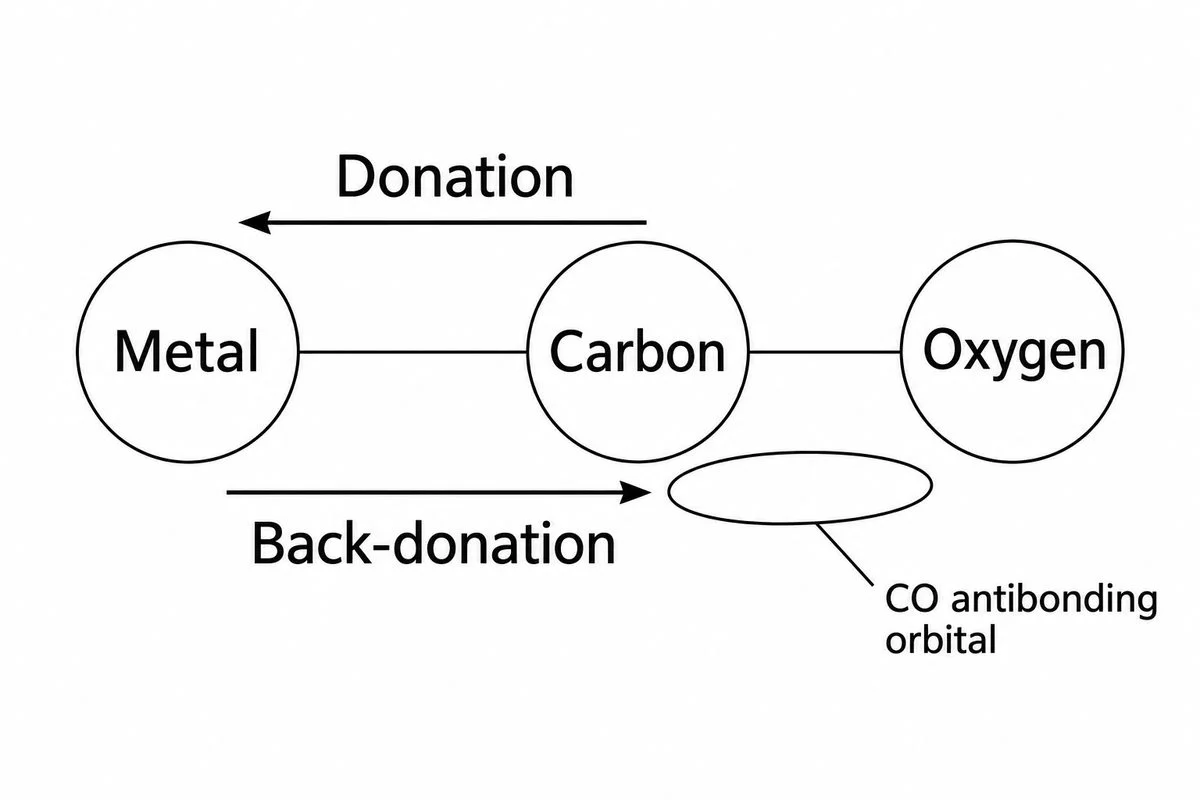
Metal–carbon–oxygen diagram with labelled donation and back-donation arrows pointing in opposite directions.

6. Bonding in metal carbonyls; stability and applications

Two-way donation strengthens metal–carbon bonds; stability concerns complex formation at equilibrium.

Show
Find the metal–carbon and carbon–oxygen bonds in the diagram. Follow the donation arrow towards the metal and the back-donation arrow towards carbon monoxide. Say, 'Back-donation enters carbon monoxide’s antibonding orbital.'
Ask
Which bond will back-donation weaken?
Say
Back-donation weakens carbon–oxygen bonding; both donations strengthen metal–carbon bonding.
Used in
Complex formation lets water tests measure hardness.
If your child says…“Back-donation strengthens every bond in a metal carbonyl.”
Ask
Would adding electrons to an antibonding orbital strengthen the carbon–oxygen bond?
What’s true
Donation and back-donation involve different orbitals and have different effects on carbon–oxygen bonding.

A real problem

Cisplatin’s ligand arrangement matters in cancer treatment.

The FDA approved cisplatin in 1978.

Cisplatin helps save lives from testicular cancer.

Researchers use it to control cancer cell division and expansion.

Its trans isomer, transplatin, has no useful anticancer activity.

Michigan State UniversityWikipediaNational Cancer Institute

Unbranded intravenous infusion bag beside an empty hospital treatment chair.

Concept Lab · Common misconception

The tempting mistake in Coordination Compounds

Open standalone misconception page →

Is coordination number the number of ligands?

Wrong

In [Co(en)₃]³⁺, the coordination number is 3 because there are three ligands.

Why it feels right. Each ligand is written as a single unit in the formula.

Right

Count donor atoms directly bonded to the metal. A ligand can supply more than one.

Worked example

Three ligands
en · NN
en · NN
en · NN
Coordination count
2+2+2
6
Each ethylenediamine ligand supplies two nitrogen donors, making six donor atoms around cobalt.
  1. Each ethylenediamine ligand binds through two nitrogen atoms.
  2. Three such ligands supply 3 × 2 = 6 donor atoms.

Ask your child six quick questions.

One per step. The answer and the reason are given.

  1. What gives cobalt’s secondary valency in this diagram?

    Six attached donor atoms. Secondary valency counts direct attachments, rather than the metal’s charge.

  2. What does III identify in this compound’s name?

    Cobalt’s oxidation state. The whole compound is neutral, but cobalt has oxidation state plus three.

  3. Can rotating the left complex make its chlorides opposite each other?

    No. Rotation keeps those chlorides adjacent.

  4. What makes this complex paramagnetic despite its paired bonding electrons?

    Three unpaired chromium electrons. The ligand pairs enter vacant orbitals, leaving three metal electrons unpaired.

  5. Why does the fourth electron pair on a lower line here?

    Pairing costs less energy. The specified energy gap exceeds the energy needed for pairing.

  6. Which bond weakens as metal-to-carbon-monoxide back-donation increases?

    The carbon–oxygen bond. Metal electron density enters a carbon monoxide antibonding orbital.

15 more questions with answers