Skip to content

Teach Electrochemistry in eight steps.

For each idea: show it, ask before you tell, then say one line.

Gather paper, a pencil, two similar iron nails, petroleum jelly, two transparent cups and water.

An adult handles nails. Never taste the materials.

Common misconceptions & worked visual for this chapter · 15 practice questions with answers

How to teach it

How cells produce electricity

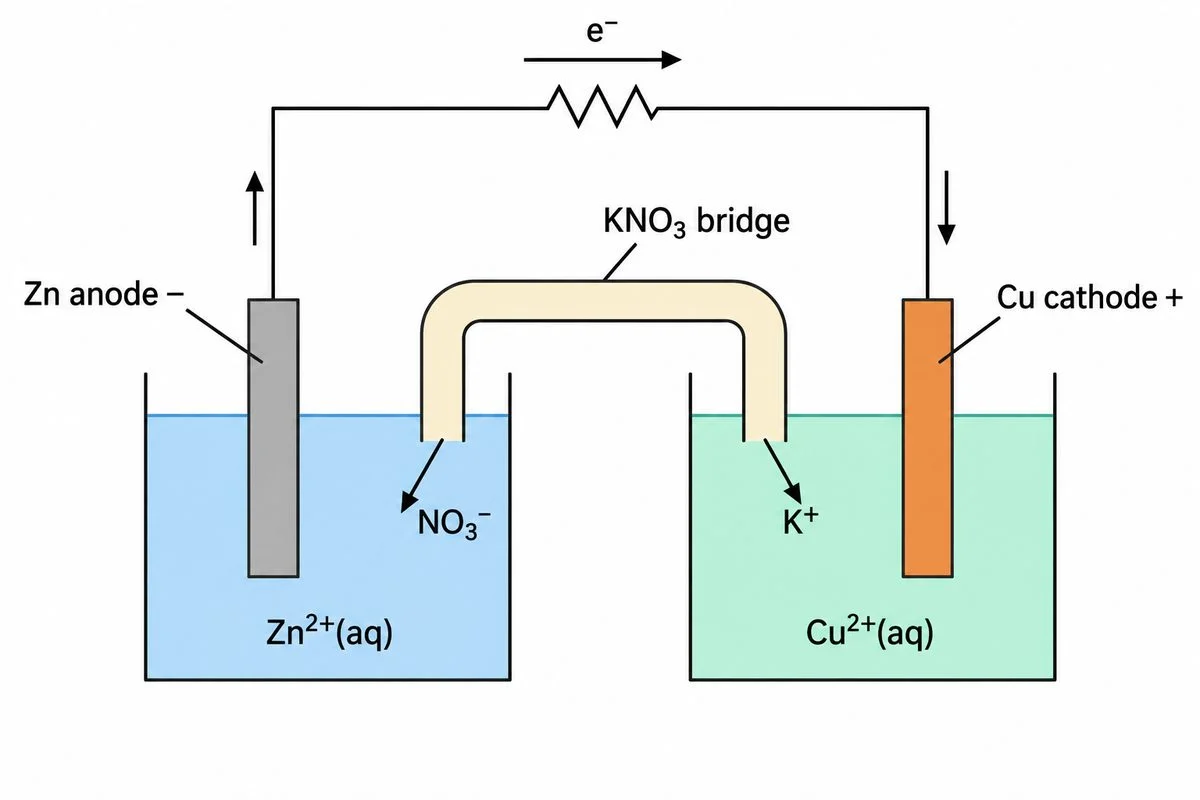
Zinc–copper cell showing separate paths for electrons and salt-bridge ions.

1. Electrochemical Cells

In galvanic cells, reactions drive electrons through an outside circuit.

Show
Look at the diagram. Follow the wire from zinc to copper, then the ions leaving the salt bridge.
Ask
Which way will electrons move through the wire connecting zinc and copper?
Say
Zinc atoms release electrons as they enter solution. These electrons travel through the wire to copper ions, which gain them and become copper metal. Salt-bridge ions keep both solutions electrically balanced so the flow continues.
Used in
Torch cells supply electricity where sockets are unavailable.
If your child says…“The salt bridge carries electrons.”
Ask
Which route connects the metal electrodes directly?
What’s true
The wire carries electrons, while ions move through the salt bridge.
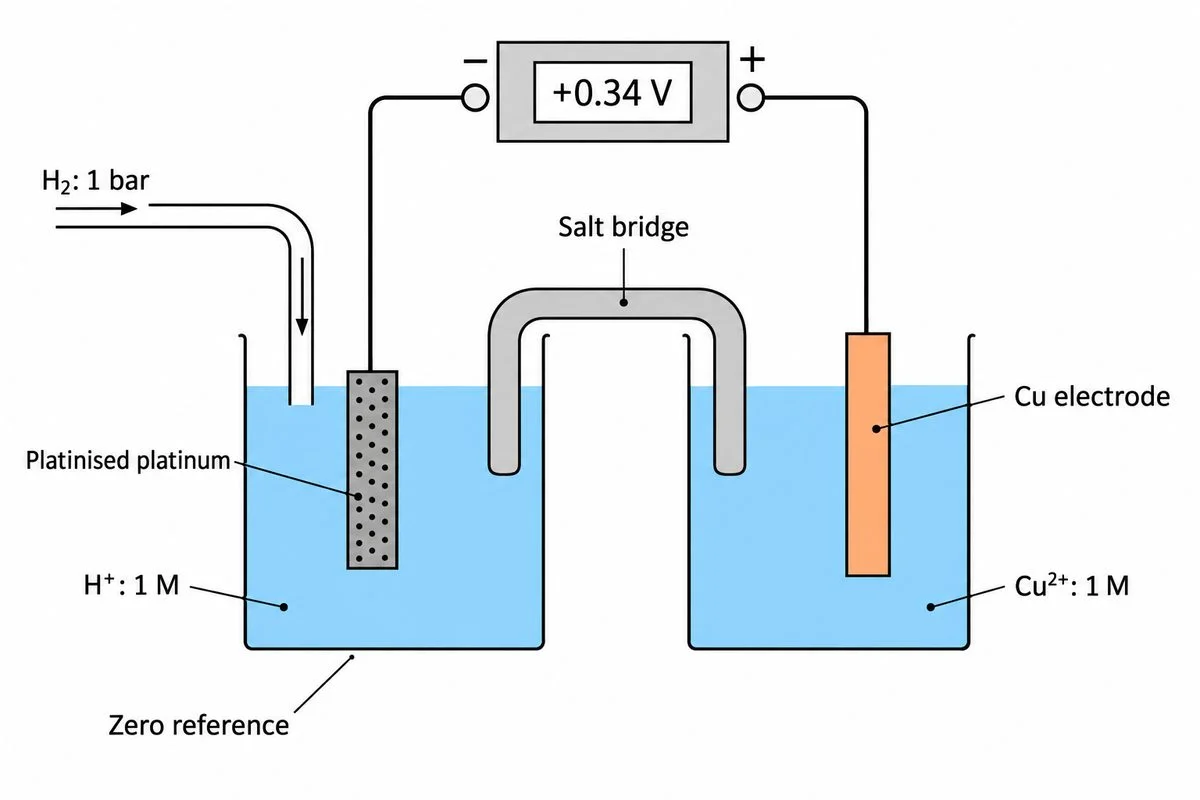
Copper half-cell connected to a standard hydrogen electrode and voltmeter.

2. Standard Electrode Potential

An electrode’s electron-gaining tendency measured against a shared standard.

Show
Look at the diagram for 298 K. Find the hydrogen electrode’s conditions, then copper and the voltmeter.
Ask
What copper potential would you predict from this reading, with hydrogen assigned zero?
Say
The standard hydrogen electrode provides an agreed zero, so copper’s reading gives +0.34 V. The meter measures the difference between them.
Used in
Electrode comparisons help select battery materials that provide a useful voltage.
If your child says…“Every hydrogen electrode has zero potential.”
Ask
Would changing hydrogen pressure still meet those standard conditions?
What’s true
Only the hydrogen electrode under specified standard conditions is assigned zero volts.

E=(1.10−0.05912log⁡1010)VE=\left(1.10-\dfrac{0.0591}{2}\log_{10}10\right)\mathrm{V}

E=(1.10−0.02955)VE=(1.10-0.02955)\mathrm{V}

3. Nernst Equation

Concentrations help determine a cell’s actual voltage.

Show
Write these lines for 298 K. Say: E means voltage; log₁₀ means base-ten logarithm. The denominator 2 counts electrons transferred in the cell reaction. The ratio 10 is zinc-ion concentration divided by copper-ion concentration.
Ask
What voltage comes next?
Say
The voltage falls to about 1.07 V.
Used in
Concentration-dependent electrode voltages let acidity meters measure how acidic a solution is.
If your child says…“The voltage always equals the standard voltage.”
Ask
Why did the calculation subtract something from 1.10 V?
What’s true
Changing ion concentrations can change voltage even when the electrode materials stay unchanged.

How solutions carry charge

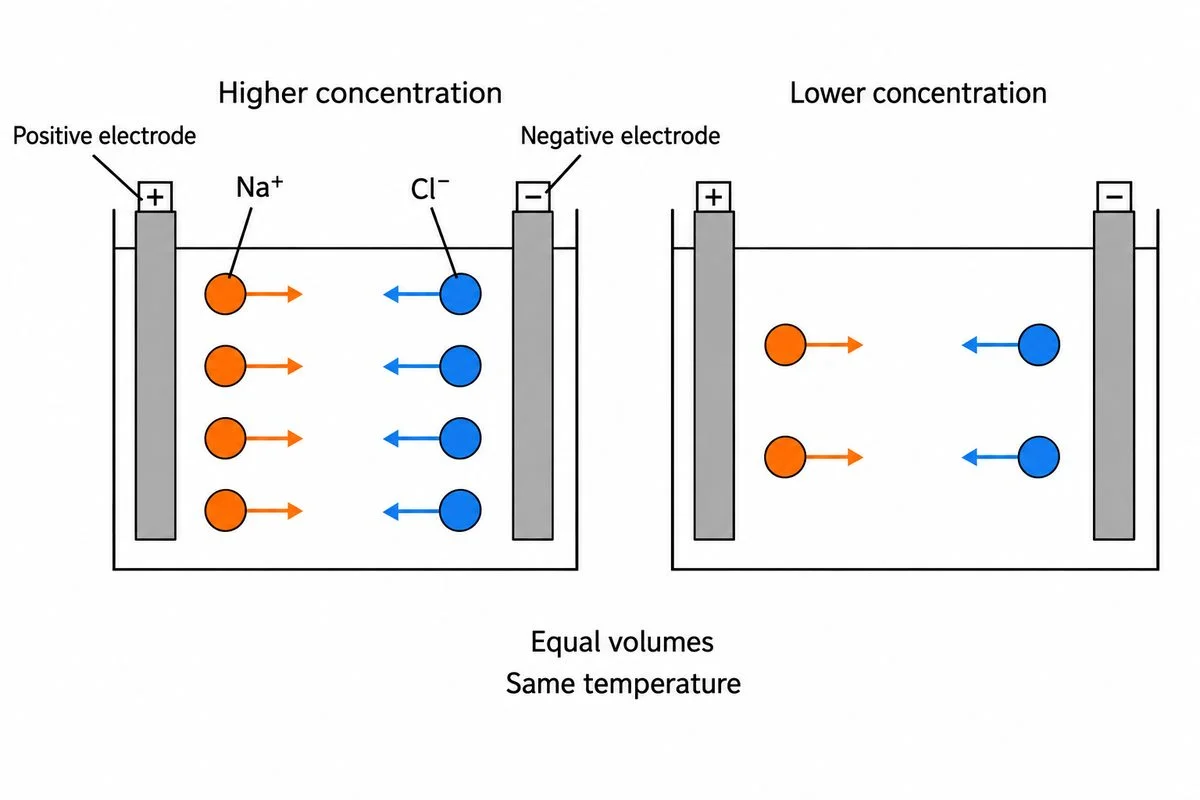
Equal solution volumes with different ion concentrations and opposite ion movements.

4. Conductance of Electrolytic Solutions

Moving ions carry charge through solutions.

Show
Compare equal solution volumes in the diagram, at the same temperature. Notice identical electrodes, fewer ions on the right, and opposite ion movements.
Ask
How will dilution change conductivity and the contribution per mole?
Say
Conductivity falls because each volume contains fewer ions to carry charge. Molar conductivity rises because ions hinder one another less, so each mole contributes more.
Used in
Water-purity checks use conductivity to detect dissolved ionic impurities.
If your child says…“Both conductivity and molar conductivity fall when we add water.”
Ask
Does fewer ions per volume mean each mole must contribute less?
What’s true
For these dilute salt solutions, dilution lowers conductivity but raises molar conductivity.

Λm∘(NaCl)=λ∘(Na+)+λ∘(Cl−)\Lambda_m^\circ(\mathrm{NaCl})=\lambda^\circ(\mathrm{Na}^+)+\lambda^\circ(\mathrm{Cl}^-)

Λm∘(NaCl)=(50.1+76.3) S cm2 mol−1\Lambda_m^\circ(\mathrm{NaCl})=(50.1+76.3)\,\mathrm{S\,cm^2\,mol^{-1}}

5. Kohlrausch’s Law

At infinite dilution, each ion contributes independently to molar conductivity.

Show
Write these lines for 298 K. Say: capital lambda means limiting molar conductivity; small lambda means each ion’s contribution.
Ask
What total comes next?
Say
The total is 126.4 S cm2 mol−1126.4\,\mathrm{S\,cm^2\,mol^{-1}}.
Used in
Conductivity measurements help measure the tiny amounts of salt that dissolve in water.
If your child says…“We count each kind of ion only once.”
Ask
How many chloride ions does one calcium chloride formula unit supply?
What’s true
Each ion’s contribution must include how many of that ion the formula supplies.

Electrochemistry in use

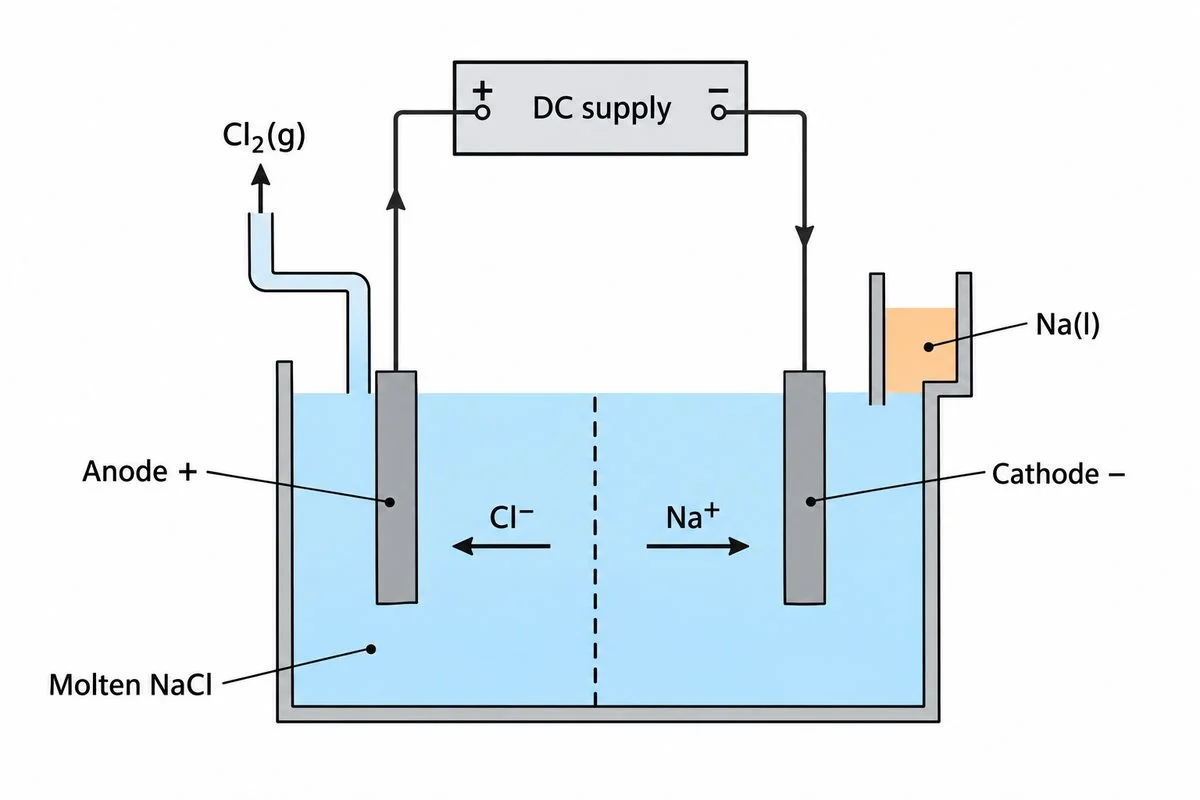
Molten sodium chloride connected to a supply, with ion and electron paths.

6. Electrolytic Cells and Electrolysis

An electricity supply drives a chemical reaction.

Show
Look at the diagram. Trace each supply connection, then follow chloride left and sodium ions right.
Ask
How will the supply turn this molten salt into sodium and chlorine?
Say
The supply gives electrons to sodium ions and removes electrons from chloride ions.
Used in
Electrolysis refines copper for electrical wiring.
If your child says…“One faraday makes one mole of any product.”
Ask
Will the same electron amount form equal numbers of sodium atoms and chlorine molecules?
What’s true
One faraday supplies one mole of electrons, so product amounts depend on their electron requirements.
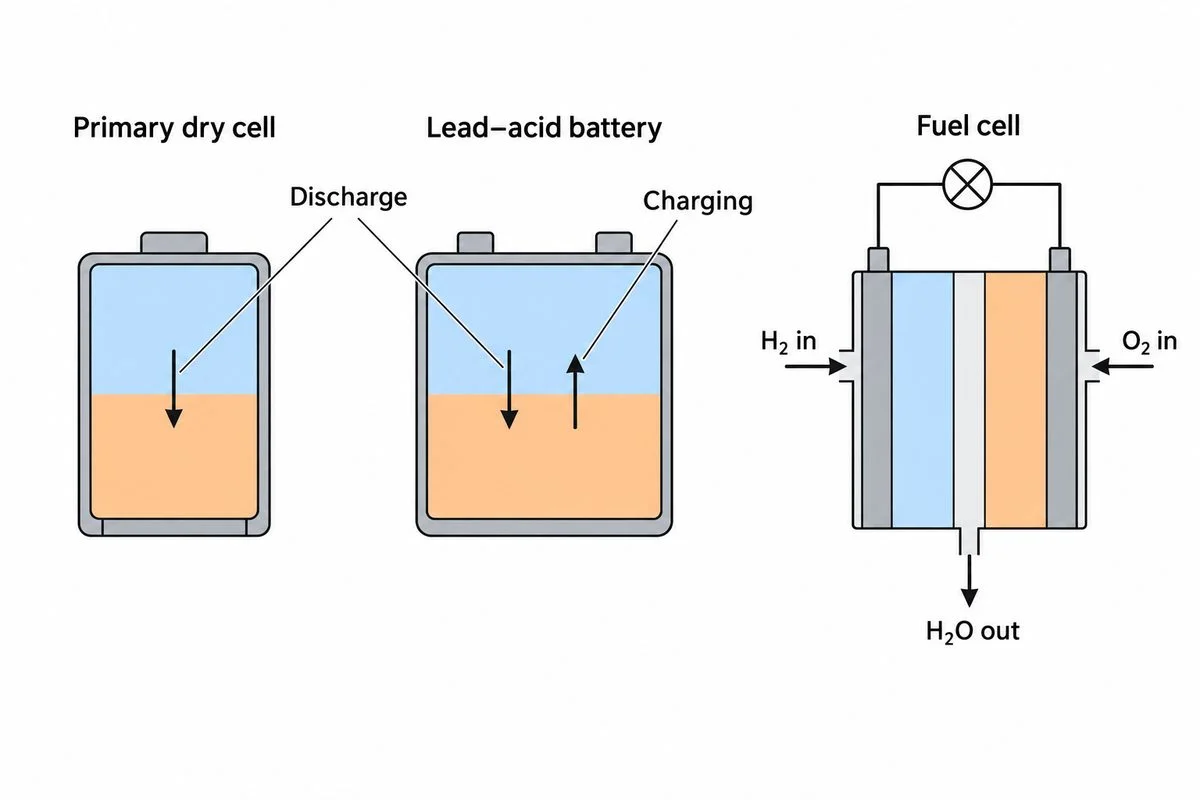
Dry cell, rechargeable battery and fuel cell compared by reaction direction and reactant supply.

7. Batteries and Fuel Cells

Cells differ in recharging and how their reactants reach them.

Show
Look across the diagram from the dry cell to the lead–acid battery. Follow the fuel cell’s incoming gases and outgoing water.
Ask
Which system will need fresh reactants fed in continuously to keep supplying electricity?
Say
The fuel cell needs hydrogen and oxygen supplied continuously, producing electricity and water.
Used in
Rechargeable batteries store solar electricity for use after sunset.
If your child says…“Every battery can be recharged.”
Ask
Which system has a charging arrow that reverses its discharge arrow?
What’s true
Primary cells are not designed for safe recharging.
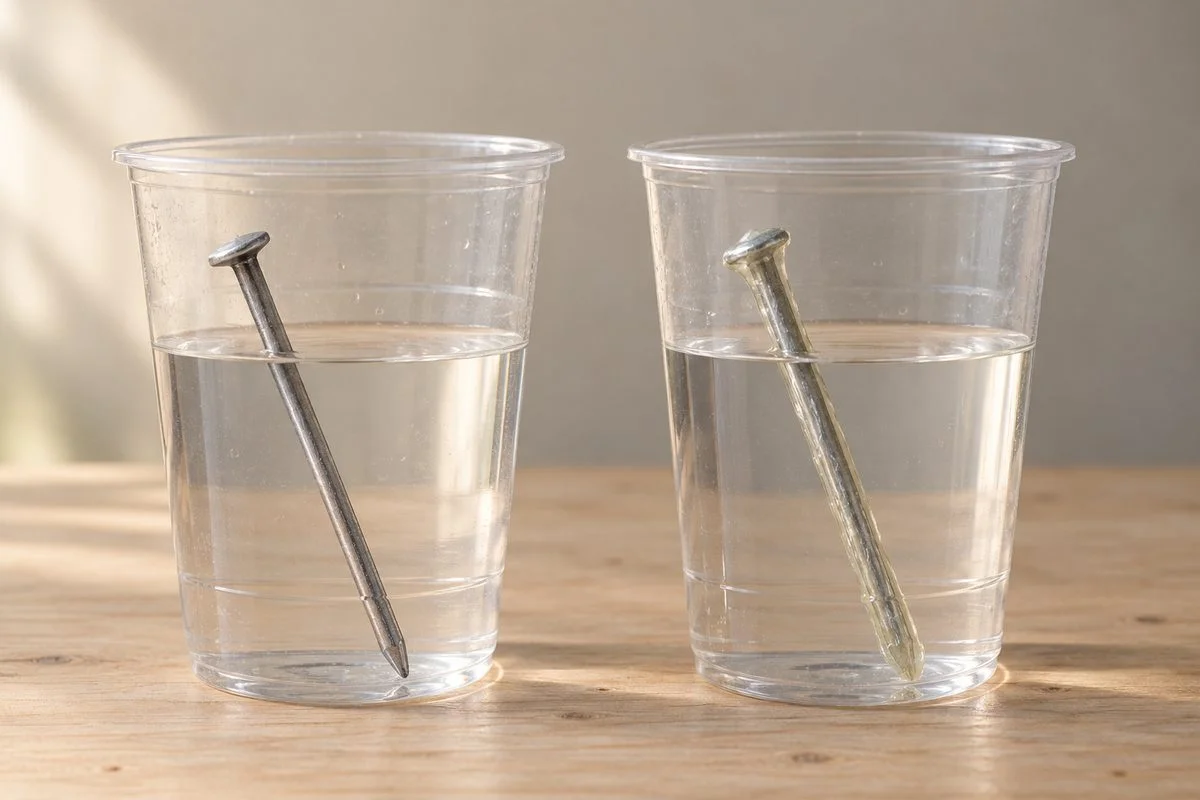
Two cups hold clean iron nails, one bare and one coated.

8. Corrosion

Metal deteriorates through reactions that transfer electrons.

Show
An adult completely coats one of two similar iron nails with petroleum jelly. The adult places them in separate cups containing equal amounts of water. Leave both open to air. Compare after three to five days.
Ask
Which nail will develop more rust?
Say
The uncoated nail will usually develop more visible rust. The coating slows rusting by reducing water and oxygen access.
Used in
Paint slows corrosion of outdoor railings, helping them last longer.
If your child says…“Dry iron simply joins with oxygen to make rust.”
Ask
What does the coating keep from reaching the iron easily?
What’s true
Rusting needs water, with electrons moving through iron and ions through the surface water.

A real problem

Apollo’s fuel cells supplied power and water.

Apollo achieved the first human Moon landing in July 1969.

Its alkaline fuel cells supplied electricity and drinking water.

These cells used hydrogen and oxygen.

Water from their reaction supplied the command module’s drinking-water system.

NASASmithsonianNASA Technical Reports Server

A clear glass of drinking water beside a lit electric lamp.

Concept Lab · Common misconception

The tempting mistake in Electrochemistry

Open standalone misconception page →

Does the anode always have a negative sign?

Wrong

Every anode is negative because the anode is negative in a galvanic cell.

Why it feels right. The sign in the first cell diagram becomes part of my definition.

Right

Oxidation defines the anode. The sign depends on how the cell operates.

Worked example

Daniell cell
Zn loses electrons→Oxidation at negative anode
Electrolytic cell
Supply pulls electrons from electrode→Oxidation at positive anode
The anode is the oxidation site in both cells. The sign is negative in this galvanic cell and positive in the electrolytic cell.
  1. Zinc oxidation occurs at the negative anode of a Daniell cell.
  2. In an electrolytic cell, the positive terminal of the supply draws electrons from the anode, where oxidation still occurs.

Ask your child eight quick questions.

One per step. The answer and the reason are given.

  1. What carries charge through the salt bridge?

    Ions. Electrons travel through the outside wire.

  2. What happens to hydrogen-electrode potential when hydrogen pressure changes, with other conditions unchanged?

    It changes. Assigned zero applies only under the specified standard conditions.

  3. With temperature and zinc-ion concentration fixed, will lowering copper-ion concentration raise or lower voltage?

    Lower it. The reaction quotient increases, making the subtracted correction larger.

  4. Which conductivity increases when this solution is diluted?

    Molar conductivity. Each mole contributes more as interactions between ions weaken.

  5. For calcium chloride, how many chloride contributions belong in the total?

    Two. Each formula unit supplies two chloride ions.

  6. How much copper can one faraday deposit from copper ions needing two electrons each?

    Half a mole. Each copper atom needs two electrons.

  7. Can reversing current safely recharge an ordinary zinc–carbon dry cell?

    No. Its chemistry is not designed for safe reversal during charging.

  8. Why does a complete petroleum-jelly coating reduce rusting?

    It limits water and oxygen. The coating reduces access needed for the corrosion reactions.

15 more questions with answers