Skip to content

Teach Solutions in eight steps.

For each idea: show it, ask before you tell, then say one line.

Gather sugar, water, a glass, teaspoon, water jug, an existing fizzy-drink bottle, paper and a pencil.

An adult opens the drink; taste nothing and never mix cleaning products.

Common misconceptions & worked visual for this chapter · 15 practice questions with answers

How to teach it

Making and describing solutions

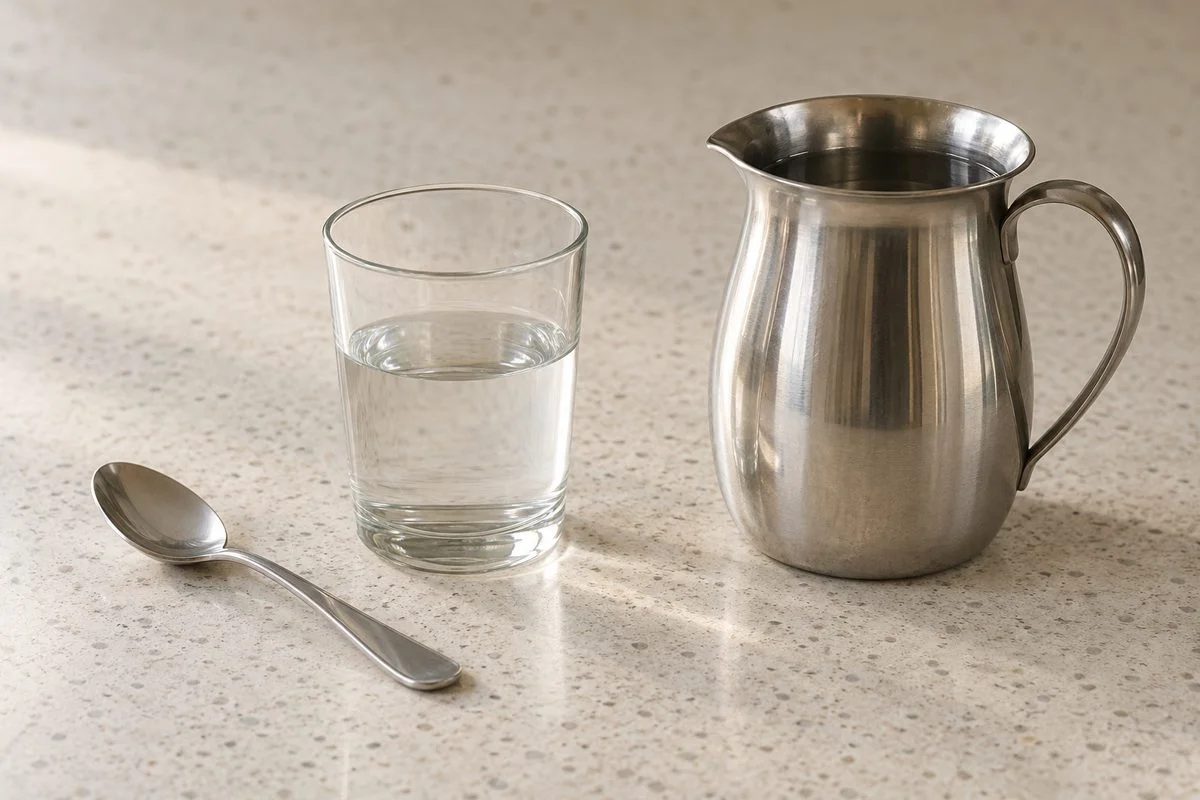
Glass of sugar solution beside a teaspoon and water jug before dilution.

1. Types of solutions and expressing concentration

Concentration compares solute amount with a specified solution or solvent amount.

Show
Stir a teaspoon of sugar into half a glass of water. Name sugar the solute and water the solvent. After the prediction, add more water.
Ask
Which ingredient's amount will stay unchanged when we add water?
Say
The sugar stays unchanged, but its concentration falls.
Used in
Medicine labels give mass per solution volume, helping measure the required amount.
If your child says…“A percentage compares sugar with just the water.”
Ask
Does the dissolved sugar contribute to the solution's total mass?
What’s true
Percentages and parts per million compare with the whole solution, using the stated mass or volume basis.
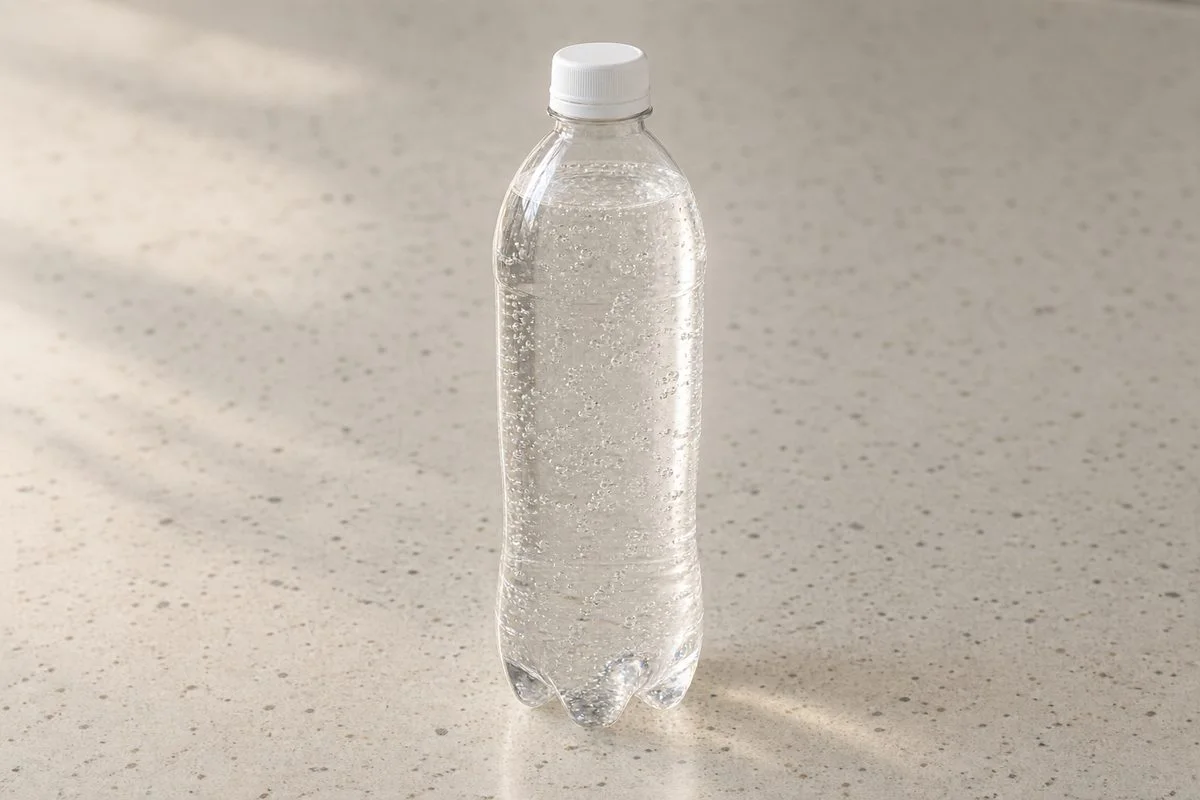
Unopened transparent fizzy-drink bottle standing upright.

2. Solubility and Henry's law

At fixed temperature, dissolved gas increases with its pressure above liquid.

Show
Stand an existing fizzy-drink bottle upright. After the prediction, an adult opens it slowly. Watch the bubbles.
Ask
What will happen to dissolved gas when the cap opens?
Say
Lower pressure lets dissolved gas escape.
Used in
Sealed fizzy-drink bottles retain gas under pressure, keeping the drink fizzy.
If your child says…“A bigger Henry's constant means more gas dissolves.”
Ask
At the same pressure, does dividing by a larger constant give a larger answer?
What’s true
Dissolved mole fraction equals the gas's partial pressure divided by Henry's constant.

Vapour pressure and mixing

ptotal=xApA0+xBpB0p_{\mathrm{total}}=x_Ap_A^0+x_Bp_B^0

ptotal=(12×20+12×40) kPap_{\mathrm{total}}=\left(\frac12\times20+\frac12\times40\right)\,\mathrm{kPa}

ptotal=(10+20) kPap_{\mathrm{total}}=(10+20)\,\mathrm{kPa}

3. Raoult's law

Ideal partial pressure equals liquid mole fraction times pure-component vapour pressure.

Show
Write these lines for equal moles of ideal liquids A and B. Explain x as liquid mole fraction, p as pressure, and superscript zero as pure.
Ask
What total pressure comes next?
Say
The total is 30 kPa after weighting each contribution.
Used in
Distillation enriches the more volatile liquid, helping recover solvents.
If your child says…“Just add the two pure-liquid pressures.”
Ask
Does either liquid occupy the whole mixture?
What’s true
Each liquid's contribution must first be weighted by its liquid mole fraction.
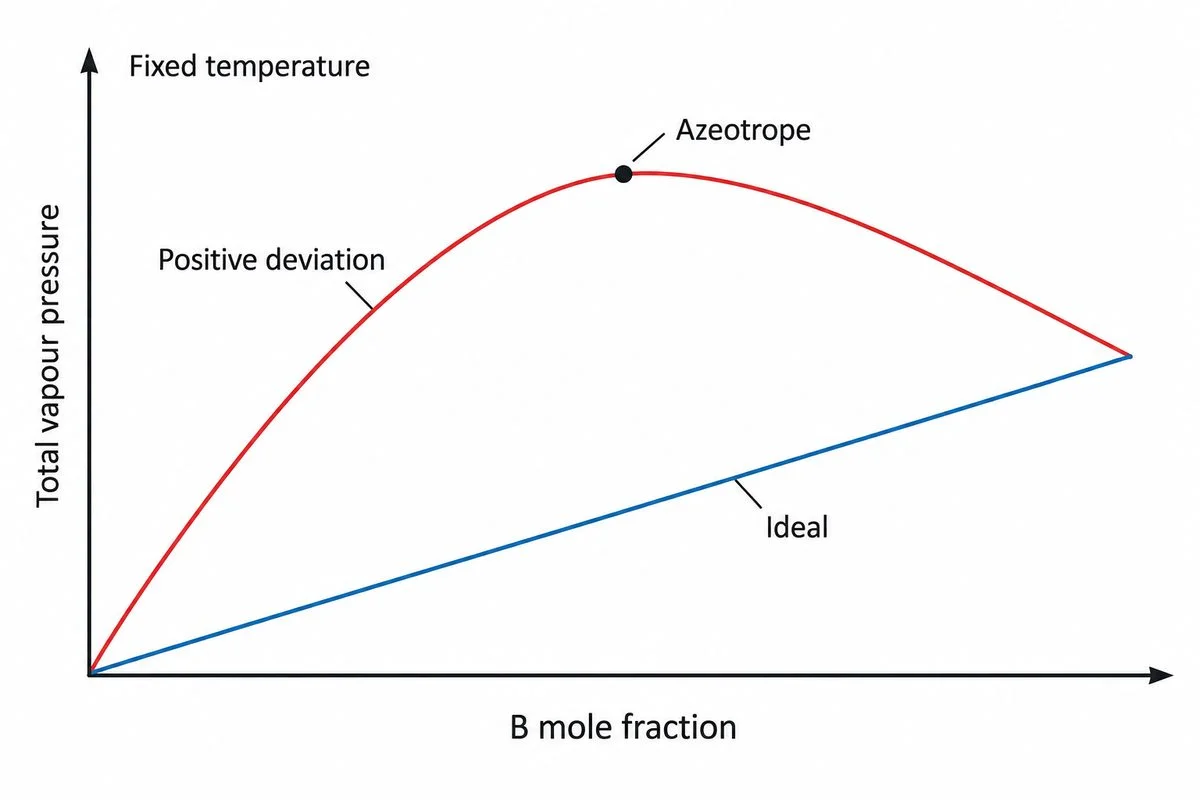
Pressure–composition diagram with an ideal line and positive-deviation curve peaking at an azeotrope.

4. Ideal and non-ideal solutions

Ideal solutions follow Raoult's law throughout; changed attractions cause deviations.

Show
Look at the diagram and compare both lines at the same liquid composition. Find the curve's peak, labelled 'Azeotrope'. Temperature stays fixed.
Ask
At the same composition, would molecules escape more readily from the mixture on the higher curve?
Say
Yes. The higher curve shows positive deviation: unlike molecules attract less strongly than like molecules.
Used in
Recognising azeotropes prevents ineffective attempts to purify mixtures by repeated ordinary fractional distillation.
If your child says…“Enough distillation will separate an azeotrope.”
Ask
How could collecting vapour enrich a liquid if both have the same composition?
What’s true
At an azeotrope, boiling provides no change in composition to exploit.

Effects of dissolved particles

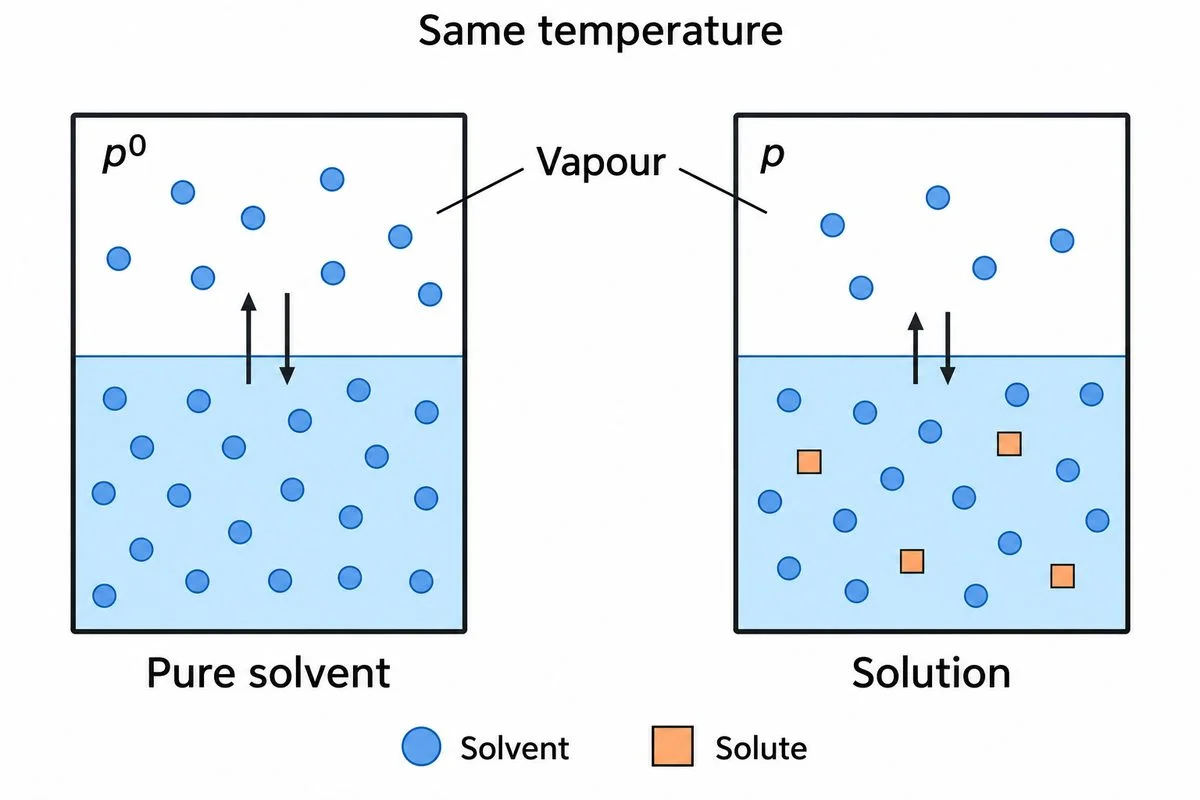
Pure solvent and solution at equilibrium, with fewer vapour particles above the solution.

5. Colligative properties and relative lowering of vapour pressure

Dilute ideal effects follow particle concentration at fixed solvent and temperature.

Show
Compare the diagram's vapours. Name pure-solvent pressure p⁰, solution pressure p, and solute mole fraction x₂.
Ask
Would more non-volatile solute raise or lower this solution's vapour pressure?
Say
Solute reduces solvent escape, lowering equilibrium vapour pressure.
Used in
Vapour-pressure measurements help determine dissolved substances' molar masses.
If your child says…“Divide the pressure fall by the solution's pressure.”
Ask
Should a relative fall be compared with the original pressure or the reduced pressure?
What’s true
Relative lowering compares the pressure fall with pure-solvent pressure at the same temperature.

ΔTb=Kbm\Delta T_b=K_bm

m=0.052 K0.52 K kg mol−1=0.100 mol kg−1m=\frac{0.052\,\mathrm K}{0.52\,\mathrm{K\,kg\,mol^{-1}}}=0.100\,\mathrm{mol\,kg^{-1}}

(0.100 mol kg−1)(0.100 kg)=0.0100 mol(0.100\,\mathrm{mol\,kg^{-1}})(0.100\,\mathrm{kg})=0.0100\,\mathrm{mol}

6. Elevation of boiling point and depression of freezing point

Dissolved particles raise boiling temperature and lower freezing temperature.

Show
Write these lines: boiling-point rise equals water's boiling constant times molality. Use 1.00 g non-volatile solute; particles neither split nor join.
Ask
What molar mass follows?
Say
The molar mass is 100 g/mol: divide mass by moles.
Used in
Antifreeze keeps coolant liquid in cold conditions.
If your child says…“Adding solute raises the freezing point too.”
Ask
For a freezing-point drop, should we add to or subtract from the pure solvent's freezing temperature?
What’s true
A non-volatile solute raises boiling temperature but lowers freezing temperature in this dilute solution.
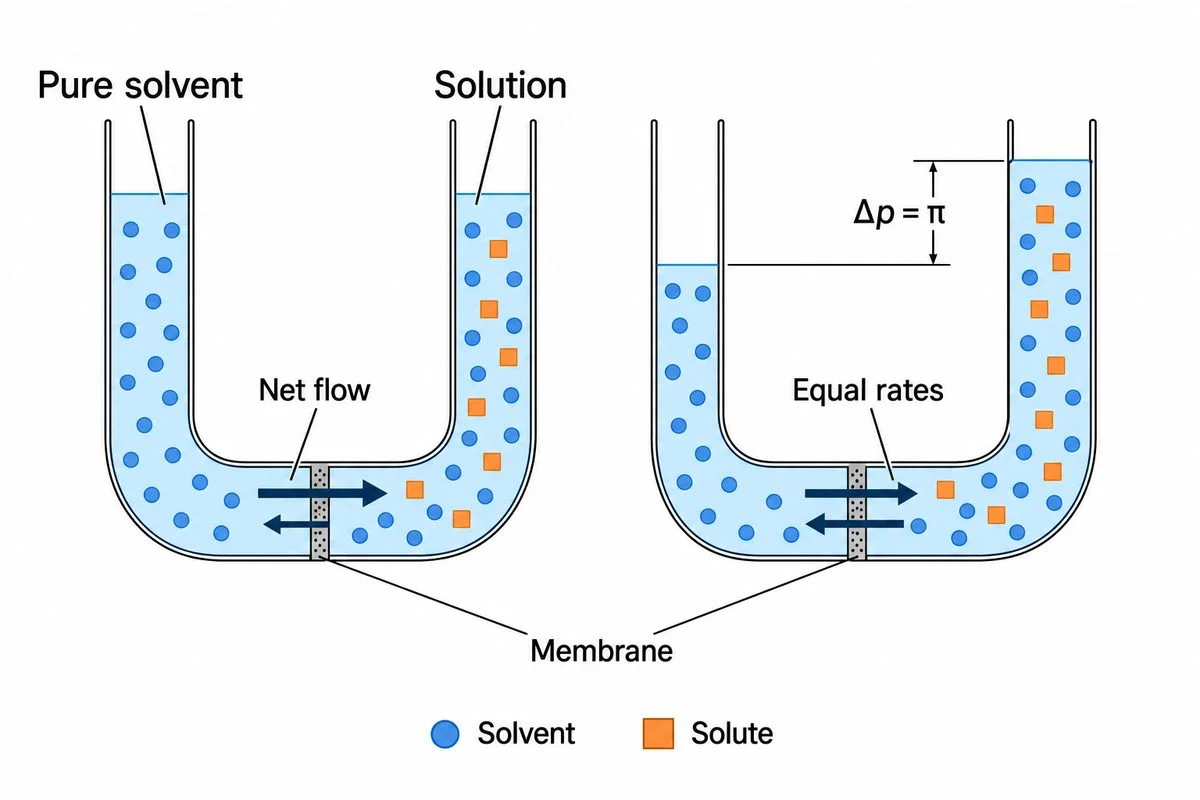
U-tube stages show solvent entry followed by a balancing pressure from the raised solution.

7. Osmosis and osmotic pressure

Osmotic pressure is the opposing pressure that stops net osmosis.

Show
In the diagram, follow solvent towards solution. Find the final raised level and equal arrows.
Ask
What eventually stops net solvent entry?
Say
The raised column supplies opposing pressure, balancing the diluted solution's osmotic pressure. Solvent still crosses both ways equally.
Used in
Salting vegetables draws water out, helping remove excess moisture before cooking.
If your child says…“The solute crosses the membrane while water stays put.”
Ask
Which particles cross the membrane in the diagram?
What’s true
The membrane lets solvent cross, while solute stays on the solution side.

(1.86 K kg mol−1)(0.0100 mol kg−1)=0.0186 K(1.86\,\mathrm{K\,kg\,mol^{-1}})(0.0100\,\mathrm{mol\,kg^{-1}})=0.0186\,\mathrm K

i=0.03610.0186≈1.94i=\frac{0.0361}{0.0186}\approx1.94

8. Abnormal molar masses and van't Hoff factor

The factor compares measured effects with predictions ignoring splitting or joining.

Show
Write these lines for sodium chloride. Its measured freezing-point drop is 0.0361 K; call the measured-to-predicted ratio i.
Ask
What apparent molar mass follows from dividing 58.5 g/mol by this factor?
Say
The apparent molar mass is about 30.2 g/mol.
Used in
Particle-count corrections improve freezing-temperature predictions for cooling mixtures.
If your child says…“Splitting particles makes the calculated molar mass too large.”
Ask
If splitting suggests more moles, what happens to mass divided by moles?
What’s true
Dissociation increases the measured effect, so ignoring it makes the inferred molar mass too small.

A real problem

Nemmeli uses reverse osmosis to make seawater drinkable.

The Nemmeli desalination plant was commissioned in 2013.

Reverse osmosis converts its seawater into drinking water.

The water was intended for residents of southern Chennai neighbourhoods.

WaterWorldThe New Indian ExpressPress Information Bureau

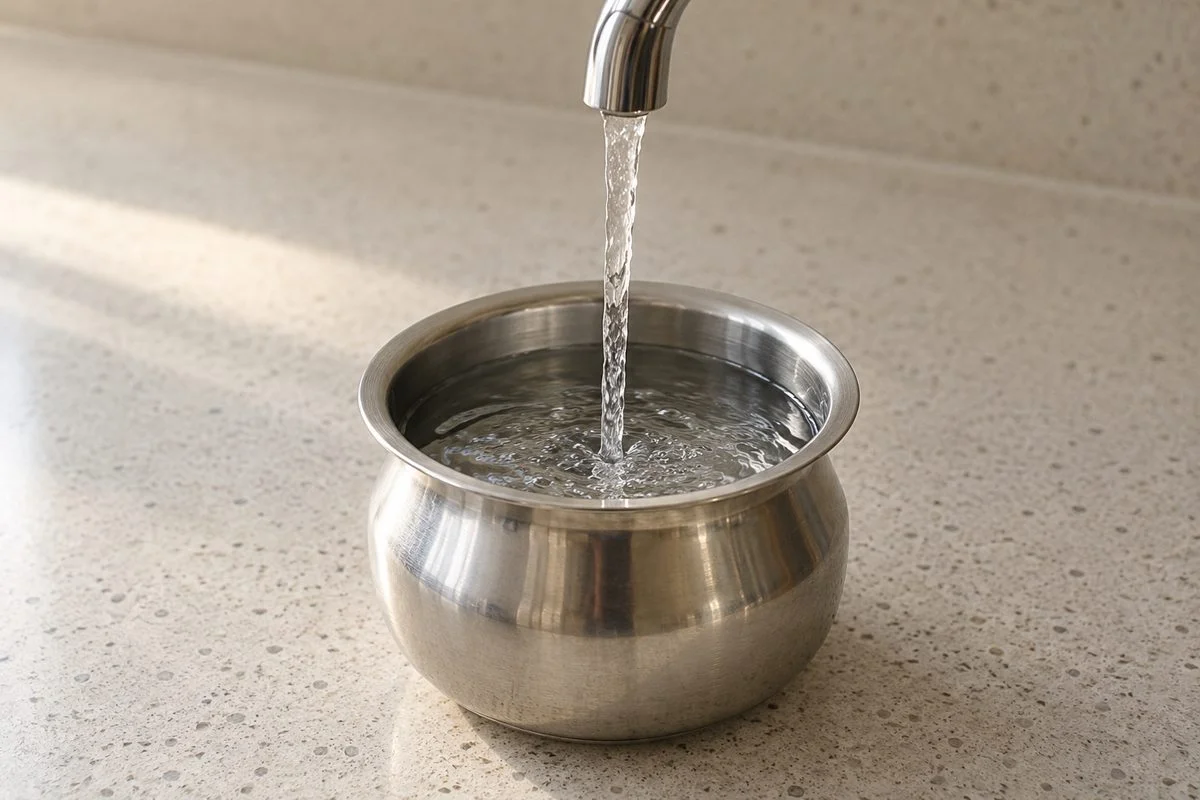
Kitchen tap filling a stainless-steel water vessel.

Concept Lab · Common misconception

The tempting mistake in Solutions

Open standalone misconception page →

Does molarity stay constant when a solution is warmed?

Wrong

The molarity remains unchanged because the amount of solute stays the same.

Why it feels right. I track the numerator and overlook the volume.

Right

Molarity uses solution volume. Molality uses solvent mass.

Worked example

SampleVolumeMolarityMolality
Before1.00 L1.00 mol/L1.00 mol/kg
After1.02 L0.98 mol/L1.00 mol/kg
Warming expands the example solution. The volume-based concentration falls while the mass-based concentration stays fixed.
  1. A closed sample has 1.00 mol of solute in 1.00 L of solution made with 1.00 kg of solvent.
  2. If volume grows to 1.02 L, molarity falls to 0.98 mol/L while molality stays 1.00 mol/kg.

Ask your child eight quick questions.

One per step. The answer and the reason are given.

  1. For 12 g sugar dissolved in 88 g water, what mass divides the mass-percentage calculation?

    100 g of solution. The denominator includes both sugar and water.

  2. At equal gas pressure and temperature, which Henry's constant means less dissolved gas?

    The larger constant. The dissolved mole fraction decreases when its divisor increases.

  3. Which liquid contributes more to this mixture's vapour pressure?

    B. Halving both pure pressures gives 20 kPa from B and 10 kPa from A.

  4. For the mixture at the curve's marked peak, would condensing its vapour change the composition?

    No. The vapour has the same composition as the liquid it leaves.

  5. Pressure falls from 100 to 98 mm Hg after dissolving solute. What is the relative lowering?

    0.020. Divide the fall of 2 by the original pressure of 100.

  6. Compared with pure water, where would this solution's freezing temperature lie?

    Below pure water's. Dissolved solute lowers the freezing temperature.

  7. At the final levels, what crosses the membrane equally in both directions?

    Solvent. Pressure balances net flow, while the membrane continues to hold back solute.

  8. For this salt, how does the uncorrected molar mass compare with 58.5 g/mol?

    It is smaller. Dissociation increases particle count, making the uncorrected calculation overestimate solute moles.

15 more questions with answers