Skip to content

Teach Haloalkanes and Haloarenes in six steps.

For each idea: show it, ask before you tell, then say one line.

Gather paper and a pencil.

Common misconceptions & worked visual for this chapter · 15 practice questions with answers

How to teach it

Identify and prepare

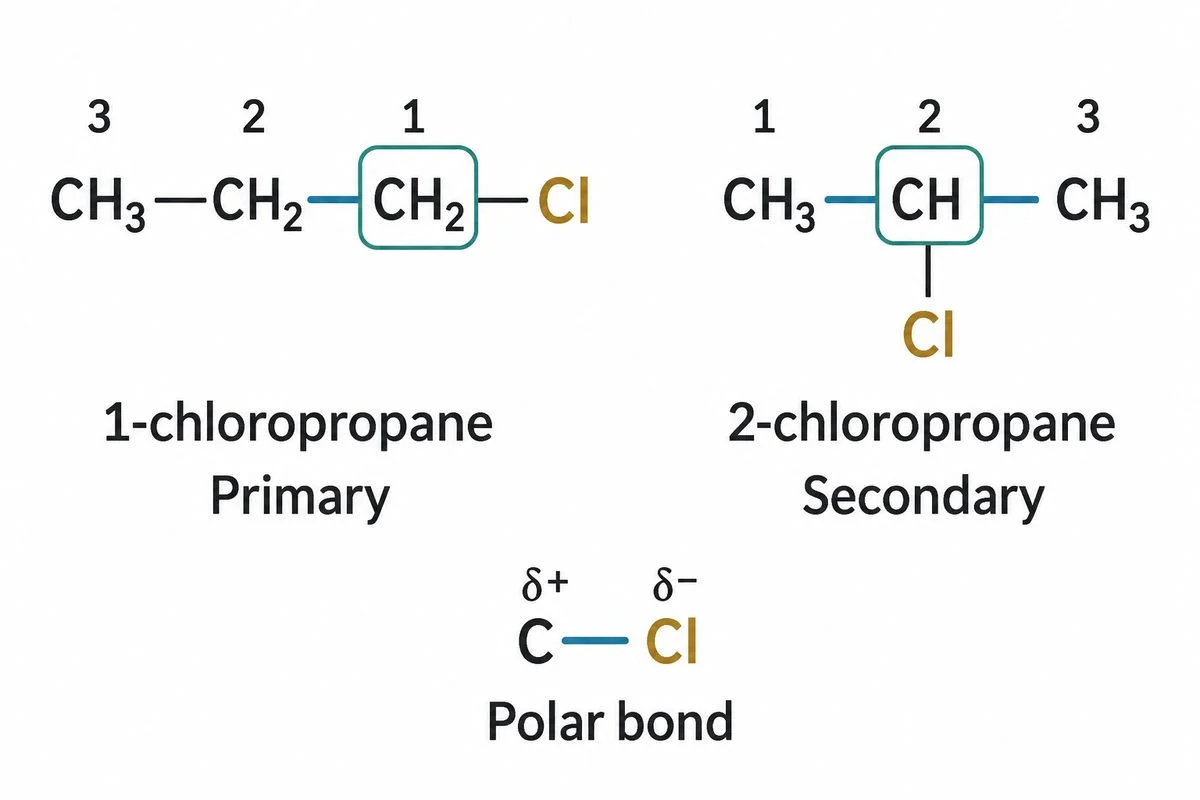
Two chloropropane structures show chlorine positions, carbon neighbours and carbon–chlorine bond polarity.

1. Classification, Naming and the Carbon–Halogen Bond

The halogen’s position and its carbon determine classification and naming.

Show
Look at the diagram. Find each chlorine-bearing carbon, then count its carbon neighbours. Read the position numbers and partial charges.
Ask
How would moving chlorine from the end to the middle change the name and class?
Say
The name changes from 1-chloropropane to 2-chloropropane. Two carbon neighbours make the middle carbon secondary. Chlorine attracts shared electrons more strongly, making carbon slightly positive and chlorine slightly negative.
Used in
Chemical names identify ingredients precisely, helping manufacturers select the intended starting material.
If your child says…“Secondary means there are two chlorine atoms.”
Ask
How many chlorines are present, and how many carbon neighbours does chlorine’s carbon have?
What’s true
Secondary means the chlorine-bearing carbon has two carbon neighbours.
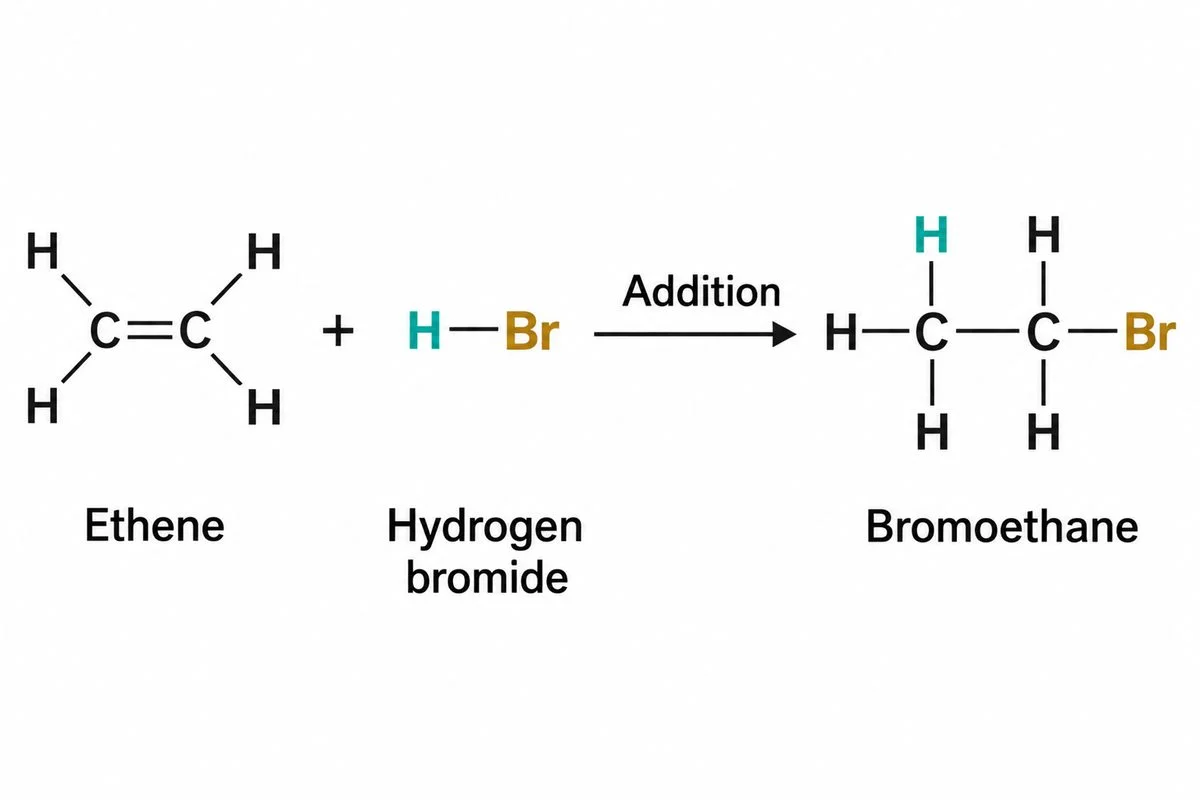
Ethene and hydrogen bromide form bromoethane, with the added atoms highlighted.

2. Methods of Preparation

Adding hydrogen halide across an alkene’s double bond makes a haloalkane.

Show
Cover the diagram’s product with paper. Find ethene’s double bond, then hydrogen bromide. After the prediction, uncover the product and trace both added atoms.
Ask
How could hydrogen and bromine attach without breaking the carbon chain?
Say
Hydrogen and bromine attach to neighbouring carbons, forming bromoethane. The double bond becomes a single bond, and every atom remains.
Used in
Preparing halo compounds supplies starting materials for making medicines.
If your child says…“Opening the double bond removes some atoms.”
Ask
Can you find every starting atom in the product?
What’s true
This addition changes bonds while keeping every atom.

Predict reactions

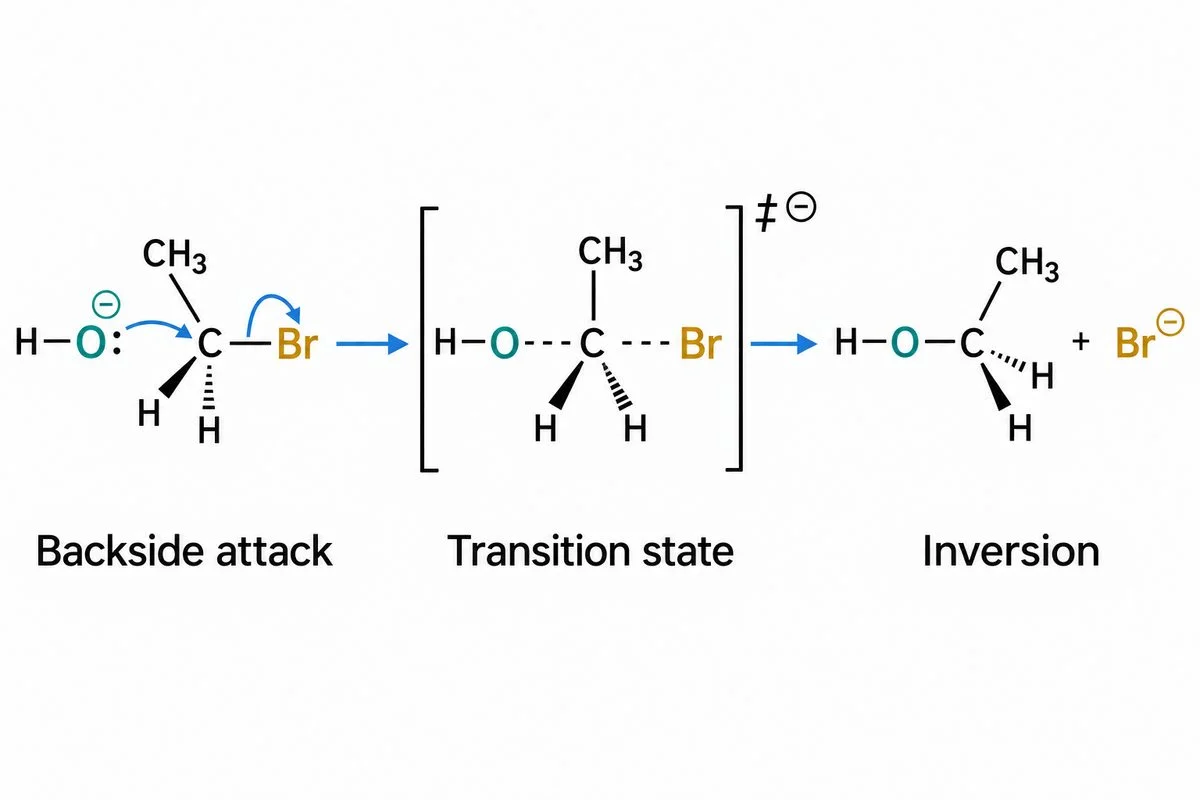
Hydroxide replaces bromide through backside attack, a transition state and an inverted bond arrangement.

3. Nucleophilic Substitution Reactions

Replacing halogen can change molecular arrangement.

Show
Cover the diagram’s final panel. Follow hydroxide’s electron pair towards carbon and the carbon–bromine pair towards bromine. After the prediction, uncover the final panel.
Ask
How will attack from opposite bromine change the arrangement around carbon?
Say
In SN2, the arrangement turns inside out as hydroxide joins and bromide leaves together.
Used in
Controlling molecular arrangement helps manufacturers obtain the required medicine form.
If your child says…“The incoming group simply takes bromine’s exact position.”
Ask
Which side can hydroxide reach while bromine is still attached?
What’s true
Hydroxide approaches opposite bromine, inverting the arrangement around the reacting carbon.
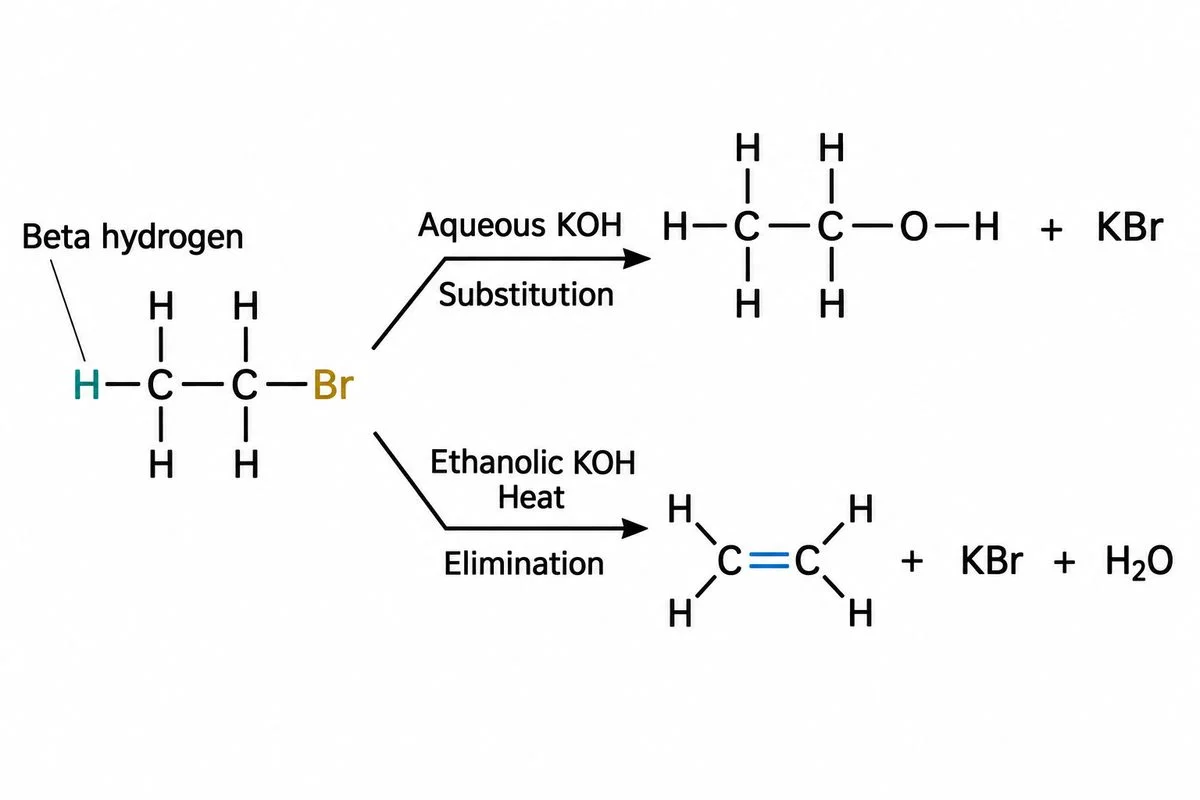
Bromoethane branches towards ethanol or ethene under different potassium hydroxide conditions.

4. Elimination Reactions and Reaction with Metals

Reaction conditions affect whether halogen replacement or elimination predominates.

Show
Cover both products in the diagram. Find bromoethane, then read each arrow’s conditions. Locate bromine and the highlighted hydrogen on its neighbouring carbon.
Ask
How might hot ethanolic potassium hydroxide change the product compared with aqueous potassium hydroxide?
Say
Aqueous potassium hydroxide favours replacement of bromine by hydroxide, forming ethanol. Hot ethanolic potassium hydroxide favours elimination, forming ethene. Hydrogen and bromine leave neighbouring carbons, creating a double bond.
Used in
Elimination supplies alkenes as starting materials for making other organic compounds.
If your child says…“Potassium hydroxide always replaces bromine with hydroxide.”
Ask
What differs between the conditions written beside these two arrows?
What’s true
The starting compound, base, solvent and temperature affect competition between substitution and elimination.
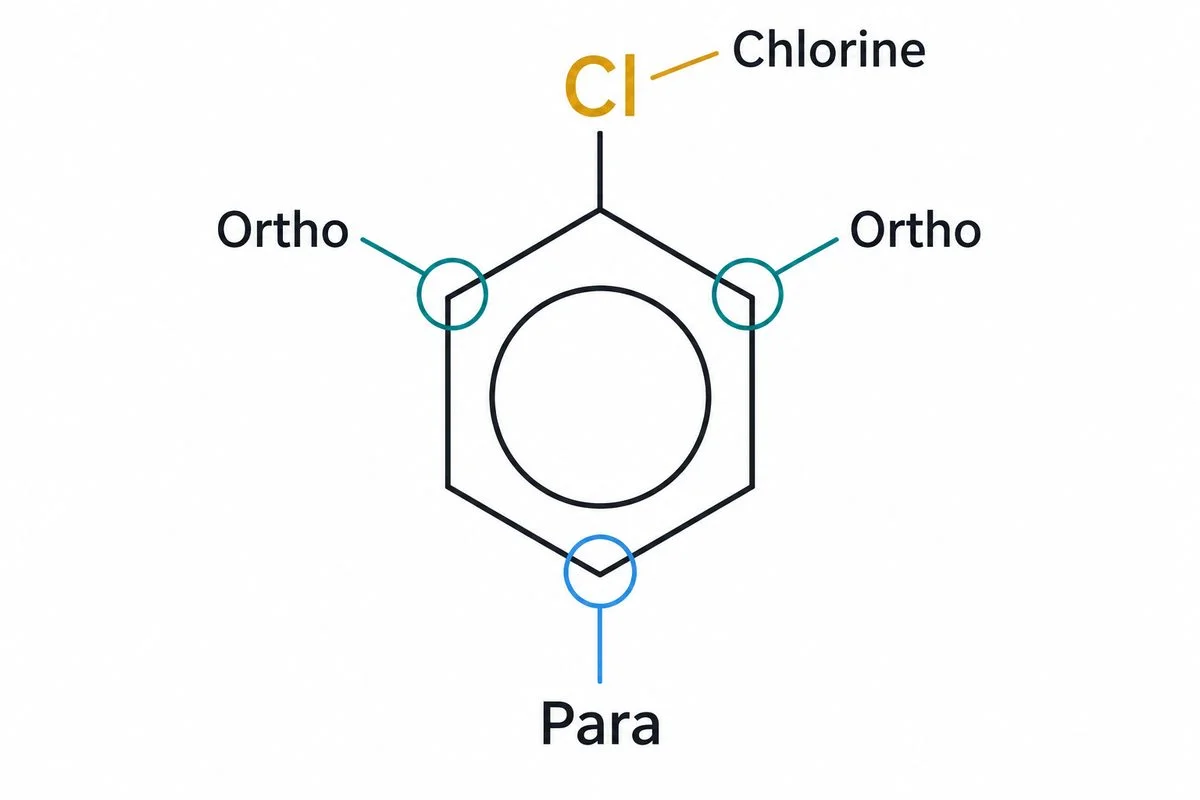
Chlorobenzene diagram with chlorine above and ortho and para ring positions circled.

5. Reactions of Haloarenes

Ring-bound halogen resists replacement but directs substitution of ring hydrogen.

Show
Find chlorine on the diagram. Locate the two neighbouring ring carbons and the opposite ring carbon.
Ask
Does favouring these positions mean chlorobenzene reacts faster than benzene?
Say
Chlorine slows electrophilic substitution while directing it mainly to neighbouring ortho and opposite para positions.
Used in
Predicting ring positions helps chemists prepare the intended starting materials for dyes.
If your child says…“Ortho and para directing means faster than benzene.”
Ask
Does choosing where a reaction happens tell us how quickly it happens?
What’s true
Chlorine favours substitution at ortho and para positions, but chlorobenzene reacts more slowly than benzene.

Connect usefulness and harm

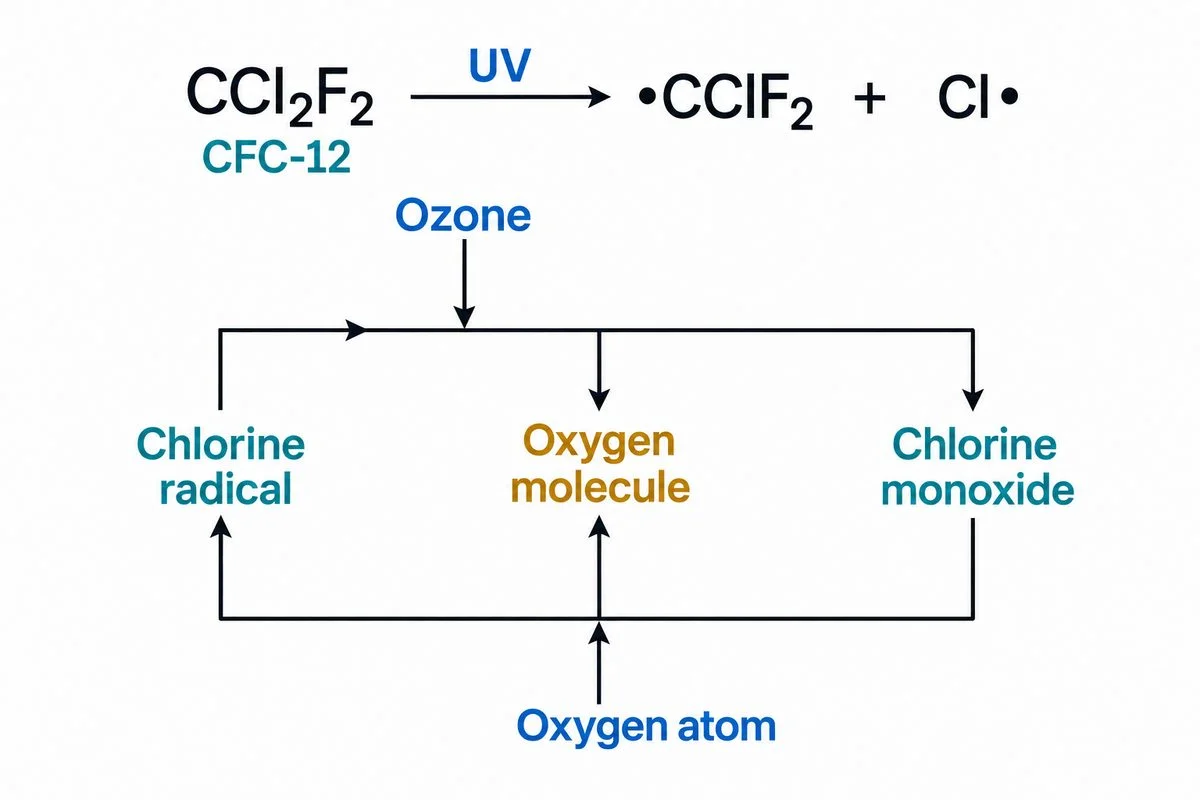
Ultraviolet light releases chlorine, which cycles through reactions consuming ozone and regenerating chlorine.

6. Polyhalogen Compounds

Compounds containing several halogens can have lasting environmental effects.

Show
Look at the diagram’s ultraviolet breakdown of the CFC. Follow chlorine around the loop. Track the ozone entering and oxygen molecules leaving.
Ask
What would let this chlorine radical destroy another ozone molecule?
Say
The cycle regenerates the chlorine radical, so it can react again.
Used in
Halogen-containing refrigerants remove heat, keeping food cool.
If your child says…“One chlorine atom can destroy only one ozone molecule.”
Ask
Where is the chlorine atom when the cycle finishes?
What’s true
Chlorine is regenerated during this reaction cycle rather than permanently used up.

A real problem

DDT helped malaria control but persists in the environment.

Successful DDT spraying trials in India preceded the national programme.

India launched its National Malaria Control Programme in 1953.

DDT is an organochlorine insecticide used to control mosquitoes that spread malaria.

DDT remains in the environment for a long time.

Indian Journal of Medical ResearchWHOOregon State University

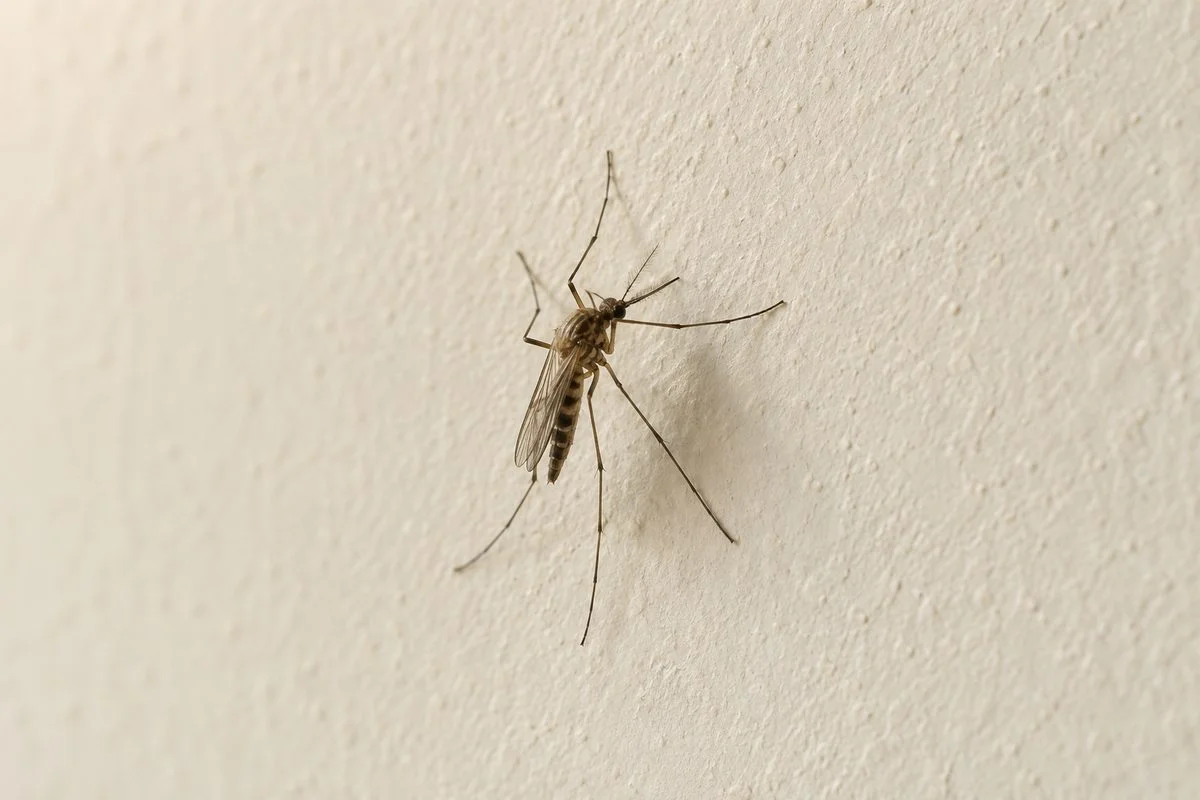
A mosquito resting on a pale interior wall.

Concept Lab · Common misconception

The tempting mistake in Haloalkanes and Haloarenes

Open standalone misconception page →

Should chlorobenzene react like chloroethane?

Wrong

Chlorobenzene readily substitutes chloride under the same conditions as chloroethane.

Why it feels right. Both contain a C–Cl bond and chloride seems like the same leaving group.

Right

Chlorobenzene has chlorine bonded to an aromatic sp² carbon. Resonance gives that C–Cl bond partial double-bond character.

Worked example

Chloroethane
C–Cl at saturated carbon→Can substitute under suitable mild conditions
Chlorobenzene
C–Cl at aromatic carbon→Much less reactive under those conditions
A C–Cl bond attached to an aromatic carbon behaves differently from one attached to a saturated carbon.
  1. Under mild conditions suitable for substituting chloroethane with aqueous hydroxide, chlorobenzene is much less reactive.
  2. Its aromatic C–Cl bond and geometry make the usual alkyl substitution pathways unfavourable.

Ask your child six quick questions.

One per step. The answer and the reason are given.

  1. How many carbon neighbours does the chlorine-bearing carbon have in 2-chloropropane?

    Two. Count carbon neighbours of the chlorine-bearing carbon, rather than chlorine atoms.

  2. Are any atoms lost when ethene reacts with hydrogen bromide?

    No. The carbon–carbon bond changes, but all starting atoms enter bromoethane.

  3. How does SN2 change the arrangement at this carbon?

    It inverts the arrangement. The incoming group attacks from the side opposite the leaving group.

  4. Which organic product forms in this elimination?

    Ethene. Removing hydrogen and bromine from neighbouring carbons creates a carbon–carbon double bond.

  5. Compared with benzene, how readily does chlorobenzene undergo electrophilic substitution?

    Less readily. Chlorine deactivates the ring even though it favours particular positions.

  6. What lets the same chlorine atom destroy more ozone?

    It is released again. The cycle regenerates chlorine, allowing another reaction with ozone.

15 more questions with answers