Skip to content

Teach Patterns in Mathematics in eight steps.

For each idea: show it, ask before you tell, then say one line.

Gather paper, a pencil, 36 dried chickpeas and nine equal-sized coins.

Common misconceptions & worked visual for this chapter · 15 practice questions with answers

How to teach it

Recognising number patterns

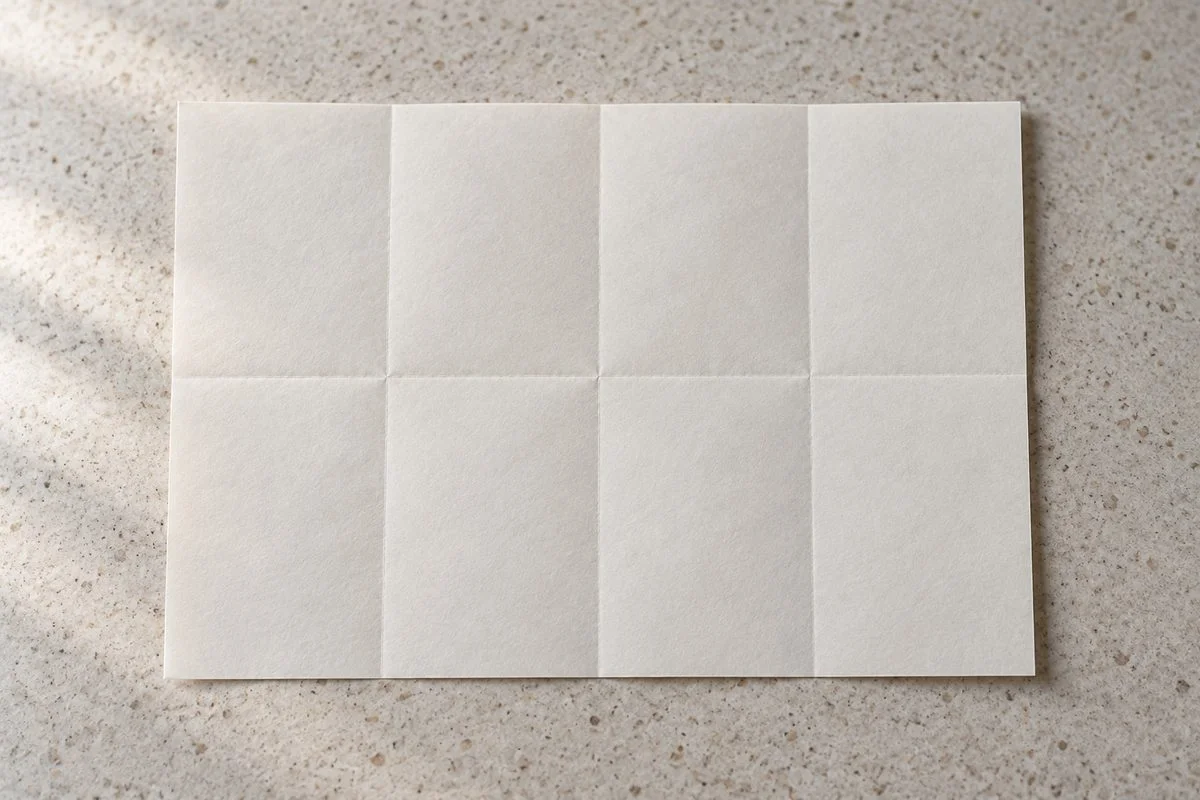
An unfolded sheet divided by creases into eight equal regions.

1. Number Sequences

Numbers arranged in order using a rule.

Show
Count the unfolded sheet as one region. Fold the whole sheet in half, open and count. Repeat twice, restoring previous folds before each new fold.
Ask
Which rule fits every region count and predicts the count after another fold?
Say
When each new fold halves every region, the count doubles. Another such fold gives 16.
Used in
Weavers follow repeating rules to keep cloth borders consistent.
If your child says…“The first increase is one, so we keep adding one.”
Ask
Does adding one take us from 2 regions to 4?
What’s true
Adding one fails at later counts, while doubling fits every fold.
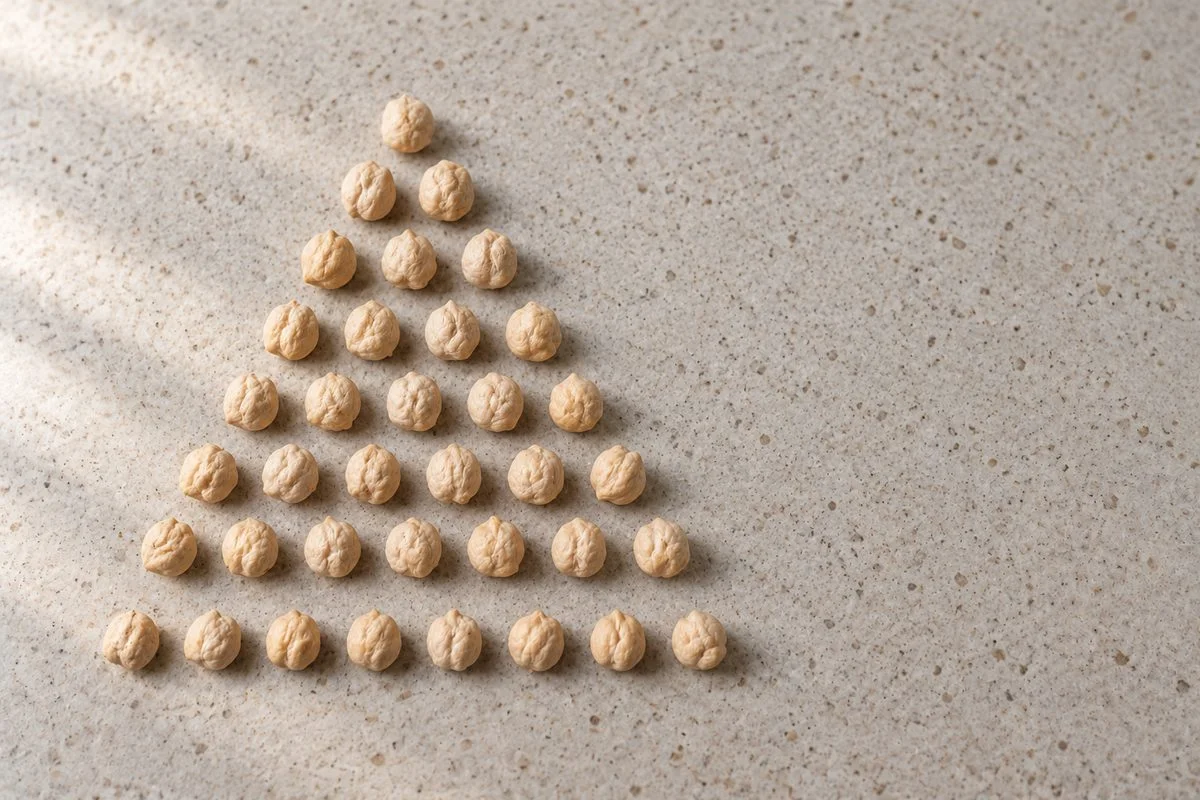
Chickpea triangle with its bottom row slightly separated.

2. Visualising Number Sequences

Arrangements explain why numbers have shape names.

Show
Arrange 36 chickpeas in centred rows from 1 to 8. Separate the final row slightly. Count its eight chickpeas.
Ask
Will these same chickpeas fill a square without leftovers?
Say
Yes, they fill six rows of six.
Used in
Fruit sellers arrange displays in rows, making their stock easier to count.
If your child says…“A square number cannot also be triangular.”
Ask
Did rearranging the chickpeas change how many we had?
What’s true
A count can fit both arrangements without gaining or losing anything.
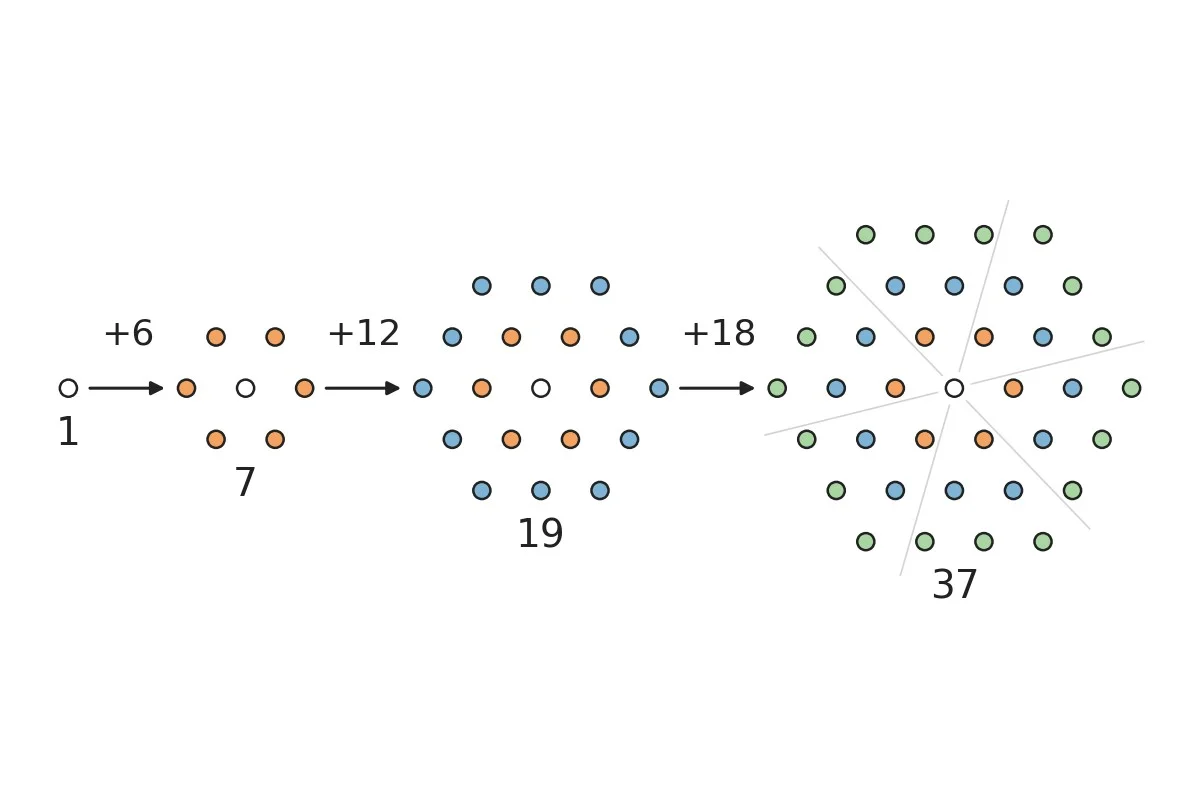
Growing hexagonal dot rings with totals and additions labelled.

3. Hexagonal Numbers

A centre and growing hexagonal rings give these totals.

Show
Find the centre dot in the diagram. Follow the arrows through the growing rings. Count each ring’s six equal groups.
Ask
What total will the next ring give after 37, without recounting the inner dots?
Say
The rings add 6, then 12, then 18 dots. The next adds 24, giving 61 altogether.
Used in
Hexagonal packing fits round jars closely together, saving shelf space.
If your child says…“Every new ring adds six dots.”
Ask
How many dots does each group gain when we move to the next ring?
What’s true
Each new ring contains six more dots than the previous ring.

Adding number patterns

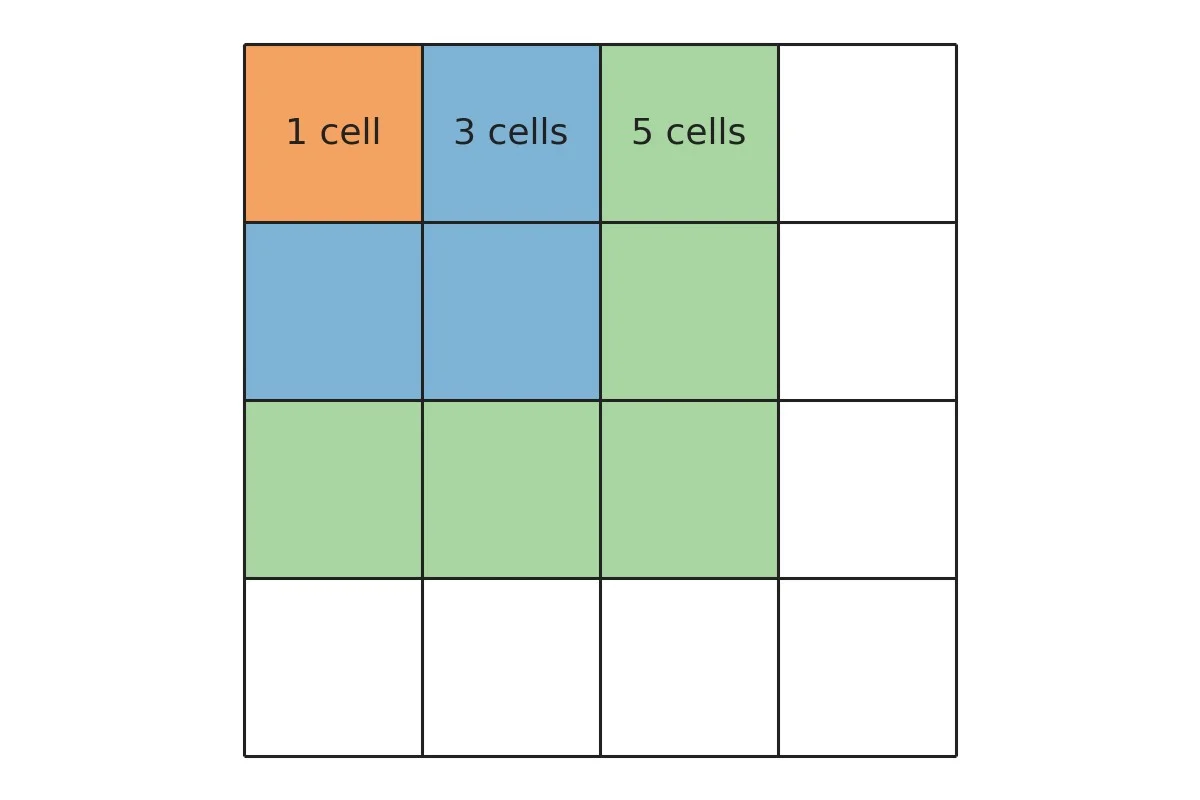
Nested shaded square bands beside an unshaded L-shaped border.

4. Adding up Odd Numbers

Successive odd counts, starting at one, build squares.

Show
Find the square’s shaded bands in the diagram. Count the cells in each band. Follow the unshaded L along the bottom and right.
Ask
What square will the next L complete?
Say
Seven more cells complete four rows of four. The first four odd numbers therefore total 16.
Used in
L-shaped tile borders enlarge a square patch while keeping it square.
If your child says…“The last odd number is seven, so the total is seven squared.”
Ask
Will the completed square have four cells along each side, or seven?
What’s true
The number of groups gives the square’s side length.
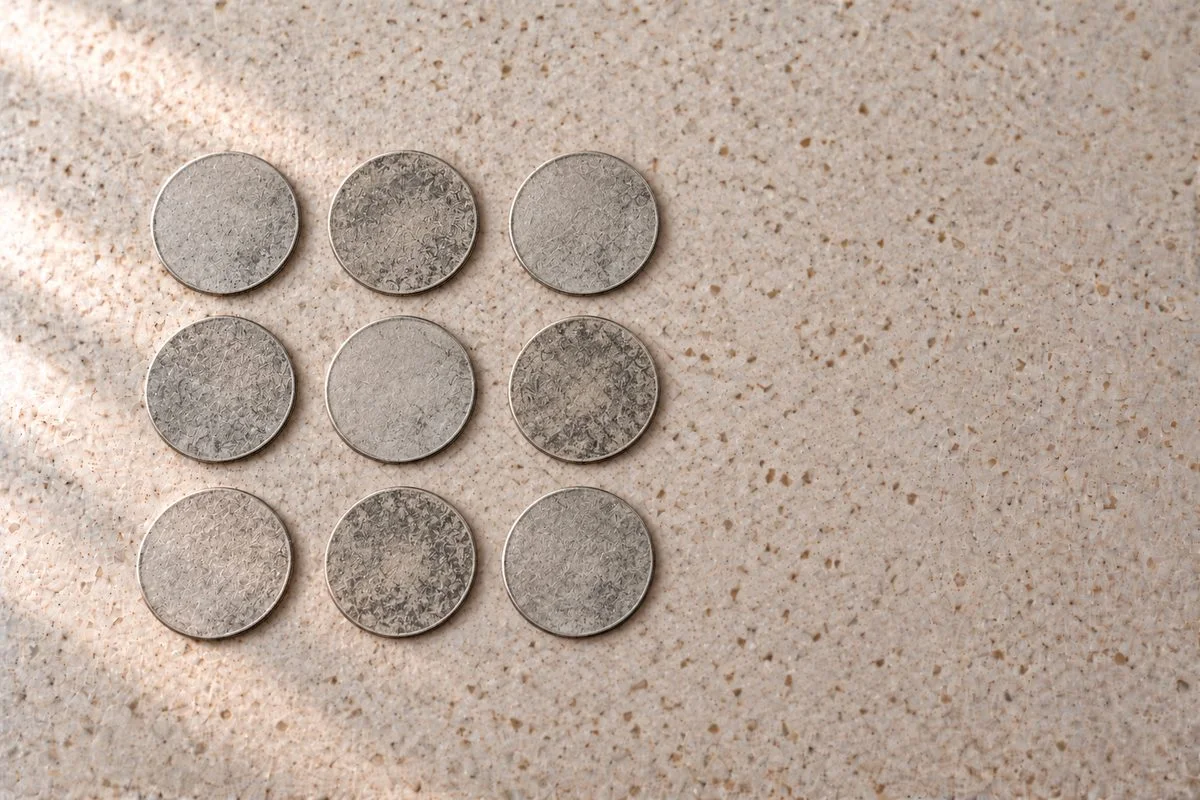
Nine coins rearranged into three rows of three.

5. Adding up and Down

Consecutive counts from 1, up then down to 1, total squares.

Show
Align coin columns of 1, 2, 3, 2 and 1 below. Rearrange them into three rows of three.
Ask
Using this rearrangement, what would climbing to four and back down total?
Say
Four rows of four give 16. The peak appears only once.
Used in
Square totals help count items in stepped displays that rise and fall symmetrically.
If your child says…“I can double the whole upward count.”
Ask
Where is a second peak column in our arrangement?
What’s true
Doubling the upward count includes the peak twice.

1+2+4+8=7+81+2+4+8=7+8

7+8=(8−1)+87+8=(8-1)+8

6. Relations among Number Sequences

Adding a sequence can produce a different pattern.

Show
Write this sum without its answer. Say, “The numbers double each time. The numbers before eight total seven, one less than eight.”
Ask
After adding eight, how will our total compare with the next doubling number, 16?
Say
The total is 15, one short of 16. Seven added to eight gives one less than two eights.
Used in
Running totals track savings when each deposit has a different amount.
If your child says…“The totals must also be 1, 2, 4 and 8.”
Ask
When we add two after one, does the one disappear?
What’s true
A running total includes earlier groups as well as the latest addition.

Counting growing shapes

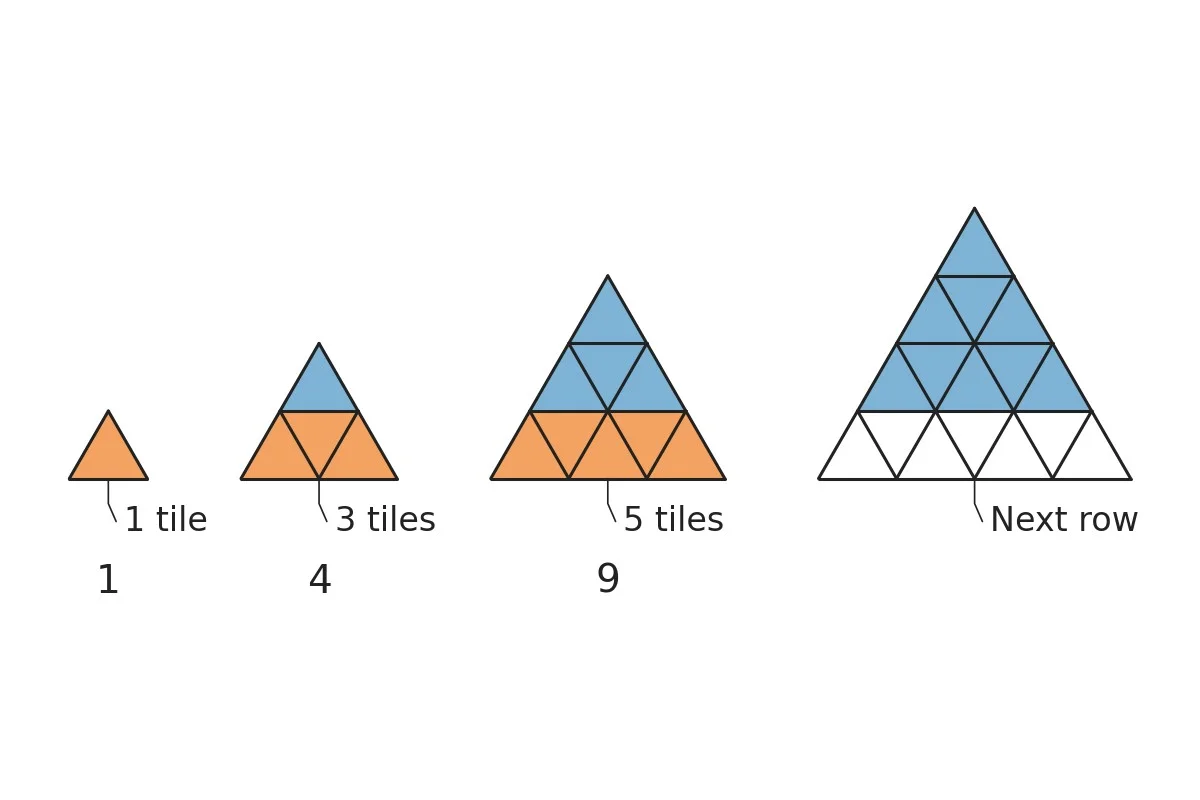
Growing tiled triangles with highlighted rows and an unfilled final row.

7. Shape Sequences and their Relation to Number Sequences

Growing shapes give number patterns when we count their parts.

Show
Look at the diagram’s growing triangles. Count the highlighted bottom rows in the first three. Find the unfilled bottom row in the last triangle.
Ask
How many small tiles will fill this new bottom row?
Say
The new row needs seven tiles, including those pointing downwards. The four rows together contain sixteen tiles.
Used in
Triangular tiling uses upward-pointing and downward-pointing pieces to cover a surface without gaps.
If your child says…“The rows have 1, 2 and 3 little triangles.”
Ask
Which tiles disappear from your count when you count only upward-pointing triangles?
What’s true
Counting tiles pointing both ways gives rows of 1, 3, 5 and 7.
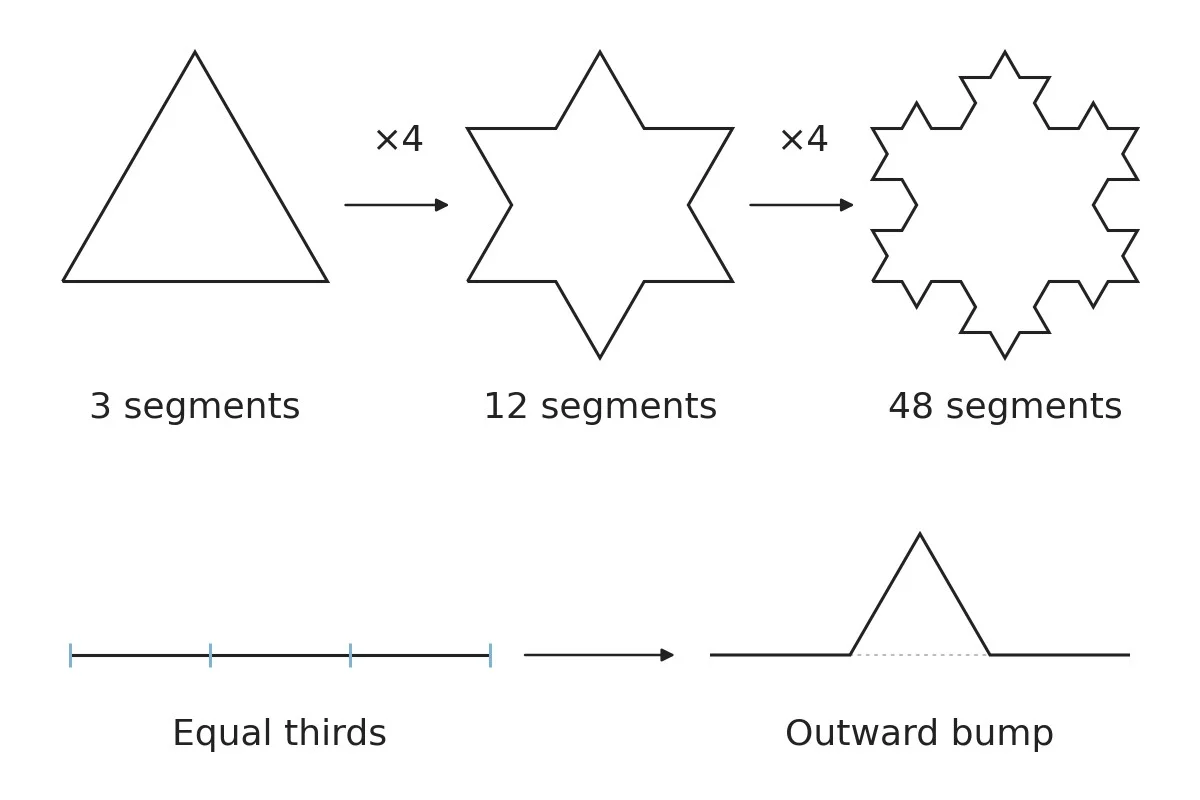
Three snowflake outlines above an enlarged four-piece segment replacement.

8. Koch Snowflake

Each segment becomes four shorter segments at every stage.

Show
Find the enlarged segment replacement at the bottom of the diagram. Count its four pieces. Follow the outlines above from 3 to 12 to 48 segments.
Ask
How many segments will the outline after 48 have, without drawing it?
Say
The next outline has 192 segments. Each of the 48 segments becomes four shorter segments.
Used in
Some antennas use repeating shapes to stay compact and receive different radio bands.
If your child says…“It adds nine segments every time.”
Ask
Does adding nine take the count from 12 to 48?
What’s true
Every existing segment gets replaced, so the total multiplies by four.

A real problem

Repeating shapes helped make compact antennas.

The Koch snowflake inspired one of Nathan Cohen’s early antenna designs.

His fractal antenna designs first appeared in publications in 1995.

Fractal antennas can stay compact while working across different radio frequency bands.

PBS NOVAWikipedia

A handheld radio; the photo does not show whether its antenna uses fractal shapes.

Concept Lab · Common misconception

The tempting mistake in Patterns in Mathematics

Open standalone misconception page →

Does doubling mean adding the same amount each time?

Wrong

The doubling pattern 3, 6, 12 continues with 18.

Why it feels right. I use the last jump, +6, as a fixed step.

Right

In a doubling pattern each term is twice the previous term. The amount added grows with the term.

Worked example

Double each number to get the next one. The amount added changes each time.
  1. 3 × 2 = 6.
  2. Then 6 × 2 = 12.
  3. Doubling 12 gives 24.
  4. Adding 6 would give 18, which is only one and a half times 12.

Ask your child eight quick questions.

One per step. The answer and the reason are given.

  1. What repeated change explains all the counts 1, 2, 4 and 8?

    Doubling. Each fold in this pattern splits every existing region into two.

  2. Which shape names fit 36 after making both arrangements?

    Triangular and square. The same chickpeas fill both shapes exactly.

  3. How many dots must we add around the 19-dot arrangement?

    18 dots. The previous ring used twelve, and the next needs six more.

  4. What do the first four odd numbers add up to?

    16. Four groups fill four rows of four cells.

  5. Which extra number must we remove after doubling the climb from one to four?

    4. The climb and descent share one peak.

  6. What running totals come from adding 1, 2, 4 and 8?

    1, 3, 7, 15. Each new number joins everything already counted.

  7. How many small tiles fill the triangle with three rows?

    Nine. The rows contain one, three and five, including downward-pointing triangles.

  8. What multiplication takes twelve segments to the next snowflake stage?

    Multiply by four. Each existing segment becomes four smaller segments.

15 more questions with answers, 3 with pictures