Skip to content

Teach Prime Time in eight steps.

For each idea: show it, ask before you tell, then say one line.

Gather beans, raisins, roasted chana, a plate, paper, scrap-paper strips, a pencil and a ruler.

Common misconceptions & worked visual for this chapter · 15 practice questions with answers

How to teach it

Factors and primes

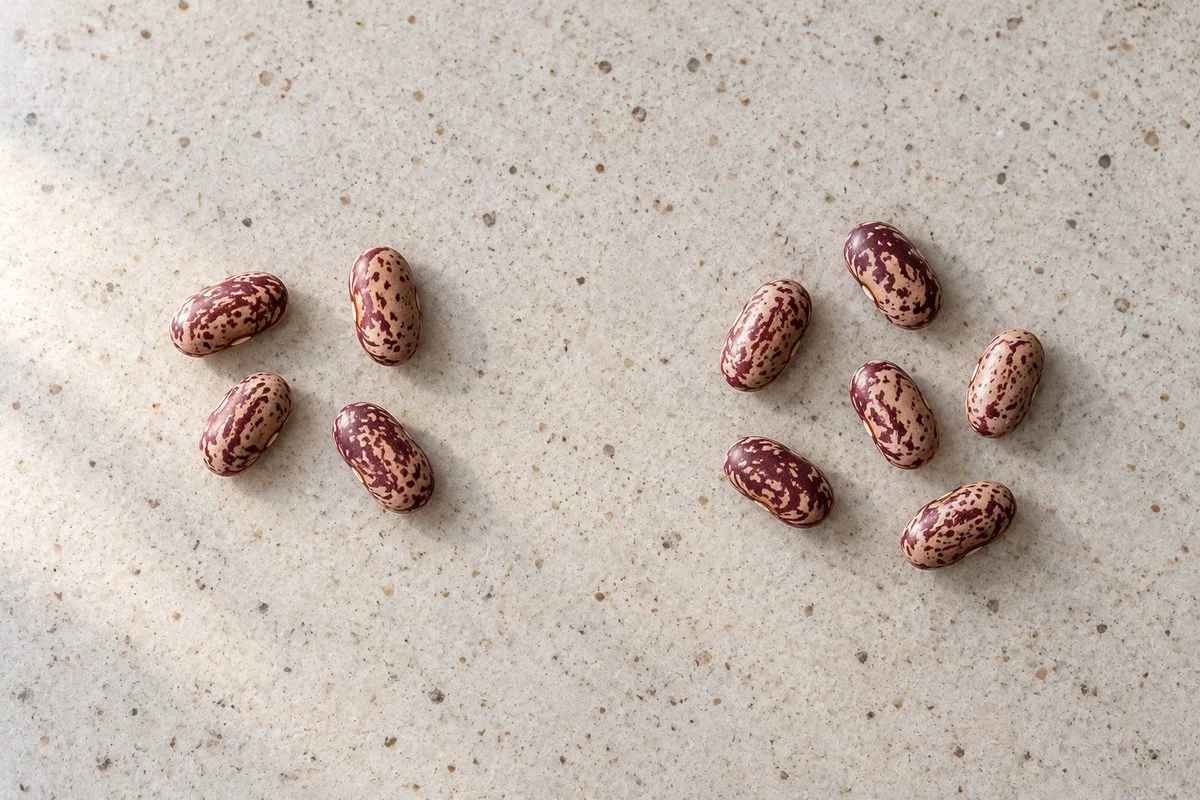
Separate groups of four and six beans on a tabletop.

1. Common Multiples and Common Factors

Factors divide exactly. Multiples are totals of whole groups. Common means shared.

Show
Set out 4 beans and 6 beans separately. After predicting, make every rectangle, including single rows. Record each row length.
Ask
Which row lengths will fit both totals without leftovers?
Say
Row lengths 1 and 2 are common factors.
Used in
Factors help gardeners arrange plants in equal rows without leftover plants.
If your child says…“One and the total itself don't count as factors.”
Ask
How many rows are there, and how many beans are in each row?
What’s true
Single rows show that 1 and the total both count.
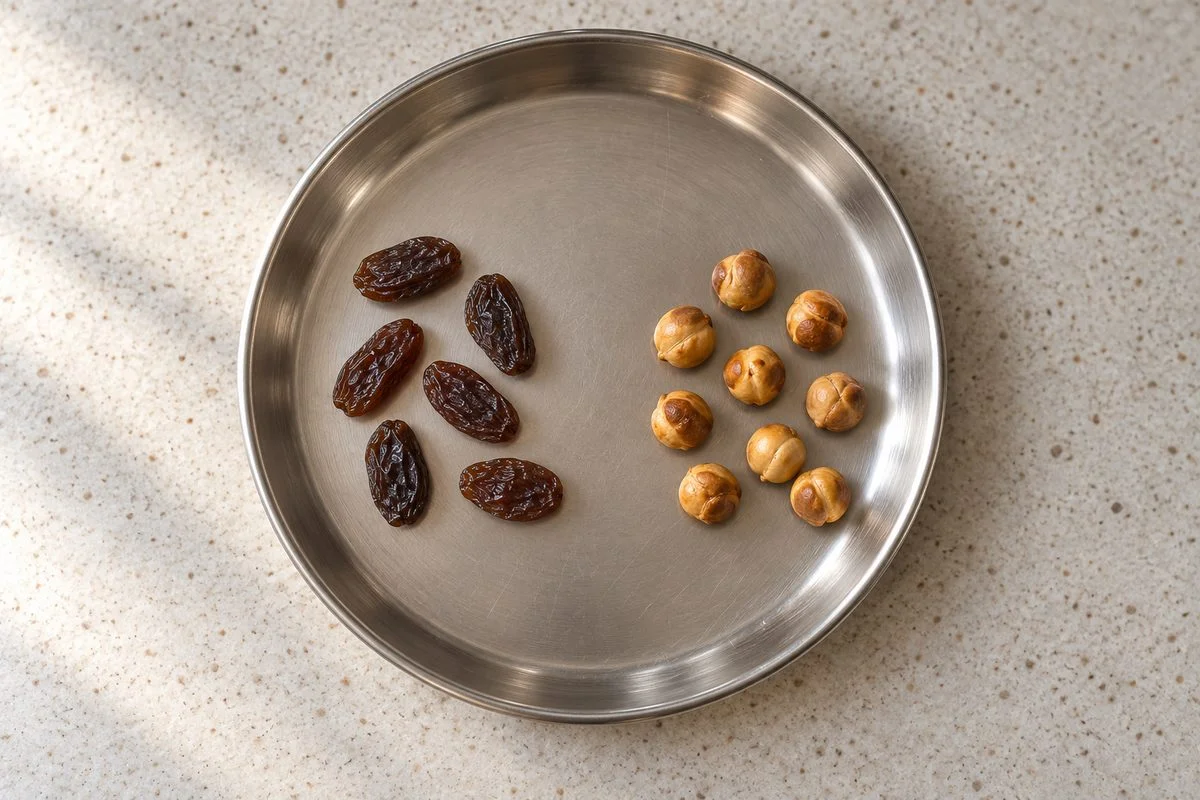
Raisins and roasted chana in separate piles on a steel plate.

2. Common Factors

The greatest common factor gives the most identical complete portions.

Show
Put 6 raisins and 9 roasted chana on a plate. List possible portion counts for the raisins. After predicting, test those counts with the chana.
Ask
What is the greatest number of identical portions we can make?
Say
Three portions use everything equally, so 3 is the greatest common factor.
Used in
Common factors let florists make identical bouquets without leftover flowers.
If your child says…“Any number that shares both is the greatest common factor.”
Ask
Can we make more than three identical portions without leftovers?
What’s true
The greatest common factor is the largest count that works.
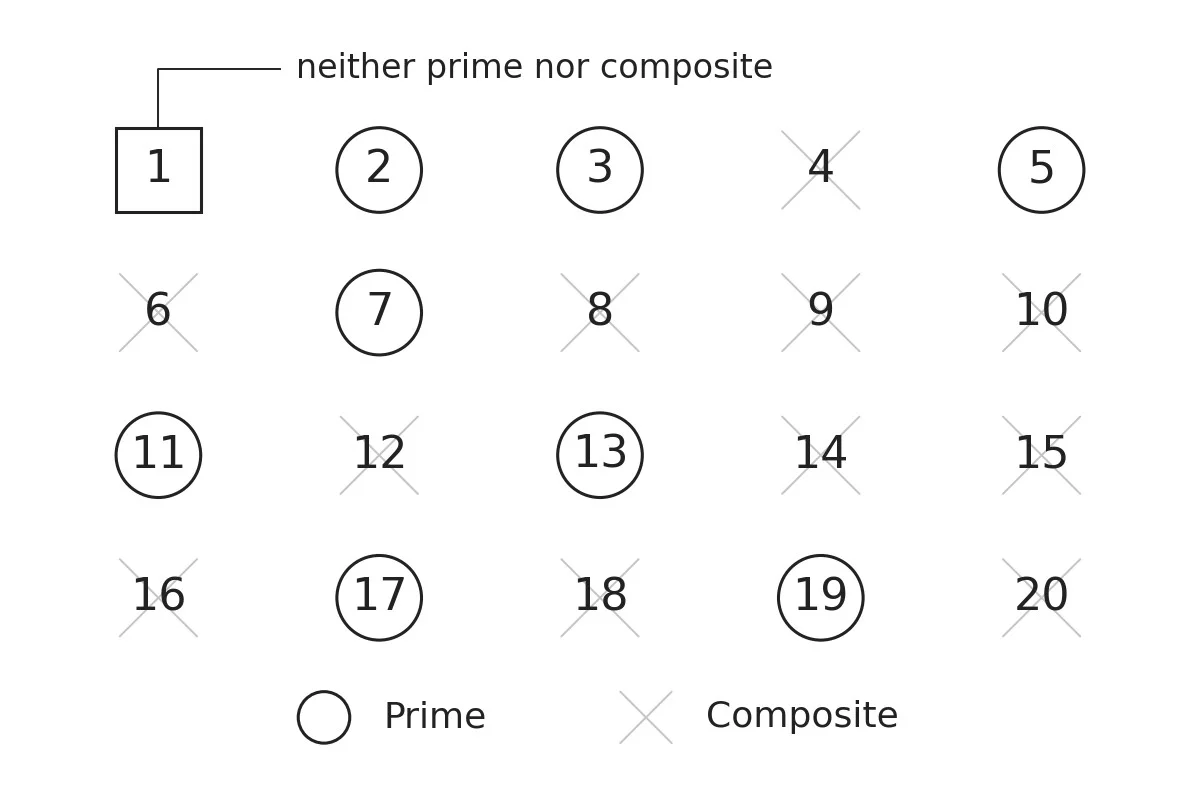
Sieve showing circled primes, crossed-out composites and 1 marked as neither.

3. Prime Numbers

Primes have exactly two factors. Composites have more.

Show
Look at the sieve diagram together. Find 2 and 4. Compare their factors to see why 2 stays while 4 is crossed out.
Ask
Will 2 stay when we remove numbers with more than two factors?
Say
Two stays because its only factors are 1 and 2.
Used in
Prime headcounts flag leftovers when forming several equal teams with at least two children each.
If your child says…“I cross out 2 along with its multiples.”
Ask
Which factor does 2 have besides 1 and itself?
What’s true
The sieve keeps each prime and removes its larger multiples.
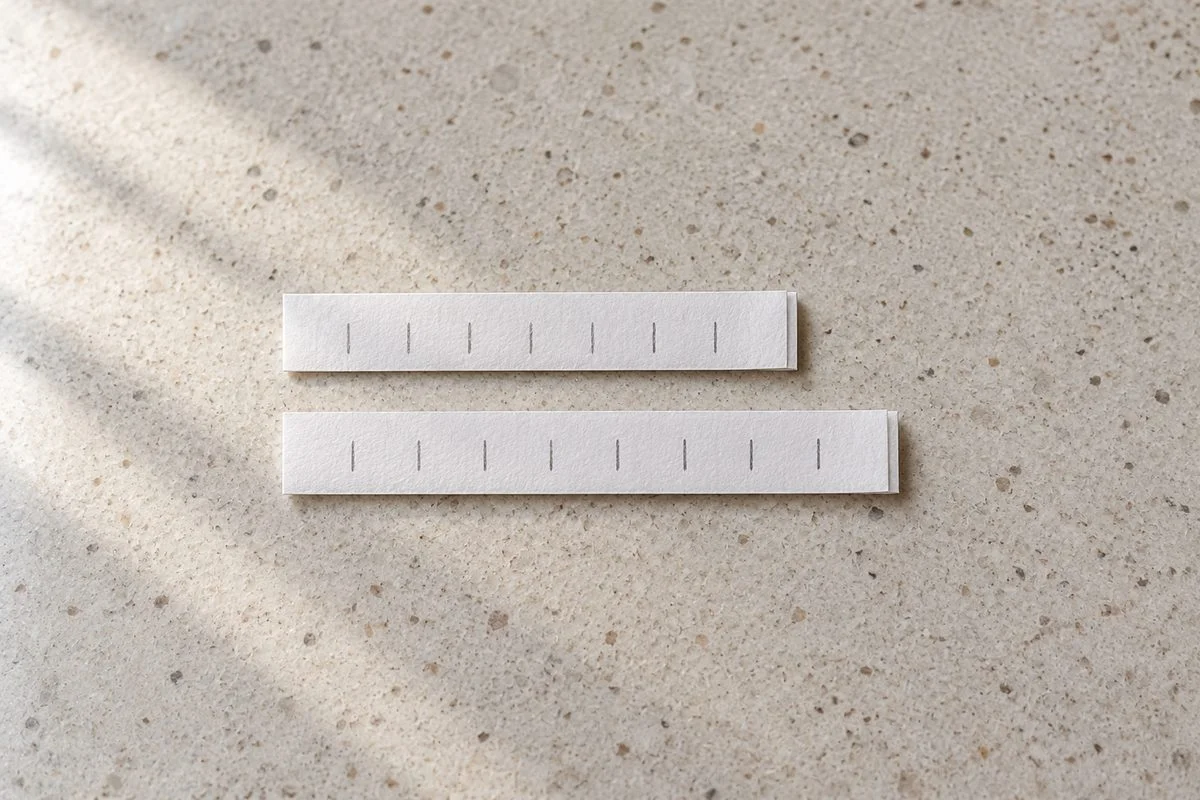
Two paper strips aligned at the left, with one extending a centimetre farther.

4. Co-prime Numbers

Two numbers are co-prime when their only common factor is 1.

Show
Fold strips to 8 cm and 9 cm. Mark centimetres and align their starting ends. After predicting, check which whole-centimetre section lengths fit both.
Ask
Which whole-centimetre section length will fit both strips exactly?
Say
Any shared section length must also fit the extra centimetre. Only 1 cm works, so 8 and 9 are co-prime.
Used in
Co-prime stocks can fill equal-sized packs without leftovers only when each pack holds one item.
If your child says…“Both numbers must be prime to be co-prime.”
Ask
Which factor greater than 1 do 8 and 9 share?
What’s true
Composite numbers can still be co-prime.

Using factors and multiples

Blank paper folded into two rows for recording clap counts.

5. First Common Multiple

The smallest positive multiple shared by the given numbers.

Show
Fold paper into two recording rows. After predicting, count aloud from 1 to 24. Clap every fourth count while your child claps every sixth. Record each clapping pattern separately.
Ask
At which count will we first clap together?
Say
Twelve is the first shared clap, so it is the first common multiple. Twenty-four also works, but comes later.
Used in
For bus services starting together, common multiples identify later shared departures.
If your child says…“I always multiply the numbers to find their first common multiple.”
Ask
Did we clap together before reaching 24?
What’s true
Their product is a common multiple, but an earlier one may work.

Twelve is two times six.

12=2×(2×3)12 = 2 \times (2 \times 3)

6. Prime Factorisation

Prime factorisation expresses numbers as products of primes, including repeated primes.

Show
Write these lines, saying that six splits into two times three.
Ask
When we split six into primes, which prime factors will we write for twelve?
Say
Twelve is two times two times three. Keep both twos, although the different primes are 2 and 3.
Used in
Prime factors help check whether a stock quantity can fill an order of equal batches.
If your child says…“Two times six is already a prime factorisation.”
Ask
Can six still split into factors greater than 1?
What’s true
Every factor must be prime before the splitting is finished.

300=4×75300 = 4 \times 75

16=4×416 = 4 \times 4

316=4×79316 = 4 \times 79

7. Divisibility Tests

Final digits test division without remainders.

Show
Write these lines, saying that 316 is three hundred plus sixteen. Point to the groups of four in each part.
Ask
Without long division, what multiplication by 4 gives 316?
Say
Sixteen divides exactly by 4, so 316 is four times seventy-nine.
Used in
Shopkeepers use divisibility tests to check full packs quickly.
If your child says…“For 4, I only check the last digit.”
Ask
Can 34 split into fours without a remainder, even though it ends in 4?
What’s true
Divisibility by 4 depends on the number formed by the last two digits.
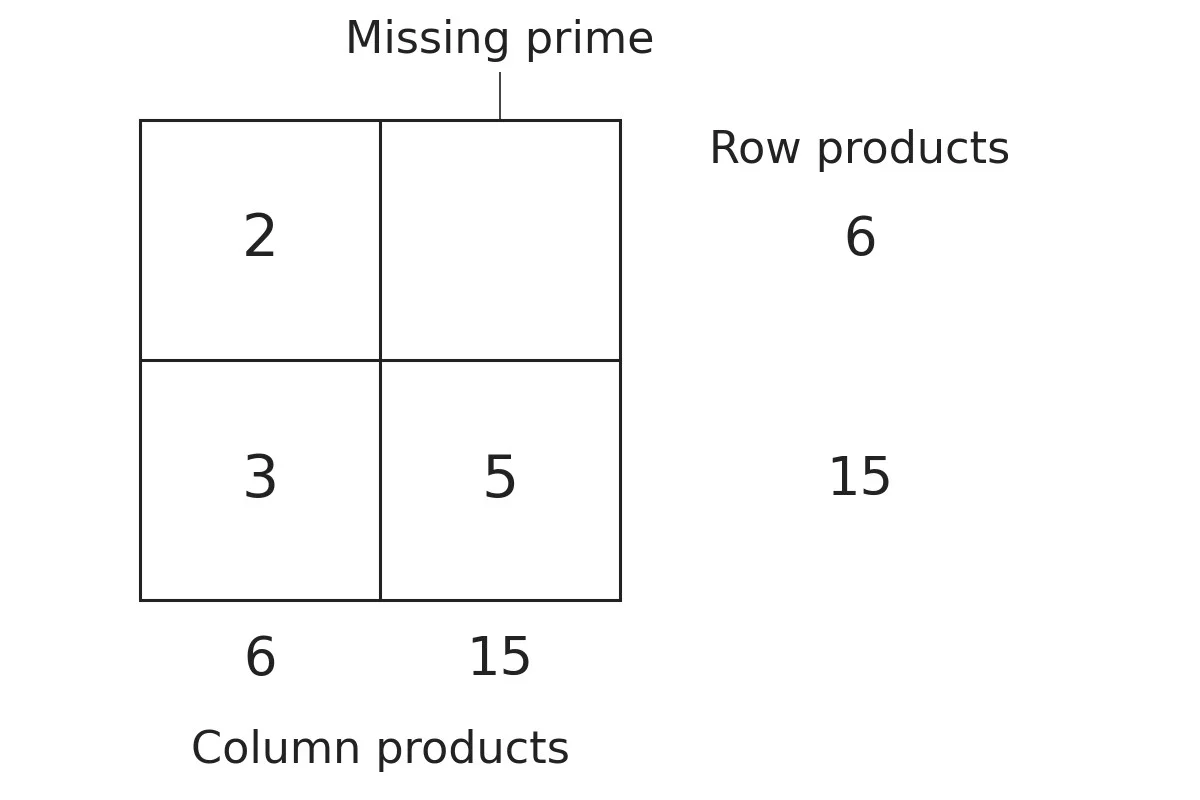
Prime grid with a missing entry and multiplication clues beside rows and below columns.

8. Fun with Numbers

Use every clue and check what makes a number special.

Show
Look at the grid diagram together and find the square marking the missing prime. Find the products beside its rows, then beneath its columns. After predicting, check every row and column product.
Ask
Which prime fills the blank so both its row and column work?
Say
Three fits both clues.
Used in
Checking row and column totals helps shopkeepers find mismatches in stock records.
If your child says…“If the rows work, the grid is finished.”
Ask
Does your entry also make its column product match?
What’s true
Every row and every column must give its stated product.

A real problem

Prime factors help protect confidential messages.

RSA encryption was developed in 1977.

It allowed encryption keys to be public while the corresponding decryption keys stayed secret.

RSA uses a product of two large primes whose factors are hard to find.

MIT NewsMIT Research RepositoryPrimePages

Unbranded laptop displaying a message window with a lock symbol.

Concept Lab · Common misconception

The tempting mistake in Prime Time

Open standalone misconception page →

Is 1 a prime number?

Wrong

1 is prime because it can be divided by 1 and itself.

Why it feels right. The words 1 and itself sound like two factors.

Right

A prime has exactly two distinct positive factors.

Worked example

Factors of 1
1
Factors of 2
1
2
Count distinct positive factors. One factor is short of the two required for a prime.
  1. 1 has just one factor, 1.
  2. The number 2 has two distinct factors, 1 and 2, so 2 is prime.

Ask your child eight quick questions.

One per step. The answer and the reason are given.

  1. Which factors of 4 does a single row show?

    1 and 4. There is one row containing four beans.

  2. What makes 3 a better answer than 1 here?

    It makes more identical portions. Both counts work, but three is the greatest possible.

  3. Why does 2 stay while 4 is crossed out?

    Two has exactly two factors. Four has an extra factor, 2, besides 1 and itself.

  4. Which factors do 8 and 9 share?

    Only 1. Their factor lists overlap only at 1, although both numbers are composite.

  5. What is the first common multiple of 4 and 12?

    12. Twelve is already a multiple of both numbers.

  6. Why must 6 be split in the first line?

    Six is composite. It still splits into the prime factors 2 and 3.

  7. Which divides exactly by 4: 24 or 34?

    24. Both end in 4, but only 24 contains a whole number of fours.

  8. A filled grid matches every row product. Which products still need checking?

    The column products. Each entry must satisfy its row and column clues.

15 more questions with answers, 9 with pictures