Skip to content

Teach Lines and Angles in eight steps.

For each idea: show it, ask before you tell, then say one line.

Gather paper, thin tracing paper, a pencil, a ruler and a school protractor.

Common misconceptions & worked visual for this chapter · 15 practice questions with answers

How to teach it

Points, lines and angles

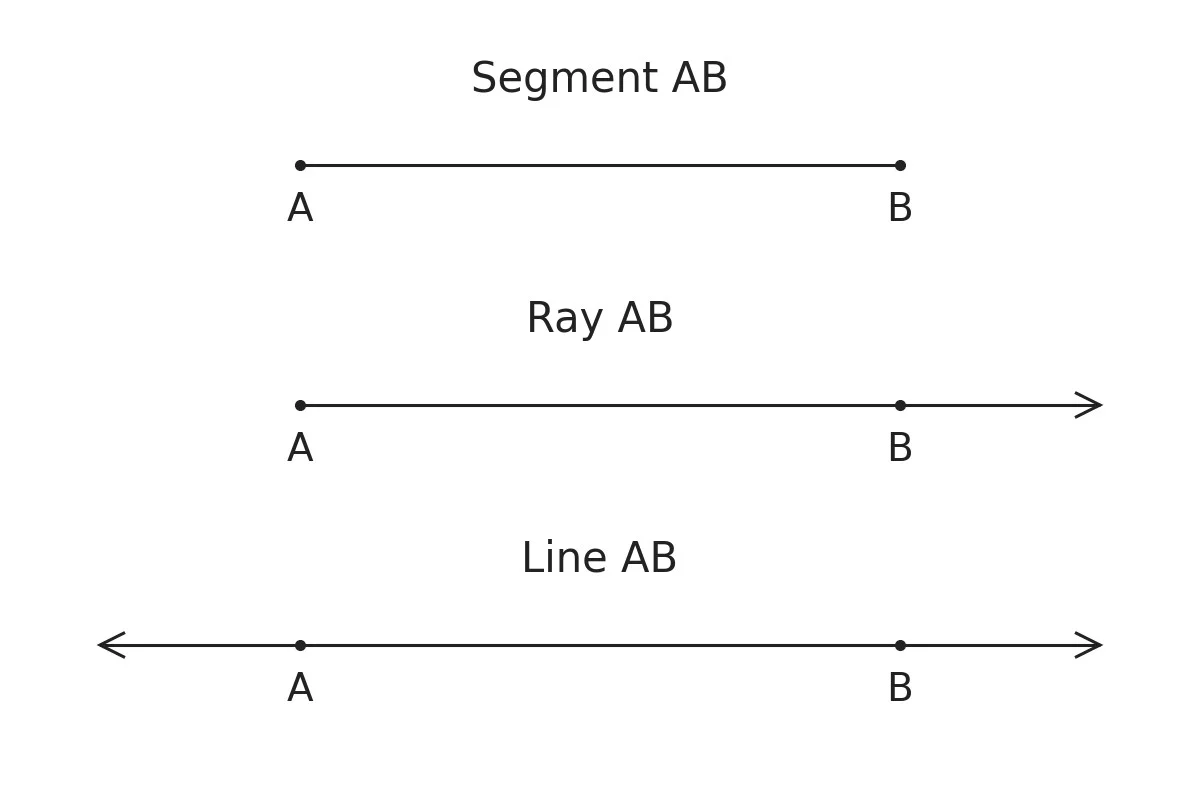
A segment, ray and line through A and B show different endpoints.

1. Point, Line Segment, Line and Ray

Points lack size. Segments, rays and lines have different numbers of endpoints.

Show
Find segment AB in the diagram. After the prediction, follow its extensions beyond B, then A.
Ask
How many endpoints will remain after each extension?
Say
A segment has two endpoints, a ray has one, and a line has none. Ray AB starts at A.
Used in
Tailors mark endpoints of straight seams to get the required length.
If your child says…“Ray AB and ray BA are the same.”
Ask
Which starting point does each name give?
What’s true
Reversing the letters changes the ray's starting point and direction.
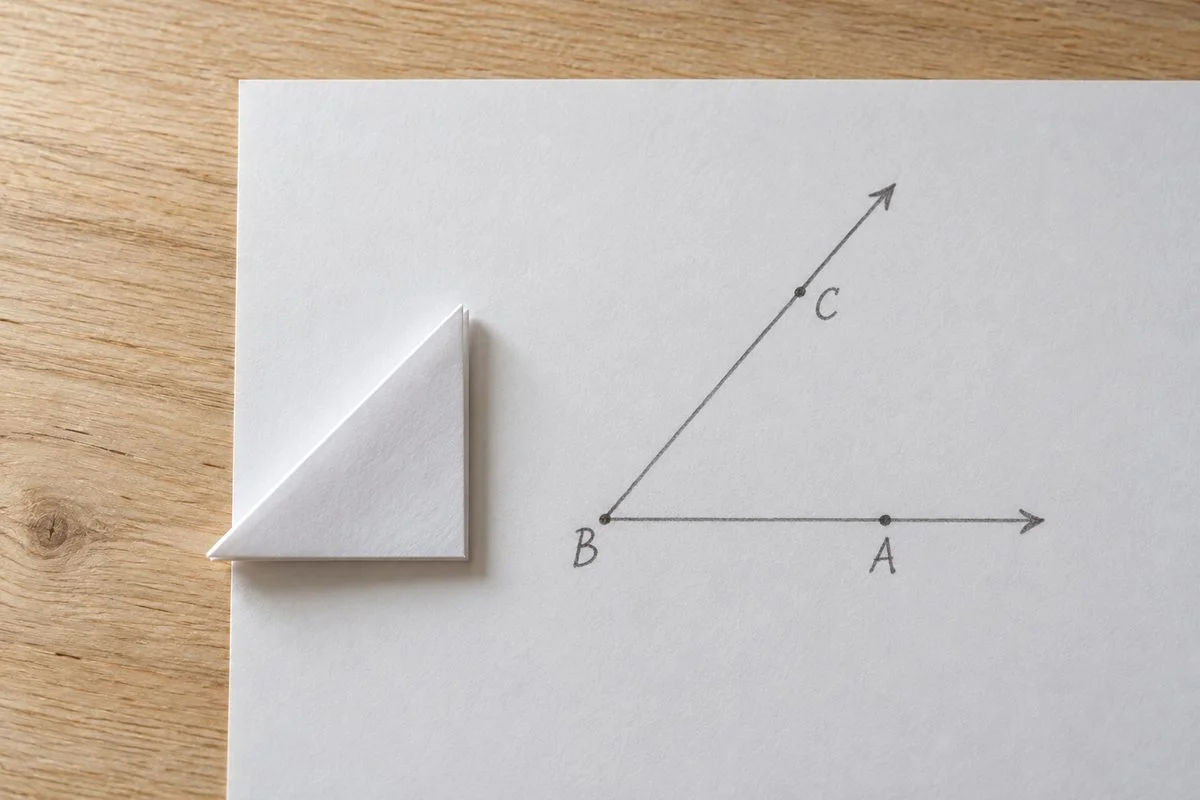
A folded paper corner beside two pencil strokes meeting at a corner.

2. Angle

Two rays start together at a corner called the vertex.

Show
Fold a paper corner inward. Trace two edges meeting at a new corner, B. Mark A and C along those edges. Extend the traces with arrows.
Ask
If we read from C through B to A, will we name a different angle?
Say
The rays are the arms, and B is their shared vertex. ABC and CBA name this same angle.
Used in
Naming angles on building plans identifies which corner needs a particular opening.
If your child says…“I can put the corner letter anywhere.”
Ask
Which letter do both paths, A–B–C and C–B–A, pass through?
What’s true
The corner's letter belongs between the other two letters.
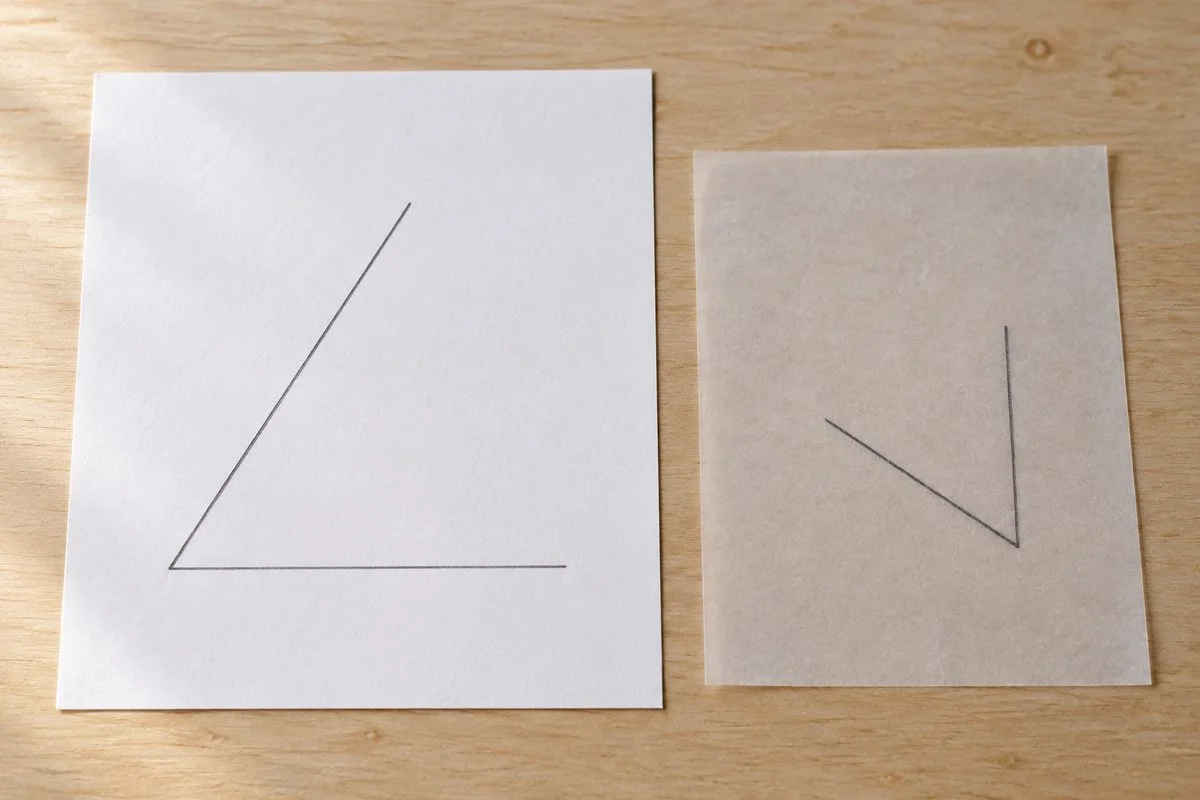
A short angle tracing lies rotated beside the longer original.

3. Comparing Angles

Angle size depends on the turn, not the drawn lengths.

Show
Draw an angle. Trace it onto thin paper with shorter strokes. Move and rotate the tracing. After the prediction, overlap the corners and one arm.
Ask
Will the other arms line up despite the shorter strokes?
Say
Both arms match, so these angles are equal. Compare angles by matching their corners and one arm.
Used in
Matching corner angles helps replacement tiles fit the same space.
If your child says…“Longer arms make a bigger angle.”
Ask
Where is any extra turn when both arms overlap?
What’s true
Extending a drawn arm without turning it leaves the angle unchanged.

Angle types and measurement

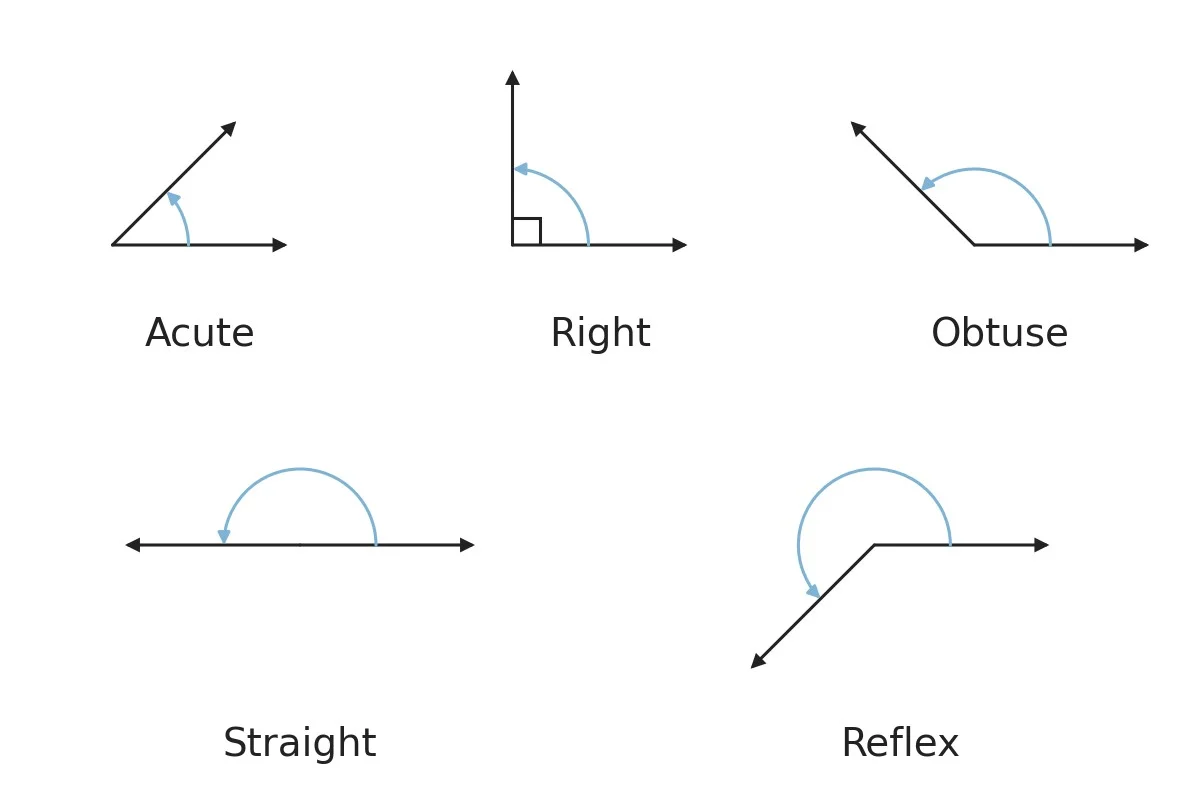
Five labelled angles show turns smaller than, equal to, and larger than a half-turn.

4. Special Types of Angles

Right angles match square corners. Straight angles make half a turn.

Show
Find Right and Straight in the diagram. Compare the other marked turns with these.
Ask
Which name fits when the marked turn grows beyond straight?
Say
Right matches a square corner, and straight means half a turn. Acute stays below right, while obtuse lies between right and straight. Reflex exceeds straight.
Used in
Right angles in window frames help rectangular glass panes fit.
If your child says…“Exactly half a turn is obtuse too.”
Ask
At half a turn, do the outer arms still bend or form a straight path?
What’s true
Half a turn is straight, marking the boundary between obtuse and reflex.
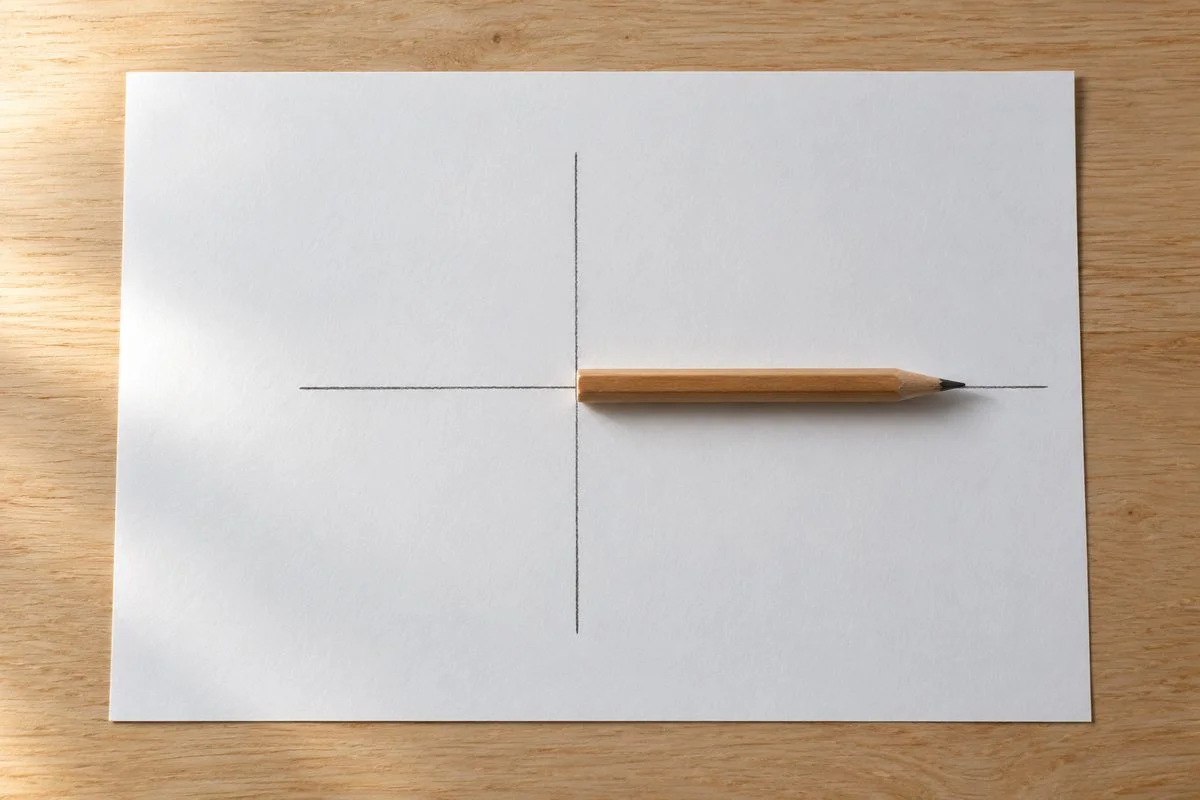
A pencil points right from four strokes meeting at right angles between neighbouring pairs.

5. Measuring Angles

Degrees count equal turning units. A full turn contains 360.

Show
Use a paper corner to mark four quarter-turn directions around O. Rest a pencil's blunt end at O. After the prediction, turn it through all four directions.
Ask
A full turn is 360°. What will a quarter-turn and a half-turn measure?
Say
A quarter-turn is 90°, and a half-turn is 180°. These measure right and straight angles.
Used in
Clock hands turn through equal angles between hour marks, dividing time evenly.
If your child says…“Four equal turns means four degrees.”
Ask
How many degrees must each equal turn contain to total 360°?
What’s true
Four counts the equal turns here, not the degrees within each turn.
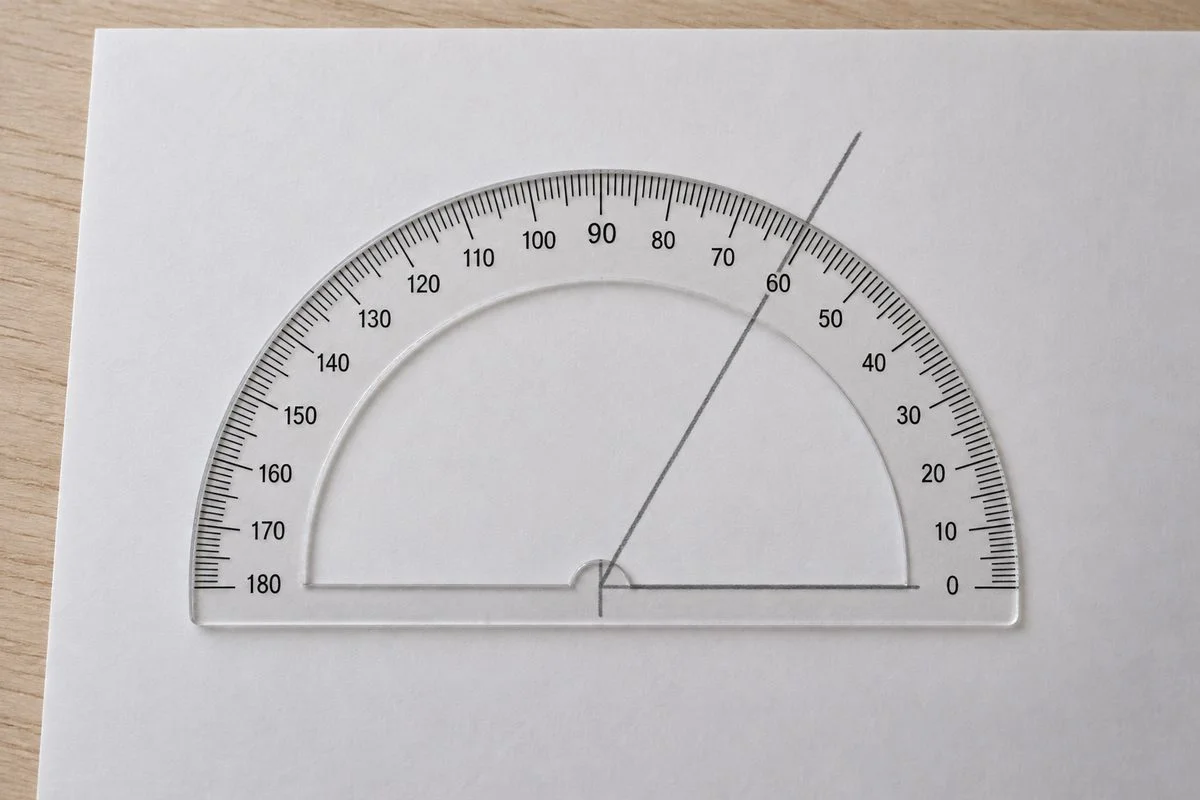
A protractor centred on an angle, with one arm aligned to its baseline.

6. Measuring Angles with a Protractor

A protractor's scale measures the turn between two arms.

Show
Prepare an unlabelled 60° angle. Compare its opening with a paper corner. Centre the protractor on the vertex. Align one arm with zero.
Ask
Will this opening measure less or more than 90°?
Say
Follow the scale beginning at your aligned zero: it reads 60°. The other scale's 120° does not measure this opening.
Used in
Measuring a furniture joint's angle helps replacement pieces meet neatly.
If your child says…“Either number beside the arm will do.”
Ask
Which scale begins at zero where this arm lies?
What’s true
The correct scale starts at zero on the aligned arm.

Dividing and drawing angles

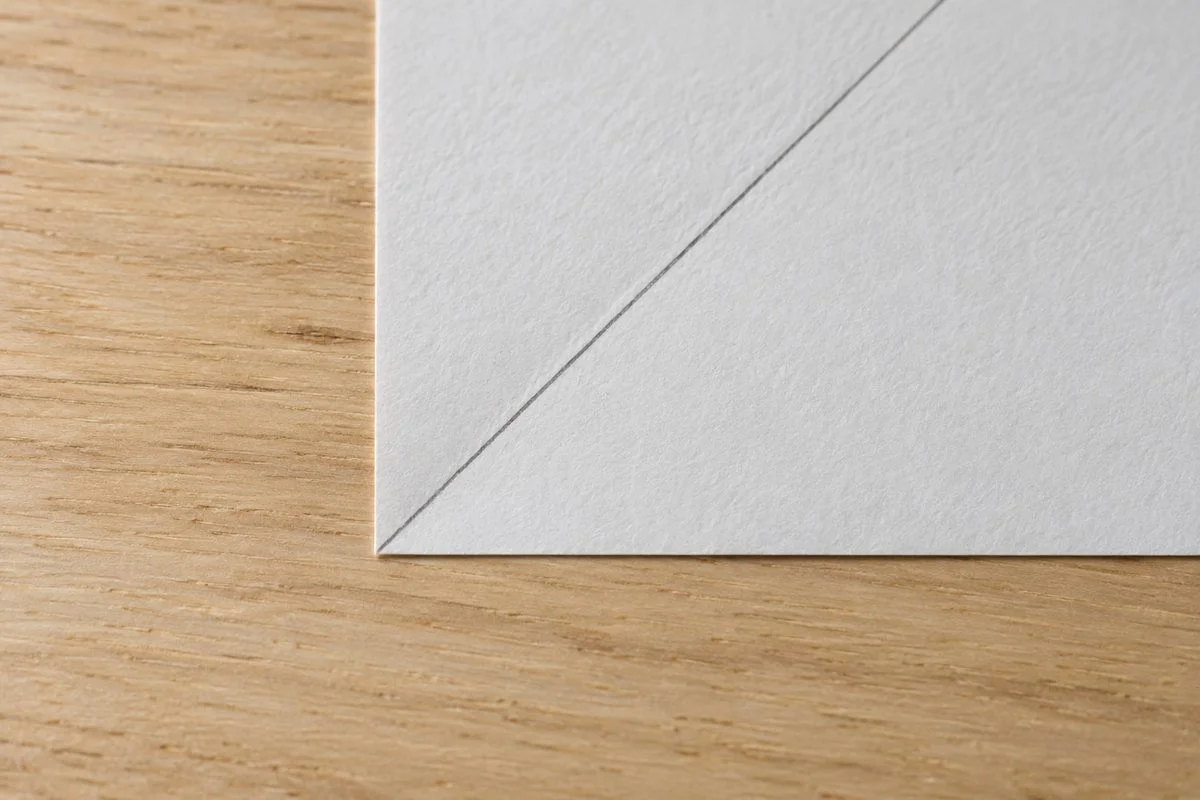
An opened square paper corner with its diagonal crease traced in pencil.

7. Angle Bisector

A bisector halves an angle. Trisectors make three equal parts.

Show
Fold a paper's square corner until its edges coincide. Press the crease. Open it and trace the crease from the corner. Refold after the prediction.
Ask
Will the angles on either side of the crease overlap exactly?
Say
The crease bisects the right angle into matching 45° halves.
Used in
Halving a frame's corner angle helps its two edge pieces meet evenly.
If your child says…“Any ray inside an angle is a bisector.”
Ask
Would unequal openings overlap exactly when folded together?
What’s true
Only a ray making equal halves bisects the angle.
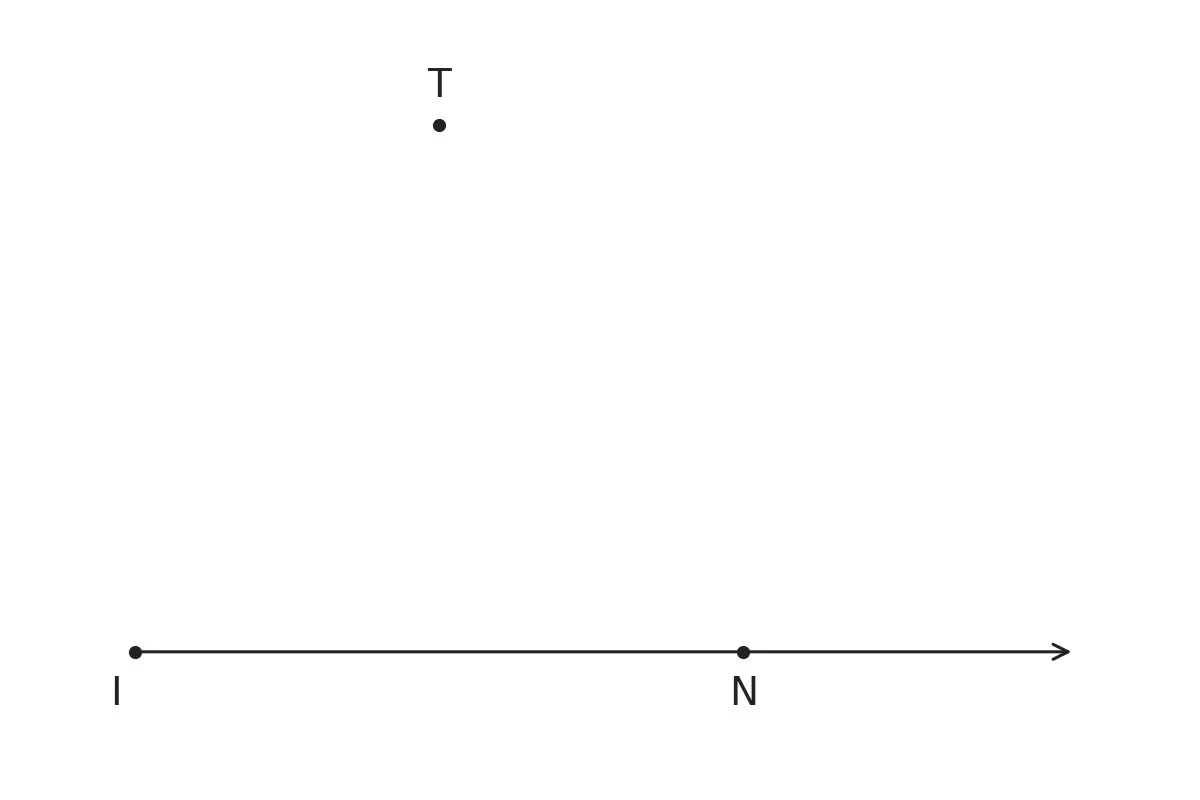
Ray IN with a separate dot T placed at 60 degrees from it.

8. Drawing Angles

A measured mark sets the direction for the second arm.

Show
For a paper design, draw ray IN from I. Centre the protractor at I with zero along IN. Mark T at 60° on that scale. Remove the protractor.
Ask
If we draw a ray from I through T, will angle TIN be complete?
Say
Draw ray IT, starting at I and passing through T. The measured mark sets its direction.
Used in
Measured angles make repeated corners in craft patterns match.
If your child says…“The degree mark finishes the angle.”
Ask
Where is the second arm joining the vertex to your mark?
What’s true
The mark locates the direction, but the second arm still needs drawing.

A real problem

Delhi's Jantar Mantar used angular scales to study the sky.

Delhi's observatory was built in 1724.

Its instruments supported tables predicting movements of the Sun, Moon and planets.

The Rama Yantra's floor and walls carry scales for measuring celestial angles.

Jantar Mantar research projectIncredible India / Google Arts & CultureJantar Mantar research project

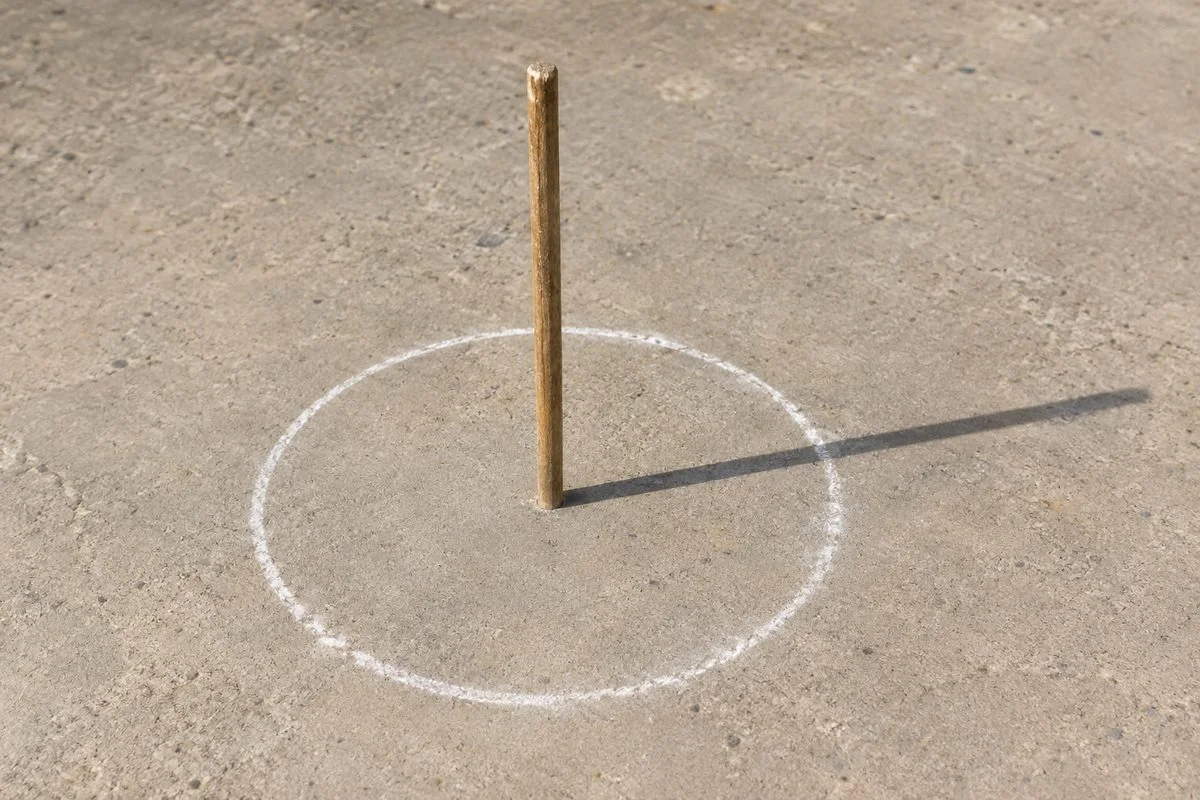
An upright stick casts a shadow across a chalk circle; an illustration, not the Rama Yantra.

Concept Lab · Common misconception

The tempting mistake in Lines and Angles

Open standalone misconception page →

Which angle opens wider?

Wrong

The angle with longer arms is larger.

Why it feels right. Longer lines look like they make a bigger angle.

Right

Angle size measures the opening between rays.

Worked example

Both openings are 90°. Extending a ray leaves its direction unchanged.
  1. Draw two right angles.
  2. Extend one arm of either drawing.
  3. Each opening still matches a square corner of 90°.

Ask your child eight quick questions.

One per step. The answer and the reason are given.

  1. Ray BA passes through A. Where does it start?

    At B. The first letter identifies the starting point.

  2. An angle's arms start at C and pass through A and B. Which letter belongs in the middle?

    C. Both arms begin at C, making C the vertex.

  3. Both arms overlap exactly, but one drawing has longer strokes. Which angle is larger?

    Neither; they are equal. Their turns match despite the different stroke lengths.

  4. Two right-angle turns in the same direction make which type of angle?

    A straight angle. Together they make exactly half a turn, the boundary beyond obtuse.

  5. A clock has 12 equal gaps. How many degrees separate neighbouring hour marks?

    30°. Dividing the full 360° turn into 12 equal parts gives 30° each.

  6. Your starting arm reads zero. The other arm reads 60° on that scale. What is the angle?

    60°. The chosen scale counts from the starting arm's zero.

  7. A ray splits an angle into 30° and 50°. What prevents it being a bisector?

    The parts are unequal. A bisector must produce matching halves.

  8. You marked T at 60° from ray IN. Which ray completes angle TIN?

    Ray IT. The second arm must start at I and pass through T.

15 more questions with answers, 15 with pictures