Skip to content

Teach Arithmetic Progressions in seven steps.

For each idea: show it, ask before you tell, then say one line.

Gather 13 unlit matchsticks, paper and a pencil.

Common misconceptions & worked visual for this chapter · 15 practice questions with answers

How to teach it

Recognise the pattern and find terms

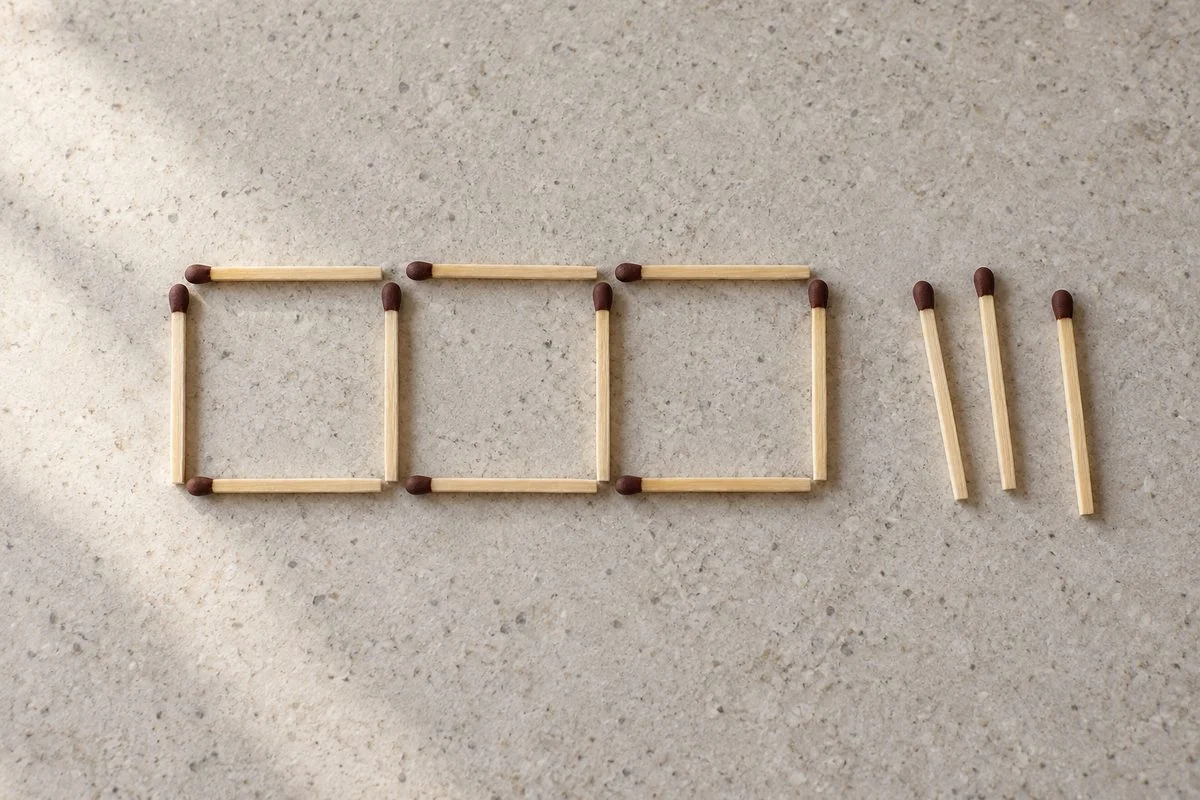
Three adjoining matchstick squares with three loose sticks beside them.

1. Arithmetic Progressions

A number list with equal changes between neighbours.

Show
Make a square with unlit matches. Extend in a straight row, with each new square sharing exactly one side. Record totals and subtract neighbouring counts. Pause before adding the fourth square.
Ask
How many extra sticks will the fourth square need?
Say
Each new square shares a side, needing three extra sticks.
Used in
Fixed salary increases let workers predict their future pay.
If your child says…“Any number pattern is an AP.”
Ask
Does following a pattern guarantee equal additions?
What’s true
A pattern qualifies only when every neighbouring pair gives the same difference.
a4=1+2+2+2a_4=1+2+2+2

a4=1+(4−1)×2a_4=1+(4-1)\times2

2. nth Term of an AP

Find a term by counting equal changes from the start.

Show
Write these lines for 1, 3, 5, … . Call the first term a, the common difference d, and the position n. Call the term at that position ana_n.
Ask
What is the fourth term without listing every earlier term?
Say
The fourth term is 7: start at 1 and add 2 three times. The first term needs no addition, so each position has one fewer gap.
Used in
Regularly spaced shelf positions let a carpenter calculate where a later shelf belongs.
If your child says…“The fourth term needs four additions.”
Ask
How many additions reach the first term?
What’s true
With first term a and common difference d, an=a+(n−1)da_n=a+(n-1)d.

11=2+3(n−1)11=2+3(n-1)

9=3(n−1)9=3(n-1)

3=n−13=n-1

3. nth Term of an AP

Find a number’s position in an AP.

Show
Write these lines for 2, 5, 8, … . Say, “Here, n counts positions.”
Ask
Which position holds 11?
Say
11 is fourth: three gaps follow the start.
Used in
House numbers increasing equally along a street help locate an address within that sequence.
If your child says…“Its position is 11.”
Ask
Are we finding the number, or its place?
What’s true
A term’s value and its place answer different questions.

a=4−(2−1)×2a=4-(2-1)\times2

a=4−2a=4-2

4. First Term and Common Difference

Use two known terms to recover the start and step.

Show
Write these lines: the second term is 4 and the fourth is 8. Call the start a and the common difference d. Say, “The increase is 4 across two gaps, so each gap adds 2.”
Ask
What is the first term?
Say
The first term is 2. Divide the increase across two gaps, then undo one gap.
Used in
Factory records with equal yearly increases reveal the starting output and annual increase.
If your child says…“The common difference is 4.”
Ask
How many steps separate the second and fourth terms?
What’s true
The increase spans two steps, so each step adds 2.

Find totals and averages

S4=1+2+3+4S_4=1+2+3+4

2S4=(1+4)+(2+3)+(3+2)+(4+1)2S_4=(1+4)+(2+3)+(3+2)+(4+1)

2S4=4×52S_4=4\times5

5. Sum of First n Terms of an AP

Find the total by pairing terms from opposite ends.

Show
Write these lines for weekly deposits of ₹1, ₹2, ₹3 and ₹4. Call their total S4S_4. Say, “Reversing the deposits keeps their total unchanged.”
Ask
These pairs count every deposit twice. What is the total saved?
Say
Each pair totals 5, and the four pairs count the savings twice. Divide by two to get ₹10.
Used in
Adding seats across rows that grow equally gives a hall’s seating capacity.
If your child says…“Four deposits mean four times the first deposit.”
Ask
Are all four deposits the same size?
What’s true
Multiply the term count by the average of the first and last values.

an=Sn−Sn−1a_n=S_n-S_{n-1}

an=n2−(n−1)2a_n=n^2-(n-1)^2

an=n2−(n2−2n+1)a_n=n^2-(n^2-2n+1)

an=n2−n2+2n−1a_n=n^2-n^2+2n-1

6. Sum of First n Terms of an AP

Subtract consecutive totals to recover the newly added term.

Show
Call the total through position n SnS_n, and its latest term ana_n. Call the total through the previous position Sn−1S_{n-1}. Write these lines using Sn=n2S_n=n^2.
Ask
What remains after the squared terms cancel?
Say
Subtracting totals leaves the newest term: an=2n−1a_n=2n-1.
Used in
Subtracting yesterday’s accumulated savings from today’s reveals today’s deposit.
If your child says…“The total is also the latest term.”
Ask
When earlier terms are removed, what remains?
What’s true
A total includes earlier terms too.
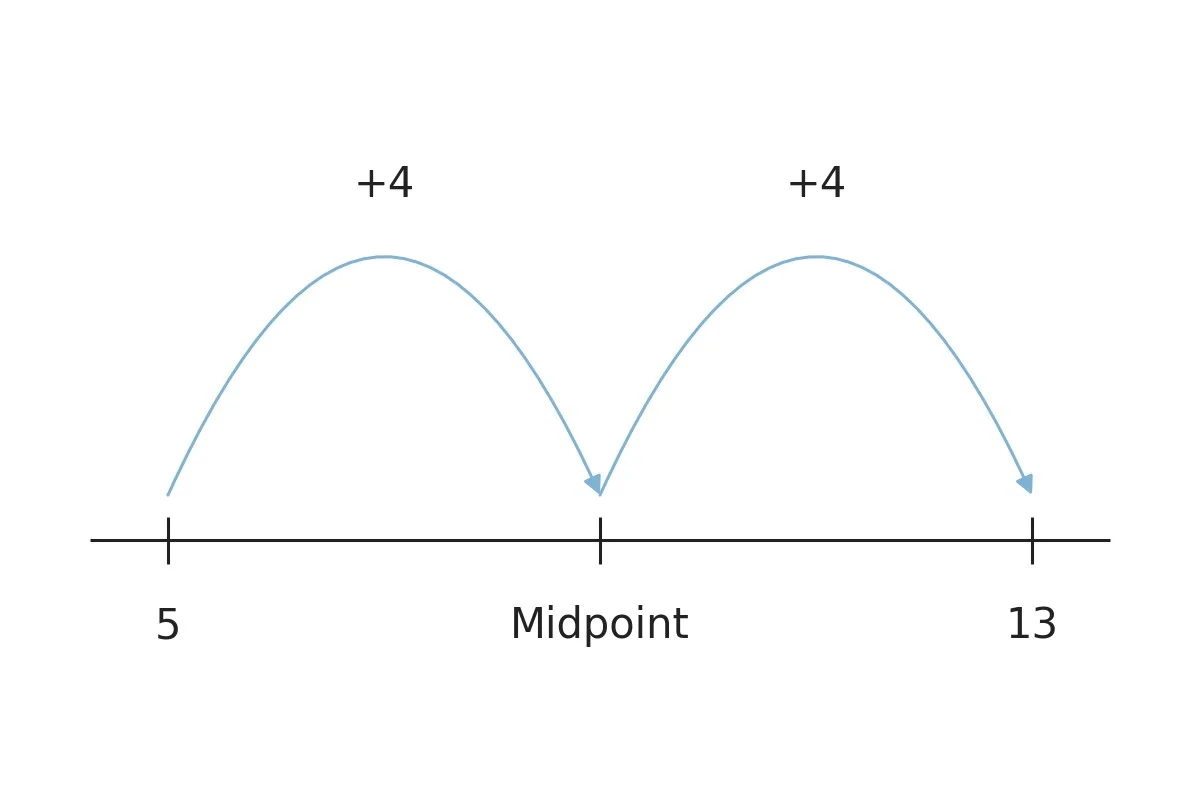
Number line showing equal jumps from 5 through an unnumbered midpoint to 13.

7. Arithmetic Mean

For three consecutive AP terms, the middle averages the outer two.

Show
Look at the diagram. Find 5 on the left and 13 on the right. Follow the equal jumps to the unnumbered middle point.
Ask
Which number belongs halfway between 5 and 13?
Say
The middle number is 9 because both gaps are 4.
Used in
Averaging equally spaced end measurements locates the middle position for a fitting.
If your child says…“The middle is the outer two added together.”
Ask
Does adding the outer numbers give the midpoint, or twice the midpoint?
What’s true
Add the outer values, then halve their sum to find the middle value.

A real problem

Galileo’s falling-body law links distance and time.

Galileo had found the correct law of freely falling bodies by 1604.

With constant acceleration from rest, a ball’s equal-time distances down an incline follow odd-number ratios.

Its total distance is then proportional to elapsed time squared.

A real ball may only approximate these rules.

University of Minnesota PressMuseum of Engineering and Technology, KrakówMuseo Galileo

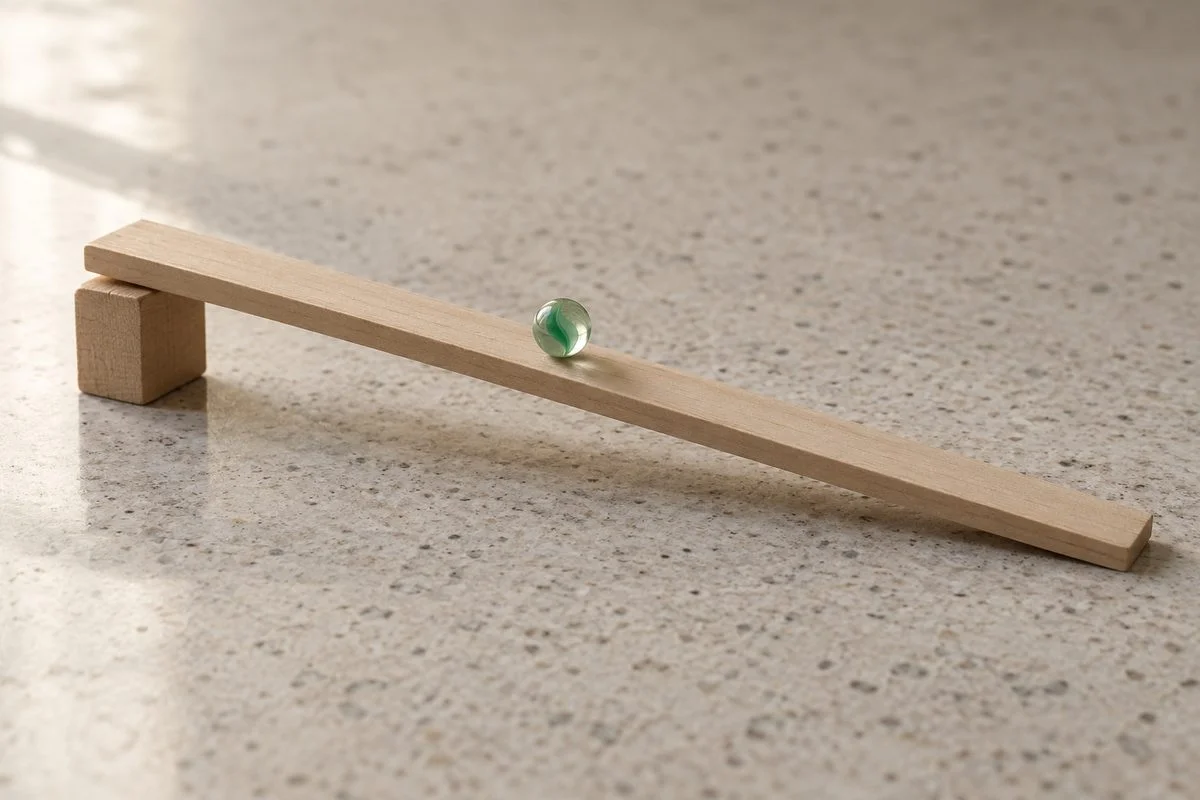
A marble on a wooden ramp sloping down from left to right.

Concept Lab · Common misconception

The tempting mistake in Arithmetic Progressions

Open standalone misconception page →

Is the first term one step from itself?

Wrong

The nth term is a + nd.

Why it feels right. I associate term number n with n jumps.

Right

From term 1 to term n there are n − 1 jumps.

Worked example

Term 1 is the starting value. Reaching term 3 takes two jumps of +3.
  1. For 4, 7, 10, the third term is 4 + 2 × 3 = 10.
  2. Only two jumps were needed.

Ask your child seven quick questions.

One per step. The answer and the reason are given.

  1. Why is 2, 4, 8, 16 not an AP?

    The differences change. Doubling gives a pattern, but the additions are unequal.

  2. How many additions take us from the first term to the tenth?

    Nine. The first term is already there before any additions.

  3. In this list, what does n tell us about 11?

    Its position: fourth. 11 is the value we located, not the position we found.

  4. What is the common difference when the second term is 4 and fourth is 8?

    2. The increase of 4 spans two gaps.

  5. Would four copies of ₹1 equal these deposits altogether?

    No. The later deposits are larger than ₹1.

  6. For this rule, what is the fourth term?

    7. Subtract the third total from the fourth total to isolate the fourth term.

  7. For −5, x, 3 in AP, what is x?

    −1. The outer terms total −2, which must be halved.

15 more questions with answers