Skip to content

Teach Triangles in seven steps.

For each idea: show it, ask before you tell, then say one line.

Gather paper, squared paper, a pencil, ruler, string and a straight stick. Use a sunlit post on level ground.

Common misconceptions & worked visual for this chapter · 15 practice questions with answers

How to teach it

Shape and matching parts

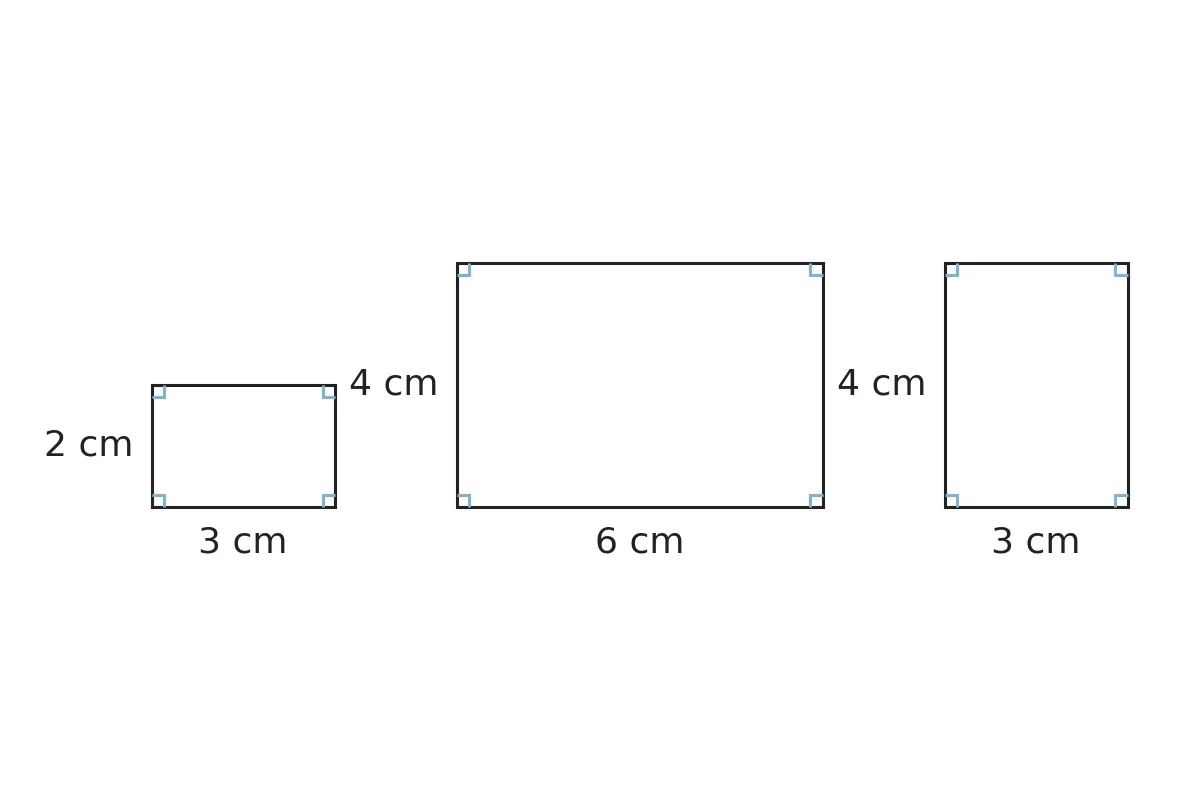
Three rectangles with labelled dimensions and matching right angles, but different proportions.

1. Similar Figures

Matching angles agree, and matching sides share one scale factor.

Show
Look at the diagram. Compare each rectangle's height and width with the left rectangle's dimensions.
Ask
Which larger rectangle keeps the left rectangle's shape?
Say
The 4 by 6 rectangle doubles both dimensions and keeps the angles. The 4 by 3 rectangle changes only the height, so its shape changes.
Used in
Photograph enlargements scale both dimensions together, keeping faces from looking stretched.
If your child says…“Their corners match, so all these rectangles are similar.”
Ask
Does the 4 by 3 rectangle multiply both original dimensions by the same amount?
What’s true
Matching corners alone cannot establish polygon similarity; matching side lengths must also scale together.
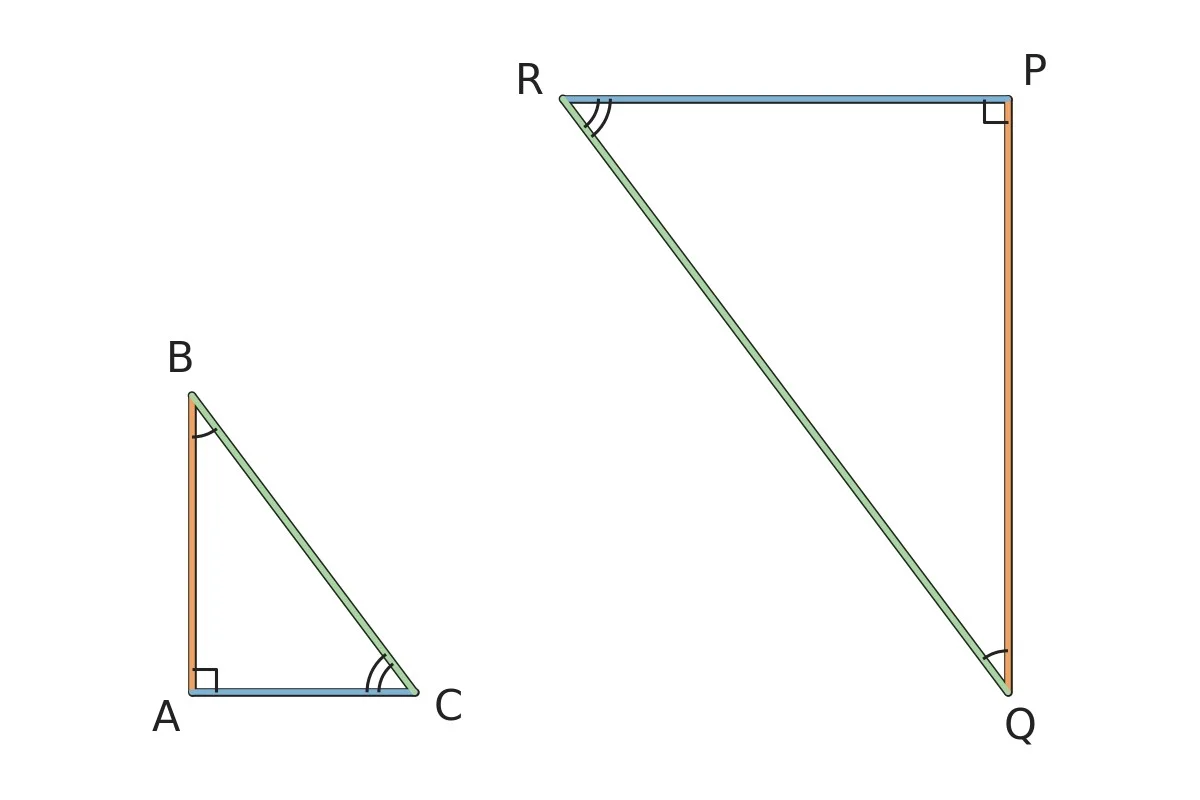
Two similar right triangles with matching angle marks and the larger triangle rotated.

2. Corresponding Vertices and Sides

Matching endpoints tell us which sides belong together.

Show
Look at the diagram. Match the angle marks, then follow the endpoints of AB and PQ.
Ask
Which side matches AB when the larger triangle is turned?
Say
A matches P, B matches Q, and C matches R: △ABC∼△PQR\triangle ABC\sim\triangle PQR. So AB matches PQ, even after turning.
Used in
Matching corners helps a tailor enlarge a triangular pattern without swapping its edges.
If your child says…“AB can match whichever side is at the bottom.”
Ask
After turning the triangle, which side still joins P to Q?
What’s true
Turning a triangle changes its position, while its matching vertices remain the same.

Parallel lines and proportions

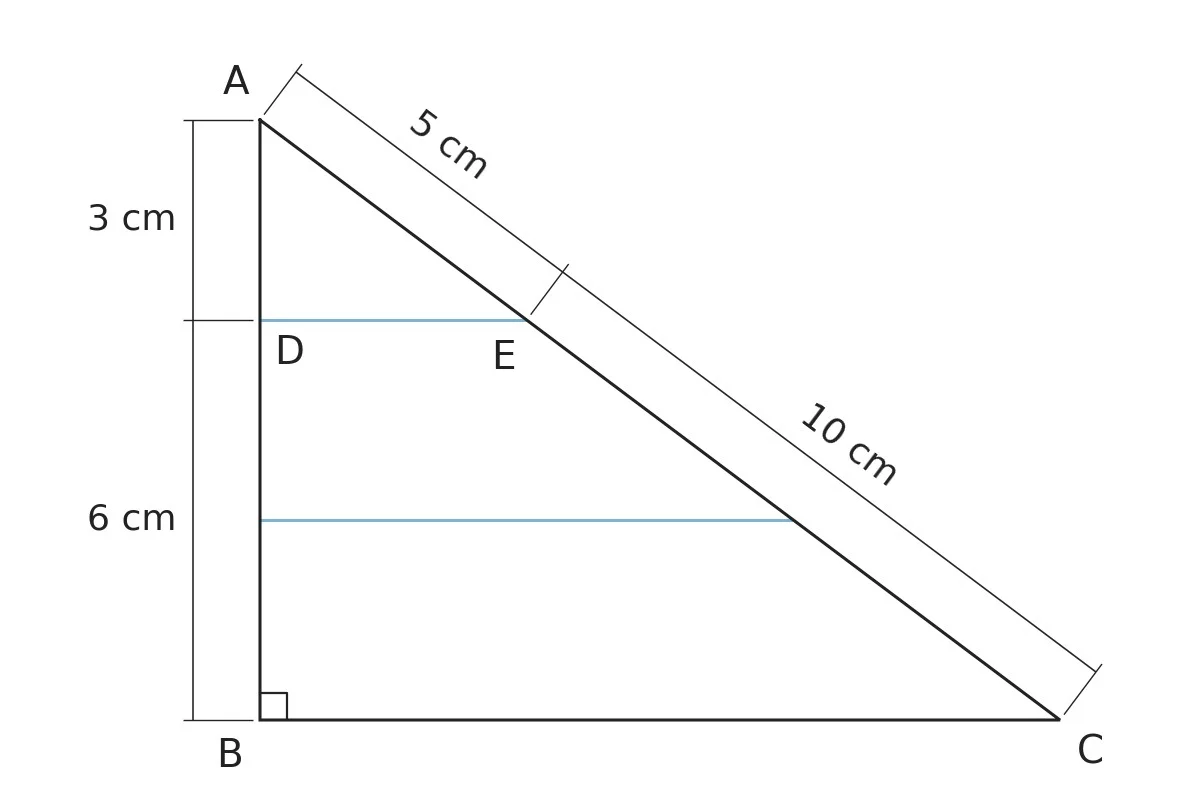
A labelled right triangle with two parallel cuts and lengths above and below DE.

3. Basic Proportionality Theorem

Parallel cuts give matching side-division ratios.

Show
Look at the diagram. Compare the labelled lengths above and below DE on each side.
Ask
What upper-to-lower ratios will measurements give at DE?
Say
Both give one to two, not halves: 3 to 6 and 5 to 10.
Used in
Parallel shelves meet triangular rack edges proportionally, helping locate their supports.
If your child says…“A parallel line always cuts both sides into halves.”
Ask
What is the ratio of the lengths above and below DE on each side?
What’s true
A parallel cut halves both sides only when it passes through a midpoint.
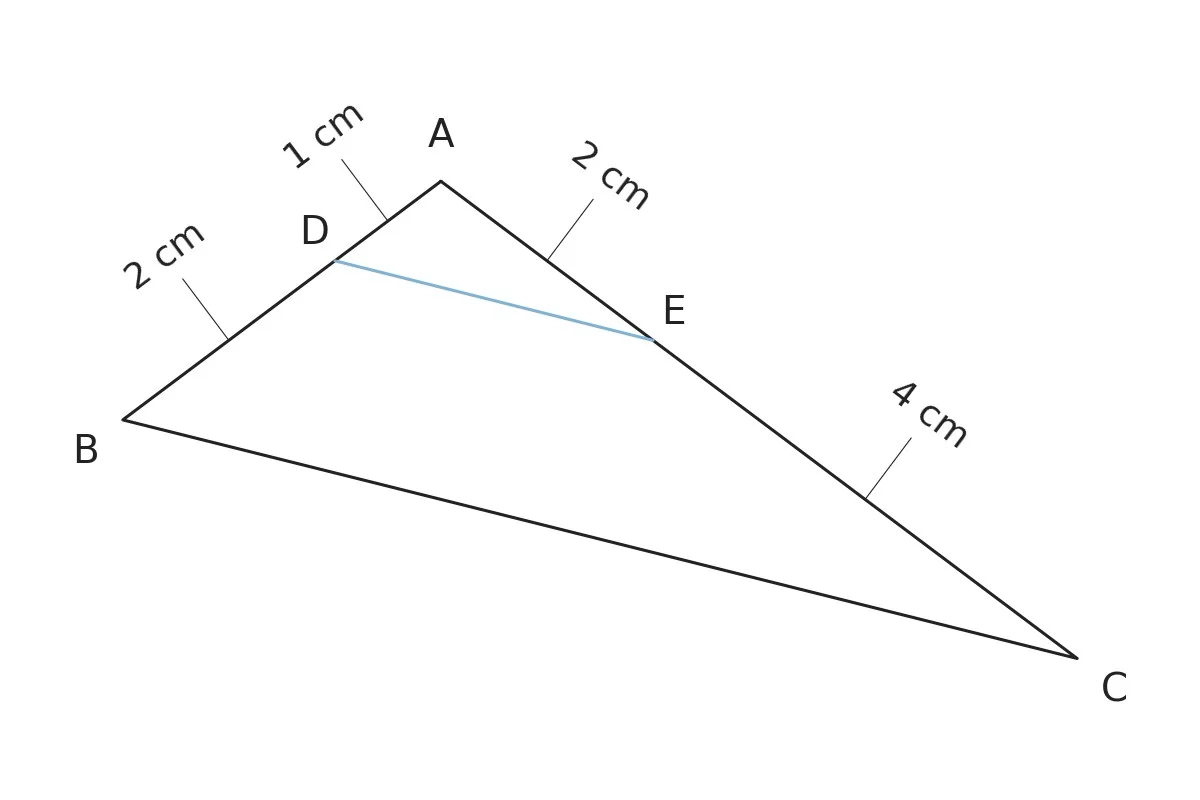
Triangle ABC with labelled side pieces and joining segment DE, without parallel marks.

4. Converse of the Basic Proportionality Theorem

Equal side-division ratios establish parallelism.

Show
Look at the diagram. Compare AD with DB, then AE with EC.
Ask
How are DE and BC related?
Say
DE is parallel to BC: the parallel through D must reach this same division point E.
Used in
Proportional marks help align crosspieces on triangular supports.
If your child says…“Nearly equal ratios are enough to prove the lines parallel.”
Ask
Would a nearby point still divide AC in exactly the required ratio?
What’s true
The converse requires exactly equal ratios, even when a drawing looks convincing.
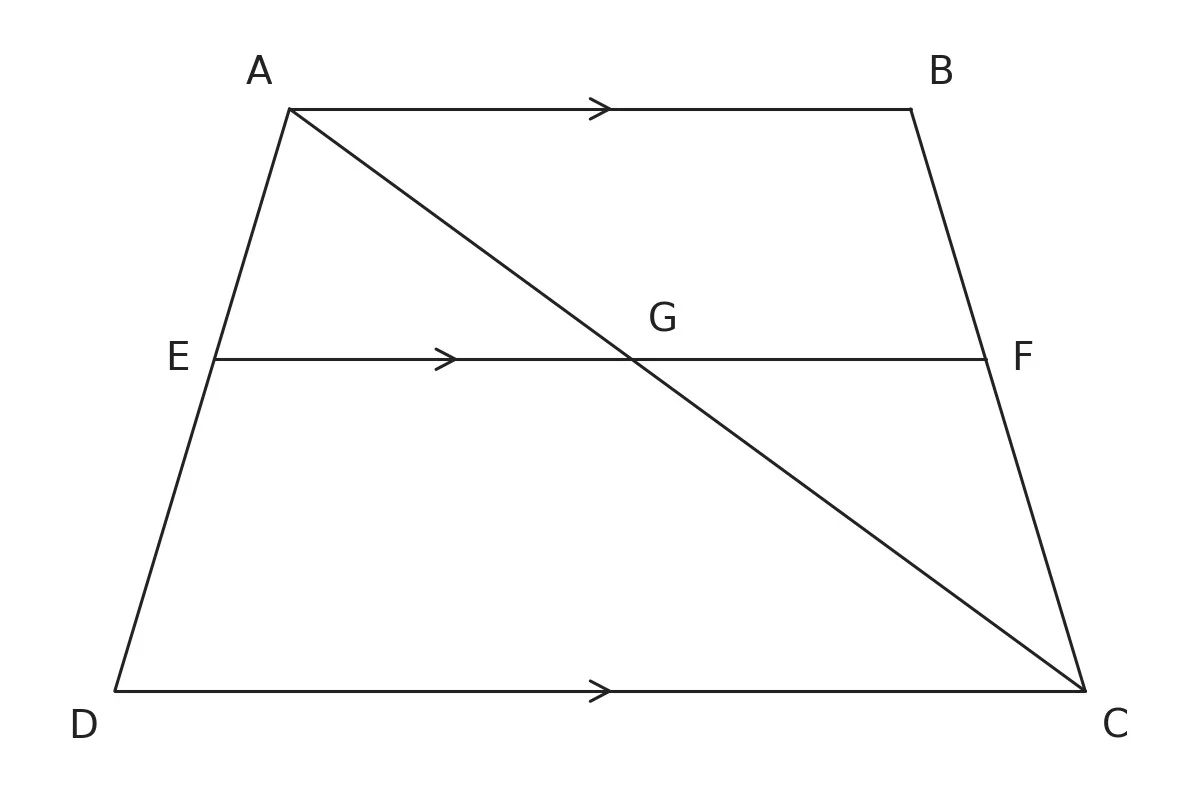
A labelled trapezium with three parallel segments and diagonal AC crossing EF at G.

5. Applications of the Basic Proportionality Theorem

A diagonal creates two triangles whose BPT results we can link.

Show
Find triangles ADC and CAB in the diagram. Follow how each connects an outer side to diagonal AC.
Ask
Which outer-side ratios must match?
Say
Both outer sides have the same division ratio as the diagonal.
Used in
Diagonals help calculate rail positions in trapezium-shaped frames.
If your child says…“BPT works directly on the whole trapezium.”
Ask
Which triangle connects the left side to the diagonal, and which connects the right?
What’s true
The diagonal supplies two triangles, and each contributes a ratio needed for the conclusion.

Establish similarity and use it

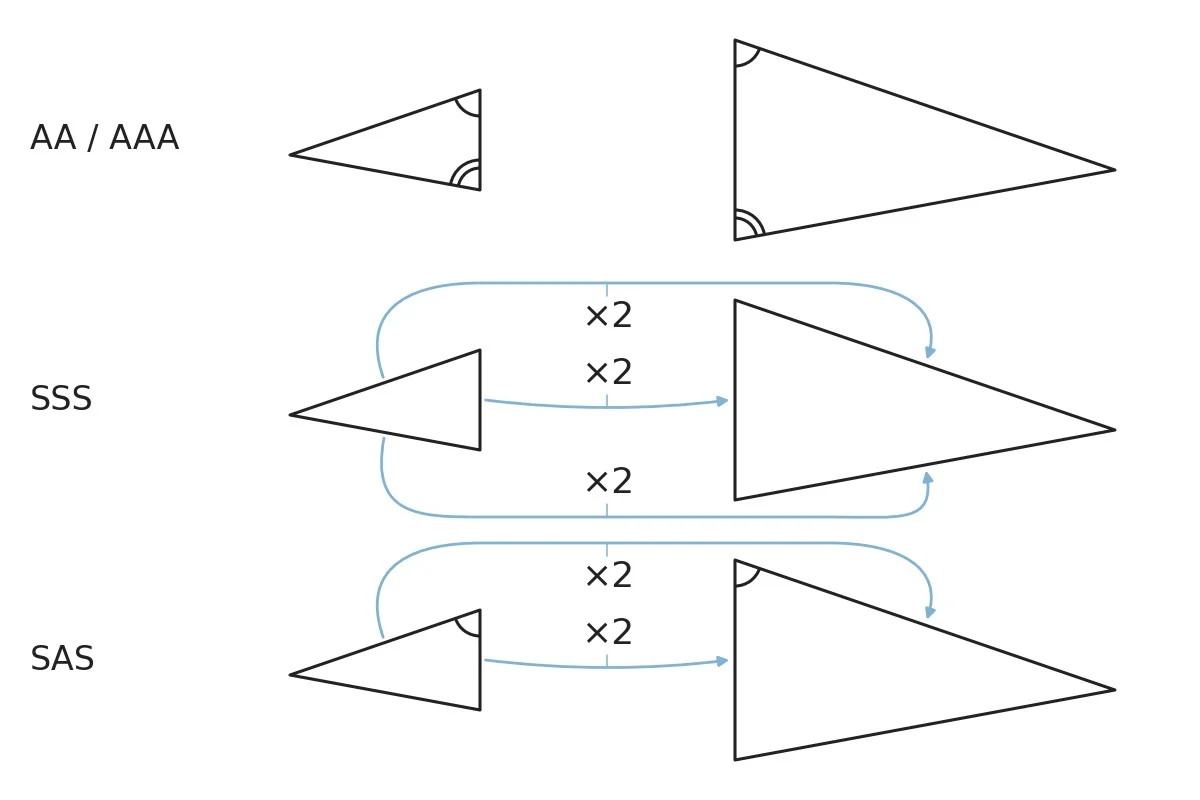
Three triangle pairs show the angle and side information required for AA, SSS and SAS.

6. Criteria for Similarity of Triangles

AA, AAA, SSS and SAS establish similarity.

Show
Look at the diagram. Compare the marked angles and sides in the AA, SSS and SAS panels.
Ask
Looking at the marks, will each triangle pair have the same shape, and why?
Say
Two matching angles force the third to match, so AA already gives AAA. SSS needs every matching side pair to share one ratio. SAS needs two matching side pairs in one ratio, with equal angles between those sides.
Used in
Similarity checks help carpenters verify enlarged triangular templates.
If your child says…“Two matching angles aren't enough.”
Ask
What room is left for different third angles after subtracting the same two angles?
What’s true
Matching two angles forces the third to match because every triangle totals 180°.
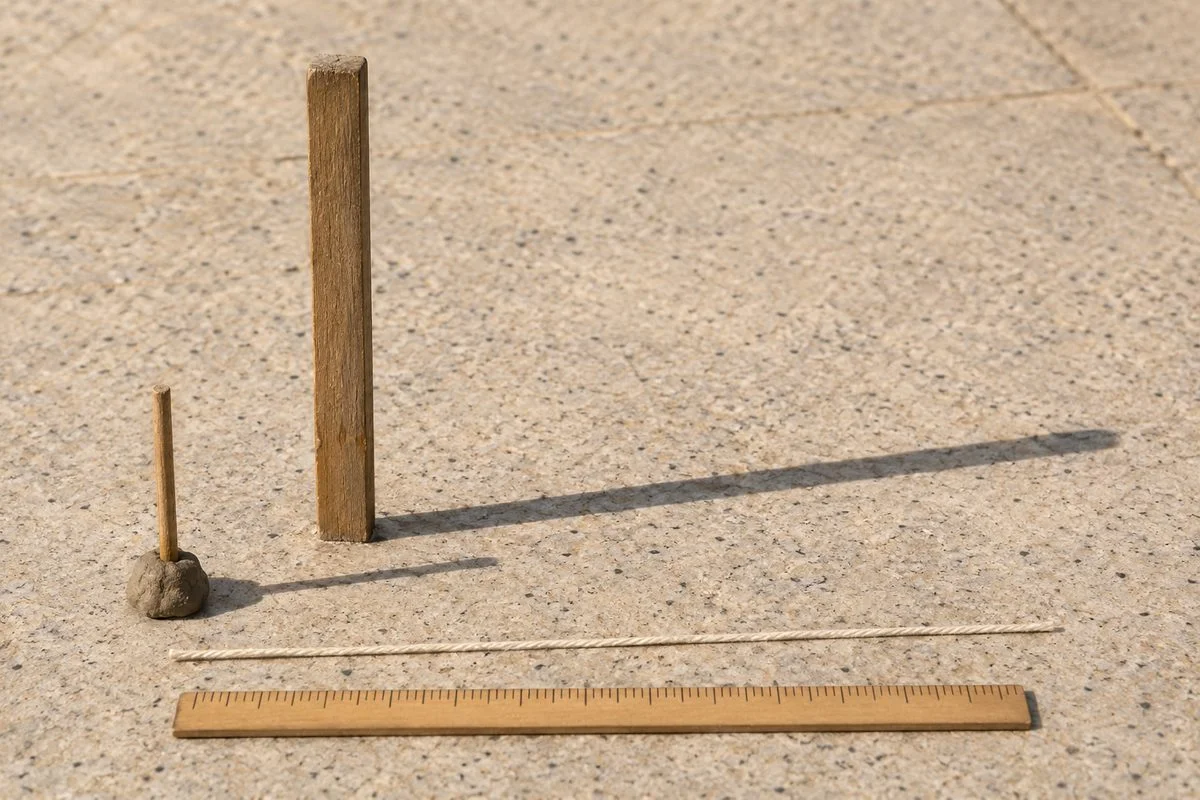
A short upright stick and a taller post casting shadows, with string and a ruler beside them.

7. Applications of Similar Triangles

Matching lengths supply the scale for unknown lengths.

Show
Hold a stick vertically beside a post on sunny, level ground. Measure its height, then both shadows immediately, using string and ruler.
Ask
What post height does the shadow ratio predict?
Say
AA applies: both triangles have right angles and matching sunlight angles. Multiply stick height by post-shadow divided by stick-shadow length.
Used in
Surveyors calculate river widths using similar triangles.
If your child says…“For perimeters, I square the side ratio.”
Ask
If every side doubles, what happens when you add the three lengths?
What’s true
Adding side lengths preserves their common scale factor, so perimeter uses the unsquared ratio.

A real problem

A calculating compass used similar triangles.

Galileo began building his geometric and military compasses in 1597.

The instrument used properties of similar triangles to perform calculations.

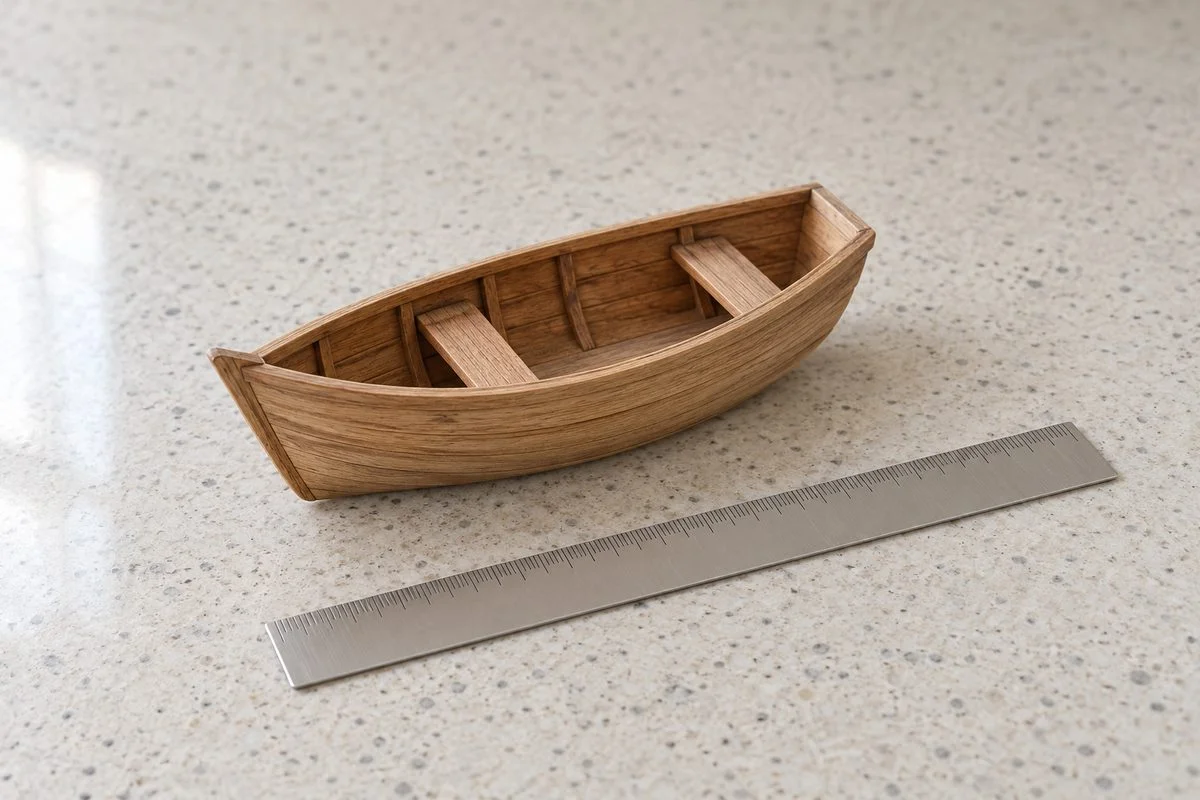
Shipbuilders used it when testing scale models of hull designs.

Museo GalileoHarvard UniversitySmithsonian Magazine

A wooden model boat beside a ruler on a workbench.

Concept Lab · Common misconception

The tempting mistake in Triangles

Open standalone misconception page →

Does similarity mean equal areas?

Wrong

Similar triangles have the same area.

Why it feels right. Their shapes match, so I expect their size to match too.

Right

Areas of similar figures scale with the square of their length ratio.

Worked example

The larger triangle has twice the base and height, so its area is four times as large.

Doubling a right triangle’s base from 3 to 6 and height from 4 to 8 changes area from 6 to 24.

Ask your child seven quick questions.

One per step. The answer and the reason are given.

  1. A square and a long rectangle have matching angles. Are they similar?

    No. Their matching sides do not share one scale factor.

  2. ABC matches QRP in that order. Which side matches AB?

    QR. A pairs with Q, and B pairs with R.

  3. A parallel cut leaves 2 cm above and 3 cm below on one side. What upper-to-lower ratio must the other cut side have?

    2 : 3. Parallel cuts preserve matching ratios without necessarily making equal pieces.

  4. The side-division ratios are 34\frac{3}{4} and 45\frac{4}{5}. Is the joining line parallel to the base?

    No. Those ratios differ; a parallel cut would make them equal.

  5. What theorem justifies the two starting ratios?

    BPT in each triangle. The given parallels justify BPT; appearance alone establishes nothing.

  6. Two angle pairs match. What else must we measure to establish triangle similarity?

    Nothing. The third pair follows from the angle sum.

  7. Similar triangles have matching sides in the ratio 4 : 7. What is their perimeter ratio?

    4 : 7. Every side and their sum grow by the same factor.

15 more questions with answers, 6 with pictures