Skip to content

Teach Coordinate Geometry in seven steps.

For each idea: show it, ask before you tell, then say one line.

Gather squared paper, a pencil and a ruler.

Common misconceptions & worked visual for this chapter · 15 practice questions with answers

How to teach it

Locate and measure

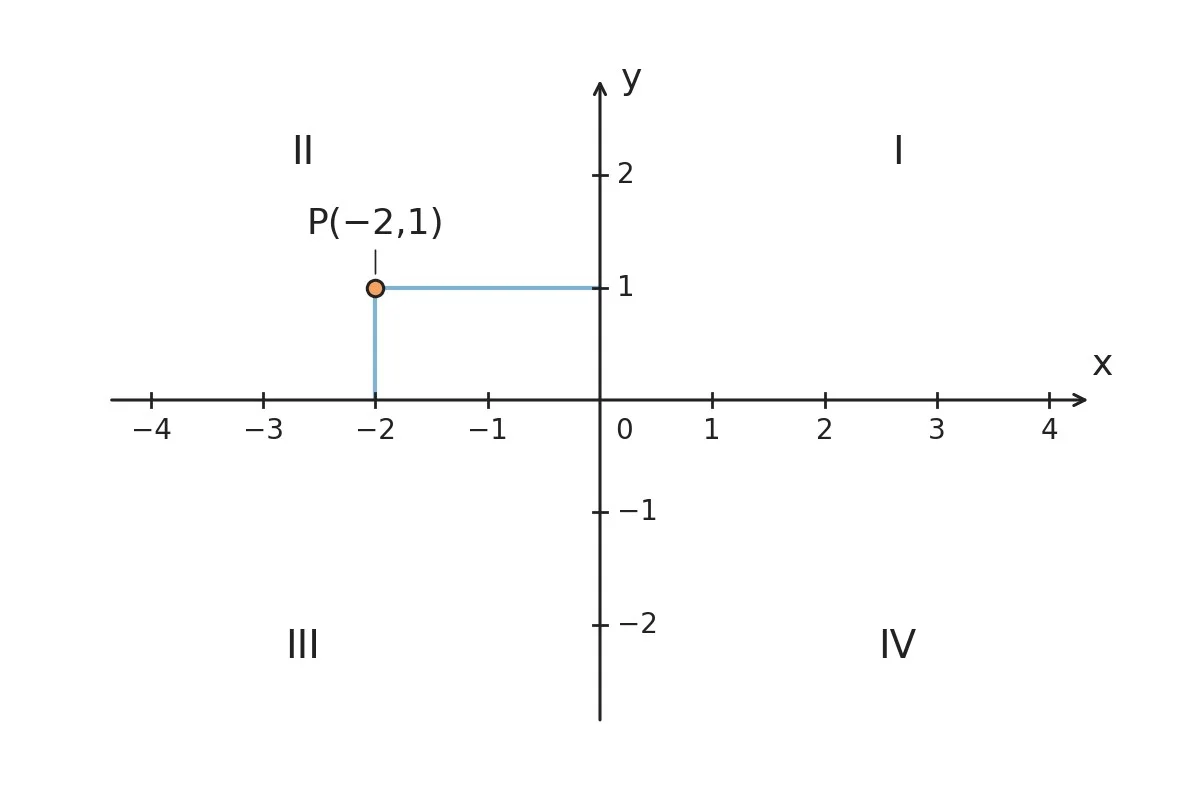
Coordinate diagram with numbered axes, labelled quadrants and perpendicular guides from P.

1. Coordinates

Abscissa gives horizontal position; ordinate gives vertical position.

Show
Find P(−2,1), the numbered axes and quadrants I–IV in the diagram. Follow the perpendicular segments and count the gaps to both axes.
Ask
Which coordinate will change when you reflect P across the horizontal axis?
Say
Mark its reflection at (−2,−1). Only the ordinate changes sign because the horizontal position stays unchanged.
Used in
Coordinates help map readers locate a place precisely.
If your child says…“Reflecting across the x-axis changes x.”
Ask
Does the reflected point move left or right?
What’s true
Crossing the horizontal mirror line reverses the vertical position.
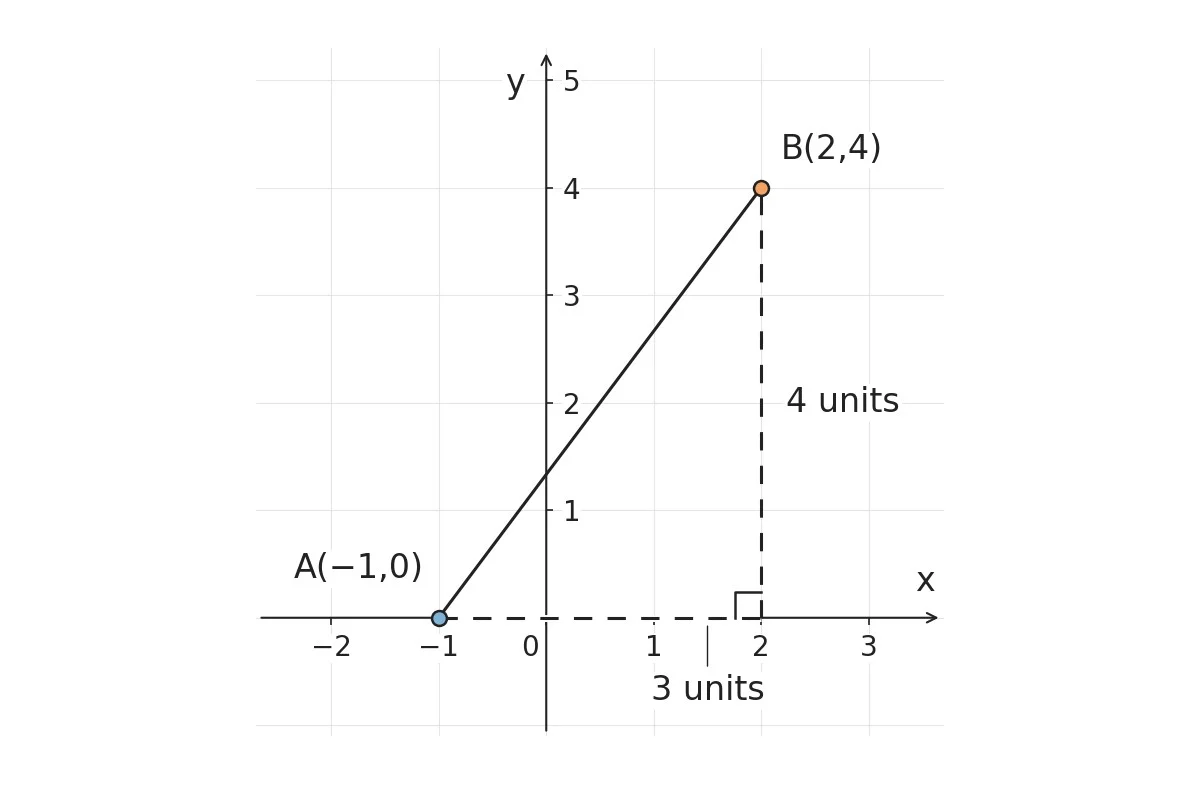
Coordinate diagram showing A, B and a right triangle with labelled horizontal and vertical legs.

2. Distance Formula

Find the straight distance using horizontal and vertical gaps.

Show
Find A(−1,0), B(2,4), and their straight join in the diagram. Count the right triangle’s horizontal and vertical legs: 3 and 4 units.
Ask
How long will the straight join be, compared with the seven-unit route along the legs?
Say
Pythagoras gives 5 units: square both gaps, add, then take the nonnegative square root. Measure the join in grid units to check.
Used in
Builders calculate straight beam lengths from endpoint positions.
If your child says…“The straight distance is 3 plus 4.”
Ask
Does the straight join follow both legs?
What’s true
Adding the legs measures the bent route, rather than the straight join.
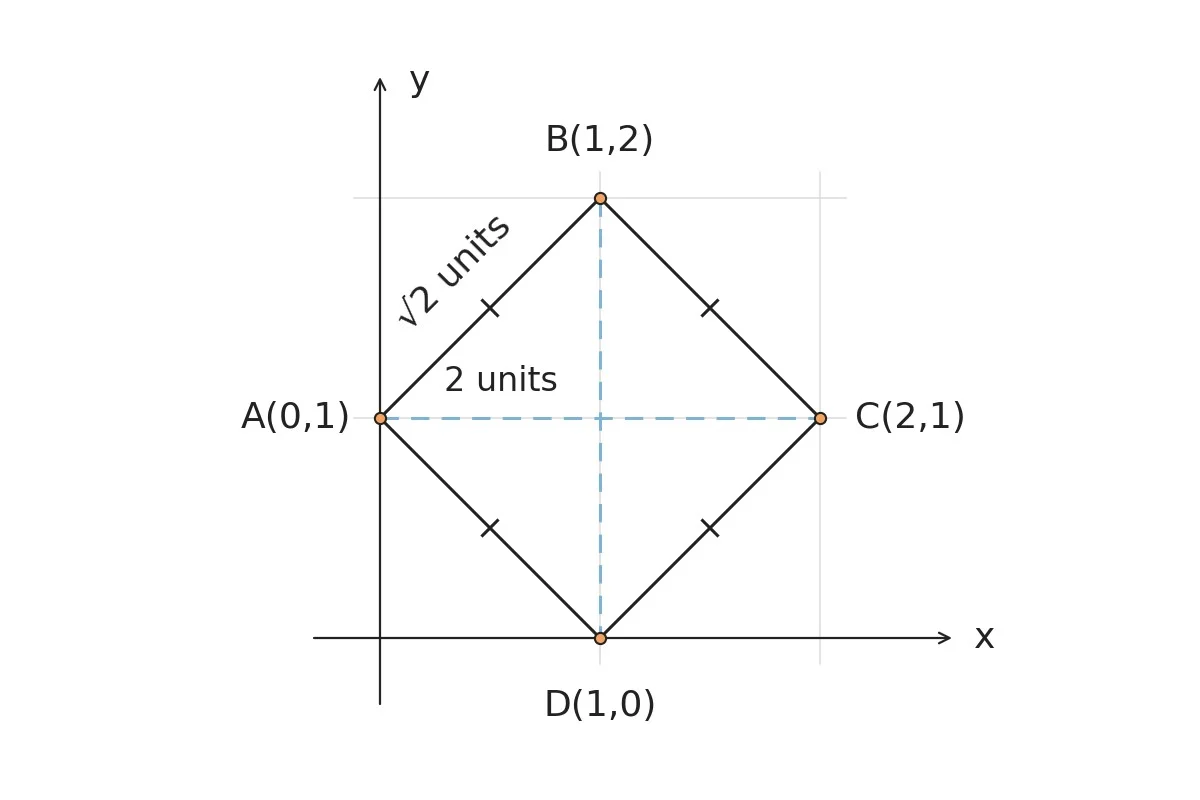
Tilted square on a coordinate grid, showing equal sides and both diagonals.

3. Applications of the Distance Formula

Compare lengths to establish what shape the points form.

Show
Look at the diagram. Follow A, B, C and D around the sides. Compare their grid gaps, then the diagonal lengths.
Ask
Looking at this figure, do you expect its two diagonals to have equal lengths?
Say
Each side is 2\sqrt{2} units, so the figure is a rhombus. Both diagonals are 2 units, so this rhombus is a square.
Used in
Tilers check diagonals to keep square layouts square.
If your child says…“Four equal sides always make a square.”
Ask
What evidence do the diagonals add beyond the equal sides?
What’s true
A rhombus also has equal sides, but its corners need not be right angles.

AP2=BP2AP^2=BP^2

x2+1=(x−2)2+1x^2+1=(x-2)^2+1

x2=x2−4x+4x^2=x^2-4x+4

4x=44x=4

4. Applications of the Distance Formula

Use a distance condition to find an unknown coordinate.

Show
Introduce A(0,1), B(2,1), and P(x,0) on the x-axis. Say, “x is P’s horizontal coordinate.” After the prediction, write these lines, saying, “Equal distances have equal squares.”
Ask
Where on the x-axis do you expect equal distances?
Say
Dividing by 4 gives x=1x=1, placing P at (1,0).
Used in
Planners can position shared facilities to balance straight distances from two sites.
If your child says…“Only the midpoint is equally far from both endpoints.”
Ask
Is the midpoint (1,1) on the required x-axis?
What’s true
Equal distances occur along the perpendicular bisector, including points beyond the midpoint.

Divide a segment

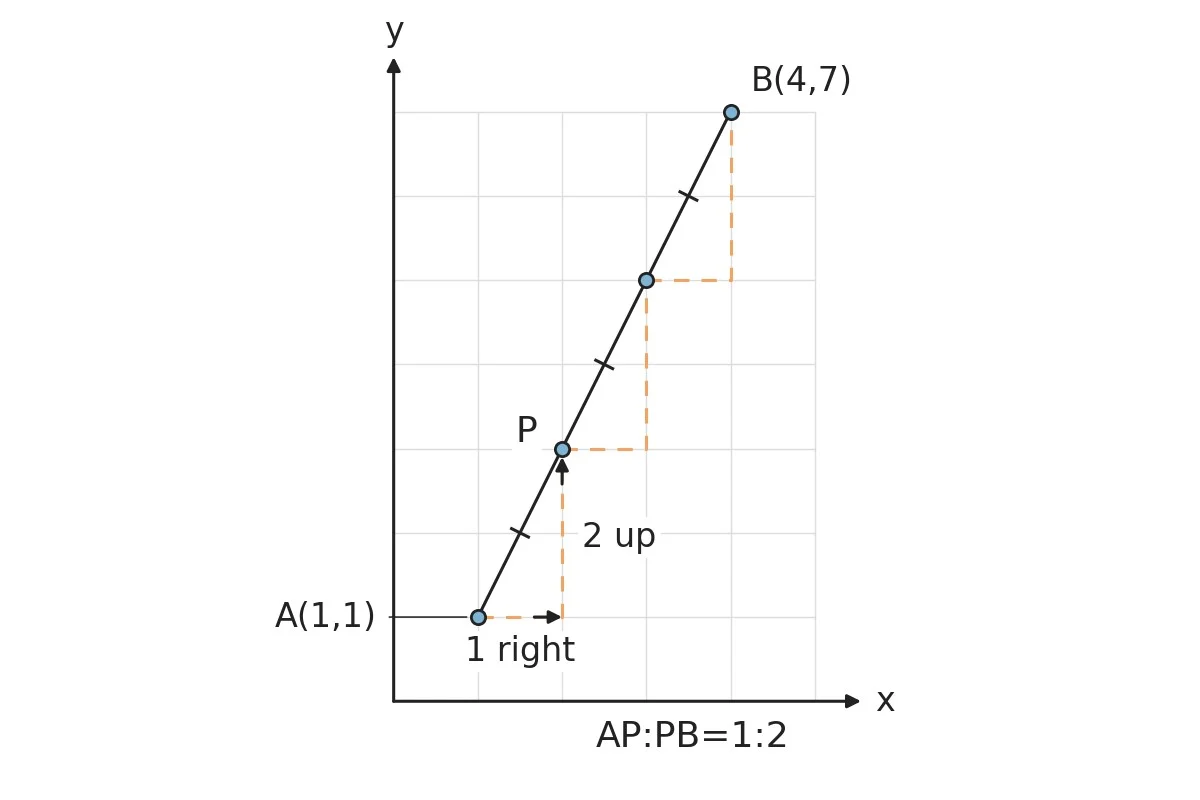
Segment divided into three equal intervals, with steps showing coordinate changes towards P.

5. Section Formula

Locate a point that divides a segment in a given ratio.

Show
Find the three equal intervals in the diagram. Follow the steps from A to P.
Ask
What coordinates put P one-third of the way from A to B?
Say
P is (2,3): move 1 right and 2 up from A. That uses one-third of each coordinate change.
Used in
Designers divide edges in set ratios to preserve proportions when resizing drawings.
If your child says…“One-third along means the ratio is 1:3.”
Ask
How many equal pieces remain after P?
What’s true
The ratio compares the first piece with the remainder, rather than the whole.
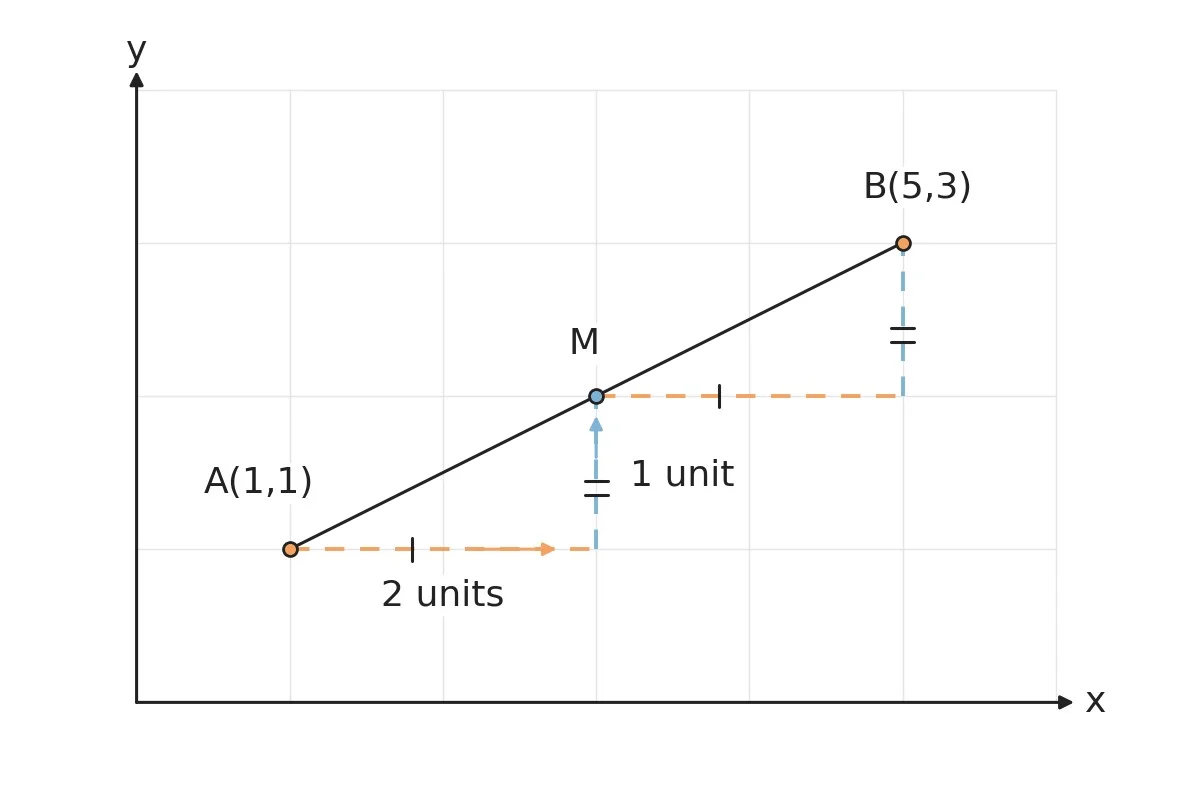
Segment with matching horizontal and vertical steps on either side of its midpoint.

6. Mid-point Formula

Average matching endpoint coordinates to locate halfway.

Show
Look at the diagram. Find A, M and B along the segment. Compare the horizontal steps, then the vertical steps, on either side of M.
Ask
What coordinates place M exactly halfway from A to B?
Say
M is (3,2), halfway through both coordinate changes. Average each pair of matching endpoint coordinates to find this halfway position.
Used in
Carpenters locate the middle of a board to position a central support.
If your child says…“Halving the coordinate differences gives the midpoint’s coordinates.”
Ask
Where must you start before moving through half each gap?
What’s true
Half a coordinate difference gives movement from an endpoint, rather than the final position.

1=3kk+11=\frac{3k}{k+1}

k+1=3kk+1=3k

1=2k1=2k

k=12k=\frac{1}{2}

7. Section Formula

Find the division ratio when the dividing point is known.

Show
Introduce A(0,0), B(3,6), and P(1,2). After the prediction, say, “Call the ratio AP:PB k:1, and use P’s horizontal coordinate.” Write these lines.
Ask
What whole-number ratio do you expect for AP:PB?
Say
Multiply both ratio parts by 2 to get 1:2. Check P’s vertical coordinate: one-third of the rise from 0 to 6 is 2.
Used in
Scale drawings preserve division ratios, allowing a marked position to transfer accurately to a larger layout.
If your child says…“The ratio puts the distance from B first.”
Ask
Is P nearer A or B?
What’s true
AP comes first because A is the first named endpoint.

A real problem

Coordinates helped guide the Channel Tunnel.

Surveyors created a local coordinate grid for the tunnel.

Survey reference markers helped guide the initial tunnelling.

The tunnel opened in May 1994.

It greatly shortened travel times between Britain and mainland Europe.

Transportation Research BoardStanford Linear Accelerator CenterInstitution of Civil Engineers

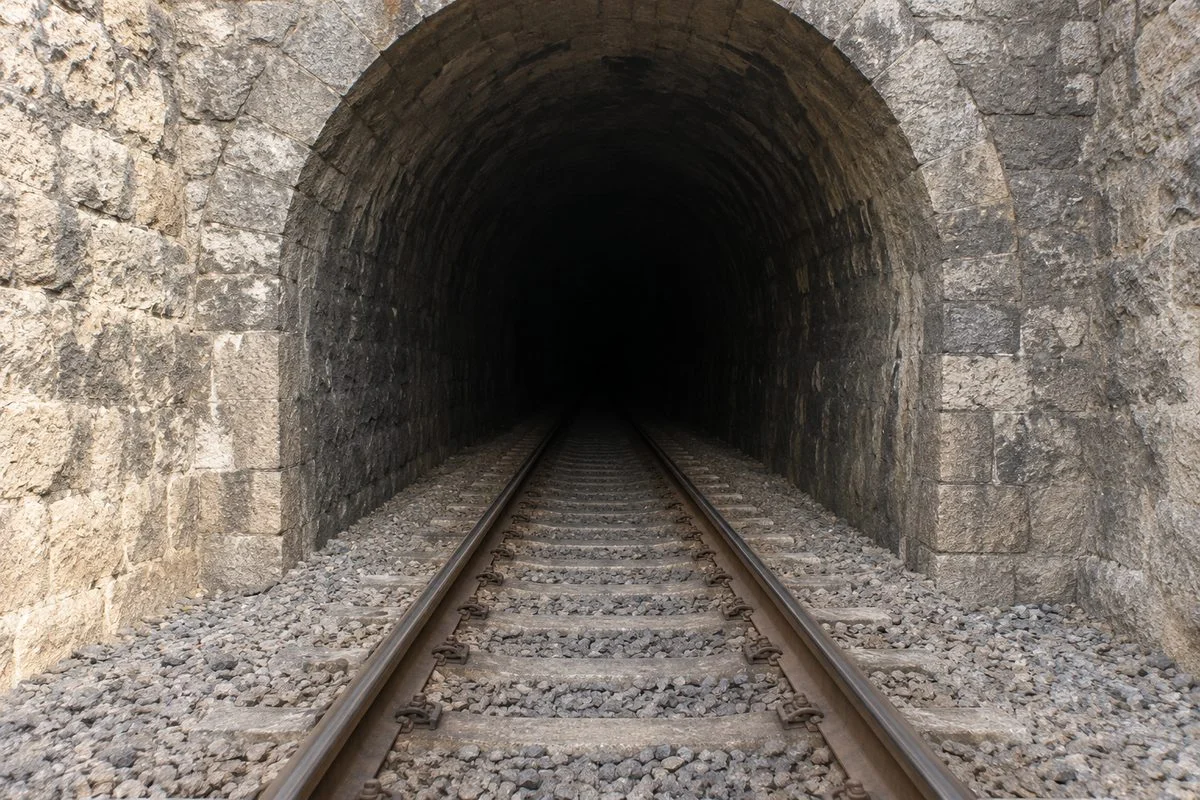
Railway tracks entering a tunnel.

Concept Lab · Common misconception

The tempting mistake in Coordinate Geometry

Open standalone misconception page →

Can opposite coordinate signs cancel the distance?

Wrong

The distance from (−3, 0) to (3, 0) is zero.

Why it feels right. I add −3 and 3 and get zero.

Right

Distance measures the separation between positions.

Worked example

The six spaces between the points measure their separation.
  1. On the x-axis, the points lie 3 units on opposite sides of 0.
  2. Subtract their positions and take the magnitude.
  3. The separation is 6 units.

Ask your child seven quick questions.

One per step. The answer and the reason are given.

  1. Where does P(−2,1) land after reflection across the x-axis?

    (−2,−1). Reflection reverses the vertical position while keeping the horizontal position.

  2. What is the straight distance between A and B?

    5 units. Pythagoras uses the squares of the gaps, rather than their sum.

  3. How must the two diagonal lengths compare for a rhombus to be a square?

    Its diagonals are equal. Equal diagonals establish that a rhombus has right angles.

  4. Which point on the x-axis is equally far from these endpoints?

    (1,0). The equal-distance equation gives x as 1, and the axis requires zero ordinate.

  5. What ratio does the first dividing point make?

    1:2. One equal piece comes before the point, and two remain after it.

  6. What are M’s coordinates halfway between A(1,1) and B(5,3)?

    (3,2). Average matching coordinates; halving differences gives only movement from A.

  7. For these points, what is AP:PB?

    1:2. AP comes first in AP:PB, whether it is shorter or longer.

15 more questions with answers