Skip to content

Teach Pair of Linear Equations in Two Variables in six steps.

For each idea: show it, ask before you tell, then say one line.

Gather paper and a pencil.

Common misconceptions & worked visual for this chapter · 15 practice questions with answers

How to teach it

What the solution means

Three plus one equals four.

Three minus one equals two.

1. Pair of Linear Equations in Two Variables

The same two values must fit both equations.

Show
Call the numbers x and y. Write that their sum is four and their difference is two. Write these lines to check three and one.
Ask
From these checks, which ordered pair do you expect to satisfy both equations?
Say
Three and one make both equations true. Write x first and y second: (3,1)(3,1).
Used in
Checking both item counts and payment helps shopkeepers find billing errors.
If your child says…“Any two numbers totalling four solve the pair.”
Ask
What difference do you get with two and two?
What’s true
The same numbers must also have a difference of two.
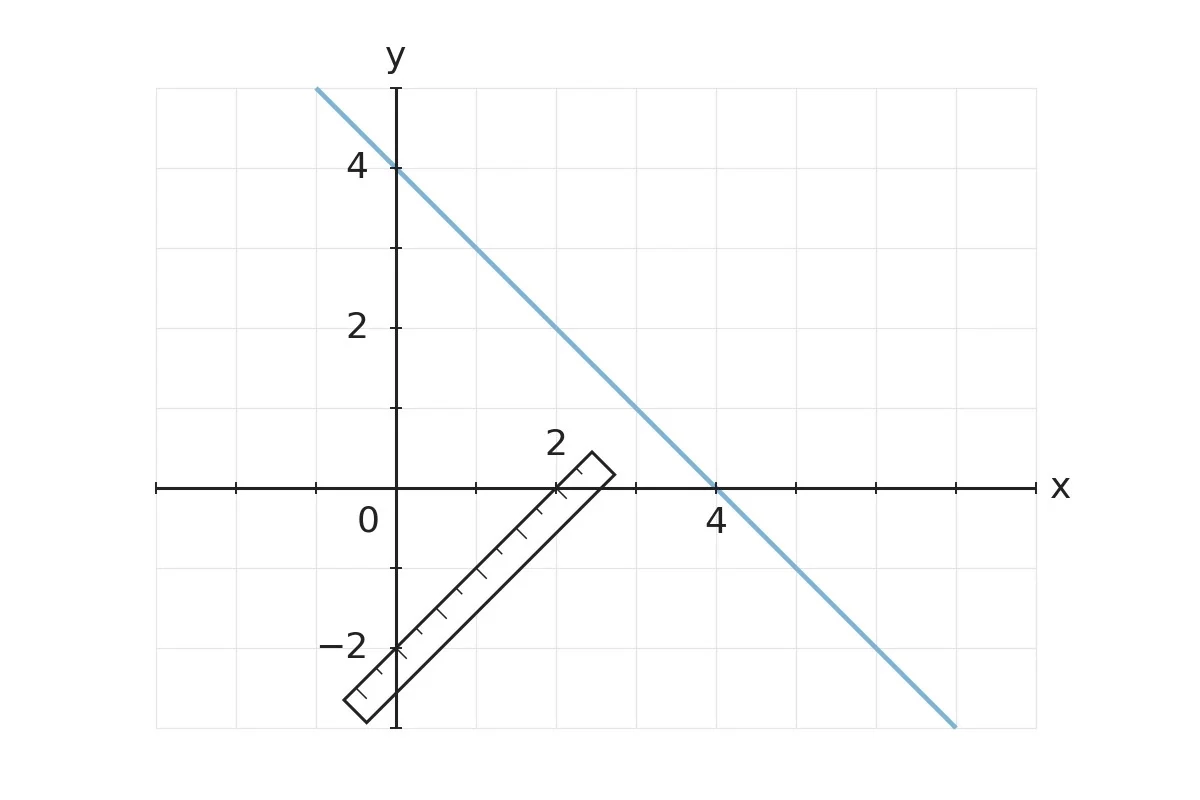
Labelled coordinate diagram with one line and a ruler aligned through two axis crossings.

2. Graphical Method of Solution of a Pair of Linear Equations

The lines' crossing gives values that fit both equations.

Show
In the diagram, find each line's axis crossings. Follow the ruler's edge towards the drawn line.
Ask
Where will the second line cross the first?
Say
The crossing is (3,1)(3,1).
Used in
Comparing fare graphs shows where different charging plans cost the same.
If your child says…“The crossing gives y first, then x.”
Ask
Which coordinate measures how far across the crossing lies?
What’s true
Read the horizontal position first and the vertical position second.

How many solutions

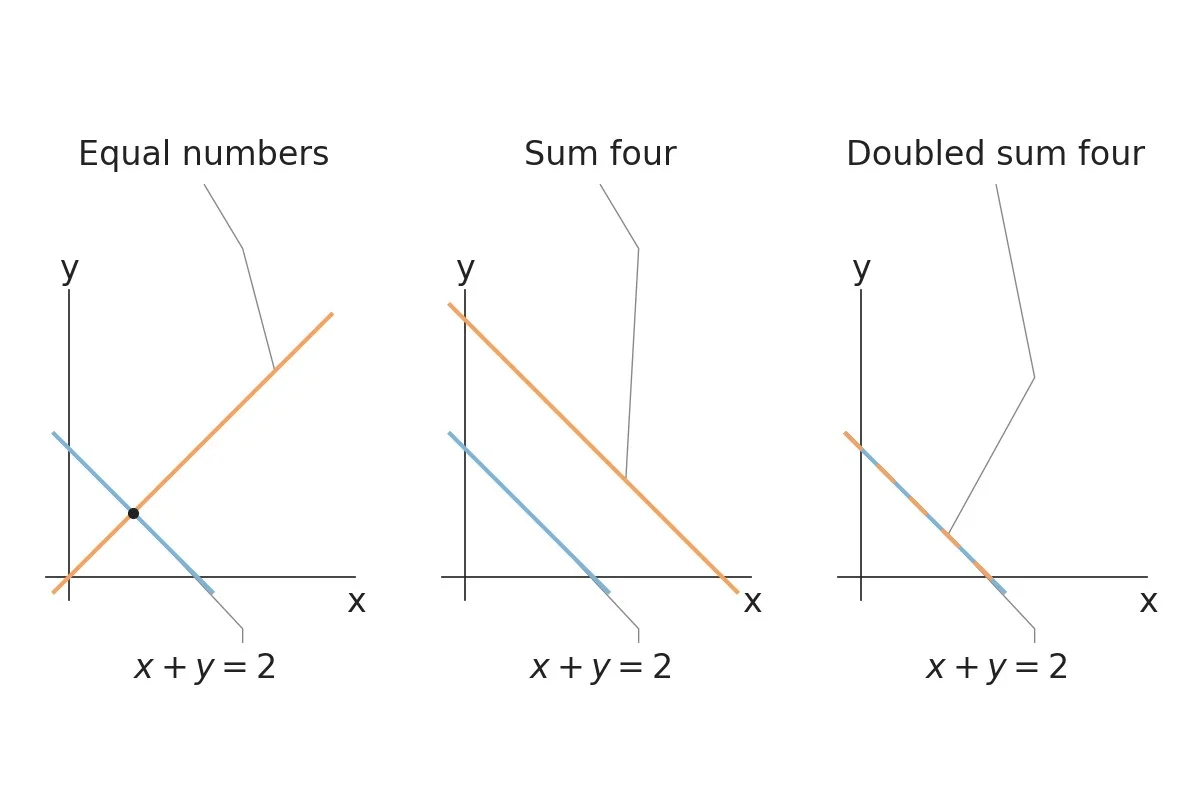
Three graphs show crossing lines, separate parallel lines, and completely overlapping lines.

3. Consistent and Inconsistent Pairs of Linear Equations

A pair can have one, no, or infinitely many solutions.

Show
Look at the diagram's crossing, separate parallel lines, and overlapping lines, from left to right. Compare each pair's coefficients and constants.
Ask
Will every pair shown give exactly one shared solution?
Say
The crossing and overlapping pairs are consistent because they have shared points. The separate parallel pair is inconsistent because it has none. The overlapping pair is also dependent, with infinitely many solutions.
Used in
Checking equations exposes conflicting totals before someone searches for prices that cannot fit.
If your child says…“The constant does not matter.”
Ask
Do the middle pair's constants scale like their variable coefficients?
What’s true
Coincident lines require the constant to scale with both variable coefficients.

k2=11\frac{k}{2}=\frac{1}{1}

k2=1\frac{k}{2}=1

4. Conditions for Infinitely Many Solutions

The unknown coefficient must make the whole equations match.

Show
Call the unknown coefficient k. Write k times x plus y minus one equals zero. Write twice x plus y minus one equals zero. Write these lines. Say, 'We want infinitely many solutions. The y-coefficients and constants already match.'
Ask
What next line gives the value of k?
Say
The missing coefficient must match too: k=2k=2.
Used in
Matching a recipe's ingredient proportions keeps its mixture unchanged when batch sizes change.
If your child says…“That same value gives exactly one solution.”
Ask
If both equations match, what selects just one point?
What’s true
Identical equations allow every point on their shared line.

Finding and using the values

x=y+1x=y+1

(y+1)+y=3(y+1)+y=3

y=1y=1

x=1+1x=1+1

5. Substitution Method and Elimination Method

Replace or cancel a variable to find the unknown values.

Show
Write that x minus y equals one and x plus y equals three. Write these lines. Say, 'Replace x in the other equation with its equal expression.'
Ask
What next line gives x?
Say
Since y is 1, x is one more: x=2x=2.
Used in
Solving equations gives exact costs when a graph would give only an estimate.
If your child says…“I can substitute into the equation I started from.”
Ask
Where have you used the condition that their sum is three?
What’s true
Substituting into the source equation repeats information instead of using the other condition.

(x+2y)−(x+y)=5−3(x+2y)-(x+y)=5-3

y equals two.

x equals three minus two.

6. Applications of a Pair of Linear Equations

Turn each fact into an equation, then interpret the solution.

Show
Let x count one-rupee coins and y count two-rupee coins. Write x+y=3x+y=3 for count and x+2y=5x+2y=5 for value. Write these lines, subtracting count from value.
Ask
What coin counts complete the solution?
Say
There is one one-rupee coin and two two-rupee coins. Together, they give three coins worth five rupees.
Used in
Ticket counts and receipts together can reveal how many tickets sold at each price.
If your child says…“A two-rupee coin counts as two coins.”
Ask
Does a coin's denomination change how many coins you hold?
What’s true
Its value is two rupees, but it is one coin.

Concept Lab · Common misconception

The tempting mistake in Pair of Linear Equations in Two Variables

Open standalone misconception page →

Does every pair of lines have one solution?

Wrong

Two linear equations always give one solution.

Why it feels right. I picture two lines crossing.

Right

The solution set is the intersection of the two graphs.

Worked example

The lines have the same slope and different vertical intercepts, so they never cross.
  1. The lines y = 2x + 1 and y = 2x − 3 have equal slopes and different intercepts.
  2. They are parallel, so there is no common solution.

Ask your child six quick questions.

One per step. The answer and the reason are given.

  1. Two and two total four. Which condition do they fail?

    A difference of two. Their difference is zero, so they satisfy only the first equation.

  2. The crossing is three across and one up. What ordered pair describes it?

    Three, then one. The horizontal coordinate comes first.

  3. Which parts need the same nonzero multiplier for two equations to describe the same line?

    Both variable coefficients and constant. Matching only variable-coefficient ratios can still give separate parallel lines.

  4. Which value of k must you exclude for exactly one solution here?

    2. That value makes the equations identical.

  5. Which original equation must receive the expression for x?

    Their sum is three. The other equation adds the information needed to find both values.

  6. What does twice y count in the value equation?

    Rupees from two-rupee coins. Each such coin contributes two rupees but only one coin.

15 more questions with answers, 3 with pictures