Skip to content

Teach Surface Areas and Volumes in five steps.

For each idea: show it, ask before you tell, then say one line.

Gather a cup, bowl, spoon, water and a clean stone that fits fully inside the cup.

Common misconceptions & worked visual for this chapter · 15 practice questions with answers

How to teach it

Measure the solid

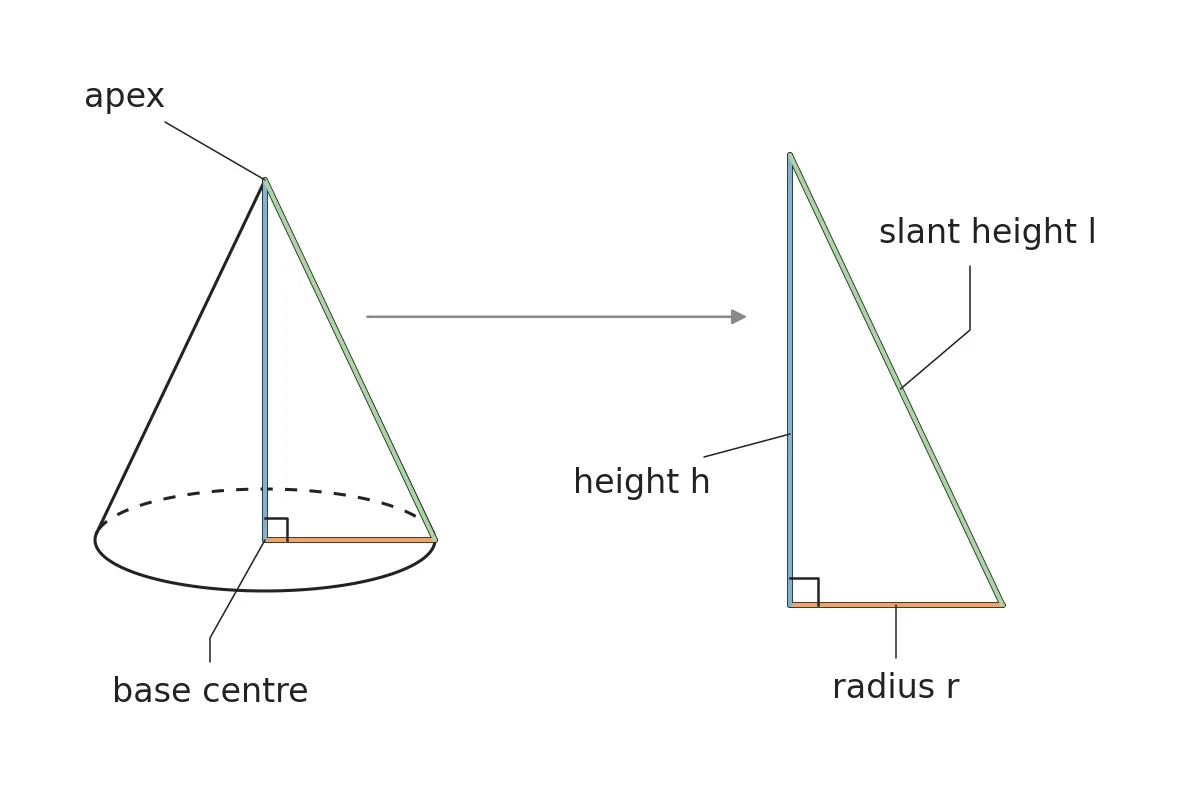
Cone and enlarged internal triangle showing radius, perpendicular height and slant height.

1. Radius, height and slant height

Radius, upright height and slant height form a right triangle.

Show
Look at the cone diagram. Trace radius r, upright height h and slant height l. Find the right angle in the enlarged triangle.
Ask
Will this cone’s slant height be longer than both its radius and upright height?
Say
Use Pythagoras because the radius and upright height meet at a right angle: l2=r2+h2l^2=r^2+h^2. The slant height is the triangle’s longest side.
Used in
Cone-shaped covers use slant height to calculate the covering material needed.
If your child says…“The upright height and slant height are the same.”
Ask
Which side lies opposite the right angle?
What’s true
The sloping route from tip to rim is longer than the perpendicular height.
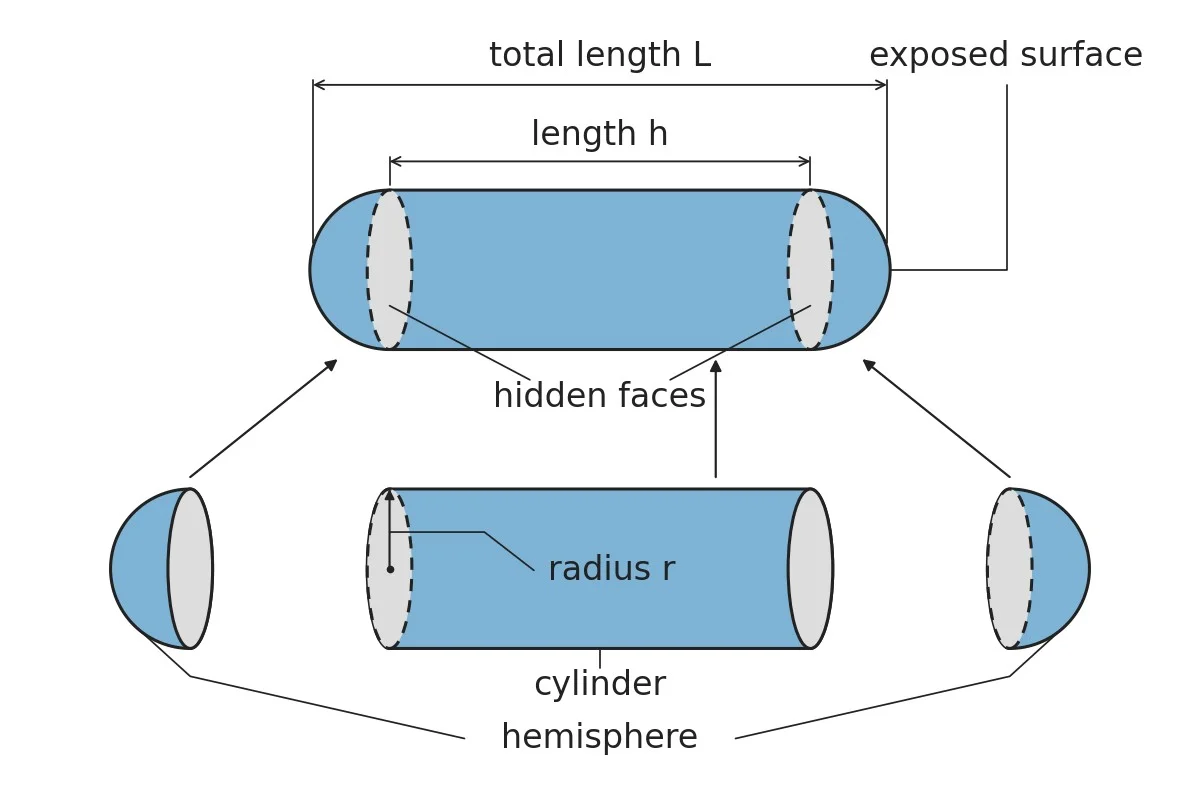
Count the exposed surfaces

Capsule and separated parts showing hidden circular faces and different lengths.

2. Surface Area of a Combination of Solids

Add the areas left exposed after joining.

Show
Look at the diagram’s separated cylinder and hemispheres. Find radius r, cylinder length h and total length L. Follow the parts into the capsule and locate the hidden circular faces.
Ask
Which surfaces would receive paint after these parts are joined?
Say
Add only the curved areas to find the outside area A: A=2πrh+4πr2A=2\pi rh+4\pi r^2. The cylinder’s length is the total length minus both end radii.
Used in
A joined storage tank’s exposed area determines how much protective coating it needs.
If your child says…“I add every surface of every part.”
Ask
Could a paintbrush reach the circles without separating the parts?
What’s true
The touching circular faces lie inside the joined solid.
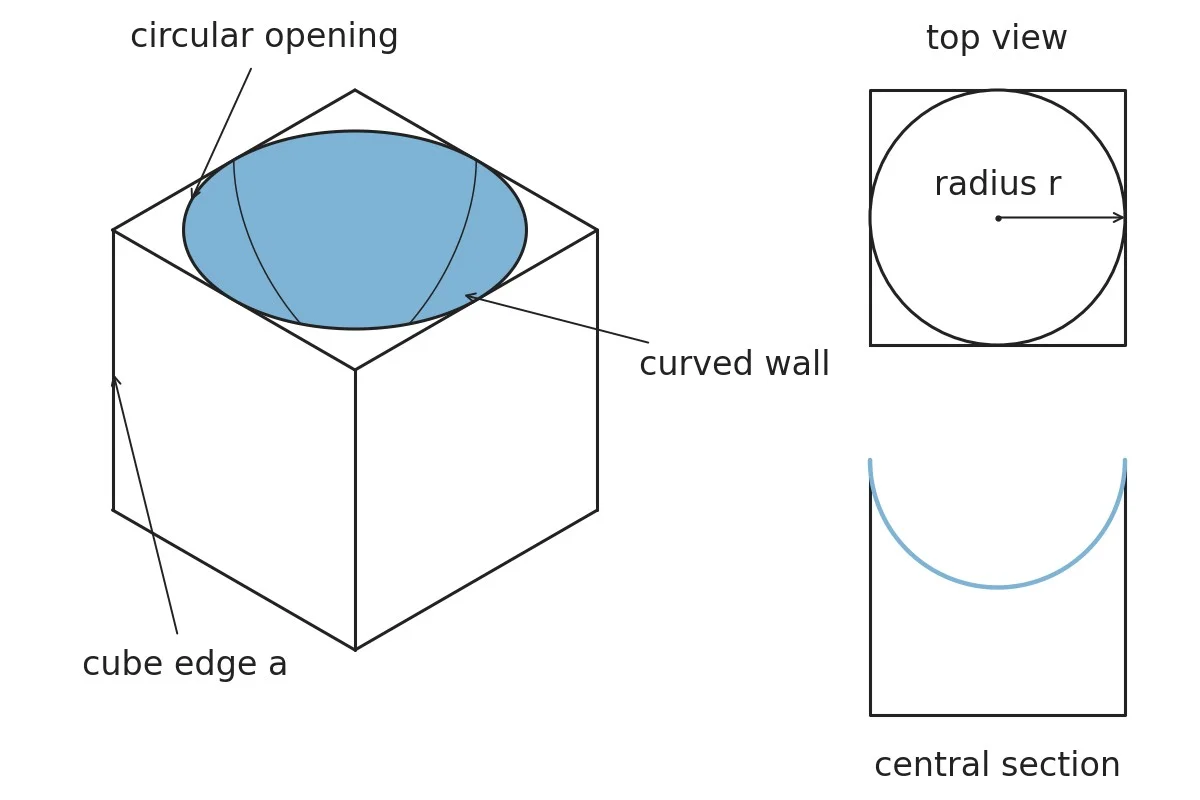
Cube with hemispherical hollow, top view and central section showing its largest opening.

3. Surface Area of a Solid with a Hemispherical Depression

A hollow replaces a flat patch with an exposed wall.

Show
Find cube edge a and hollow radius r in the diagram. Trace the opening and wall.
Ask
What surface area remains after making this hollow?
Say
For remaining area A, subtract the opening and add the wall: A=6a2−πr2+2πr2A=6a^2-\pi r^2+2\pi r^2.
Used in
Coating a mould’s hollow helps the cast release.
If your child says…“Scooping removes surface, so I subtract the hollow’s wall.”
Ask
Could you coat the whole object while leaving this inner wall bare?
What’s true
Scooping exposes an inner wall that belongs in the surface area.

Count the space occupied or available

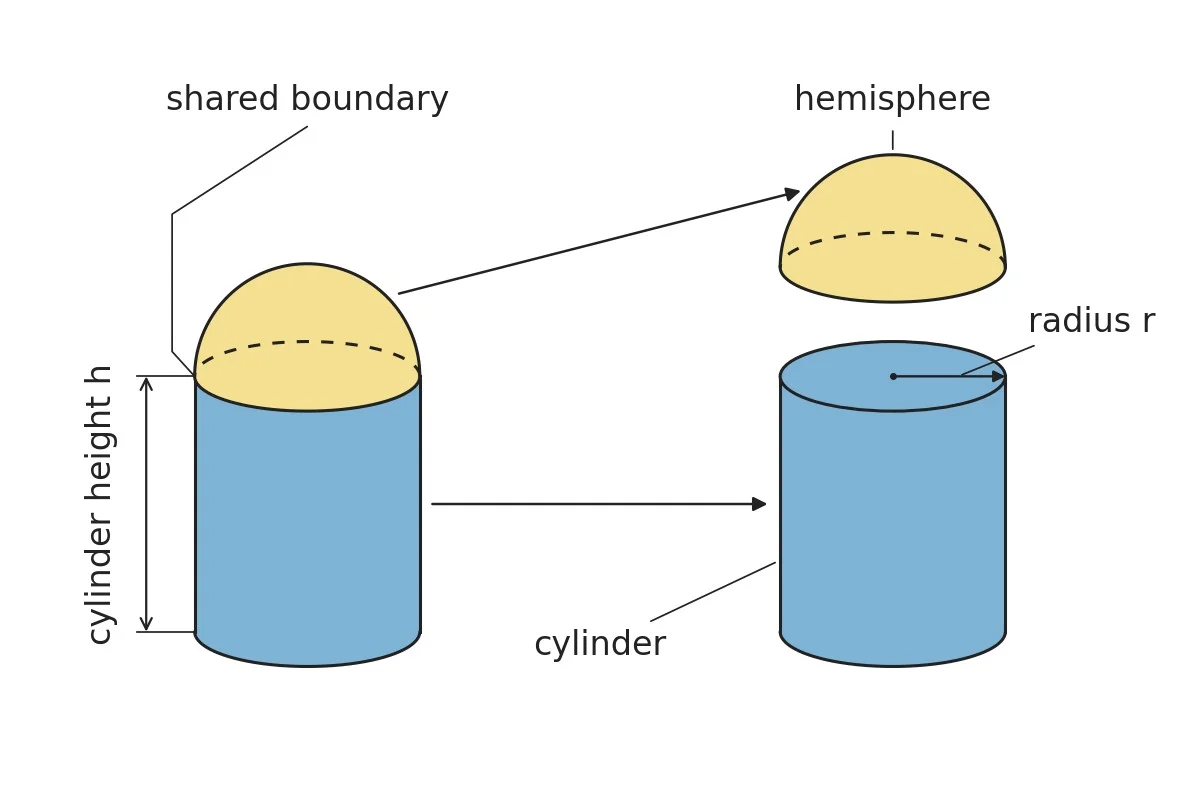
Cylinder with hemispherical top beside separated parts, showing common radius and cylinder height.

4. Volume of a Combination of Solids

Add the volumes of parts that meet without overlapping.

Show
Look at the diagram’s cylinder and hemispherical top. Find their common radius r and the cylinder’s height h. Follow each part to the separated view.
Ask
Will joining these parts give a volume equal to their separate volumes added together?
Say
Add the cylinder’s volume and the hemisphere’s volume to find total volume V: V=πr2h+23πr3V=\pi r^2h+\frac{2}{3}\pi r^3. Their interiors do not overlap, so each part’s volume is counted once.
Used in
Concrete quantities come from adding the volumes of a staircase’s solid sections.
If your child says…“I must subtract something where the parts join.”
Ask
Does either part lose any material when their faces meet?
What’s true
Touching faces become hidden, but neither part loses volume.
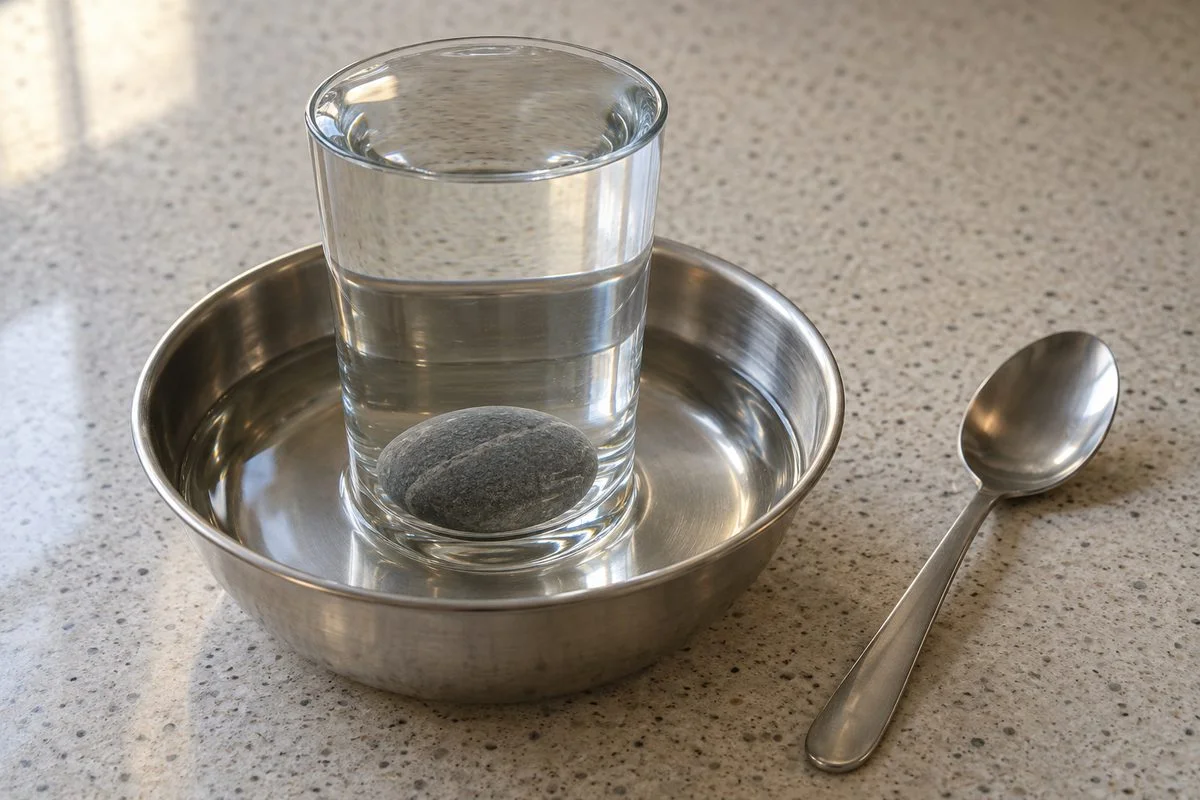
Cup containing water and a submerged stone, inside a bowl catching overflow.

5. Capacity and Volume Remaining

Subtract occupied space; divide available volume to count equal portions.

Show
Stand a cup in a dry bowl. Fill it to the brim with counted spoonfuls, including any partial spoonful. Gently submerge a clean stone. Measure the overflow with the same spoon.
Ask
How many spoonfuls can remain beside the stone?
Say
Subtract the overflow from the original amount.
Used in
Dividing juice volume by bottle capacity tells a seller how many bottles can be filled.
If your child says…“The cup still holds the same amount of water.”
Ask
Where could the spilled water fit while the stone stays submerged?
What’s true
The submerged stone occupies space that water previously filled.

Concept Lab · Common misconception

The tempting mistake in Surface Areas and Volumes

Open standalone misconception page →

Do joined faces still count as outer surface?

Wrong

Add both full surface areas when two cubes are joined face to face.

Why it feels right. I calculate each solid separately and then add.

Right

Faces inside the join are excluded from the exposed area.

Worked example

Apart
□□□□□□
□□□□□□
Joined
□□□□□
□□□□□
The joined faces are now inside. Two groups of six exposed faces become two groups of five.
  1. Two unit cubes have 12 faces before joining.
  2. The two faces at the join become internal, leaving 10 exposed unit squares.

Ask your child five quick questions.

One per step. The answer and the reason are given.

  1. Which cone measurement is longest: radius, upright height or slant height?

    The slant height. It lies opposite the right angle, making it the triangle’s longest side.

  2. Which circular faces count in this capsule’s outside surface area?

    None of the joining faces. Each circular face is covered by the part touching it.

  3. Does a hemispherical hollow increase or decrease the cube’s total surface area?

    It increases it. The exposed curved wall has more area than the circular patch removed.

  4. What volume must you subtract at the shared face?

    No volume. The parts touch without overlapping or losing material.

  5. What volume must you subtract from the full capacity to find the water space left?

    The submerged stone’s volume. The stone and water cannot occupy the same space.

15 more questions with answers, 10 with pictures