Skip to content

Teach Quadratic Equations in six steps.

For each idea: show it, ask before you tell, then say one line.

Gather scrap paper and a pencil.

Common misconceptions & worked visual for this chapter · 15 practice questions with answers

How to teach it

Recognise and solve

x(x+1)=2x(x+1)=2

x2+x=2x^2+x=2

1. Quadratic equations in standard form

After simplifying, x has whole-number powers only, with two as the highest.

Show
Write these lines. Say, “x names the unknown; x squared means x times x.”
Ask
What equation follows when we subtract 2 from both sides?
Say
Subtracting 2 gives x2+x−2=0x^2+x-2=0, with a nonzero squared term.
Used in
Frame makers use area equations to find uniform border widths.
If your child says…“Any equation showing a squared term is quadratic.”
Ask
If the squared terms cancel completely, what squared term remains?
What’s true
A squared term must survive after simplifying, with no higher powers remaining.
x2−x=0x^2-x=0

12−1=01^2-1=0

1−1=01-1=0

2. Roots of a quadratic equation

Values that make the equation true when substituted.

Show
Write these lines. Say, “Replace every x with 1, including the x being squared.”
Ask
What equality comes next, and is it true?
Say
Both sides become zero: 0=00=0, so 1 is a root.
Used in
Checking a calculated travel speed against the travel time catches unsuitable answers.
If your child says…“A number is a root if it divides the constant.”
Ask
If substitution leaves unequal sides, can that number be a root?
What’s true
Substitution must make the two sides equal.

x2−3x+2=0x^2-3x+2=0

x2−x−2x+2=0x^2-x-2x+2=0

x(x−1)−2(x−1)=0x(x-1)-2(x-1)=0

(x−1)(x−2)=0(x-1)(x-2)=0

3. Solution of a quadratic equation by factorisation

When a product is zero, set each factor to zero and solve.

Show
Write these lines. Say, “Minus one and minus two add to minus three and multiply to two.”
Ask
Which values make either bracket zero?
Say
The roots are 1 and 2 because either value makes a factor zero.
Used in
Factorising area equations finds rectangular panel dimensions, helping plan cuts.
If your child says…“The roots are minus one and minus two.”
Ask
Does putting minus one into the first bracket make it zero?
What’s true
Solve each bracket equal to zero instead of copying its number.
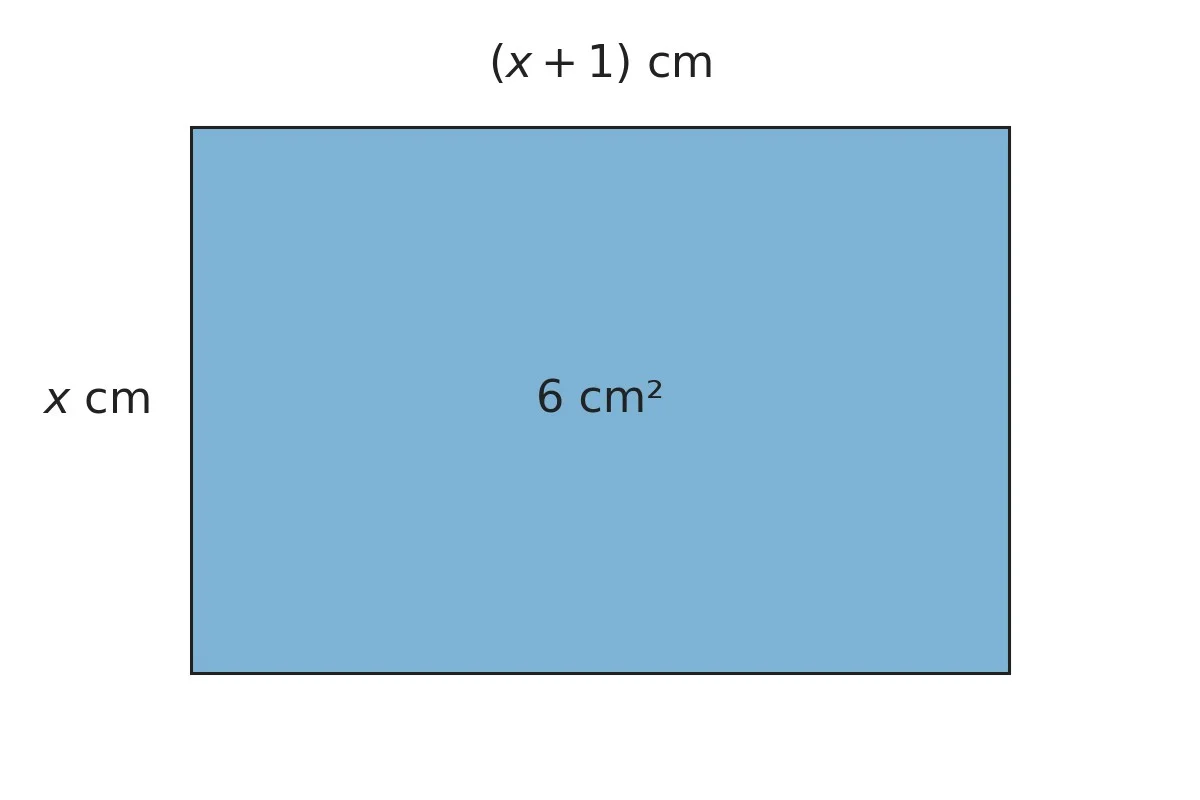
Rectangle labelled with width x, length x plus one, and area six square centimetres.

4. Problems involving quadratic equations

Turn a situation into an equation, then choose answers that fit.

Show
Look at the diagram. Read the width, length and area labels. Say, “Multiply the sides to find area.”
Ask
What width and length give this area while keeping the length one centimetre greater?
Say
The width is 2 cm and length 3 cm, giving the required area.
Used in
Garden dimensions calculated from area help gardeners plan beds that fit.
If your child says…“Both roots must be possible widths.”
Ask
Could this rectangle have a width of minus three centimetres?
What’s true
An equation's roots still need checking against what the unknown measures.

Predict and choose the roots

x2+2x+2=0x^2+2x+2=0

D=22−4(1)(2)D=2^2-4(1)(2)

D=4−8D=4-8

5. Nature of roots

The discriminant distinguishes different, equal or absent real roots.

Show
Name a, b and c as the squared-term coefficient, linear-term coefficient and constant. Call the discriminant D and write D=b2−4acD=b^2-4ac. The quadratic formula takes the square root of D. Write these lines.
Ask
What will the next line tell us about real roots?
Say
The discriminant is negative: D=−4D=-4, so there are no real roots.
Used in
A discriminant check shows whether given fencing can enclose a requested rectangular area.
If your child says…“I can ignore the minus when taking the square root.”
Ask
Which real number could give minus four when squared?
What’s true
Squaring a real number never produces a negative result.

x2+2x+k=0x^2+2x+k=0

22−4(1)k=02^2-4(1)k=0

4−4k=04-4k=0

4k=44k=4

6. Condition for equal roots

Choose a coefficient that makes the discriminant zero.

Show
Write these lines. Say, “k is the coefficient we choose. Equal roots need the square-root part to vanish.” Check that the squared-term coefficient stays nonzero.
Ask
What value of k follows from the last line?
Say
Dividing by 4 gives k=1k=1, making the discriminant zero.
Used in
Equal roots identify when a thrown ball reaches its greatest height.
If your child says…“Real roots always need a zero discriminant.”
Ask
When the discriminant is positive, can the formula still give real answers?
What’s true
Real roots occur with either a zero or a positive discriminant.

A real problem

Quadratic equations help locate a GPS receiver.

Bancroft published this positioning method in 1985.

It finds the receiver's position and the difference between its clock and GPS time.

The method reduces the positioning calculation to a quadratic equation.

ESA NavipediaWikipedia

A handheld GPS receiver resting beside a walking trail.

Concept Lab · Common misconception

The tempting mistake in Quadratic Equations

Open standalone misconception page →

Can you divide away a possible solution?

Wrong

Divide x² = 3x by x and keep only x = 3.

Why it feels right. Cancelling x looks like a quick simplification.

Right

Dividing by x assumes x is nonzero.

Worked example

Original
x² = 3x→x(x − 3) = 0
First factor
x = 0→0 = 0
Second factor
x = 3→9 = 9
Factoring keeps both branches. Dividing by x would lose the branch x = 0.
  1. Write x² − 3x = x(x − 3) = 0.
  2. Check x = 0 and x = 3 in the original equation.

Ask your child six quick questions.

One per step. The answer and the reason are given.

  1. After simplifying x(x+1)=x2+2x(x+1)=x^2+2, is the equation quadratic?

    No. The squared terms cancel, leaving x−2=0x-2=0.

  2. Is 2 a root of x2−x=0x^2-x=0?

    No. Substitution gives 2=02=0, which is false.

  3. Which root comes from x minus 2?

    2. Subtracting 2 from 2 makes that factor zero.

  4. Which root can describe this rectangle's width?

    2 cm. The other root is negative, so it cannot measure this side.

  5. How many real roots does this equation have?

    None. The formula requires a square root of a negative number.

  6. Besides zero, what discriminant values allow real roots?

    Positive values. Their square roots are real, giving two different roots.

15 more questions with answers