Skip to content

Teach Real Numbers in seven steps.

For each idea: show it, ask before you tell, then say one line.

Gather paper, a pencil, two steel tumblers and two spoons.

Common misconceptions & worked visual for this chapter · 15 practice questions with answers

How to teach it

Prime factors

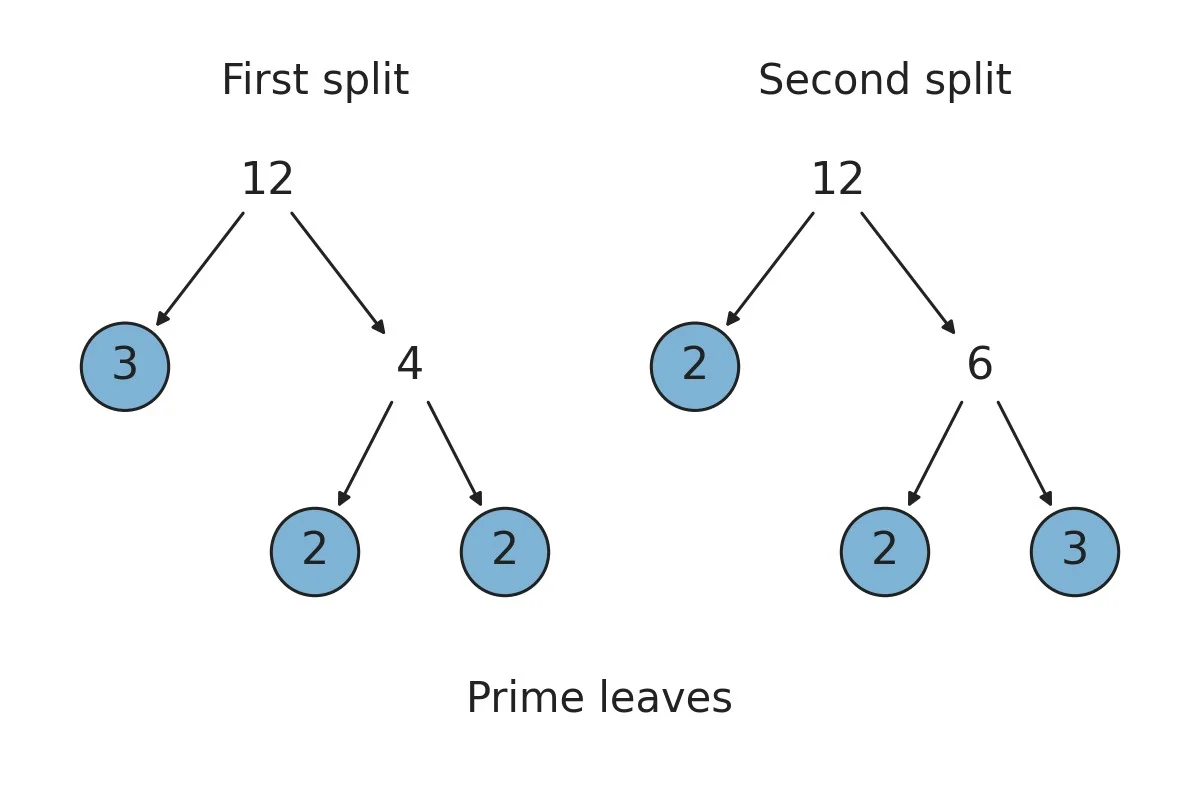
Two factor trees for twelve reach the same circled prime factors.

1. The Fundamental Theorem of Arithmetic

Different splits finish with the same primes, repeated equally often.

Show
Look at the diagram. Compare the first splits of twelve, leaving the circled ends until after predicting.
Ask
Will the different first splits finish with different prime factors?
Say
Both finish with two twos and one three.
Used in
Prime factors help simplify fractions when recipes are scaled.
If your child says…“Four times three is already a prime factorisation.”
Ask
Can four still be split into smaller factors?
What’s true
Keep splitting until every factor is prime.

4n=(2×2)n4^n = (2 \times 2)^n

4n=22n4^n = 2^{2n}

2. Applications of the Fundamental Theorem of Arithmetic

Prime factors decide whether positive powers can end in zero.

Show
Say, 'The positive integer n counts the fours multiplied together. Each four supplies two twos, so there are twice n factors of two. Ending in zero needs factors two and five.' Write this line.
Ask
What conclusion comes next: can this power end in zero?
Say
It cannot end in zero because multiplying twos never supplies a factor of five.
Used in
Last-digit checks help catch multiplication errors in bulk-order totals.
If your child says…“A much larger power might finally end in zero.”
Ask
Where could a factor of five enter this multiplication?
What’s true
Repeating multiplication changes prime counts but introduces no new primes.

Common factors and multiples

12=22×312=2^2\times3

18=2×3218=2\times3^2

HCF⁡(12,18)=2×3=6\operatorname{HCF}(12,18)=2\times3=6

3. HCF and LCM by the Prime Factorisation Method

Prime counts reveal the largest shared divisor and smallest shared multiple.

Show
Write these lines. Say, 'The highest common factor uses only prime factors available in both numbers.'
Ask
What is their least common multiple?
Say
Thirty-six needs two twos and two threes. These are the smallest counts that contain both numbers' factors.
Used in
The LCM finds the smallest order that fills different packet sizes exactly.
If your child says…“The HCF takes the larger powers because it means highest.”
Ask
Could thirty-six divide twelve exactly?
What’s true
LCM takes every prime's greatest required count, while HCF takes each shared prime's smallest count.

2L=6×10²L = 6 \times 10

L=602L = \frac{60}{2}

4. HCF × LCM = Product of the Two Numbers

Their product divided by their HCF gives their LCM.

Show
Write these lines. Say, 'L means least common multiple. Multiplying six and ten counts their shared factor two twice.'
Ask
What is L?
Say
L is thirty. Dividing by their HCF removes the extra shared factor.
Used in
This relation shortens calculations of when repeating machine cycles next finish together.
If your child says…“Multiplying the numbers always gives their LCM.”
Ask
Does multiplying six and ten count their shared two once or twice?
What’s true
Multiplying gives the LCM directly only when the highest common factor is one.
Two steel tumblers, each with a spoon beside it, ready for tapping.

5. Applications of HCF and LCM

HCF finds largest equal pieces; LCM finds shared repeats.

Show
Place spoons beside tumblers. Say, 'I will tap every second count; you will tap every third.' Tap together at zero, then pause. After predicting, count steadily and tap.
Ask
On which count will our taps first meet again?
Say
The taps meet at six.
Used in
The HCF finds the largest square tiles covering a rectangular floor without cutting.
If your child says…“The next shared tap uses the HCF.”
Ask
Would both taps be due at the highest common factor?
What’s true
A shared tap must complete whole intervals of both lengths.

Proving irrationality

2=ab\sqrt{2}=\frac{a}{b}

a2=2b2a^2=2b^2

4k2=2b24k^2=2b^2

6. Revisiting Irrational Numbers: Irrationality of √2

No integer fraction equals a prime's square root.

Show
Write these lines. Say, 'Let a and b be positive integers in lowest terms. Odd squares are odd, so a is even: twice integer k.'
Ask
After dividing by two, must b also be even?
Say
Yes, its square is even. Both share two, contradicting lowest terms. The assumed fraction cannot exist.
Used in
Square roots give exact diagonal lengths for braces.
If your child says…“A shared factor contradicts the denominator being nonzero.”
Ask
Can an even denominator still be nonzero?
What’s true
Lowest terms excludes shared factors greater than one, yet both numbers share factor two.

1+2=ab1 + \sqrt{2} = \frac{a}{b}

2=ab−1\sqrt{2} = \frac{a}{b} - 1

2=ab−bb\sqrt{2} = \frac{a}{b} - \frac{b}{b}

7. Proving Numbers Involving Surds Irrational

Rational additions, subtractions and nonzero rational multipliers preserve irrationality.

Show
Write these lines. Say, 'Assume one plus square root of two equals a over b. Both are integers; b is nonzero. Subtract one.'
Ask
What single fraction comes next?
Say
The numerator becomes a minus b, over b.
Used in
Surds keep design lengths exact, preventing accumulated rounding errors.
If your child says…“Even multiplying by zero keeps it irrational.”
Ask
Does multiplying by zero leave any of the starting number?
What’s true
A rational multiplier preserves irrationality only when it is nonzero.

A real problem

Prime factors help speed up sound calculations.

Cooley and Tukey published their fast Fourier transform paper in 1965.

One version splits the data length into prime factors to organise smaller calculations.

This reduces how quickly calculation time grows as the data gets longer.

It supports sound analysis, multimedia compression and wireless communication.

IEEE Computer SocietyDSPRelated — Julius O. Smith’s textbookCarnegie Mellon University

Unbranded laptop displaying a sound spectrum beside a microphone.

Concept Lab · Common misconception

The tempting mistake in Real Numbers

Open standalone misconception page →

Can an endless decimal be rational?

Wrong

Every decimal that goes on forever is irrational.

Why it feels right. I treat never-ending and non-repeating as the same.

Right

A rational number can have a decimal with a repeating block.

Worked example

1/3
0.
3
3
3
3
…
Non-repeating
0.
1
01
001
0001
…
The same digit block keeps returning in 1/3. The example below has growing gaps, so no fixed block repeats.
  1. Long division for 1 ÷ 3 repeats the same remainder, so 0.333… is rational.
  2. The decimal 0.101001000100001… has increasingly long gaps between its ones and never repeats a fixed block, so it is irrational.

Ask your child seven quick questions.

One per step. The answer and the reason are given.

  1. Which factor still needs splitting in four times three?

    Four. Four is composite, so its factors must be split further.

  2. Which missing prime prevents every positive power of four from ending in zero?

    Five. A final zero requires both two and five as factors.

  3. Why can't thirty-six be the HCF of twelve and eighteen?

    It cannot divide either number. A common factor must divide each number exactly.

  4. What must you divide their product by to get the LCM?

    Their highest common factor. Division removes the extra copy of the shared factors.

  5. Why is the highest common factor too early for our next shared tap?

    Neither interval has finished. The next shared tap must complete both intervals a whole number of times.

  6. Both numbers are even: which starting condition has failed?

    Lowest terms. Both share factor two, but lowest terms excludes shared factors greater than one.

  7. What is zero times square root of two?

    Zero, which is rational. Multiplication by zero gives zero, regardless of the other factor.

15 more questions with answers, 4 with pictures