Skip to content

Teach Polynomials in six steps.

For each idea: show it, ask before you tell, then say one line.

Gather paper and a pencil.

Common misconceptions & worked visual for this chapter · 15 practice questions with answers

How to teach it

Degrees, values and graphs

p(x)=1+x×xp(x)=1+x\times x

p(x)=1+x2p(x)=1+x^2

1. Degree of a polynomial

The highest surviving power gives degree. The zero polynomial’s degree is undefined.

Show
Say: “Call the input x and its output p of x.” Write this formula. Explain aloud: “Multiplying x by x gives x squared.”
Ask
What degree should we write next?
Say
The greatest power is 2, so this polynomial is quadratic.
Used in
Recognising squared lengths helps distinguish floor area from the length of its edges.
If your child says…“The first term decides the degree.”
Ask
Does writing the constant first remove the squared term?
What’s true
Find the greatest power after simplifying, wherever its term appears.
p(x)=x−2p(x)=x-2

p(3)=3−2=1p(3)=3-2=1

p(2)=2−2p(2)=2-2

2. Value and zero of a polynomial

A zero is an input that produces an output of zero.

Show
Say: “Subtract two from the input.” Write this formula. Calculate aloud: “Three minus two gives one.” Then say: “For input two, subtract two again.”
Ask
Which input makes this polynomial equal zero: 3 or 2?
Say
The input 2 gives zero. So 2 is a zero; the input 3 gives 1 instead.
Used in
Calculating money remaining shows whether another purchase fits a budget.
If your child says…“The input is 2, so the value is 2.”
Ask
What remains after subtracting 2 from the input 2?
What’s true
The value comes from calculating with the input, not copying it.
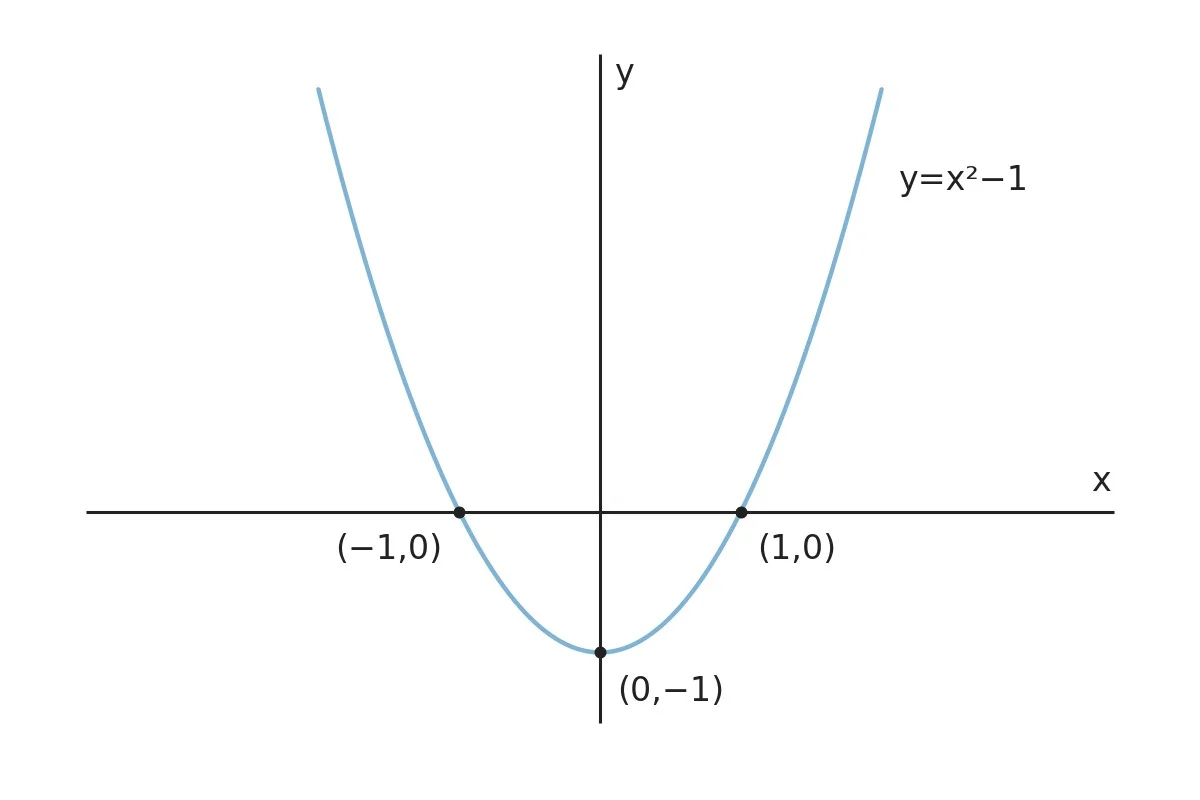
Parabola with labelled horizontal-axis intersections and its bottom below the axis.

3. Geometrical meaning of the zeroes of a polynomial

Zeroes are inputs where the graph meets the horizontal axis.

Show
Look at the diagram’s horizontal and vertical axes. Say: “Height is input squared minus one.” Find where the curve meets the horizontal axis, then its bottom point.
Ask
Which inputs give height zero?
Say
The zeroes are −1 and 1.
Used in
Profit graphs show where income covers costs.
If your child says…“The bottom of the curve is a zero.”
Ask
Is the bottom point on the horizontal axis or below it?
What’s true
A turning point counts only when its height is zero.

Finding and using zeroes

x2−3x+2=0x^2-3x+2=0

x2−x−2x+2=0x^2-x-2x+2=0

x(x−1)−2(x−1)=0x(x-1)-2(x-1)=0

(x−1)(x−2)=0(x-1)(x-2)=0

4. Zeroes of a quadratic polynomial

Factorising reveals which inputs make the polynomial zero.

Show
Write these lines. Say: “Split the middle term, group, then factor out the shared bracket.”
Ask
Which values of x make a bracket zero?
Say
The zeroes are 1 and 2 because either zero bracket makes the product zero.
Used in
Factoring area equations helps find possible dimensions for a rectangular garden.
If your child says…“The brackets say minus 1 and minus 2, so those are the zeroes.”
Ask
Which makes x minus 1 vanish: 1 or −1?
What’s true
A zero makes a bracket vanish when substituted.

p(x)=2x2−6x+4p(x)=2x^2-6x+4

p(x)2=x2−3x+2\frac{p(x)}{2}=x^2-3x+2

α+β=−−62=3\alpha+\beta=-\frac{-6}{2}=3

5. Relationship between zeroes and coefficients

Coefficients reveal sums and products without finding individual zeroes.

Show
Write these lines. Say: “Name the zeroes alpha and beta.”
Ask
What product comes next without finding either zero?
Say
The product is two: four divided by two. The sum reverses the middle coefficient’s sign before dividing.
Used in
Sums and products help check calculated rectangle dimensions against its perimeter and area.
If your child says…“The product needs a minus sign too.”
Ask
The zeroes here are 1 and 2; what does multiplying them give?
What’s true
For a quadratic, the product equals the constant divided by the leading coefficient.

p(x)=x2−(−1)x+(−2)p(x)=x^2-(-1)x+(-2)

p(x)=x2+x+(−2)p(x)=x^2+x+(-2)

6. Finding a quadratic polynomial

Build a quadratic using the zeroes’ sum and product.

Show
Say: “Subtract the zeroes’ sum times x from x squared, then add their product.” Explain aloud: “For zeroes 1 and −2, the sum is −1 and the product is −2.” Write this formula.
Ask
What simplified polynomial completes the next line?
Say
Subtracting the negative sum gives positive x. The polynomial is x squared plus x minus two.
Used in
A curved arch’s equation can place its ends at chosen ground positions.
If your child says…“Only one polynomial can have these zeroes.”
Ask
If an output is zero, what happens when you double it?
What’s true
Multiplying every term by the same nonzero number keeps exactly the same zeroes.

A real problem

Polynomial zeroes help locate errors in digital information.

Reed and Solomon developed these codes at MIT Lincoln Laboratory in 1960.

Finding zeroes of special polynomials helps the codes locate errors.

They can keep CDs and DVDs playing correctly despite scratches.

WikipediaCarnegie Mellon UniversityMIT Lincoln Laboratory

Scratched compact disc beside a closed disc player.

Concept Lab · Common misconception

The tempting mistake in Polynomials

Open standalone misconception page →

Are the zeros the coefficients?

Wrong

The zeros of x² − 5x + 6 are −5 and 6.

Why it feels right. They are the numbers visible in the expression.

Right

A zero is an input that makes the polynomial equal zero.

Worked example

Input xOutput x² − 5x + 6
−556
612
20
30
A zero is an x-value whose output is zero. Substitution checks all four proposed values.
  1. Substitute −5 and 6.
  2. The outputs are 56 and 12.
  3. Factor as (x − 2)(x − 3) to find x = 2 and x = 3, the inputs that make the output zero.

Ask your child six quick questions.

One per step. The answer and the reason are given.

  1. What degree would this expression have with its terms written backwards?

    2. Changing the order leaves the squared term unchanged.

  2. What is this polynomial’s value at input 2?

    0. Subtracting 2 gives the output zero, although the input is 2.

  3. Why does the bottom point here not count as a zero?

    Its height is −1. A zero requires height zero, not merely a change in direction.

  4. What are the zeroes of the factored expression here?

    1 and 2. Each positive input makes its corresponding bracket zero.

  5. What is the product of this polynomial’s zeroes?

    2. The constant 4 divided by the leading coefficient 2 gives 2.

  6. Which zeroes remain after doubling every term of this polynomial?

    1 and −2. Doubling an output preserves exactly when it equals zero.

15 more questions with answers, 3 with pictures