Skip to content

Teach Introduction to Trigonometry in seven steps.

For each idea: show it, ask before you tell, then say one line.

Gather paper and a pencil.

Common misconceptions & worked visual for this chapter · 15 practice questions with answers

How to teach it

Connect sides and angles

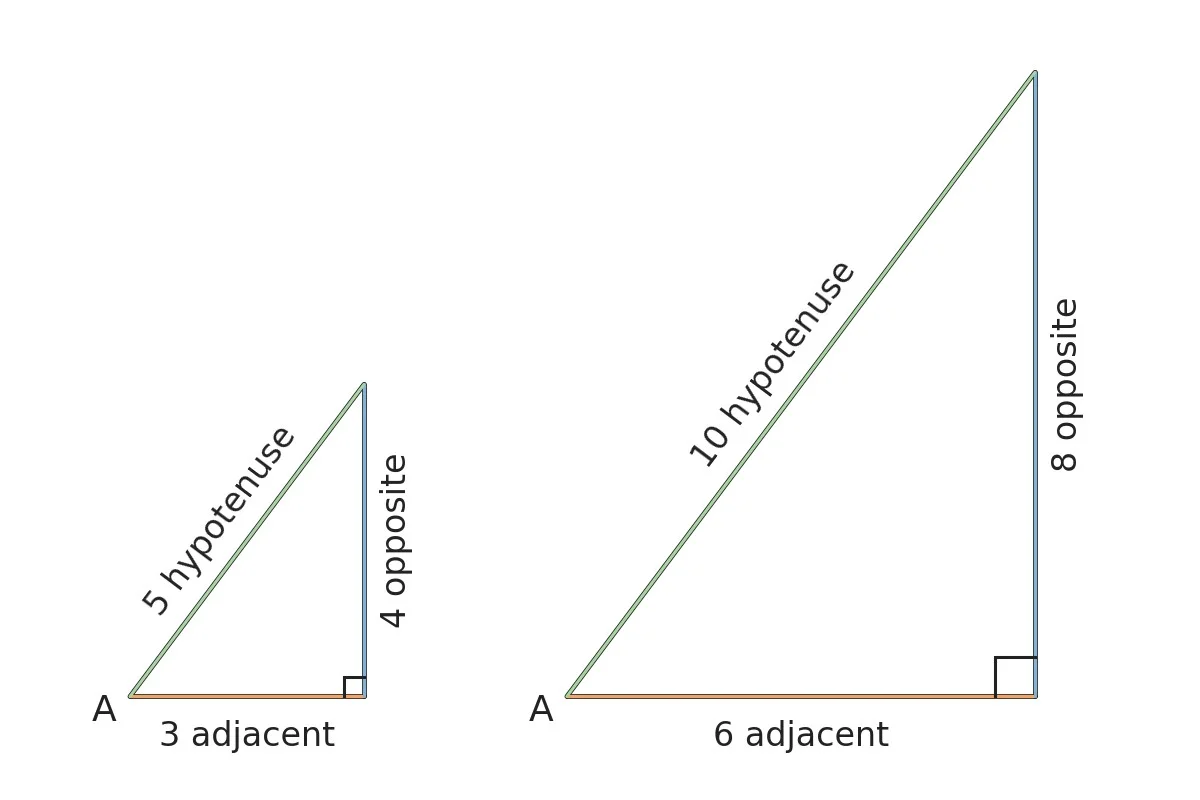
Two similar right triangles with corresponding angles and side lengths labelled.

1. Trigonometric Ratios

Six side comparisons for an acute angle.

Show
Look at the diagram. Find angle A in each triangle. Point to each opposite side, adjacent side and hypotenuse, in that order.
Ask
How will these side ratios change when every side doubles?
Say
Sine divides the opposite length by the hypotenuse. Cosine divides the adjacent length by the hypotenuse. Tangent divides the opposite length by the adjacent length. Reverse these fractions for cosec, sec and cot, respectively. Doubling both lengths leaves each ratio unchanged.
Used in
Surveyors use angles and distances to calculate inaccessible heights.
If your child says…“A bigger triangle has a bigger sine.”
Ask
What happens to a fraction when its top and bottom both double?
What’s true
Matching angles give matching ratios because corresponding sides grow by the same factor.
h2=(3k)2+(4k)2h^2=(3k)^2+(4k)^2

h2=25k2h^2=25k^2

h=5kh=5k

sin⁡A=4k5k\sin A=\frac{4k}{5k}

2. Trigonometric Ratios

One ratio fixes side proportions; Pythagoras supplies the missing side.

Show
Say: 'A is acute, and its tangent is four-thirds. Opposite is 4k, adjacent is 3k, and k is positive. Call the hypotenuse h.' Then write these lines.
Ask
What does the last fraction simplify to?
Say
The common scale cancels, giving sine A equal to four-fifths.
Used in
Roof makers calculate a sloping support’s length from its rise and horizontal reach.
If your child says…“The bottom number always gives the hypotenuse.”
Ask
Which two sides did tangent compare before we calculated h?
What’s true
Tangent compares the two perpendicular sides, so its denominator describes the adjacent side.

Use familiar angles

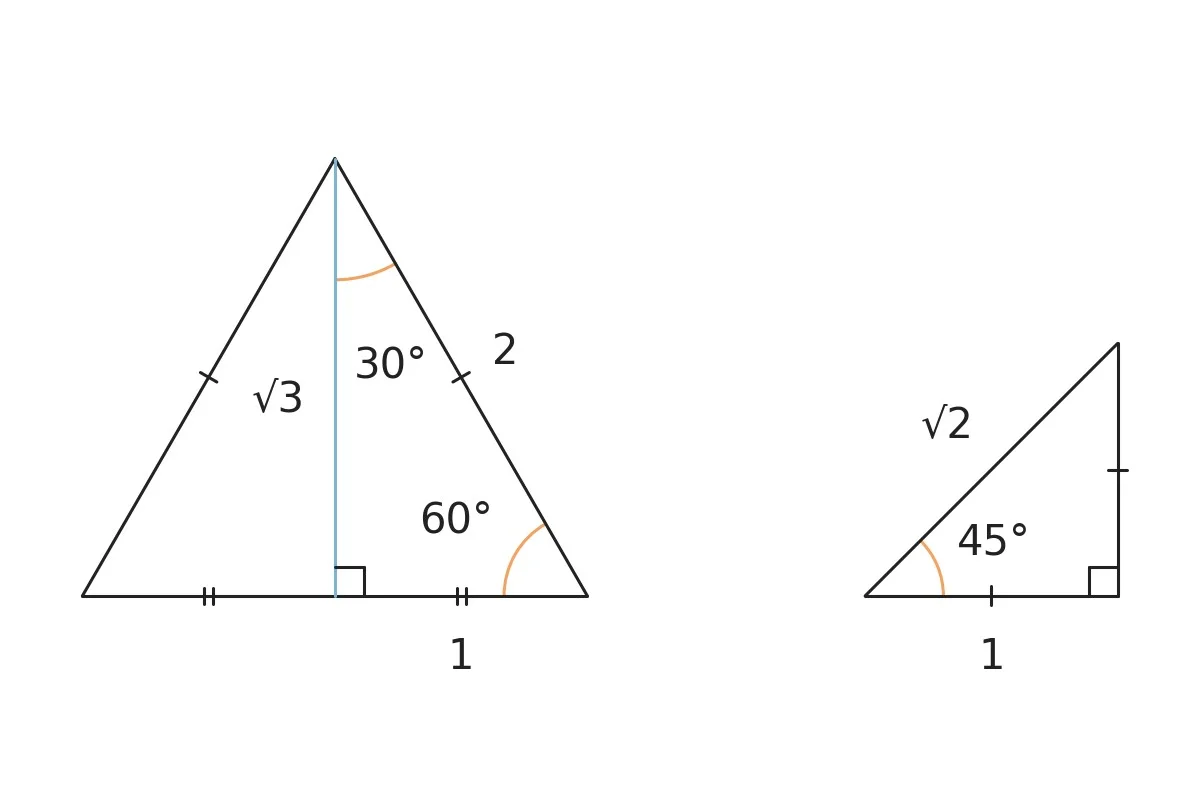
A split equilateral triangle and an isosceles right triangle show exact lengths and angles.

3. Trigonometric Ratios of Some Specific Angles

Exact ratios from geometry.

Show
Find the diagram’s lengths using Pythagoras. | Angle | Sine | Cosine | |---|---|---| | 0° | 0 | 1. | | 30° | 12\frac12 | 32\frac{\sqrt3}{2}. | | 45° | 12\frac1{\sqrt2} | 12\frac1{\sqrt2}. | | 60° | 32\frac{\sqrt3}{2} | 12\frac12. | | 90° | 1 | 0. |
Ask
What is sine of 30°?
Say
It is one-half: opposite is half the hypotenuse. Towards 0°, sine approaches zero and cosine one; towards 90°, they reverse.
Used in
Carpenters calculate diagonal brace lengths using familiar angles.
If your child says…“Sine of 30° is larger than sine of 60°.”
Ask
Which angle faces the shorter side in the right half of the equilateral triangle?
What’s true
In this triangle, the side facing 30° is shorter than the side facing 60°.

2cos⁡θ=12\cos\theta=1

cos⁡θ=12\cos\theta=\frac12

4. Trigonometric Ratios of Some Specific Angles

A known ratio can identify its acute angle.

Show
Say: 'Theta names an acute angle, and twice its cosine is one. Divide both sides by two.' Then write these lines. Keep the table above beside the working.
Ask
From this cosine value, which angle do you expect the table to give?
Say
The angle is 60° because the table gives its cosine as one-half.
Used in
Ramp designers find the slope angle from measured lengths to assess how steep it is.
If your child says…“The angle is one-half.”
Ask
Does one-half appear under Angle or Cosine in the table?
What’s true
One-half compares lengths; the angle is measured in degrees.

sin⁡30∘+sin⁡30∘=12+12\sin30^\circ+\sin30^\circ=\frac12+\frac12

sin⁡30∘+sin⁡30∘=22\sin30^\circ+\sin30^\circ=\frac22

5. Trigonometric Ratios of Some Specific Angles

Adding angles does not mean adding their sine values.

Show
Say: 'Together, the angles make 60°. Its sine is root three over two, from our table.' Then write these lines.
Ask
What does this sum become, compared with sine of 60°?
Say
The sum becomes 1, which differs from sine of 60°.
Used in
A hinged lamp’s height depends on its angle, helping designers check its reach.
If your child says…“I can split sine across the plus sign.”
Ask
Do the combined angle’s sine and the two added sines give matching values?
What’s true
Sine names a ratio for the whole angle inside its brackets.

Explain and use identities

o2+a2=h2o^2+a^2=h^2

(oh)2+(ah)2=1\left(\frac{o}{h}\right)^2+\left(\frac{a}{h}\right)^2=1

6. Trigonometric Identities

Equations true wherever their ratios are defined.

Show
Write these lines. Say: 'A is acute; o means opposite, a adjacent, and h hypotenuse.'
Ask
What connects these squared sine and cosine values?
Say
Sine squared plus cosine squared equals one. Dividing Pythagoras by adjacent squared gives one plus tangent squared equals secant squared. Dividing by opposite squared gives one plus cotangent squared equals cosecant squared.
Used in
Design software uses identities to simplify length calculations.
If your child says…“Sine plus cosine always equals 1.”
Ask
Did dividing Pythagoras remove the squares from the side ratios?
What’s true
The squares matter, and each identity requires every ratio in it to be defined.

(sin⁡A+cos⁡A)2=(sin⁡A+cos⁡A)(sin⁡A+cos⁡A)(\sin A+\cos A)^2=(\sin A+\cos A)(\sin A+\cos A)

(sin⁡A+cos⁡A)2=sin⁡2A+2sin⁡Acos⁡A+cos⁡2A(\sin A+\cos A)^2=\sin^2 A+2\sin A\cos A+\cos^2 A

7. Trigonometric Identities

Justify each change; keep the cross term when squaring sums.

Show
Say: 'A is acute. Squaring sine A plus cosine A means multiplying two identical brackets. Keep both mixed products.' Then write these lines.
Ask
Will this squared sum equal one after we use the identity?
Say
The identity leaves one plus twice sine A times cosine A. This exceeds one because both ratios are positive for acute A.
Used in
Surveying calculations use identities to check that different formulas give matching results.
If your child says…“Squaring a sum just squares each part.”
Ask
When identical sum brackets multiply, what happens to their two cross-products?
What’s true
Squaring a sum also includes twice the product of its parts.

A real problem

Trigonometry helped measure a star’s distance.

In 1838, Friedrich Bessel measured a star’s distance using stellar parallax.

A telescope that split the image enabled the precise measurement.

For tiny parallax angles, a small-angle approximation simplifies calculations using trigonometric ratios.

Ohio State UniversityCarnegie ScienceUCLA

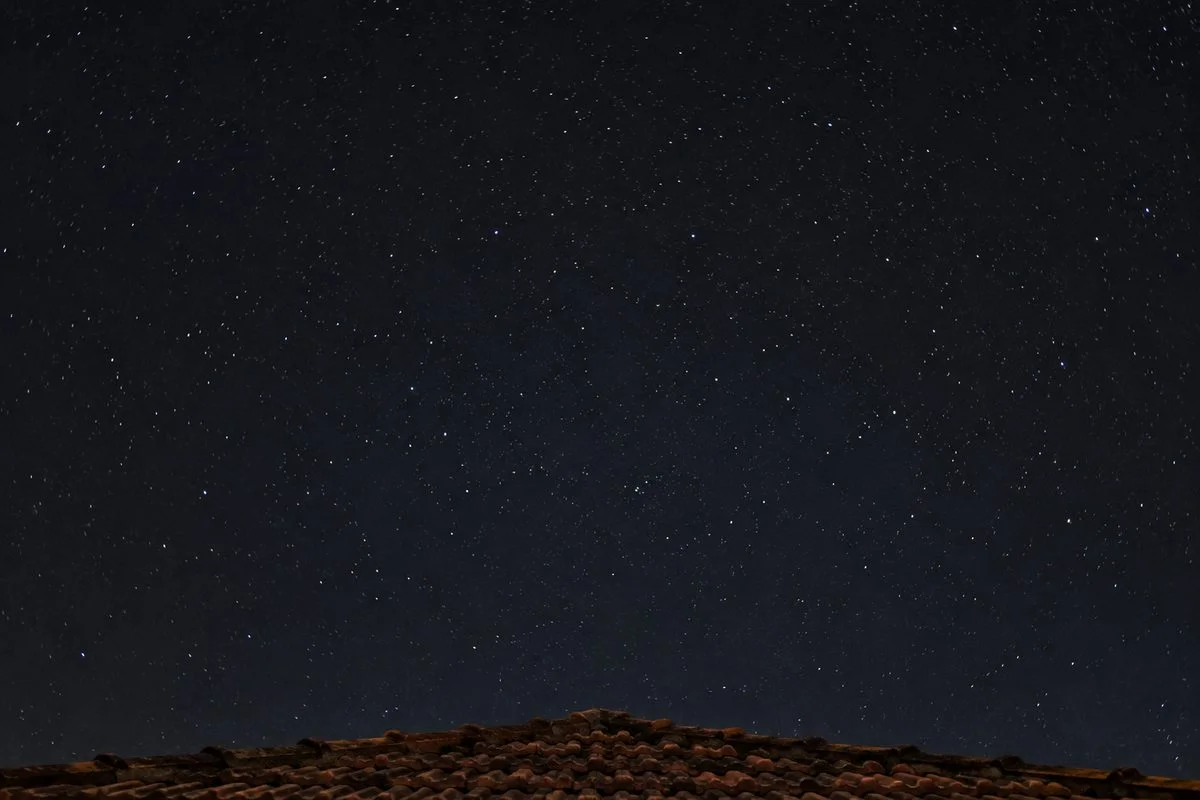
A clear star-filled night sky above a house roof.

Concept Lab · Common misconception

The tempting mistake in Introduction to Trigonometry

Open standalone misconception page →

Can you label a side opposite without choosing an angle?

Wrong

A leg stays the opposite side when I switch the reference angle.

Why it feels right. The triangle stayed the same.

Right

Opposite and adjacent depend on the chosen acute angle.

Worked example

The side opposite angle A is 3. The side opposite angle B is 4. Both angles use the same hypotenuse, 5.
  1. In a 3–4–5 right triangle, the angle opposite the 3-unit leg has sine 3/5.
  2. The other acute angle has sine 4/5.

Ask your child seven quick questions.

One per step. The answer and the reason are given.

  1. Every side triples while A stays unchanged. What happens to sine A?

    It stays unchanged. The numerator and denominator increase by the same factor.

  2. In tangent A equals four-thirds, which side does the 3 describe?

    The adjacent side. Tangent divides the opposite length by the adjacent length.

  3. Which familiar angle has a sine equal to one-half?

    30°. Its opposite side measures half the hypotenuse.

  4. What is the acute angle whose cosine equals one-half?

    60°. One-half is the ratio; 60° is its angle.

  5. What is sine of the angle formed by adding 30° and 30°?

    32\frac{\sqrt3}{2}. Add the angles first, then find sine of 60°.

  6. In our Pythagoras identity, what operation applies to sine and cosine before addition?

    Square each value. Pythagoras relates squared lengths, so the resulting ratios are squared too.

  7. What extra term appears when you square sine A plus cosine A?

    2sin⁡Acos⁡A2\sin A\cos A. The two cross-products are equal and add together.

15 more questions with answers, 1 with pictures