Skip to content

Teach Continuity and Differentiability in eight steps.

For each idea: show it, ask before you tell, then say one line.

Gather paper and a pencil.

Common misconceptions & worked visual for this chapter · 15 practice questions with answers

How to teach it

Continuity and differentiability

f(x)={x,x≠0k,x=0f(x)=\begin{cases}x,&x\ne0\\k,&x=0\end{cases}

lim⁡x→0−f(x)=0\lim_{x\to0^-}f(x)=0

lim⁡x→0+f(x)=0\lim_{x\to0^+}f(x)=0

1. Continuity

Nearby values approach the value assigned at the point.

Show
Write this line. Say, 'The function f uses x away from zero and k at zero. Limits describe approached values. From either side, the values approach zero.'
Ask
Which value of k makes both approaches match the assigned value?
Say
Both sides approach zero, so assign zero at the join.
Used in
Animation uses continuous position formulas to prevent sudden jumps.
If your child says…“Any value of k works because we choose it separately.”
Ask
If you assign a different value, will it match either approach?
What’s true
The assigned value must match what nearby values approach.
h(x)=x2+1x−1h(x)=\frac{x^2+1}{x-1}

lim⁡x→2(x2+1)=5\lim_{x\to2}(x^2+1)=5

lim⁡x→2(x−1)=1\lim_{x\to2}(x-1)=1

2. Algebra of continuous functions

Combine continuous functions while checking domains and division.

Show
Write these lines. Say, 'Call this function h; exclude 1 because division by zero is undefined.'
Ask
What limit do these continuous parts give for h at 2?
Say
The limit is 5, matching its value. Division preserves continuity here because the denominator approaches a nonzero value.
Used in
Average speed calculations need nonzero elapsed time to give a usable result.
If your child says…“One counts as a discontinuity on this function’s domain.”
Ask
Does 1 belong to the domain you wrote?
What’s true
Continuity on a domain checks only the inputs belonging to it.
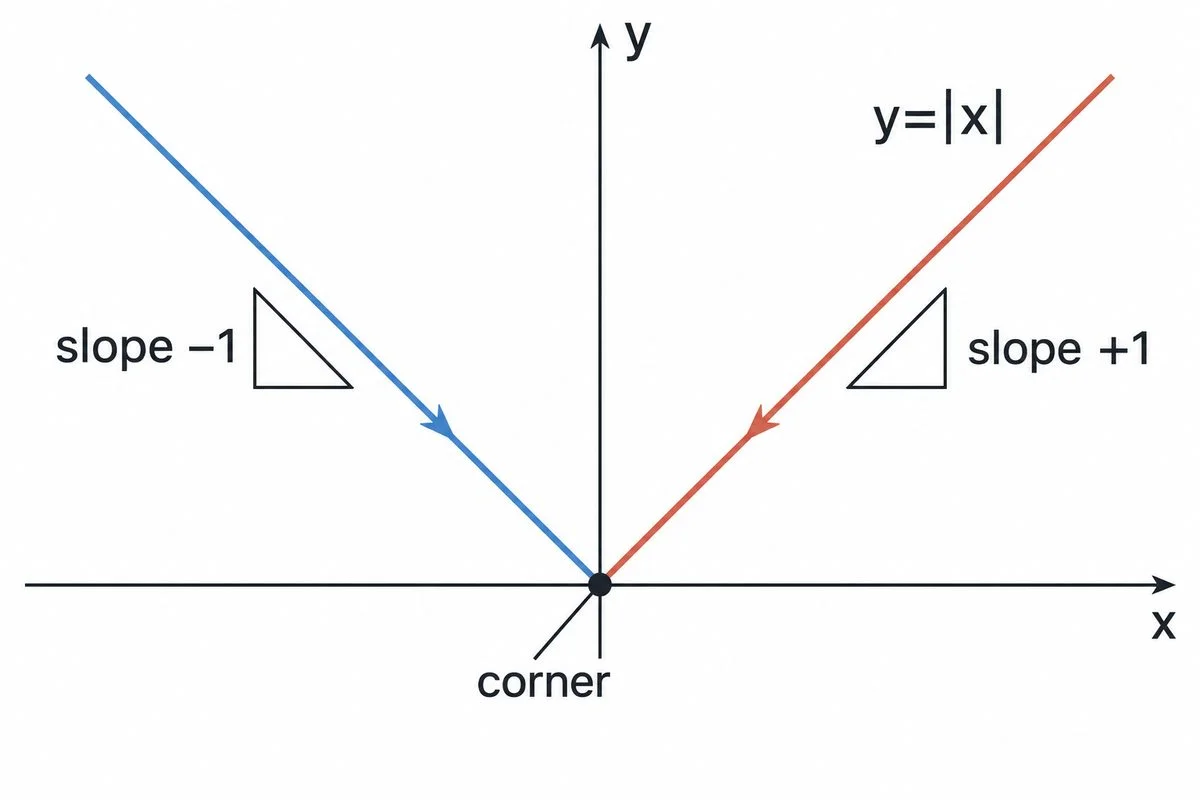
An unbroken absolute-value graph has different slopes on either side of its corner.

3. Differentiability

Both slopes, measured from the actual point value, approach one finite value.

Show
Find the absolute-value graph’s corner in the diagram. Follow each branch towards it. Compare the marked slopes.
Ask
Does this unbroken join have one definite slope?
Say
The corner has no derivative: its side slopes are −1 and 1.
Used in
Road designers use smooth joins to avoid sudden changes of direction.
If your child says…“There is no break, so there must be a derivative.”
Ask
Can −1 and 1 give one common slope?
What’s true
A derivative guarantees continuity, but a continuous graph can still have unequal side slopes.

Rules for finding derivatives

y=(3x+1)5y=(3x+1)^5

u=3x+1u=3x+1

y=u5y=u^5

dydx=5u4⋅3\frac{dy}{dx}=5u^4\cdot3

4. Chain rule

Multiply rates through each stage of a composite function.

Show
Write these lines. Say, 'The letter u names the inside expression; y is its fifth power.'
Ask
What derivative follows without expanding the fifth power?
Say
Multiply both stages’ rates, then replace u: dydx=15(3x+1)4\frac{dy}{dx}=15(3x+1)^4. The inside expression contributes the factor 3.
Used in
Image resizing calculations predict how changing width changes area when proportions stay fixed.
If your child says…“I only need to differentiate the fifth power.”
Ask
Where would the factor from the inside expression’s rate appear in your answer?
What’s true
The outside rate must be multiplied by the inside rate.

y2=xy^2=x

ddy(y2)dydx=1\frac{d}{dy}(y^2)\frac{dy}{dx}=1

2ydydx=12y\frac{dy}{dx}=1

5. Derivatives of implicit functions

Find a rate without first solving the relation for y.

Show
Write these lines. Say, 'Since y changes with x, its square needs the chain rule.'
Ask
When y is nonzero, what follows after dividing by twice y?
Say
The derivative is one divided by twice y. The chain rule includes y’s rate because y changes.
Used in
Circle equations give designers an edge’s slope without separating its arcs.
If your child says…“The derivative of y squared is just twice y.”
Ask
Which factor records how y changes when x changes?
What’s true
Differentiating with respect to x must include how y changes with x.
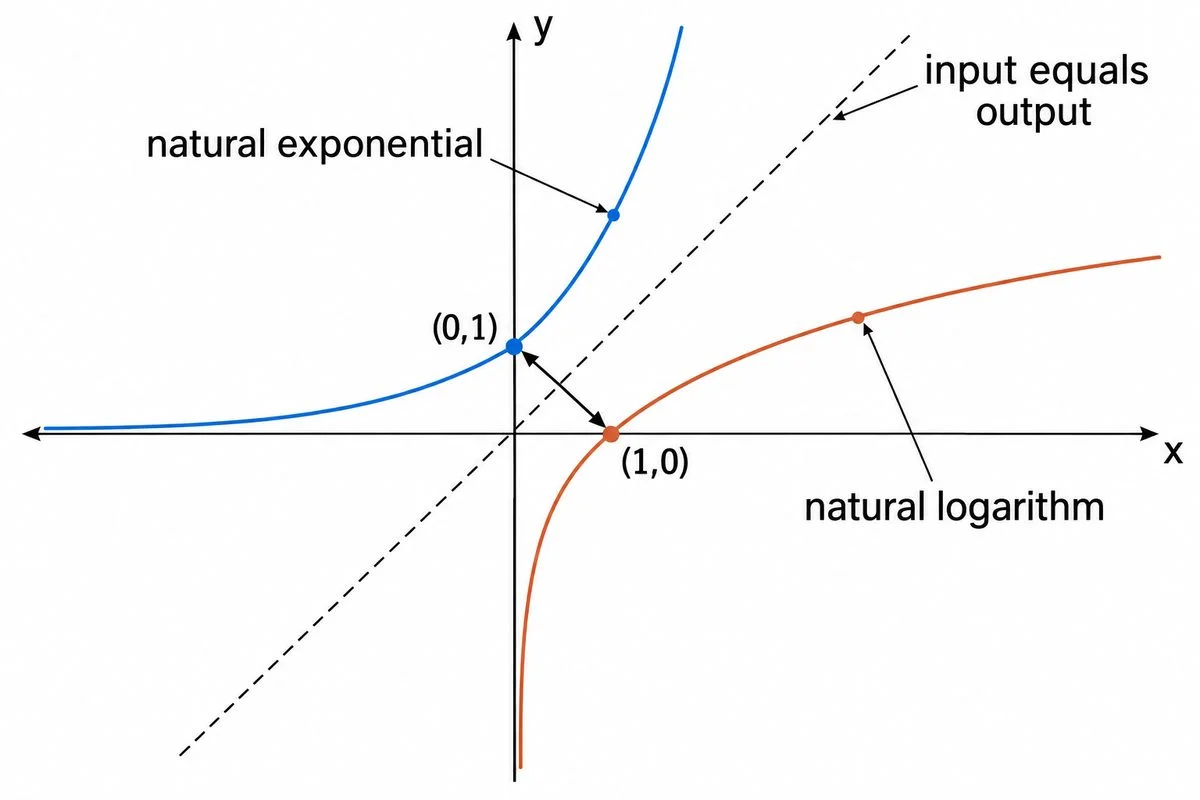
Exponential and logarithm curves exchange inputs and outputs across a diagonal.

6. Exponential and logarithmic functions

Exponentials produce powers; logarithms recover exponents.

Show
Find the exponential’s marked point in the diagram. Follow the arrow to the logarithm’s exchanged point. Say, 'Here ln means logarithm to base e.'
Ask
Which exponent gives the marked output of 1?
Say
The logarithm recovers zero by exchanging input and output.
Used in
Logarithms recover elapsed time from exponential decay, helping scientists estimate ages.
If your child says…“The logarithm of zero is zero.”
Ask
Where does the exponential curve reach an output of zero?
What’s true
Every exponential output is positive, so its inverse logarithm accepts only positive inputs.

y=xxy=x^x

log⁡y=xlog⁡x\log y=x\log x

y′y=log⁡x+1\frac{y'}y=\log x+1

y′=y(log⁡x+1)y'=y(\log x+1)

7. Logarithmic differentiation

Use logarithms to differentiate a changing base and exponent.

Show
Write these lines for positive x. Say, 'Log means natural logarithm; the prime marks y’s derivative.'
Ask
What replaces y in the last line?
Say
Restore the original function: y′=xx(log⁡x+1)y'=x^x(\log x+1).
Used in
Logarithmic differentiation simplifies how changes in multiplied measurements affect a calculated result.
If your child says…“The expression beside y-prime divided by y is already the derivative.”
Ask
What must you multiply by to leave y-prime alone?
What’s true
Division by y remains until you multiply both sides by y.

Parametric and second derivatives

x=2tx=2t

y=t2y=t^2

dydx=2t2=t\frac{dy}{dx}=\frac{2t}{2}=t

d2ydx2=d(t)/dt2\frac{d^2y}{dx^2}=\frac{d(t)/dt}{2}

8. Derivatives of functions in parametric forms; second order derivatives

Find slope from parameter rates, then find how slope changes.

Show
Write these lines. Say, 'The parameter t sets both coordinates; x changes twice as quickly.'
Ask
How quickly does this slope change with x?
Say
The second derivative is one half. Divide the slope’s rate in t by the nonzero horizontal rate, 2.
Used in
Motion tracking uses parameter equations to describe curved paths and calculate their slopes.
If your child says…“Differentiating the slope in t gives the second derivative with respect to x.”
Ask
When t increases by 1, how much does x increase?
What’s true
The second derivative measures slope change per change in x.

A real problem

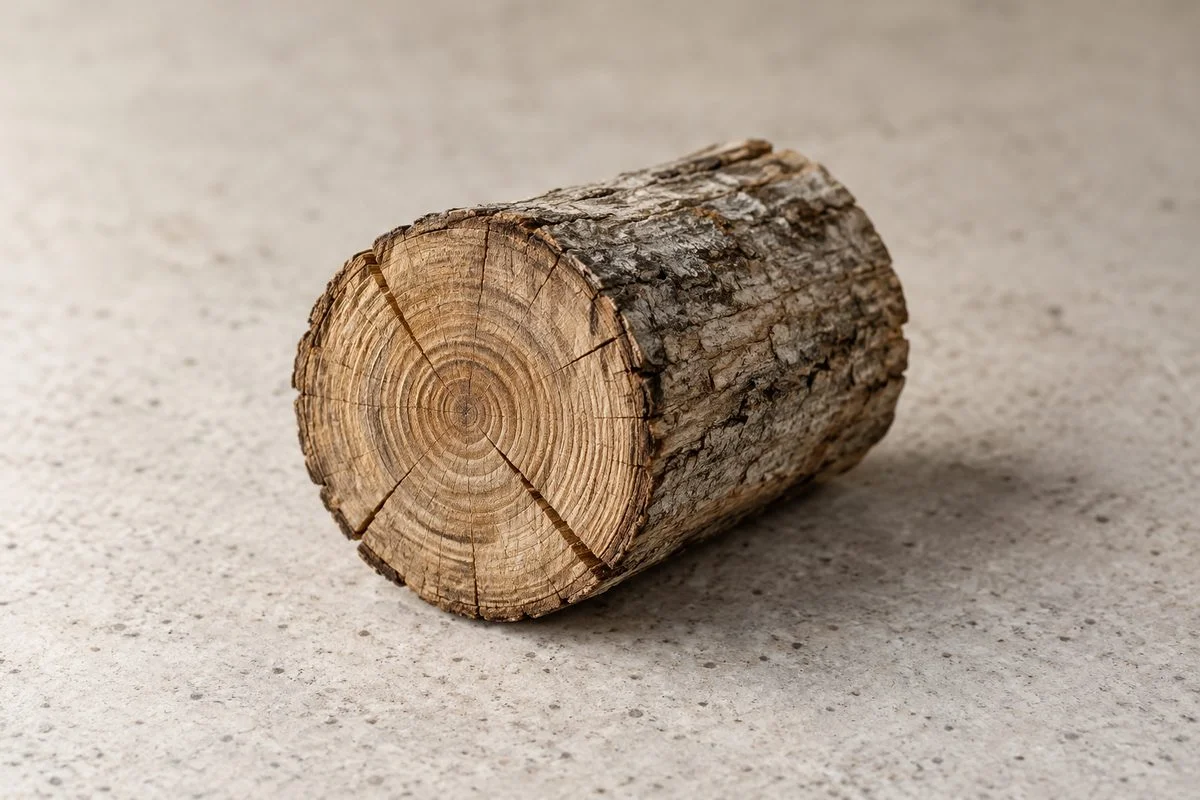
Radiocarbon dating estimates when a sampled tree ring grew.

Libby and Arnold published their radiocarbon dating findings in 1949.

The proportion of radiocarbon remaining decreases according to an exponential decay law.

For wood, the date concerns the sampled ring’s growth, not necessarily the tree’s death.

American Chemical SocietyUniversity of OxfordHistoric England

Weathered wood with growth rings visible on its exposed end.

Concept Lab · Common misconception

The tempting mistake in Continuity and Differentiability

Open standalone misconception page →

Does a continuous curve always have a tangent slope?

Wrong

Every continuous function is differentiable.

Why it feels right. A curve without a break looks as if it should have a slope everywhere.

Right

Differentiability requires the slopes from both sides to approach the same value.

Worked example

Both sides reach the same point. Their slopes differ there.
  1. At x = 0 the graph of y = abs(x) has no break.
  2. Its slope is −1 to the left and +1 to the right, so it has no derivative at 0.

Ask your child eight quick questions.

One per step. The answer and the reason are given.

  1. What must k equal for this function to be continuous?

    Zero. Both sides approach zero, so the assigned value must also be zero.

  2. Which input is excluded from this function’s domain?

    One. The denominator is zero there, so domain continuity does not test that input.

  3. Why does this continuous function lack a derivative at zero?

    Its side slopes differ. The slopes approach −1 and 1, so there is no single limiting slope.

  4. Which factor would disappear if you ignored the inside rate?

    The factor 3. The inside expression changes three times as quickly as x.

  5. What factor must accompany twice y when differentiating its square with respect to x?

    The derivative of y. The square changes through y, and y itself changes with x.

  6. What real value does the natural logarithm of zero have?

    None. No real exponent makes the natural exponential equal zero.

  7. Which factor restores the derivative after finding y-prime divided by y?

    The original function. Multiplying by the original y removes the division on the left.

  8. What is the second derivative with respect to x here?

    One half. The slope changes by 1 per t, while x changes by 2.

15 more questions with answers