Skip to content

Teach Application of Integrals in eight steps.

For each idea: show it, ask before you tell, then say one line.

Gather paper and a pencil.

Common misconceptions & worked visual for this chapter · 15 practice questions with answers

How to teach it

Choose and add strips

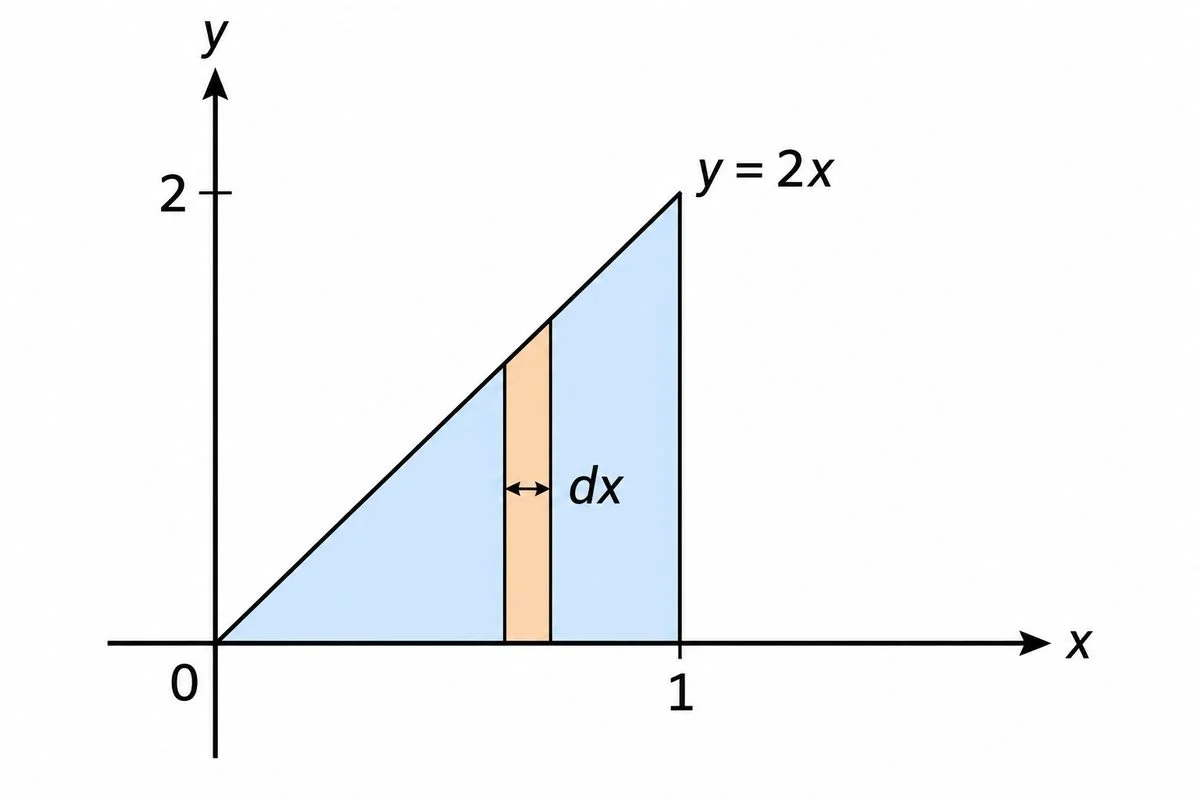
Shaded triangle beneath a straight line, with one narrow vertical strip.

1. Area under Simple Curves

Add thin vertical strips to measure the shaded region.

Show
Look at the diagram. Find the shaded triangle and its vertical strip. Here, dx represents the strip’s tiny horizontal width.
Ask
Before evaluating, what area do you predict for this shaded triangle?
Say
Subtracting zero from one gives one square unit. Integration adds the strips between the boundaries.
Used in
Curved signboards need area calculations to estimate paint.
If your child says…“I just subtract the endpoint heights.”
Ask
Does subtracting heights count any of the shaded strips?
What’s true
Height changes measure length; adding strip areas measures the surface.
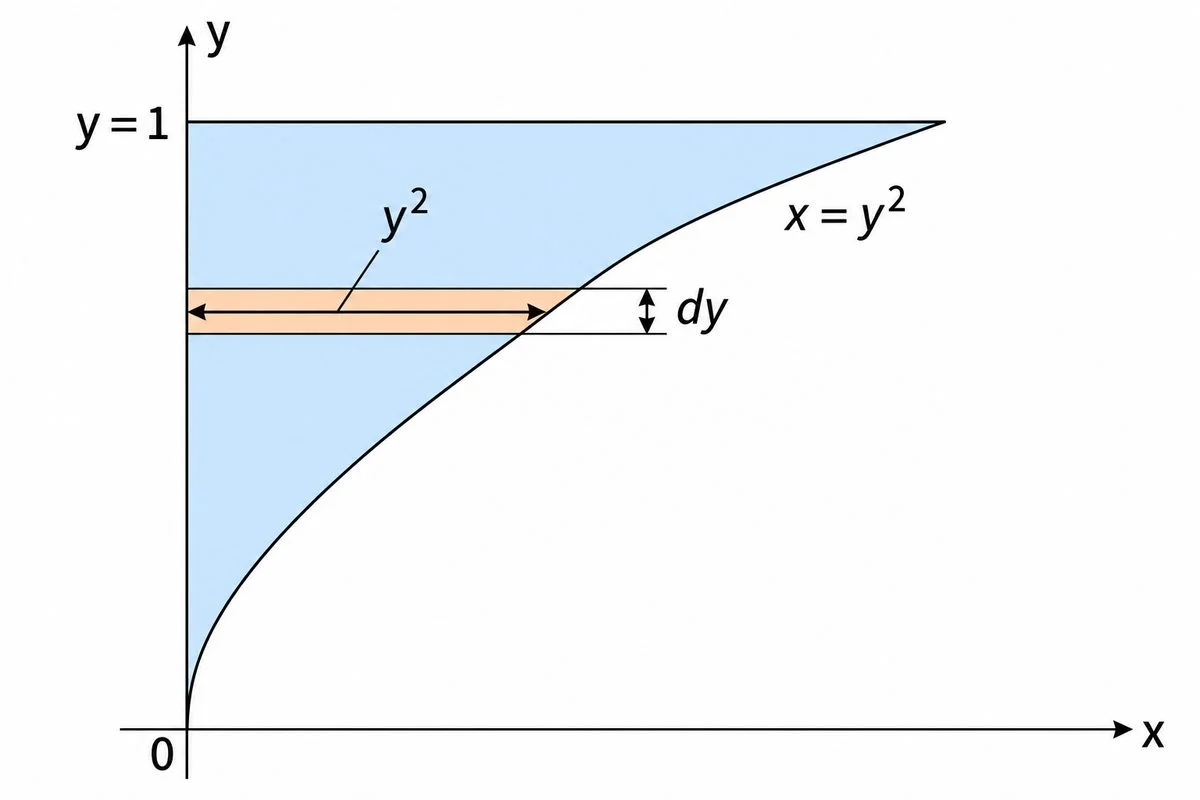
Horizontal strip between the vertical axis and a parabola, below height one.

2. Area using horizontal strips

Add sideways strips using their lengths and vertical limits.

Show
Look at the diagram. Trace the horizontal strip from the vertical axis to the curve.
Ask
What area do you predict for this shaded region before adding the horizontal strips?
Say
Each strip has length y squared and tiny thickness dy. Add their areas from height zero to one: A=∫01y2 dy=13A=\int_0^1 y^2\,dy=\frac13.
Used in
Horizontal strips help measure sideways curved panels to estimate material.
If your child says…“The strip’s length is y.”
Ask
Which coordinate measures how far the strip reaches sideways?
What’s true
Here, y locates the strip; y squared gives its length.
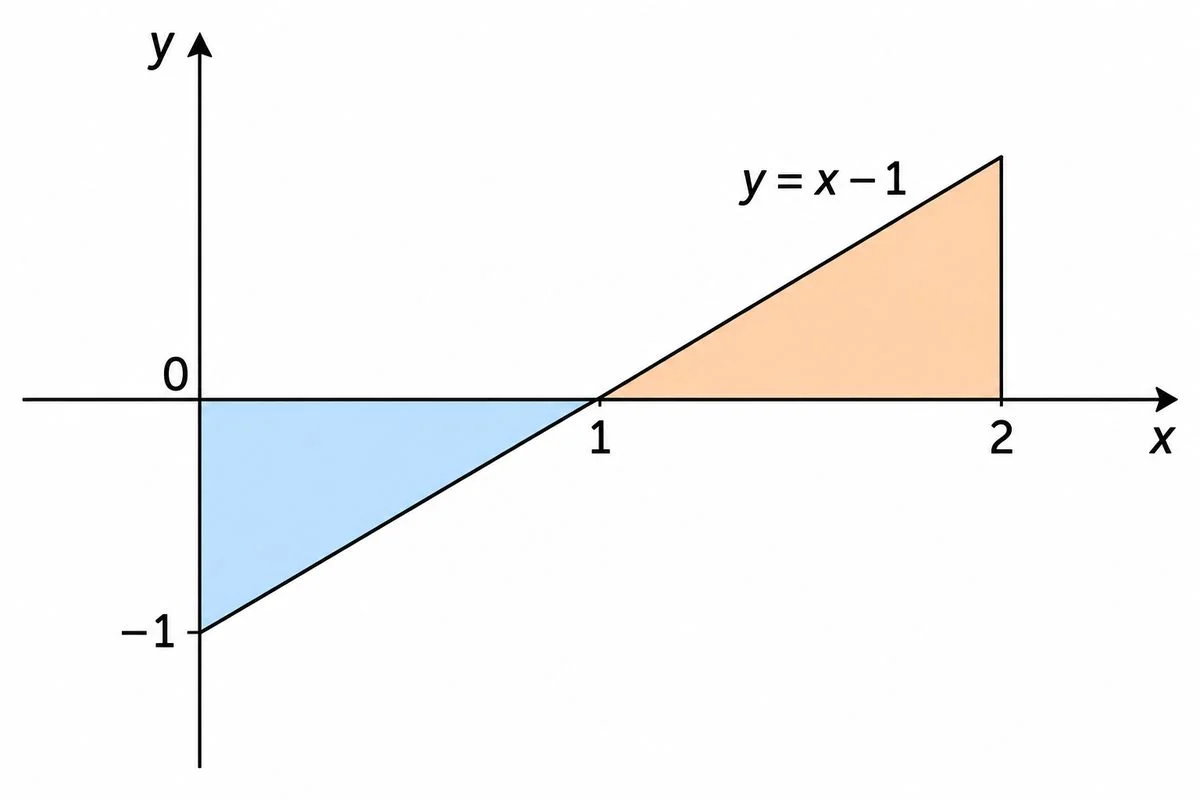
A line crosses the horizontal axis, enclosing shaded triangles below and above it.

3. Area of a region below the x-axis

Split at crossings so positive and negative contributions cannot cancel.

Show
Look at the diagram. Find both shaded triangles and where the line crosses the horizontal axis.
Ask
Before evaluating, what total area do you predict for the two shaded triangles?
Say
The lower integral gives minus one-half, and the upper gives one-half. Add their positive sizes. Both triangles occupy space, giving one square unit.
Used in
Land below a map’s reference axis still counts when estimating paving.
If your child says…“I always split at zero.”
Ask
Where does this line change from below the axis to above it?
What’s true
Split where the graph crosses the horizontal axis.

Use matching pieces

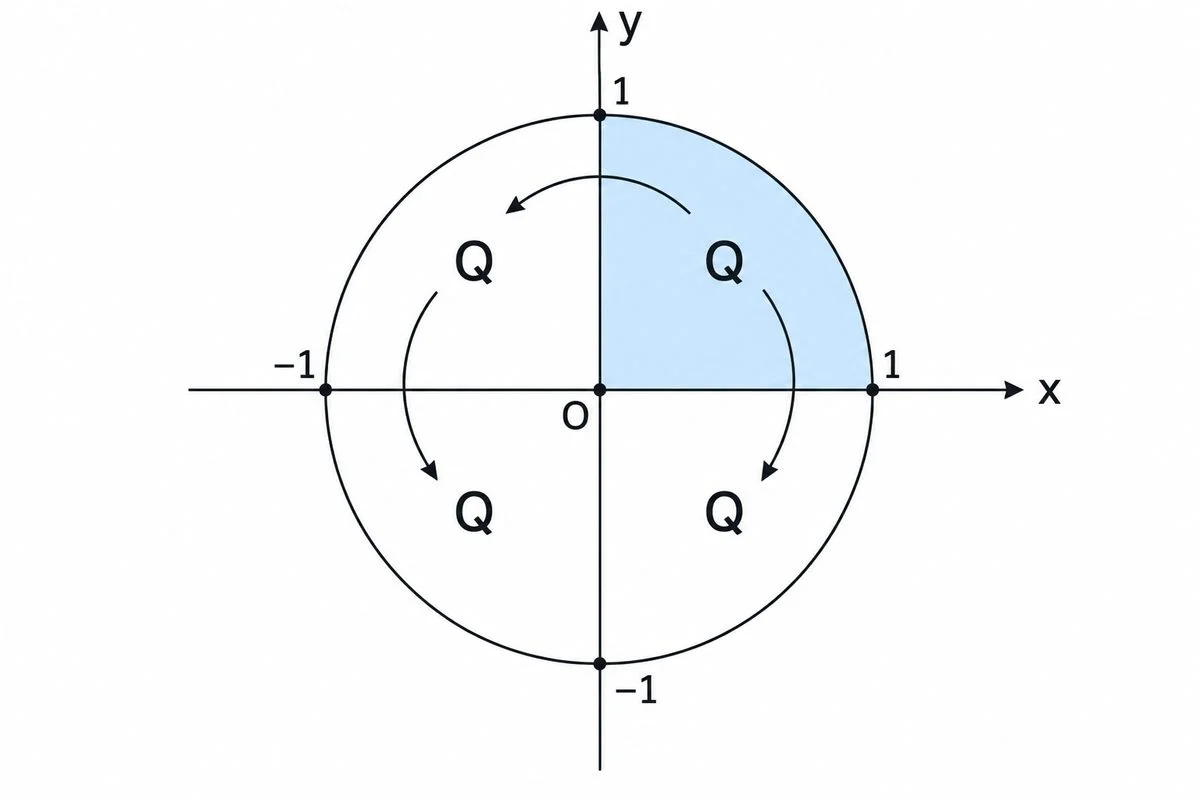
Unit circle with one shaded quarter and arrows showing its matching reflections.

4. Symmetry

Measure one matching piece, then multiply by the piece count.

Show
Look at the diagram. Find the shaded quarter between horizontal positions zero and one. Follow its reflections.
Ask
Looking at these reflections, how many copies of the shaded quarter will fill the circle?
Say
Call the quarter’s area Q. Four matching quarters fill the circle, so multiply its integral by four: A=4Q=4∫011−x2 dxA=4Q=4\int_0^1\sqrt{1-x^2}\,dx.
Used in
Matching floor tiles let one tile’s area determine the total covered area.
If your child says…“I double the quarter’s area.”
Ask
Would two quarters cover this disk?
What’s true
The multiplier counts every matching piece in the chosen region.
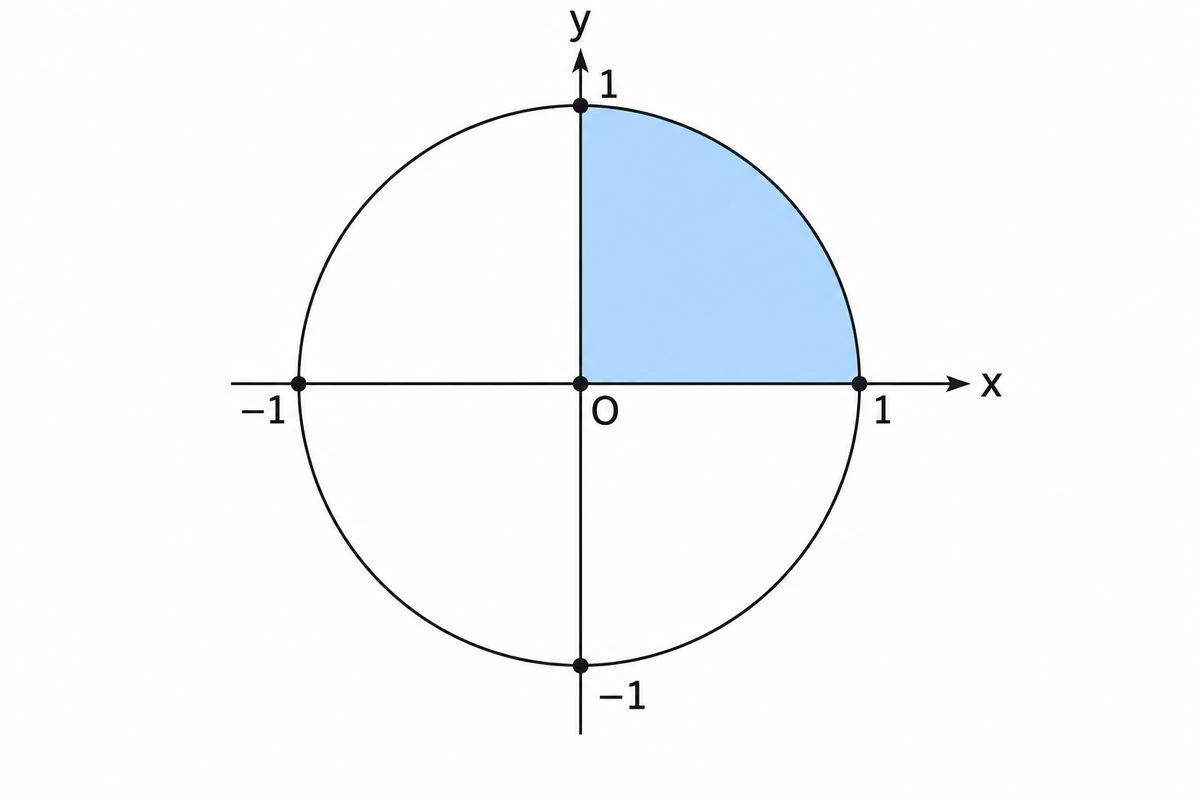
Unit circle divided by coordinate axes, with its first-quadrant interior shaded.

5. Area of a circle

Integrate a quarter of the disk, then count four quarters.

Show
Look at the diagram. Find the first-quadrant quarter and the four matching quarters of the disk.
Ask
Before evaluating, what area do you predict for the whole disk?
Say
The first-quadrant integral gives pi divided by four. Four matching quarters give pi square units.
Used in
Round tabletops need area measurements to estimate polishing material.
If your child says…“Inverse sine of 1 is 90 here.”
Ask
Is 90 written in the angle unit this integral needs?
What’s true
The integral requires radians, not degrees.

y=21−x2y=2\sqrt{1-x^2}

A=4∫0121−x2 dxA=4\int_0^1 2\sqrt{1-x^2}\,dx

A=8(π4)A=8\left(\frac{\pi}{4}\right)

6. Area of an ellipse

Stretching every strip’s height scales the circle’s area.

Show
The ellipse has x squared plus one quarter of y squared equal to one. Its horizontal semi-axis is 1 and vertical semi-axis is 2. Write the integral, saying: “Every strip is twice the circle strip’s height.”
Ask
Before evaluating, what area do you predict for this ellipse?
Say
The quarter integral gives pi divided by two. Doubling every strip’s height doubles its area, giving two pi square units.
Used in
An elliptical tablecloth’s area helps estimate fabric needed.
If your child says…“I can use the circle’s area unchanged.”
Ask
What happens to a rectangle’s area when only its height doubles?
What’s true
The extra height factor multiplies every strip’s area.

Follow the boundaries

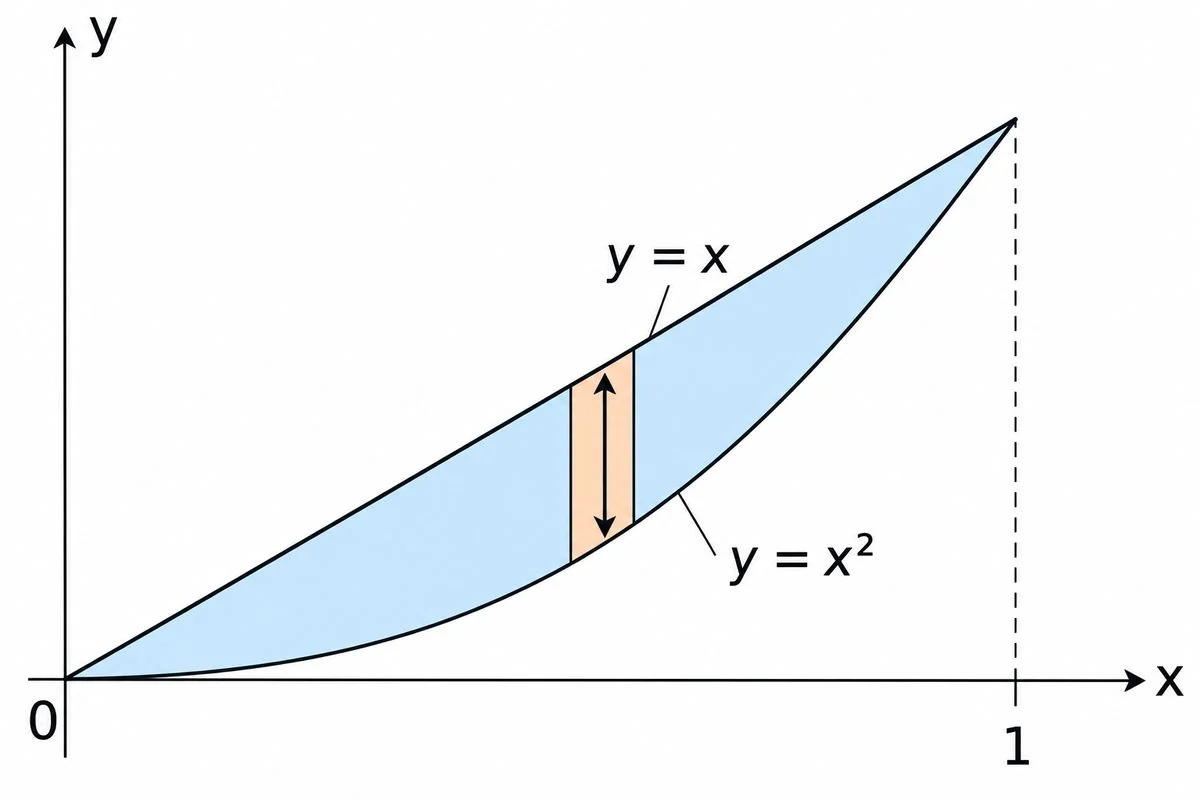
Shaded gap between a line and a parabola, with one vertical strip.

7. Area between Two Curves

Measure the gap between boundaries, starting and ending where they meet.

Show
Look at the diagram. Find where the curves meet and which curve lies above the shaded gap.
Ask
Before evaluating, what area do you predict for the gap between these curves?
Say
The integral gives one-half minus one-third, leaving one-sixth of a square unit. Here, each strip starts at the parabola and ends at the line.
Used in
A curved border’s area determines how much decorative material it needs.
If your child says…“I only need the upper curve.”
Ask
Does your strip begin at the axis or at the lower curve?
What’s true
That also counts the unwanted region beneath the lower curve.
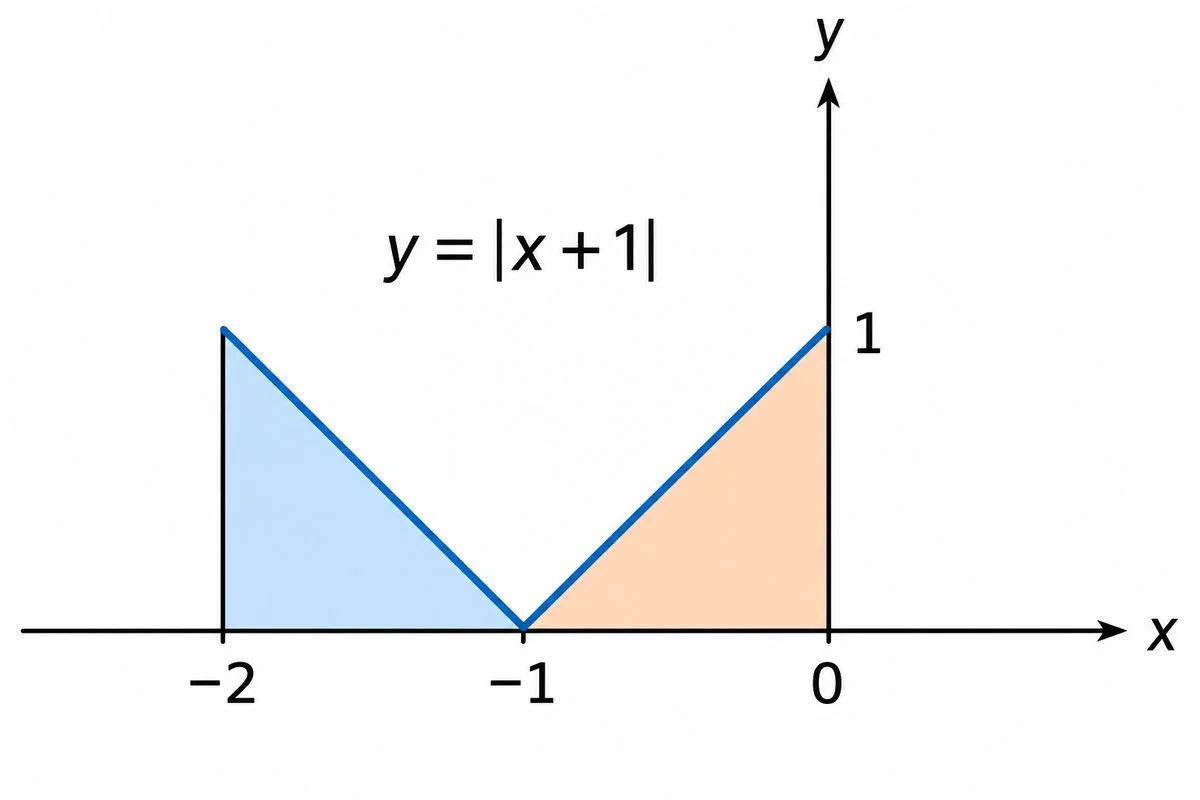
V-shaped graph with its corner at minus one and both underlying triangles shaded.

8. Area under a modulus function

Split the V at its corner and integrate each arm.

Show
Look at the diagram. Find the corner and the shaded triangle beneath each arm.
Ask
Before evaluating, what total area do you predict under both arms?
Say
Each integral gives half a square unit. Both arms stay above the axis, giving one square unit.
Used in
A symmetric V-shaped panel’s area comes from doubling one half, helping estimate material.
If your child says…“The bars work just like brackets.”
Ask
Would ordinary brackets keep the left arm above the axis?
What’s true
The left arm needs its sign reversed to give positive heights.

A real problem

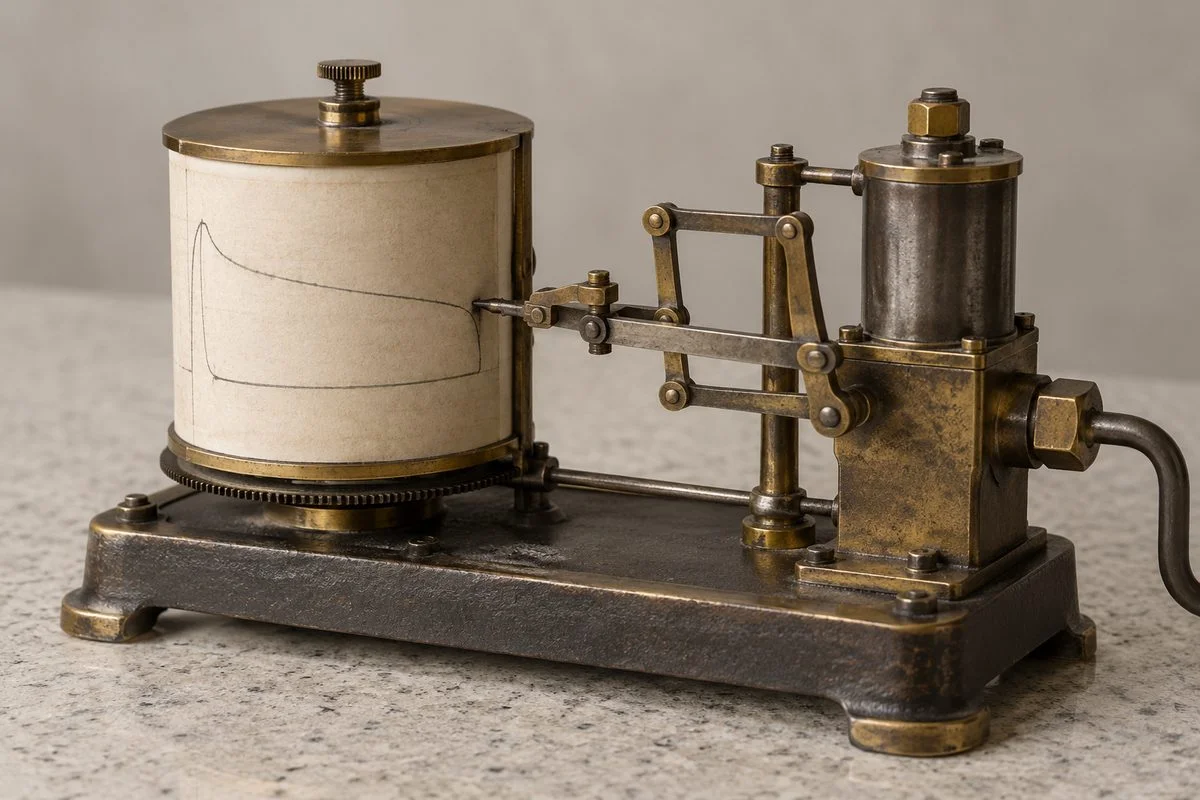
Watt’s indicator made steam-engine work measurable.

The indicator was introduced in 1796 to help engineers adjust steam-engine valves.

On a pressure–volume graph, area beneath the expansion curve measures work during that stroke.

Watt used these diagrams to improve steam-engine performance.

Science Museum GroupWikipedia

Preserved steam-engine indicator with its paper trace visible.

Concept Lab · Common misconception

The tempting mistake in Application of Integrals

Open standalone misconception page →

Can areas above and below the x-axis cancel?

Wrong

The area between y = x and the x-axis from −1 to 1 is zero.

Why it feels right. The two contributions to the definite integral cancel.

Right

A definite integral measures signed area. Geometric area counts both regions positively.

Worked example

One region lies below the axis. Each triangle has geometric area 1/2.
  1. Each triangle has base 1 and height 1.
  2. The integral adds −1/2 and 1/2 to give 0.
  3. The geometric area adds 1/2 and 1/2 to give 1.

Ask your child eight quick questions.

One per step. The answer and the reason are given.

  1. What area lies under this line between the marked boundaries?

    1 square unit. The integral adds strips; subtracting endpoint heights gives a length.

  2. What expression gives this horizontal strip’s length?

    y2y^2. The curve’s horizontal coordinate is y squared.

  3. Where must this integral be split?

    x=1x=1. The line changes sign there, rather than at zero.

  4. What multiplies this quarter’s area to give the whole circle’s area?

    4. Four matching quarters fill the disk.

  5. What value replaces inverse sine of 1 in this integral?

    π2\frac{\pi}{2}. A right angle measures pi divided by two radians.

  6. What is this ellipse’s area divided by the unit circle’s area?

    2. All corresponding strips have twice the height and unchanged width.

  7. What is the height of a strip between these curves?

    x−x2x-x^2. Subtracting the lower boundary removes the space outside the gap.

  8. Which expression gives the left arm’s height?

    −x−1-x-1. The modulus reverses the negative input’s sign on this side.

15 more questions with answers