Skip to content

Teach Integrals in eight steps.

For each idea: show it, ask before you tell, then say one line.

Gather paper and a pencil.

Common misconceptions & worked visual for this chapter · 15 practice questions with answers

How to teach it

Reverse differentiation

Differentiating x squared gives twice x.

ddx(x2+C)=2x\frac{d}{dx}(x^2+C)=2x

1. Integration as an Inverse Process of Differentiation

Find functions whose derivative matches what you know.

Show
Write these lines. Say: “Here, x varies and C is any constant.” First write that differentiating x squared gives twice x. Point to the matching derivatives.
Ask
What should we write for the integral of twice x?
Say
Any constant disappears on differentiation, so the integral is x squared plus C.
Used in
Integrating speed gives distance travelled, helping measure a trip.
If your child says…“There is only one possible answer.”
Ask
What information about the constant survives differentiation?
What’s true
Adding any constant leaves the derivative unchanged.
Call x squared t.

dt=2x dxdt=2x\,dx

∫2xcos⁡(x2) dx=∫cos⁡t dt\int 2x\cos(x^2)\,dx=\int\cos t\,dt

∫2xcos⁡(x2) dx=sin⁡t+C\int 2x\cos(x^2)\,dx=\sin t+C

2. Integration by Substitution

Rename the inside expression and change the differential with it.

Show
Write these lines. Say: “Call x squared t; twice x times dx becomes dt.”
Ask
What does the last line become back in x?
Say
The answer is sine of x squared plus C.
Used in
Integrating changing water flow gives the amount collected, helping plan tank filling.
If your child says…“I can just replace dx with dt.”
Ask
What happened to twice x when you changed variables?
What’s true
The differential changes according to the derivative of the substitution.

Choose a method

cos⁡2x=1−2sin⁡2x\cos 2x=1-2\sin^2x

sin⁡2x=1−cos⁡2x2\sin^2x=\frac{1-\cos 2x}{2}

∫sin⁡2x dx=12∫(1−cos⁡2x) dx\int\sin^2x\,dx=\frac12\int(1-\cos 2x)\,dx

∫sin⁡2x dx=12(x−sin⁡2x2)+C\int\sin^2x\,dx=\frac12\left(x-\frac{\sin 2x}{2}\right)+C

3. Integration Using Trigonometric Identities

Rewrite trigonometric expressions into forms you can integrate.

Show
Write these lines. Say: “The identity replaces sine squared with simpler terms.”
Ask
What does the last line become after multiplying out the half?
Say
Half of x minus a quarter of sine of twice x, plus C.
Used in
Integrating squared alternating current helps calculate the heat produced in a resistor.
If your child says…“Sine squared uses the ordinary power rule directly.”
Ask
Where is the cosine factor needed for that substitution?
What’s true
Using the power rule on sine requires its derivative, cosine, alongside it.

ddxtan⁡−1(x2)=2x2+4\frac{d}{dx}\tan^{-1}\left(\frac{x}{2}\right)=\frac{2}{x^2+4}

ddx[12tan⁡−1(x2)]=1x2+4\frac{d}{dx}\left[\frac12\tan^{-1}\left(\frac{x}{2}\right)\right]=\frac{1}{x^2+4}

4. Integrals of Some Particular Functions

Match a standard form, including its scale, signs and roots.

Show
Write these lines. Say: “Inverse tangent returns an angle; the half corrects its derivative.”
Ask
Which integral follows from the second line?
Say
Half the inverse tangent of half x, plus C.
Used in
Integrating internal cross-sectional areas along a container’s length gives its capacity.
If your child says…“Four is the number that divides x inside inverse tangent.”
Ask
Which number squared gives four?
What’s true
The denominator contains a squared scale, so four corresponds to a scale of two.

1=A(x+2)+B(x+1)1=A(x+2)+B(x+1)

1(x+1)(x+2)=1x+1−1x+2\frac{1}{(x+1)(x+2)}=\frac{1}{x+1}-\frac{1}{x+2}

Integrate the two fractions separately.

∫dx(x+1)(x+2)=log⁡∣x+1∣−log⁡∣x+2∣+C\int\frac{dx}{(x+1)(x+2)}=\log|x+1|-\log|x+2|+C

5. Integration by Partial Fractions

Separate a rational expression into simpler fractions before integrating.

Show
Write these lines. Say: “A and B are constants; log means natural logarithm.” Substitute −1, then −2, to find the constants.
Ask
What single logarithm replaces this difference?
Say
Log of the absolute quotient, x plus one over x plus two, plus C.
Used in
Partial fractions simplify flow calculations to estimate draining times.
If your child says…“Subtracting logarithms means multiplying what is inside.”
Ask
Which logarithm rule turns division into subtraction?
What’s true
A difference of logarithms combines through division.

ddx(xex)=xex+ex\frac{d}{dx}(xe^x)=xe^x+e^x

xex=ddx(xex)−exxe^x=\frac{d}{dx}(xe^x)-e^x

∫xex dx=xex−∫ex dx\int xe^x\,dx=xe^x-\int e^x\,dx

6. Integration by Parts

Reverse the product rule by subtracting an extra integral.

Show
Write these lines. Say: “The exponential, e to the power x, is its own derivative.”
Ask
What remains after integrating the final exponential?
Say
Subtract the exponential from x times that exponential, then add C.
Used in
Integration by parts helps calculate work from product expressions for changing forces.
If your child says…“I add the extra integral.”
Ask
How did the extra exponential move across the equality?
What’s true
The extra derivative term must be subtracted to recover the required integrand.

Find a total between limits

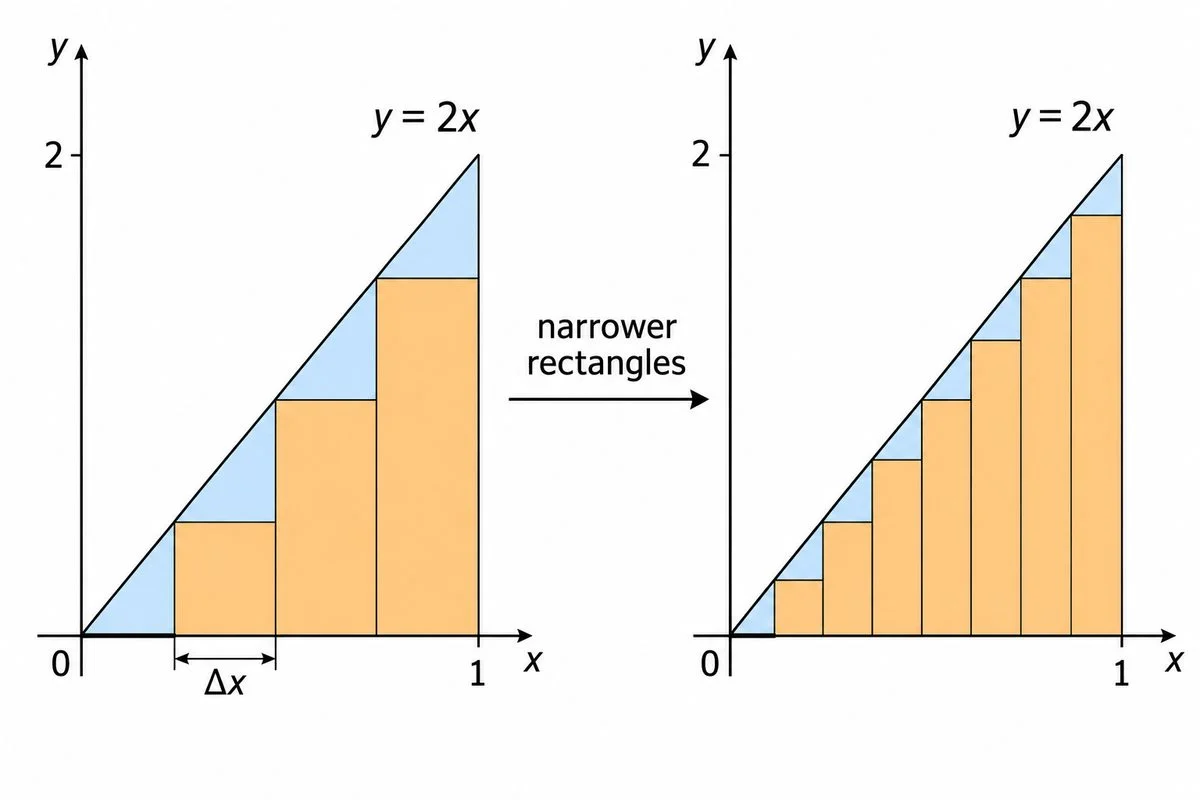
Four and eight rectangles approximate the same triangular region beneath a rising line.

7. Definite Integral

Add signed contributions across an interval to find one total.

Show
Compare the diagram’s rectangles. Delta x labels their width.
Ask
What exact area do their totals approach?
Say
Add height times width for each rectangle. As widths shrink, the total approaches the triangle’s area: ∫012x dx=1\int_0^1 2x\,dx=1.
Used in
Integrating changing electrical power gives energy use, helping estimate electricity bills.
If your child says…“The answer still needs an unknown constant.”
Ask
How could adding different constants give the same fixed triangle’s area?
What’s true
The fixed region has one area, so its integral has no arbitrary constant.
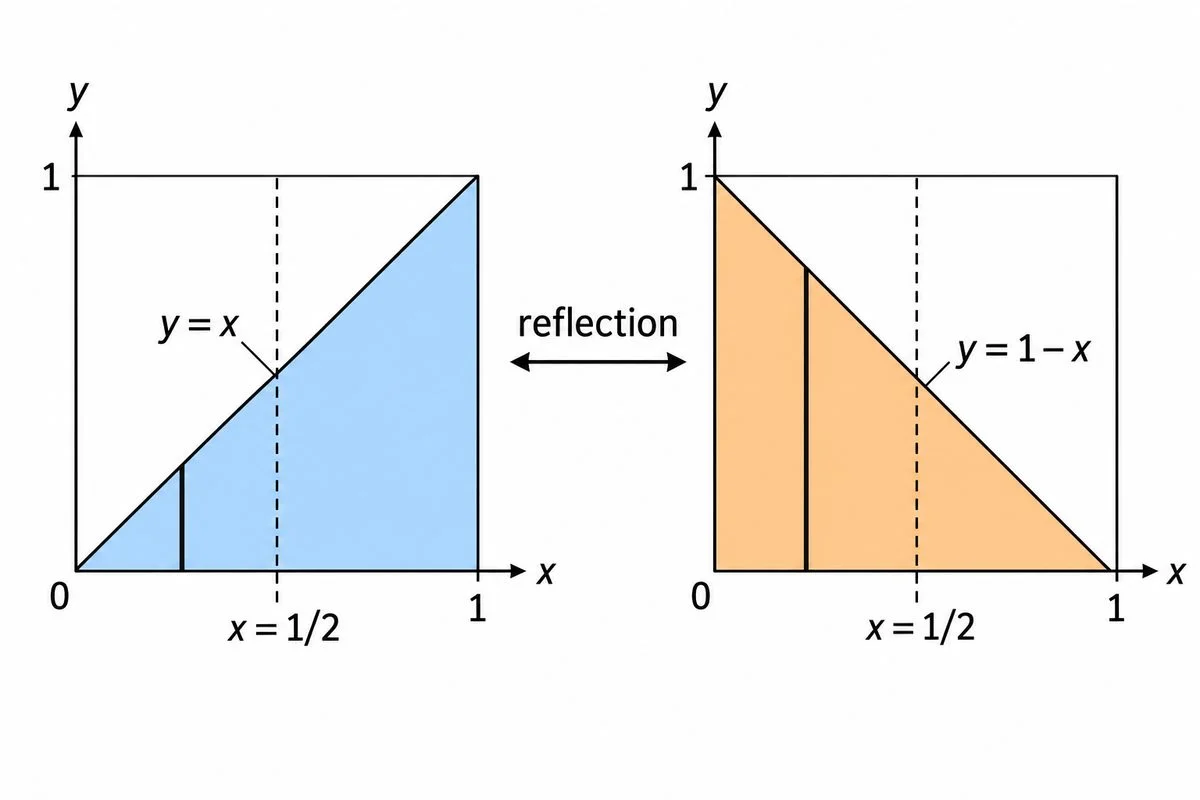
Reflected triangular regions have equal areas and heights that add to one.

8. Some Properties of Definite Integrals

Use reflection and symmetry to simplify accumulated totals.

Show
Look at the diagram’s two shaded triangles and their dashed midpoint lines. Compare the marked heights at the same horizontal position.
Ask
What total will adding these equal, reflected areas give?
Say
Reflection moves the triangle without changing its area. The two graph heights add to one everywhere, so the areas total one. Each integral is therefore one half.
Used in
Symmetric shapes let designers calculate full areas from half, reducing repeated work.
If your child says…“For equal halves, one half’s integral gives the whole.”
Ask
How many equal triangles contribute to the square’s whole area?
What’s true
The two equal triangular areas add to the whole square’s area.

A real problem

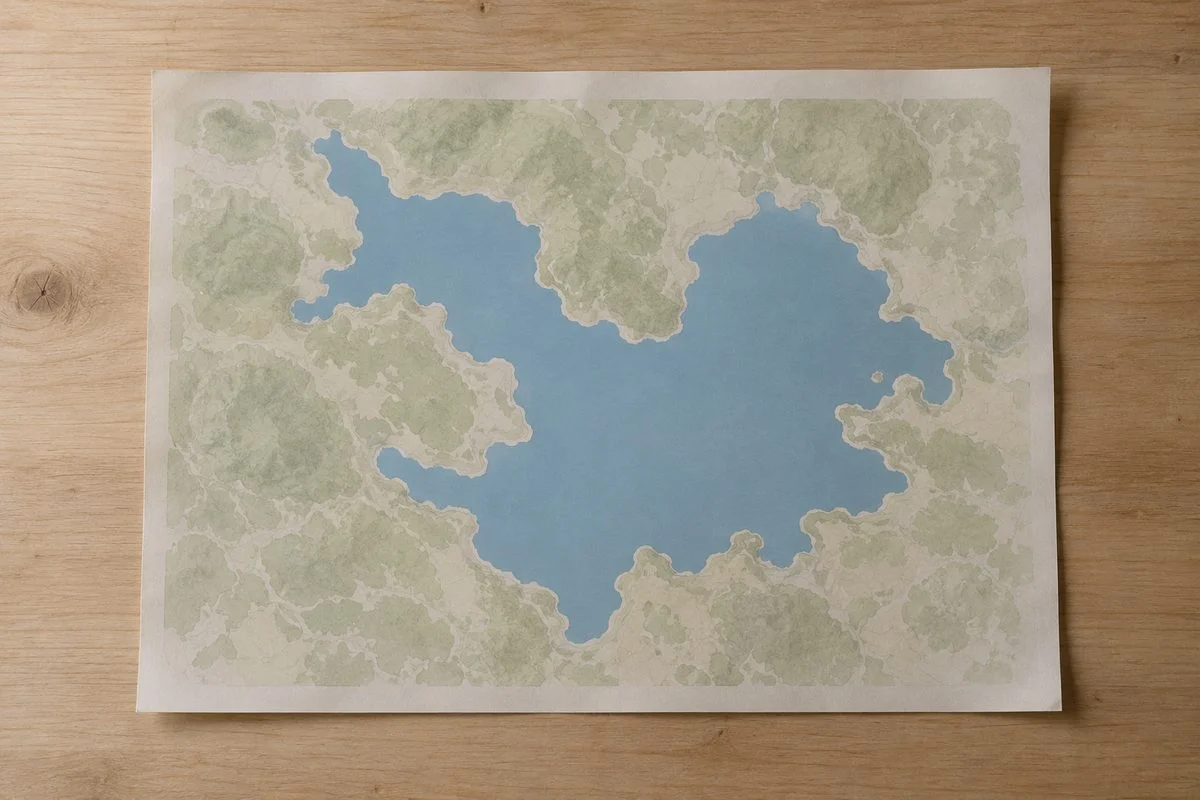
A polar planimeter measured irregular areas by tracing their boundaries.

Jakob Amsler developed a practical polar planimeter in 1854.

Tracing a flat shape’s boundary let the instrument measure its area.

Planimeters evaluate definite integrals mechanically.

Science Museum GroupPowerhouse MuseumVirginia Commonwealth University

Paper map with an irregularly shaped lake on a wooden desk.

Concept Lab · Common misconception

The tempting mistake in Integrals

Open standalone misconception page →

Does the power integration rule work for 1/x?

Wrong

Integrating x⁻¹ gives x⁰/0 by the usual power rule.

Why it feels right. The power rule works for most familiar exponents.

Right

The power rule for antiderivatives excludes exponent −1 because the new denominator would be zero.

Worked example

Power rule attempt
x⁻¹→Exponent −1 + 1 = 0→Division by zero
Derivative check
ln(abs(x))→Differentiate for x ≠ 0→1/x
Adding 1 to exponent −1 would make the divisor zero. A derivative check gives the correct antiderivative on intervals away from zero.
  1. Differentiate the natural log of the absolute value of x and you obtain 1/x.
  2. On any interval excluding zero, add a constant to get the family of antiderivatives.

Ask your child eight quick questions.

One per step. The answer and the reason are given.

  1. What remains undetermined when only the derivative is given?

    The added constant. Different constants give the same derivative.

  2. Which entire factor becomes dt here?

    2x dx2x\,dx Differentiating x squared supplies the factor twice x.

  3. Which missing factor prevents direct substitution of sine into the power rule here?

    cos⁡x\cos x Cosine is the derivative of sine.

  4. What coefficient outside inverse tangent corrects the first derivative shown?

    12\frac12 The uncorrected derivative is twice the required expression.

  5. What operation joins the two expressions inside the combined logarithm?

    Division. Multiplication would give a sum of logarithms.

  6. Which sign belongs before the remaining integral in the last line?

    Minus. Subtracting removes the extra term created by the product rule.

  7. What is this exact integral, including any constant needed?

    1, with no arbitrary constant. The triangle has a fixed base and height, so its area is fixed.

  8. The two equal integrals together give one. What is each integral?

    One half. One is the combined total of two equal areas.

15 more questions with answers