Skip to content

Teach Matrices in eight steps.

For each idea: show it, ask before you tell, then say one line.

Gather paper and a pencil.

Common misconceptions & worked visual for this chapter · 15 practice questions with answers

How to teach it

Read and combine matrices

A=[a11a12a21a22]A=\begin{bmatrix}a_{11}&a_{12}\\a_{21}&a_{22}\end{bmatrix}

A=[1−11−22−12−2]A=\begin{bmatrix}1-1&1-2\\2-1&2-2\end{bmatrix}

1. Matrix and its order

A rectangular array whose entries have row and column addresses.

Show
Say, “Call this matrix A. Each entry's subscripts give its row, then column, starting at 1.” Write the starting matrix. Point across rows and down columns. Say, “Two rows and two columns give four entries. At each position, subtract the column number from the row number.”
Ask
What completed matrix comes next?
Say
The top row is zero, minus one. The bottom row is one, zero.
Used in
Seating charts use row and column positions to locate a particular seat.
If your child says…“The column number comes first.”
Ask
Which subscript changes when you move from the top-left entry to the bottom-left entry?
What’s true
Both the order and an entry's address put the row first.
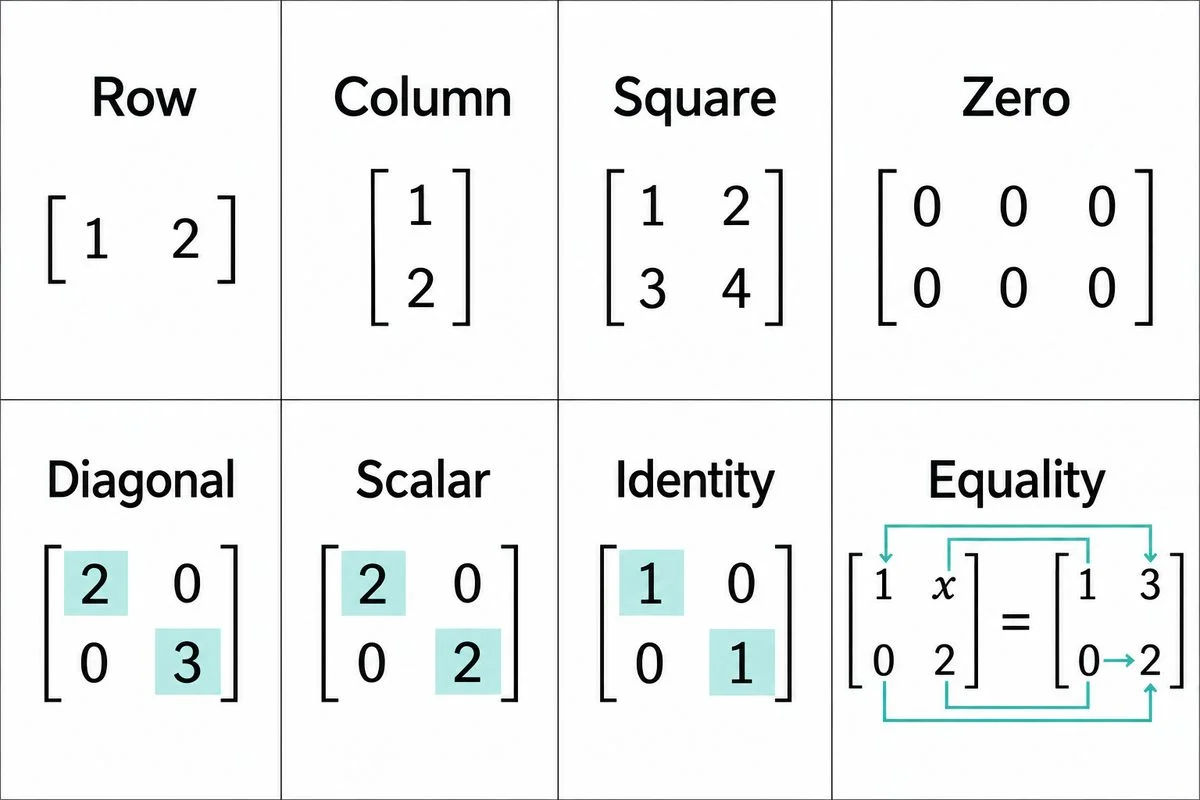
Matrix types compared beside an equality with matching positions connected.

2. Types of Matrices and Equality of matrices

Equal matrices have matching orders and identical entries at every matching position.

Show
Read the diagram’s Row, Column, Square and Zero panels. Compare Diagonal, Scalar and Identity. Follow the matching-position arrows in Equality.
Ask
Which value of x makes the arrays in the Equality panel exactly the same matrix?
Say
Three makes them equal because every matching position must agree. The identity also fits the scalar, diagonal and square patterns.
Used in
Image comparison checks corresponding pixels to locate changes.
If your child says…“A scalar matrix must have diagonal ones.”
Ask
Would equal diagonal zeros still meet the scalar rule?
What’s true
A scalar matrix can use any shared diagonal value, including zero.

C=2[12]+[21]C=2\begin{bmatrix}1&2\end{bmatrix}+\begin{bmatrix}2&1\end{bmatrix}

C=[2×12×2]+[21]C=\begin{bmatrix}2\times1&2\times2\end{bmatrix}+\begin{bmatrix}2&1\end{bmatrix}

C=[2+24+1]C=\begin{bmatrix}2+2&4+1\end{bmatrix}

3. Addition of matrices and Multiplication of a matrix by a scalar

Combine corresponding entries; a scalar multiplies every entry.

Show
Write these lines. Say, “Each order lists pencils, then notebooks; C records totals.”
Ask
What total matrix comes next?
Say
The total is four pencils and five notebooks: double each entry, then add matching entries.
Used in
Stock records add incoming supplies and subtract deliveries to track what remains.
If your child says…“Matching row counts are enough for addition.”
Ask
Where would an extra column find its partner?
What’s true
Every position needs a partner, so column counts must match too.

Multiply matrices

C=[12][23]C=\begin{bmatrix}1&2\end{bmatrix}\begin{bmatrix}2\\3\end{bmatrix}

C=[1×2+2×3]C=\begin{bmatrix}1\times2+2\times3\end{bmatrix}

C=[2+6]C=\begin{bmatrix}2+6\end{bmatrix}

4. Multiplication of matrices

Combine a left row with a right column by summing products.

Show
Say, “Bill C covers one pencil at ₹2 and two erasers at ₹3.” Write the starting formula. Talk through the two costs: two rupees and six rupees.
Ask
What completed matrix comes next?
Say
Its entry is eight: add both costs.
Used in
Recipe costing combines ingredient amounts and unit prices to calculate the total cost.
If your child says…“The first multiplication gives the whole entry.”
Ask
Where does the cost of the erasers enter your total?
What’s true
An entry includes the products from every pair in that row and column.

(A+B)2=(A+B)(A+B)(A+B)^2=(A+B)(A+B)

(A+B)2=A(A+B)+B(A+B)(A+B)^2=A(A+B)+B(A+B)

5. Properties of multiplication of matrices

Factor order matters; powers repeat matrix multiplication.

Show
Say, “A and B are equally sized square matrices; powers repeat multiplication.” Write the starting formula. Talk through distributing each left term without changing factor order.
Ask
What four terms complete the next line?
Say
Distribute without swapping factors: A squared, A times B, B times A, then B squared. Keep the middle products separate.
Used in
Computer graphics preserve the order of turns and stretches to produce the intended shape.
If your child says…“The middle terms always combine into twice A times B.”
Ask
Do A times B and B times A always give the same matrix?
What’s true
That combination works only when reversing these factors gives the same product.

Transpose, symmetry and inverses

A=[12]A=\begin{bmatrix}1&2\end{bmatrix}

A′=[a11a12]A'=\begin{bmatrix}a_{11}\\a_{12}\end{bmatrix}

6. Transpose of a matrix

Each row becomes a column, keeping its entries in order.

Show
Say, “A prime names the transpose; rows become columns.” Write the starting matrix. Talk through moving its row into a column, keeping the entries in order.
Ask
What column of numbers comes next?
Say
One goes above two.
Used in
Spreadsheets transpose tables to switch which categories run across and which run down.
If your child says…“Transposing keeps the same row and column counts.”
Ask
Where did the two entries across the top go?
What’s true
The counts exchange places because rows become columns.
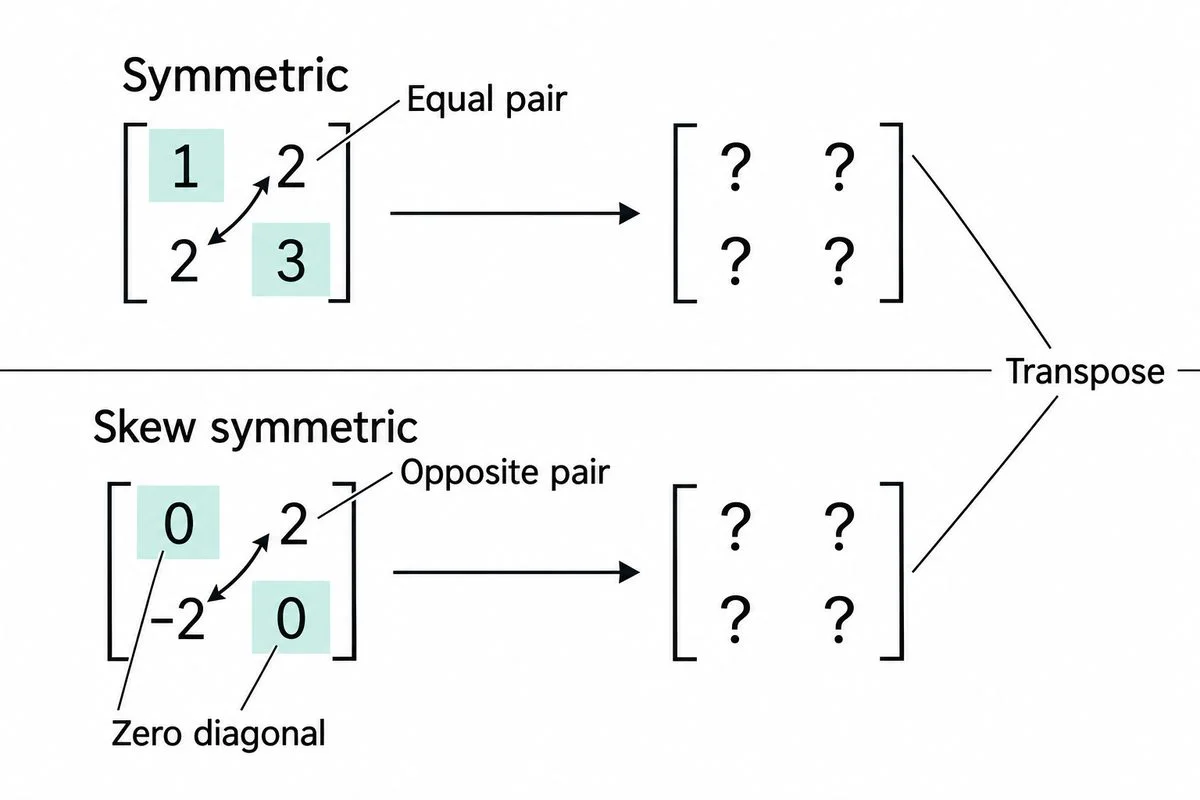
Symmetric and skew symmetric matrices with paired entries and blank transpose positions.

7. Symmetric and Skew Symmetric Matrices

Transposing preserves a symmetric matrix and negates a skew symmetric matrix.

Show
Compare the diagram’s pairs. Complete both transposes.
Ask
What does transposing change here?
Say
The symmetric matrix stays unchanged; the skew symmetric matrix changes signs and needs diagonal zeros.
Used in
Straight-line distances between places form symmetric tables, avoiding duplicate measurements.
If your child says…“A skew symmetric matrix can have nonzero diagonal entries.”
Ask
Which number can stay unchanged and also equal its own negative?
What’s true
Transposing leaves diagonal entries in place, so skew symmetry requires each to equal its negative.

A=[0110]A=\begin{bmatrix}0&1\\1&0\end{bmatrix}

AA=[0×0+1×10×1+1×01×0+0×11×1+0×0]AA=\begin{bmatrix}0\times0+1\times1&0\times1+1\times0\\1\times0+0\times1&1\times1+0\times0\end{bmatrix}

AA=I2AA=I_2

8. Invertible Matrices

An inverse undoes a matrix through multiplication in either order.

Show
Say, “A swaps two entries; I names the identity. Swapping twice restores them.” Write the starting matrix. Talk through multiplying A by itself, one row and column pair at a time.
Ask
Which matrix is A's inverse?
Say
A's inverse is A itself, because this matrix undoes itself. Both multiplication orders are identical here and give the identity.
Used in
Drawing software uses inverse matrices to recover coordinates before a reversible transformation.
If your child says…“I find the inverse by taking each entry's reciprocal.”
Ask
How could taking reciprocals handle the zeros in this invertible matrix?
What’s true
An inverse has the same square order and gives the identity when multiplied on either side.

A real problem

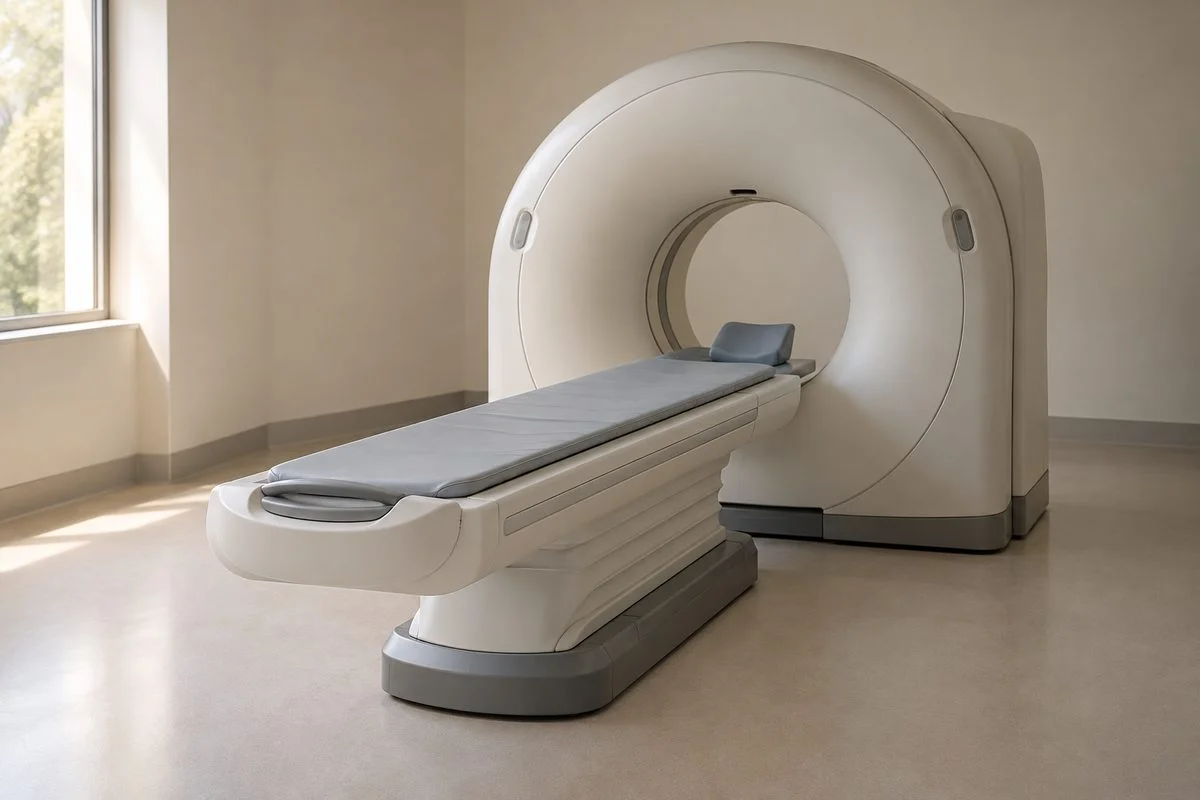
Matrix equations helped reconstruct brain images.

Hounsfield’s brain scanner had its first patient trials in 1971.

He reconstructed images by solving a large set of linear equations.

CT reconstruction uses matrix equations to find unknown image values.

The trials established CT as an important technology for imaging the brain.

Science Museum GroupJournal of Medical ImagingEmory University

CT scanner and examination table in a hospital scanning room.

Concept Lab · Common misconception

The tempting mistake in Matrices

Open standalone misconception page →

Can you reverse a matrix product?

Wrong

If A and B are square, AB must equal BA.

Why it feels right. Ordinary multiplication of numbers is commutative.

Right

A matrix product acts by applying the rightmost transformation first. Swapping the order can change the result.

Worked example

AB · B first
(1, 0)→Swap: (0, 1)→Stretch x: (0, 1)
BA · A first
(1, 0)→Stretch x: (2, 0)→Swap: (0, 2)
The rightmost matrix acts first. Stretching before swapping gives a different endpoint from swapping before stretching.
  1. Let A stretch x-coordinates by 2 and let B swap x and y.
  2. Starting at (1,0), AB gives (0,1), while BA gives (0,2).

Ask your child eight quick questions.

One per step. The answer and the reason are given.

  1. What order describes a matrix with three rows and two columns?

    Three by two. The row count comes before the column count.

  2. Which listed types describe a two-by-two matrix containing only zeros?

    Zero, square, diagonal and scalar. Every off-diagonal entry is zero, and all diagonal entries agree.

  3. Can you add a two-by-three matrix to a two-by-two matrix?

    No. The extra column has no corresponding entries in the other matrix.

  4. What does the second quantity contribute to this bill?

    ₹6. Both erasers cost ₹3 each, and their cost joins the pencil's cost.

  5. What equality lets the middle terms become twice A times B?

    AB equals BA. The two differently ordered products must agree before they count as identical terms.

  6. What order results when a two-by-three matrix is transposed?

    Three by two. Its three columns become rows, and its two rows become columns.

  7. What must every diagonal entry of a skew symmetric matrix be?

    Zero. A diagonal entry must equal its own negative, which only zero does.

  8. What happens if you try taking reciprocals of this matrix's zero entries?

    Division by zero. Zeros have no reciprocals, yet this matrix multiplied by itself gives the identity.

15 more questions with answers, 2 with pictures