Skip to content

Teach Probability in eight steps.

For each idea: show it, ask before you tell, then say one line.

Gather paper and a pencil.

Common misconceptions & worked visual for this chapter · 15 practice questions with answers

How to teach it

Conditions and combined events

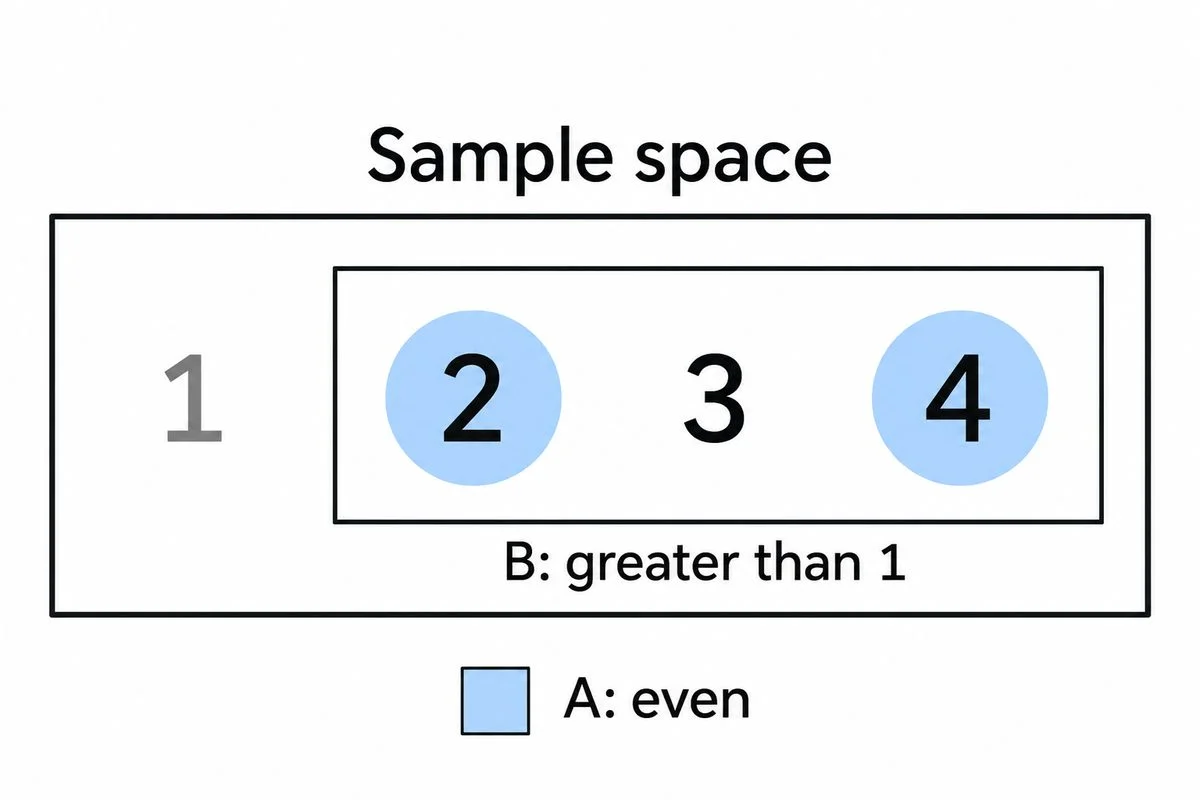
Outcome 1 lies outside B; even outcomes 2 and 4 are highlighted inside.

1. Conditional probability

Find a chance within the given condition.

Show
Look at the diagram: A means even, and B means greater than 1. Among these four equally likely outcomes, find B's boundary, then its even outcomes. Say, 'P means probability, ∩ means both, and the bar means given.'
Ask
After ruling out 1, what is the chance of an even outcome?
Say
Two of the three remaining outcomes are even.
Used in
Rain forecasts help people plan outdoor work.
If your child says…“All four outcomes still belong in the denominator.”
Ask
Can outcome 1 still qualify after you learn the number exceeds 1?
What’s true
The condition leaves three equally likely outcomes; only these belong in the denominator.
P(E∩F)=23×12P(E\cap F)=\frac23\times\frac12

P(E∩F)=26P(E\cap F)=\frac26

2. Multiplication theorem on probability

Multiply the first chance by the next chance under that condition.

Show
Say, 'Two black balls, one white; draw twice without replacement. E means first black, F second black; P means probability, ∩ means both.' Then write these lines.
Ask
For these two draws, what chance do you predict for getting black both times?
Say
The chance of two blacks is 13\frac13. Multiply two-thirds by one-half, the second black's chance after removal.
Used in
Sampling goods helps inspectors estimate the chance of drawing several faulty items.
If your child says…“The second black chance stays the same.”
Ask
After black leaves, how many black balls remain among how many balls?
What’s true
Removing a black ball reduces both the black count and the total.
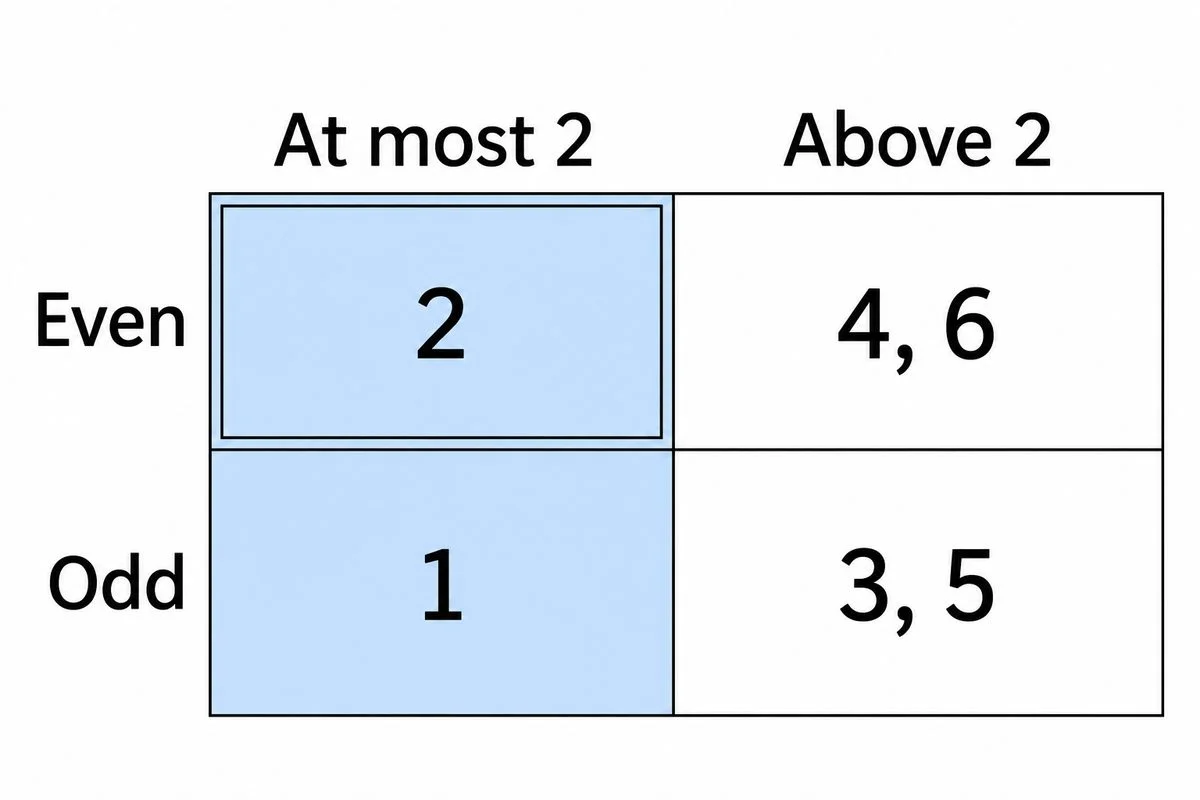
Die outcomes grouped by parity and size, with the at-most-two column highlighted.

3. Independent events

Knowing one event happened leaves the other's chance unchanged.

Show
Look at the diagram of equally likely die results. Compare the even fraction overall with that under 'At most 2'.
Ask
Does knowing 'at most 2' change the chance of even, despite the shared outcome?
Say
Both fractions are one-half, so these events are independent. They share 2, and their overlap matches their probability product: 16=36×26\frac16=\frac36\times\frac26.
Used in
Reliability calculations use independence checks to estimate whether separate backup devices might fail together.
If your child says…“Events that cannot happen together must be independent.”
Ask
If the die is even, does odd retain its original chance?
What’s true
For events with positive chances, mutual exclusion makes them dependent.

P(at least one head)=1−12×12×12P(\text{at least one head})=1-\frac12\times\frac12\times\frac12

P(at least one head)=1−18P(\text{at least one head})=1-\frac18

4. Independent events

Subtract the chance of no successes from 1.

Show
Say, 'For three independent fair-coin tosses, TTT means tails every time. Subtract the chance of all tails from 1.' Then write these lines.
Ask
What probability remains after removing the no-heads outcome?
Say
The chance is 78\frac78, because only all tails is excluded. Results with several heads still count.
Used in
Repeated independent attempts increase the chance of at least one success in games of chance.
If your child says…“At least one head means exactly one head.”
Ask
Does a result with two heads contain at least one head?
What’s true
At least one includes every result containing any heads.

Groups and evidence

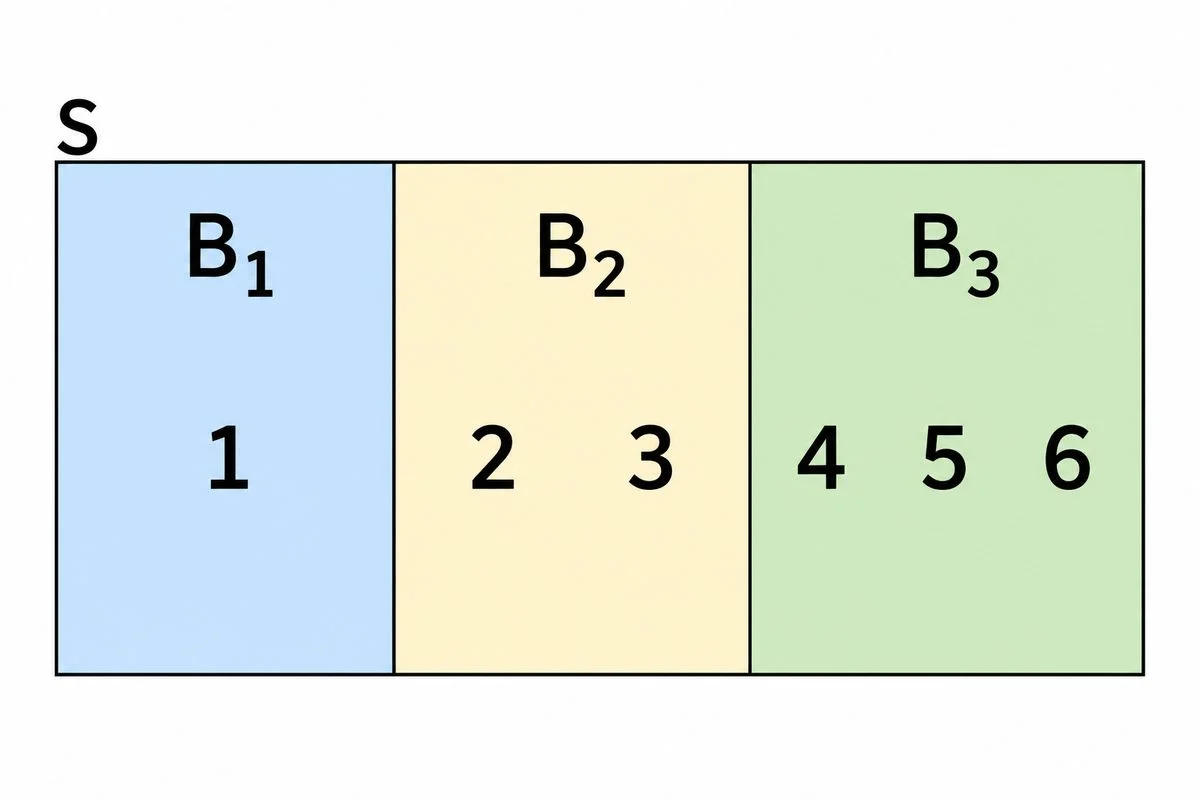
Six die results divided into groups containing one, two and three outcomes.

5. Partition of a sample space

Separate all outcomes into possible groups without overlaps or omissions.

Show
Look at the diagram. Read each group's equally likely die outcomes.
Ask
How many groups will contain your next die result?
Say
Every result appears in one group, so none is missed or counted twice. Each group has a positive chance.
Used in
Sorting stock by supplier lets shops include every source when comparing quality.
If your child says…“The groups must have equal chances.”
Ask
Would unequal group chances leave any result unclassified?
What’s true
A partition needs complete coverage, no overlap and a positive chance for each group.

P(W)=26×12+46×14P(W)=\frac26\times\frac12+\frac46\times\frac14

P(W)=16+16P(W)=\frac16+\frac16

6. Theorem of total probability

Add each group's contribution, weighted by its chance.

Show
Say, 'Batch A has two pens, one working. Batch B has four pens, one working. Choose equally among all six pens. W means working. Add each batch's share times its working fraction.' Then write these lines.
Ask
What simplified fraction comes next for choosing a working pen?
Say
The overall chance is 13\frac13, adding the working contribution from each batch.
Used in
Factories combine batch sizes and fault rates to estimate overall quality.
If your child says…“Just average the working fractions of the batches.”
Ask
Are you equally likely to select either batch when choosing among all six pens?
What’s true
A larger batch contributes more possible selections, so its working fraction needs greater weight.

P(D∣F)=14×114×1+34×13P(D\mid F)=\frac{\frac14\times1}{\frac14\times1+\frac34\times\frac13}

P(D∣F)=1/41/2P(D\mid F)=\frac{1/4}{1/2}

7. Bayes' theorem

Use evidence to update a source's chance.

Show
Say, 'Four equally likely items: one defective, three sound. The defective item and one sound item were flagged. D means defective, F flagged; the bar means given.' Then write these lines.
Ask
Given that the chosen item was flagged, what is the chance it is defective?
Say
The chance is 12\frac12: one of two flagged items is defective.
Used in
Warnings help repairers decide which fault to investigate.
If your child says…“Every defective item was flagged, so every flagged item is defective.”
Ask
Which sound item also appears among the flags?
What’s true
A flag means counting among flagged items, while a defect means counting among defective items.

Numbers from outcomes

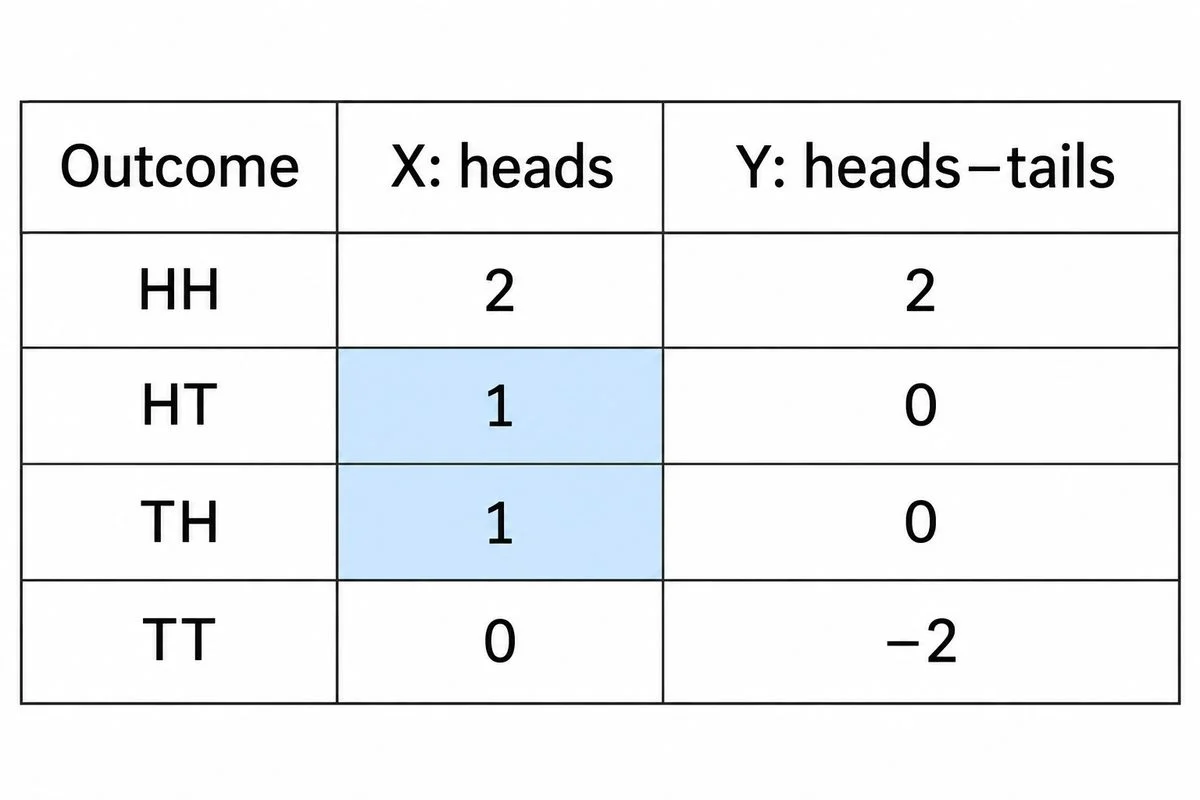
Coin outcomes mapped to head counts and heads minus tails, with repeated values highlighted.

8. Random variables

A numerical rule gives each possible outcome a number.

Show
Look at the diagram; H means heads, and T means tails. Read each outcome, then X for heads and Y for heads minus tails. The first letter records the first coin.
Ask
From these outcomes, how many values could X take on the next two-coin toss?
Say
X takes three values: 0, 1 and 2. HT and TH both give one head. Y uses another rule and can be negative.
Used in
Shops count daily sales as a random variable to plan stock.
If your child says…“Four outcomes must give four different values.”
Ask
What head count do HT and TH each give?
What’s true
Several outcomes can receive the same number.

A real problem

Bayesian search helped locate a lost submarine.

Bayesian search theory helped planners locate USS Scorpion.

After an unsuccessful search, Bayes' theorem updated the chance that the wreck occupied that area.

The research ship Mizar located sections of Scorpion's hull in October 1968.

SIAMWikipedia for Schools / ASUWikipedia

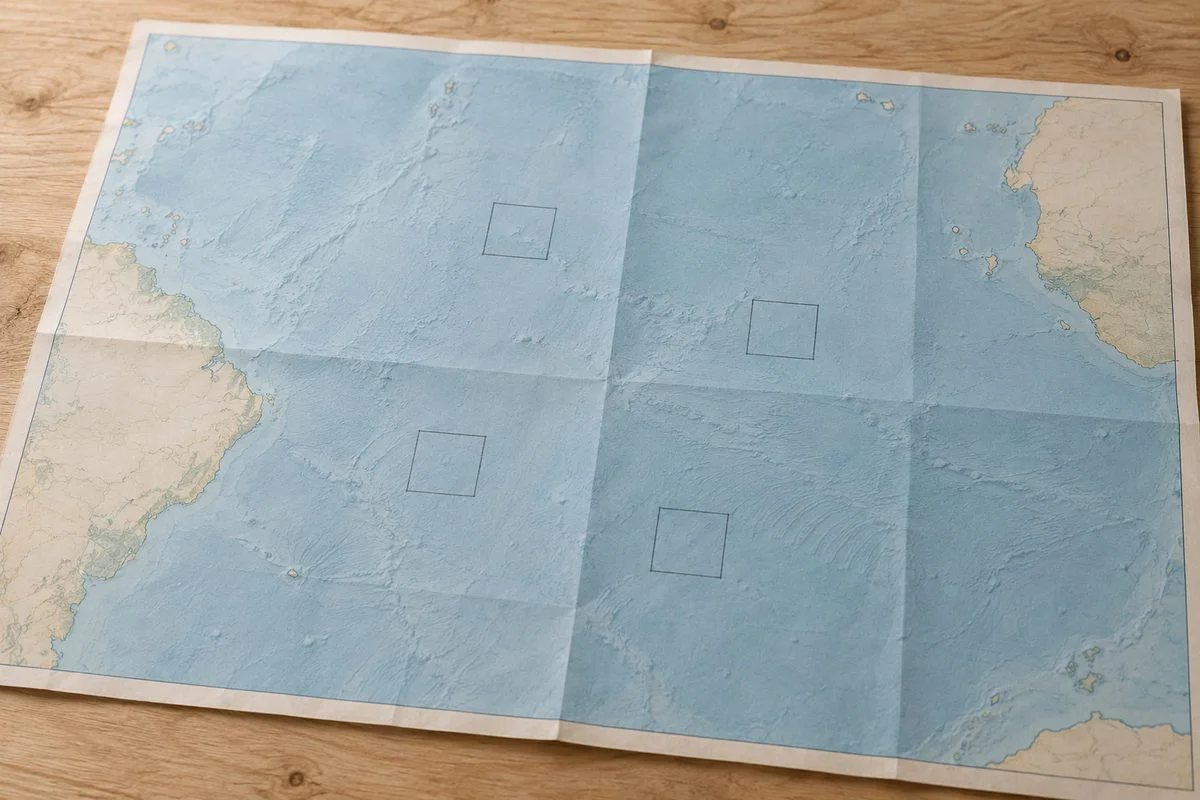
A paper ocean map with search squares marked in pencil.

Concept Lab · Common misconception

The tempting mistake in Probability

Open standalone misconception page →

Can you swap the event and the condition?

Wrong

The probability of a heart given red equals the probability of red given a heart.

Why it feels right. Both questions describe red cards and hearts.

Right

The condition determines the group you count within.

Worked example

The conditioning group changes the denominator. Hearts make up half of red cards, while every heart is red.
  1. In a standard deck, 13 of 26 red cards are hearts, so P(heart given red) = 1/2.
  2. All 13 hearts are red, so P(red given heart) = 1.

Ask your child eight quick questions.

One per step. The answer and the reason are given.

  1. Given greater than 1, what is the chance of an odd number?

    13\frac13 Only outcome 3 is odd among the three remaining possibilities.

  2. After the first black ball leaves, what is the chance the next ball is black?

    12\frac12 One black ball remains among two balls.

  3. Are even and odd independent events on this fair die?

    No. Their overlap has probability zero, but their probability product is 14\frac14.

  4. What is the chance of no heads in these three independent fair-coin tosses?

    18\frac18 Multiply the three one-half chances of tails.

  5. What are the three group probabilities, from left to right?

    16\frac16, 26\frac26, 36\frac36. The groups contain unequal numbers of equally likely outcomes; equal probabilities are unnecessary.

  6. What weight belongs to batch B's working fraction?

    46\frac46 Batch B contains four of the six equally likely pens.

  7. Which items belong in the denominator after a flag is known?

    Both flagged items. The evidence includes the defective flag and the sound item's false alarm.

  8. What value does heads minus tails give when both coins show tails?

    −2 There are no heads and two tails, so this numerical rule gives −2.

15 more questions with answers, 1 with pictures