Skip to content

Teach Relations and Functions in eight steps.

For each idea: show it, ask before you tell, then say one line.

Gather paper and a pencil.

Common misconceptions & worked visual for this chapter · 15 practice questions with answers

How to teach it

Relations and their properties

A×A={(1,1),(1,2),(2,1),(2,2)}A\times A=\{(1,1),(1,2),(2,1),(2,2)\}

R={(a,b)∈A×A:a<b}R=\{(a,b)\in A\times A:a<b\}

1. Relations

A selection of ordered pairs from the stated sets.

Show
Write these lines. Say: 'A contains 1 and 2. A cross A lists all possible ordered pairs. In each pair, a comes first and b second. R keeps pairs with the first entry smaller.'
Ask
Which pairs will remain in R?
Say
Only the pair with 1 first survives: R={(1,2)}R=\{(1,2)\}.
Used in
Bus routes link starting points with destinations, showing which journeys are available.
If your child says…“Swapping the entries keeps the same pair.”
Ask
Is 2 less than 1?
What’s true
Reversing different entries makes a different ordered pair, even if both belong to the relation.
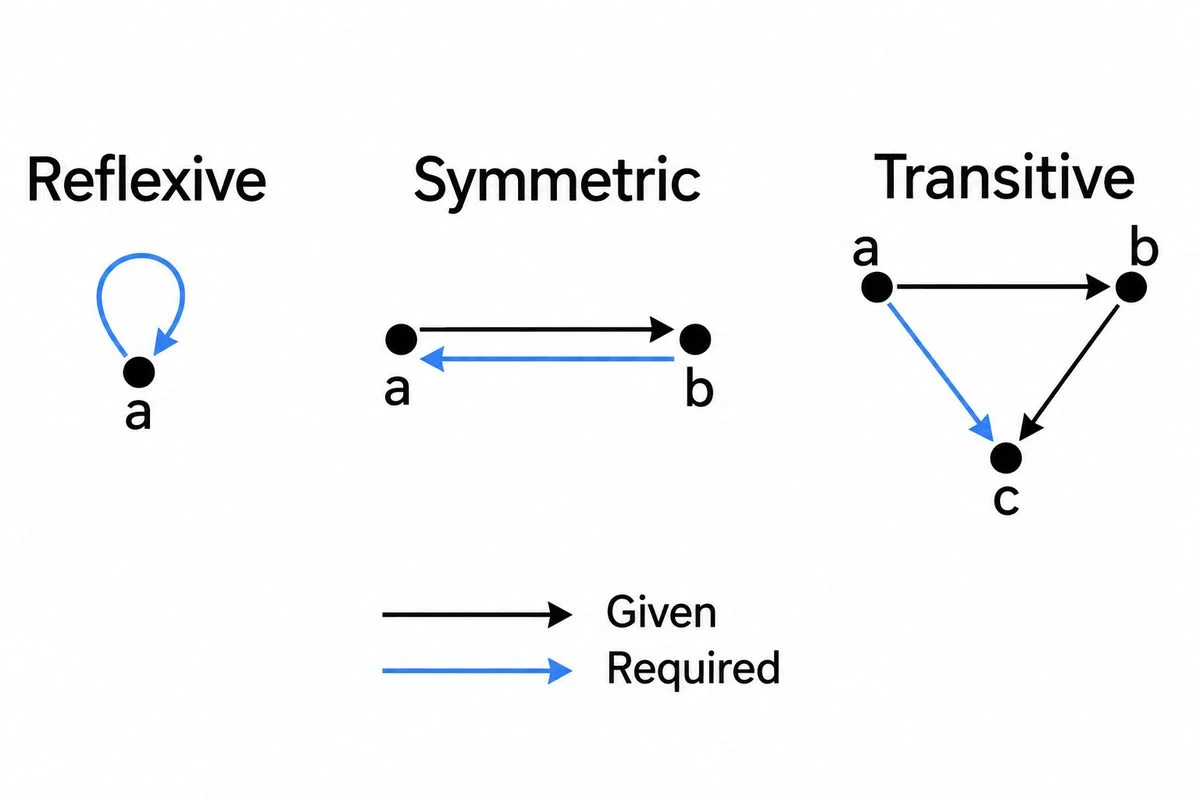
Arrow patterns show required self-loops, reverses and direct links completing chains.

2. Reflexive, symmetric and transitive relations

Check self-pairs, reversed pairs and chains separately.

Show
In the diagram, dots are elements and arrows are ordered pairs. Follow the blue requirements from left to right.
Ask
Which arrows will these dots and black arrows require for a relation behaving like equality?
Say
Every element needs a self-loop. Every arrow needs its reverse. Every two-arrow chain needs a direct arrow from its start to its end.
Used in
Matching replacement shelf lengths helps shelves fit the same supports.
If your child says…“Transitive means every pair has its reverse.”
Ask
Which arrow joins the start and end of the chain through b?
What’s true
Transitivity requires a direct pair joining the ends of every two-link chain.
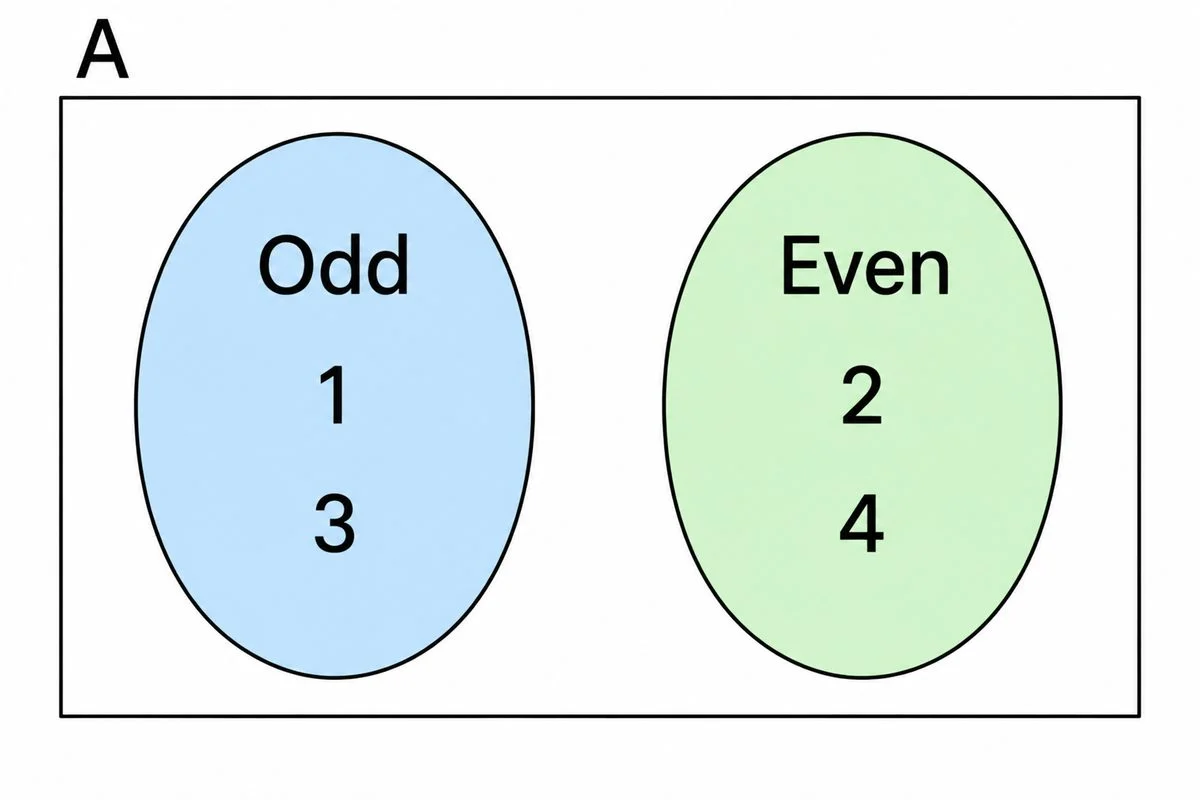
Numbers 1 and 3 share one class; 2 and 4 share another.

3. Equivalence relations and equivalence classes

All three properties create classes covering everything without overlap.

Show
Look at the diagram's odd and even groups. Relate numbers with equal remainders after division by 2.
Ask
Will choosing 3 instead of 1 change its class?
Say
Choosing 3 still names the class containing 1 and 3.
Used in
Grouping files by file type makes matching files easier to find.
If your child says…“A different chosen number means a different class.”
Ask
Which group changes when you point to 3 instead of 1?
What’s true
Related numbers name the same class, including themselves.

∣A×A∣=2×2|A\times A|=2\times2

∣A×A∣=4|A\times A|=4

N=2×2×2×2N=2\times2\times2\times2

4. Number of relations

Each possible pair doubles the number of selections.

Show
Write these lines. Say: 'For this example, A contains only 1 and 2. N counts relations.'
Ask
What total follows from the last line?
Say
These choices give sixteen relations.
Used in
Permission lists select account–file pairs, controlling who can open each file.
If your child says…“Four possible pairs means four relations.”
Ask
For each pair, can you choose either to keep it or leave it out?
What’s true
Multiply the set sizes to count pairs, then double once for each pair.

Types of functions

f(x1)=f(x2)f(x_1)=f(x_2)

x1+1=x2+1x_1+1=x_2+1

(x1+1)−1=(x2+1)−1(x_1+1)-1=(x_2+1)-1

5. One-one functions

Different inputs cannot share an output.

Show
Write these lines. Say: 'The function f adds 1 to any real input. Subscripts name two arbitrary inputs.'
Ask
After subtracting 1, what must be true of the inputs?
Say
The inputs must be equal, so the function is one-one.
Used in
Unique library card numbers keep different borrowers' records separate.
If your child says…“One output for each input means one-one.”
Ask
Does giving each input one output prevent two inputs from sharing that output?
What’s true
One-one requires different inputs to have different outputs.

2x=y2x=y

x=y2x=\frac{y}{2}

f(y2)=2(y2)f\left(\frac{y}{2}\right)=2\left(\frac{y}{2}\right)

6. Onto functions

Allowed inputs reach every value in the stated codomain.

Show
Write these lines. Say: 'The function f doubles non-negative inputs x. Let y be any non-negative target.'
Ask
What does the last line become?
Say
This returns the target using an allowed input. Every non-negative real target is reached, including zero.
Used in
Assigning duties onto all listed tasks ensures no task is left uncovered.
If your child says…“A doubling formula can reach any real number.”
Ask
What sign would an input need to produce a negative target?
What’s true
A target counts as reached only when its required input belongs to the domain.
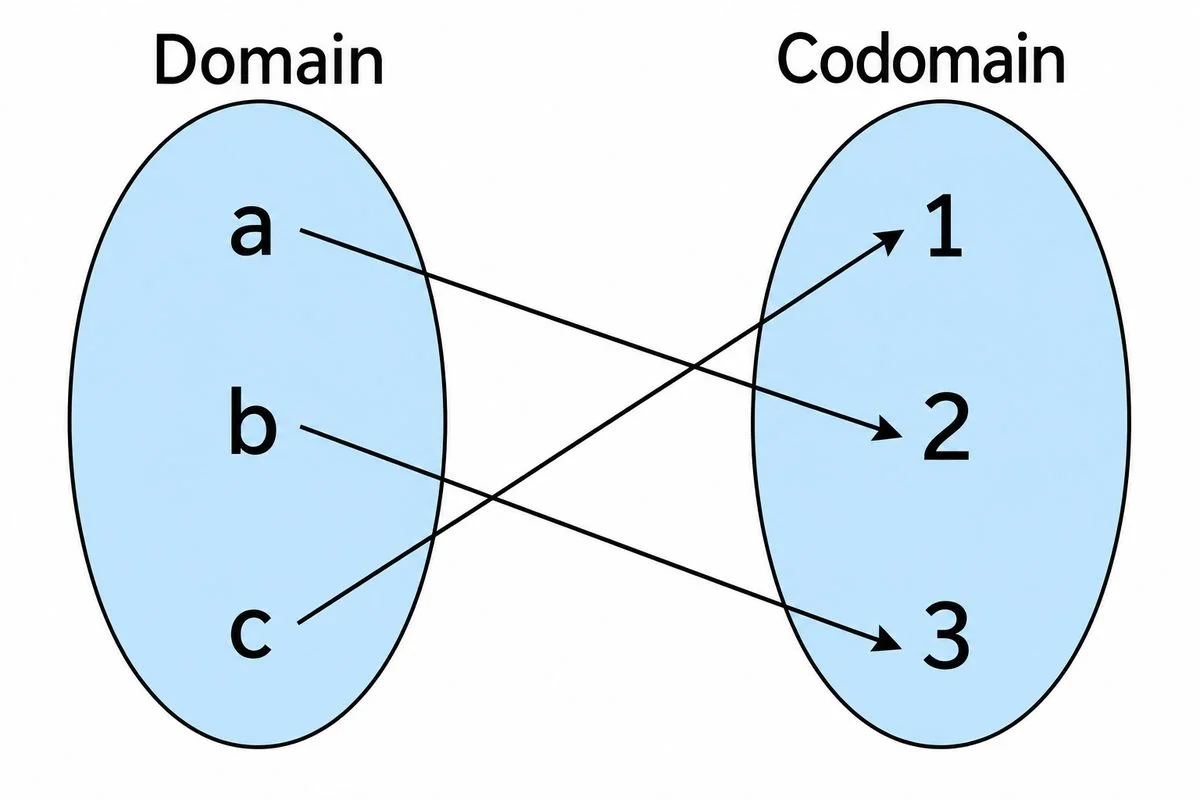
Arrows pair a with 2, b with 3, and c with 1.

7. Bijective functions

Each codomain value is reached by exactly one input.

Show
In the diagram, follow each domain element's arrow. Count the arrows reaching each codomain element.
Ask
Following these arrows backwards, will every codomain element lead to exactly one domain element?
Say
Yes, every output receives exactly one arrow, making this function one-one and onto. Together, these make it bijective.
Used in
A fully booked seating plan pairs tickets with seats, preventing double bookings and leaving none unassigned.
If your child says…“One-one is enough for every function to be bijective.”
Ask
When natural numbers are doubled, which inputs could reach odd numbers?
What’s true
One-one guarantees onto between equally sized finite sets, but this can fail for infinite sets.

Combining and undoing functions

h(x)=g(f(x))=2x+1h(x)=g(f(x))=2x+1

h−1(y)=y−12h^{-1}(y)=\frac{y-1}{2}

h−1(h(x))=(2x+1)−12=xh^{-1}(h(x))=\frac{(2x+1)-1}{2}=x

h(h−1(y))=2(y−12)+1h(h^{-1}(y))=2\left(\frac{y-1}{2}\right)+1

8. Composition of functions and invertible function

Composition applies functions in sequence; an inverse undoes a bijection.

Show
Write these lines. Say: 'On real numbers, f doubles and g adds 1. Their composition is h.'
Ask
What does the last line simplify to?
Say
It returns y. Both round trips restore their starting values.
Used in
Converting between measurement units uses inverse functions to recover the original measurement.
If your child says…“The function written first acts first.”
Ask
Which function acts directly on x inside the brackets?
What’s true
In g composed with f, f acts first and g receives its result.

A real problem

A unique identity number stays with one individual.

Aadhaar began issuing numbers in September 2010.

Each individual's number is unique and is never reassigned to someone else.

The system supports identity checks for transactions both in person and remotely.

WikipediaWorld BankIndian Economic Service

A fingerprint scanner on a service counter.

Concept Lab · Common misconception

The tempting mistake in Relations and Functions

Open standalone misconception page →

Does every function have an inverse function?

Wrong

Squaring can be undone by square root for every real input.

Why it feels right. Square root undoes squaring for the positive numbers I tested.

Right

To invert a function, each allowed output must determine one input.

Worked example

Two real inputs map to the same output. Restricting the inputs to x ≥ 0 removes the negative branch.
  1. Both −2 and 2 give 4 when squared, and √4 returns 2.
  2. On all reals √(x²) = abs(x).
  3. If you restrict the squaring function to x ≥ 0, square root undoes it on that domain.

Ask your child eight quick questions.

One per step. The answer and the reason are given.

  1. Which ordered pair remains when you test 1 and 2 in both orders?

    (1,2)(1,2). The first entry must be smaller, so order matters.

  2. Pairs (1,2)(1,2) and (2,3)(2,3) are present. Which pair completes their chain?

    (1,3)(1,3). The required pair joins the first entry to the last, without reversing either link.

  3. How many different classes do 1 and 3 name here?

    One. Both name the complete odd group, including themselves.

  4. How many relations go from a three-element set to a two-element set?

    64. Six pairs each allow two independent choices.

  5. Squaring real numbers sends both −2 and 2 to 4. Is it one-one?

    No. Different inputs share 4, even though each input has just one output.

  6. Which real outputs are unreachable when only non-negative inputs may be doubled?

    All negative numbers. Their required inputs are negative, outside the stated domain.

  7. Doubling maps natural numbers to natural numbers. Which values in this codomain are missed?

    Odd natural numbers. Missing odd outputs makes this one-one function fail onto, so it is not bijective.

  8. Starting at 1, what result comes from adding 1 before doubling?

    4. Reversing this order changes the result from 3 to 4.

15 more questions with answers, 1 with pictures