Skip to content

Teach Three Dimensional Geometry in eight steps.

For each idea: show it, ask before you tell, then say one line.

Gather paper and a pencil.

Common misconceptions & worked visual for this chapter · 15 practice questions with answers

How to teach it

Describing a line

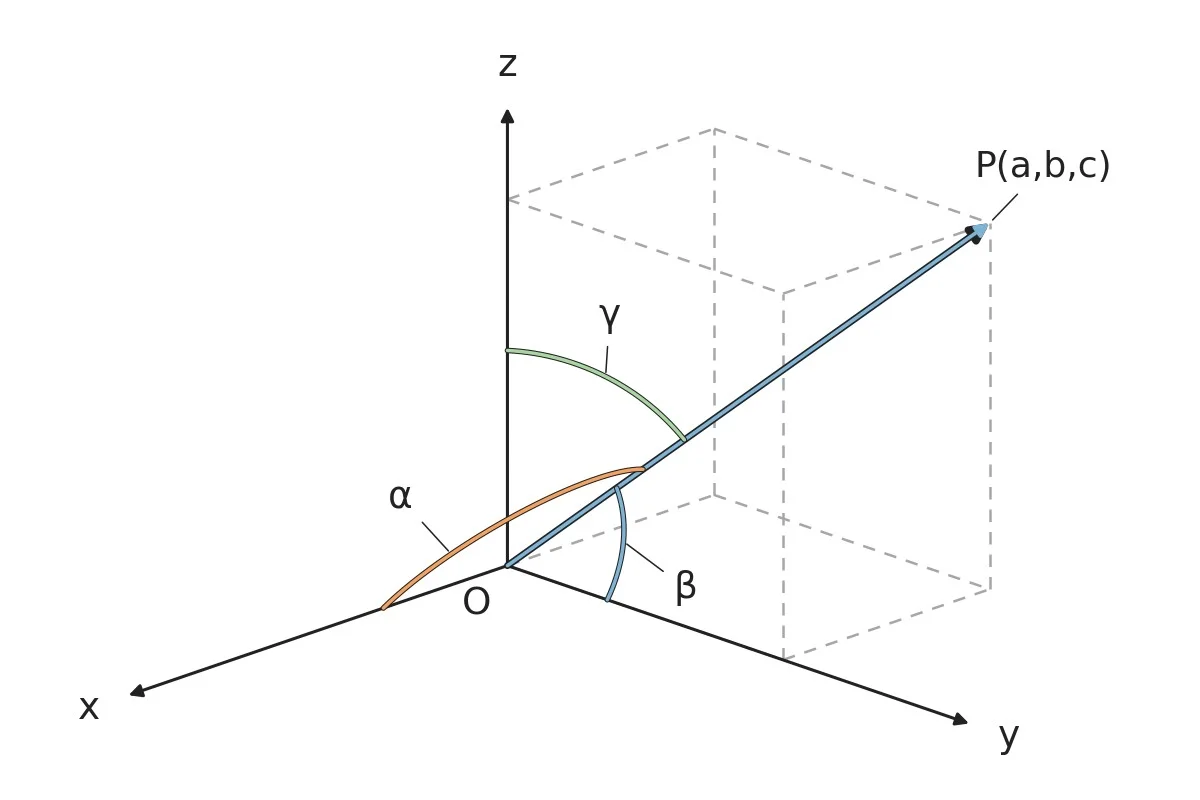
A spatial arrow with coordinate projections and angles to three positive axes.

1. Direction cosines and direction ratios of a line

Direction cosines are direction ratios divided by their vector's length.

Show
Find the arrow, projections and axis angles in the diagram.
Ask
Which axis angle has a negative cosine?
Say
The axis angle corresponding to a negative component has a negative cosine.
Used in
Ramp design uses direction ratios to control steepness.
If your child says…“The direction cosines themselves add to one.”
Ask
Does Pythagoras add the coordinate changes themselves, or their squares?
What’s true
Pythagoras makes the squared cosines total one, rather than the cosines themselves.
r=(1,0,0)+t(1,2,1)\mathbf r=(1,0,0)+t(1,2,1)

(x,y,z)=(1+t,2t,t)(x,y,z)=(1+t,2t,t)

(x−1,y/2,z)=(t,t,t)(x-1,y/2,z)=(t,t,t)

2. Equation of a line through a given point and parallel to a given vector

Start at a point and take multiples of one direction.

Show
Write these lines. Say, “r locates a point, while t scales movement along the direction.”
Ask
Before rearranging, what Cartesian equation do you expect from the shared parameter?
Say
Subtract one from x, halve y, and leave z unchanged. All three equal t.
Used in
Machines use straight paths to move tools along a chosen direction.
If your child says…“The starting point gets multiplied by t.”
Ask
When t is zero, which part must remain to locate the starting point?
What’s true
The parameter multiplies the direction, while the starting point stays fixed.

PQ→=(1,2,2)−(0,0,0)\overrightarrow{PQ}=(1,2,2)-(0,0,0)

PQ→=(1,2,2)\overrightarrow{PQ}=(1,2,2)

r=(0,0,0)+t(1,2,2)\mathbf r=(0,0,0)+t(1,2,2)

3. Equation of a line passing through two given points

Subtract endpoints to find the direction joining them.

Show
Write these lines. Say, “Destination minus start gives the displacement from P to Q.”
Ask
Where will the point move as t increases from zero to one?
Say
From P to Q, x increases by one, while y and z each increase by two. Values of t from zero to one trace the segment.
Used in
Surveyors use two marked points to set a straight boundary.
If your child says…“I add the endpoints to find the direction.”
Ask
Which operation gives the movement that takes the starting point to the destination?
What’s true
Subtracting the starting coordinates from the destination gives the movement between them.

Comparing two lines

cos⁡θ=∣(1,0,0)⋅(1,1,0)∣12\cos\theta=\dfrac{|(1,0,0)\cdot(1,1,0)|}{1\sqrt2}

cos⁡θ=12\cos\theta=\dfrac1{\sqrt2}

θ=cos⁡−1 ⁣(12)\theta=\cos^{-1}\!\left(\dfrac1{\sqrt2}\right)

4. Angle between two lines

The smaller angle depends on directions, not starting points.

Show
Write the equation, then pause before calculating. Call the smaller angle theta. The dot adds products of matching components.
Ask
Before calculating, what smaller angle do you expect between these directions?
Say
The numerator is one. Dividing by the denominator gives the cosine of forty-five degrees.
Used in
Carpenters match angles so sloping roof members fit together.
If your child says…“The dot product alone gives the angle's cosine.”
Ask
Would doubling the direction numbers turn either line?
What’s true
Dividing by both direction lengths removes their scale, and the absolute value selects the smaller angle.
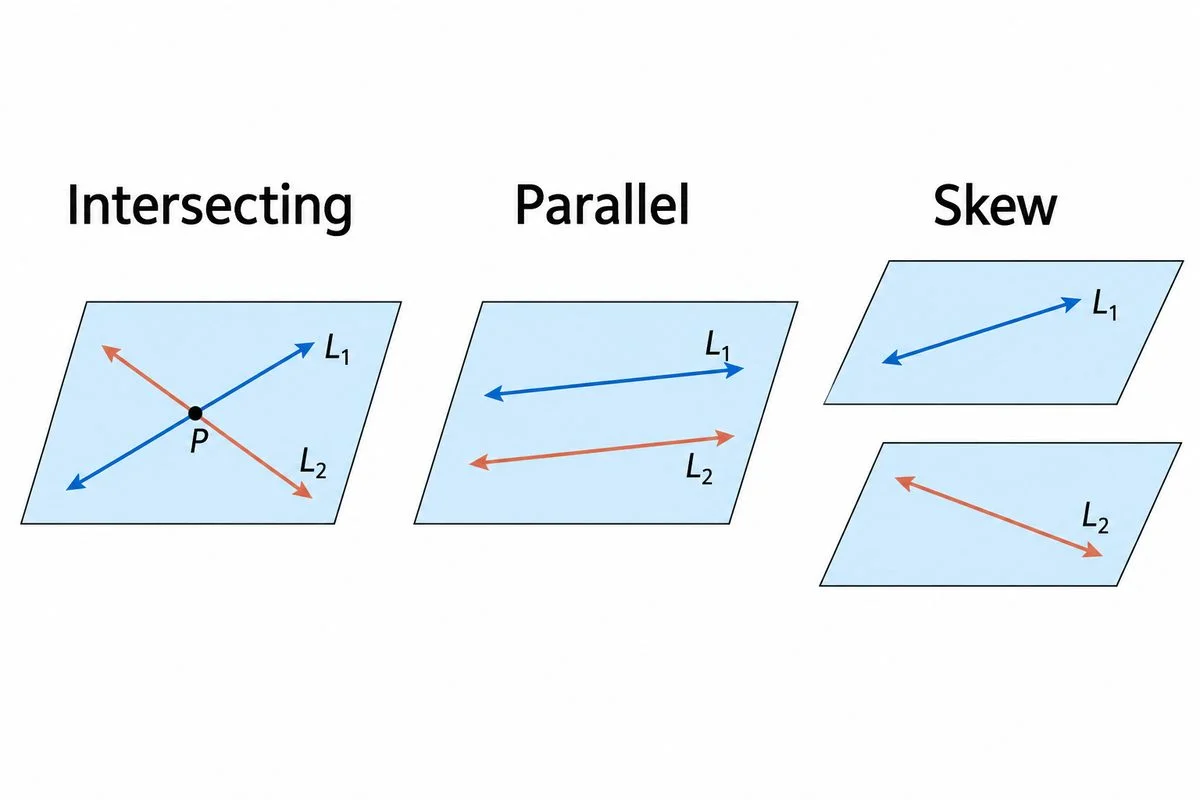
Three pairs of lines show intersection, parallel alignment and skew separation.

5. Intersecting, parallel and skew lines

Lines may meet, be parallel, or be skew.

Show
Look across the diagram's three panels. Find the shared point on the left and matching directions in the middle. Compare the directions and separate planes on the right.
Ask
Must both differently directed pairs meet when extended?
Say
The left pair meets, but the right pair is skew. No single plane contains both skew lines, so extending them cannot make them meet.
Used in
Road crossings at different heights let traffic pass without a junction.
If your child says…“If two lines aren't parallel, they must meet.”
Ask
How could extending either right-hand line take it out of its own plane?
What’s true
In space, nonparallel lines can be skew, with no shared point or shared plane.
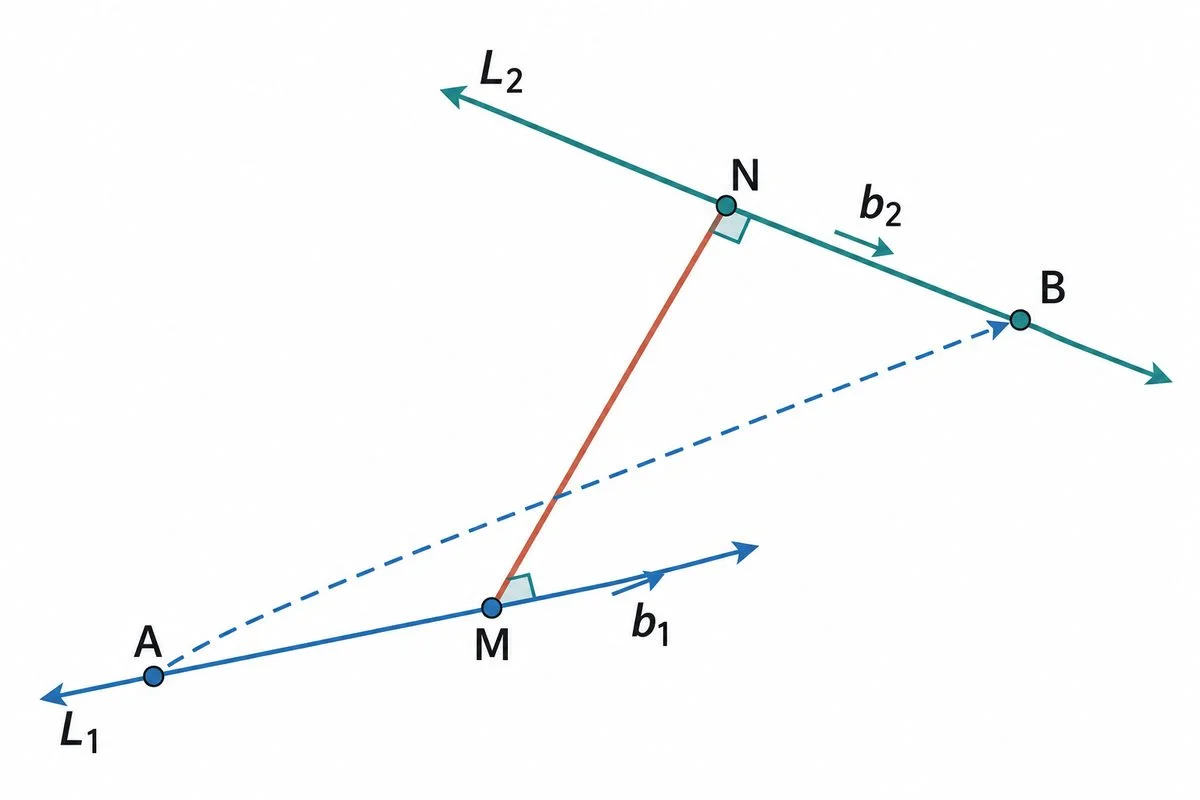
Skew lines joined by a common perpendicular and a longer oblique connector.

6. Shortest distance between two lines

The shortest connector is perpendicular to both lines.

Show
Find AB and MN in the diagram. Call the directions' cross product n and distance d.
Ask
Which part of AB measures the gap?
Say
The cross product is perpendicular to both directions. Projecting AB gives d=∣AB→⋅n∣∣n∣d=\frac{|\overrightarrow{AB}\cdot\mathbf n|}{|\mathbf n|}.
Used in
Pipe layouts use shortest separation to leave room between pipes.
If your child says…“Any two chosen points give the distance between the lines.”
Ask
Does AB cross both lines at right angles, as MN does?
What’s true
For skew or parallel lines, the shortest connector must meet both lines at right angles.

Finding feet and images

M=(0,t,0)M=(0,t,0)

(1,2−t,2)⋅(0,1,0)=0(1,2-t,2)\cdot(0,1,0)=0

2−t=02-t=0

7. Foot of the perpendicular and perpendicular distance

The foot is the nearest point; distance measures the gap.

Show
Write these lines for P at (1,2,2)(1,2,2). Say, “M lies on the y-axis.”
Ask
Which coordinate will the foot retain?
Say
The foot is (0,2,0)(0,2,0) because the joining segment is perpendicular. Its length is 5\sqrt5 by Pythagoras.
Used in
Surveyors measure perpendicular offsets to locate objects beside a straight boundary.
If your child says…“I square all three coordinates to find the distance from an axis.”
Ask
Does the y-coordinate change between P and its foot?
What’s true
The nearest axis point keeps the along-axis coordinate, so only the other coordinates contribute.
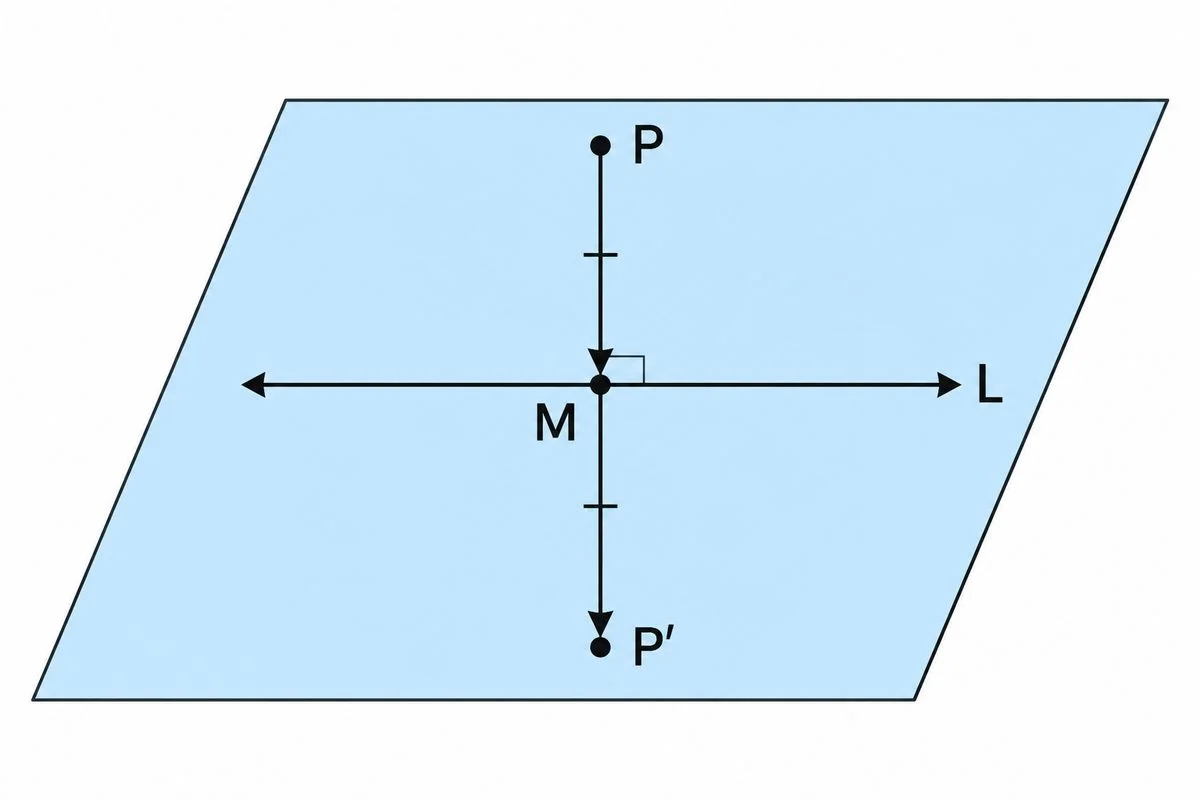
A point and its image lie equally far beyond their perpendicular foot.

8. Image of a point in a line

The image lies equally far beyond the perpendicular foot.

Show
Find P, line L and perpendicular foot M in the diagram.
Ask
Where must P′ lie for M to be halfway?
Say
Continue equally far beyond M. Double the foot's coordinates and subtract the original coordinates: P′=2M−PP'=2M-P.
Used in
Symmetric designs place matching features equally far from a centre line.
If your child says…“The nearest point on the mirror line is the image.”
Ask
If the image stopped at M, would M be halfway between the two points?
What’s true
The foot lies halfway between the original point and its image.

A real problem

Intersecting viewing lines helped reconstruct terrain.

Cartosat-1 launched on 5 May 2005.

Its stereo images supported large-scale mapping and terrain modelling.

Researchers matched stereo images and used spatial intersection to reconstruct surface models.

German Aerospace CenterWikipediaISRO

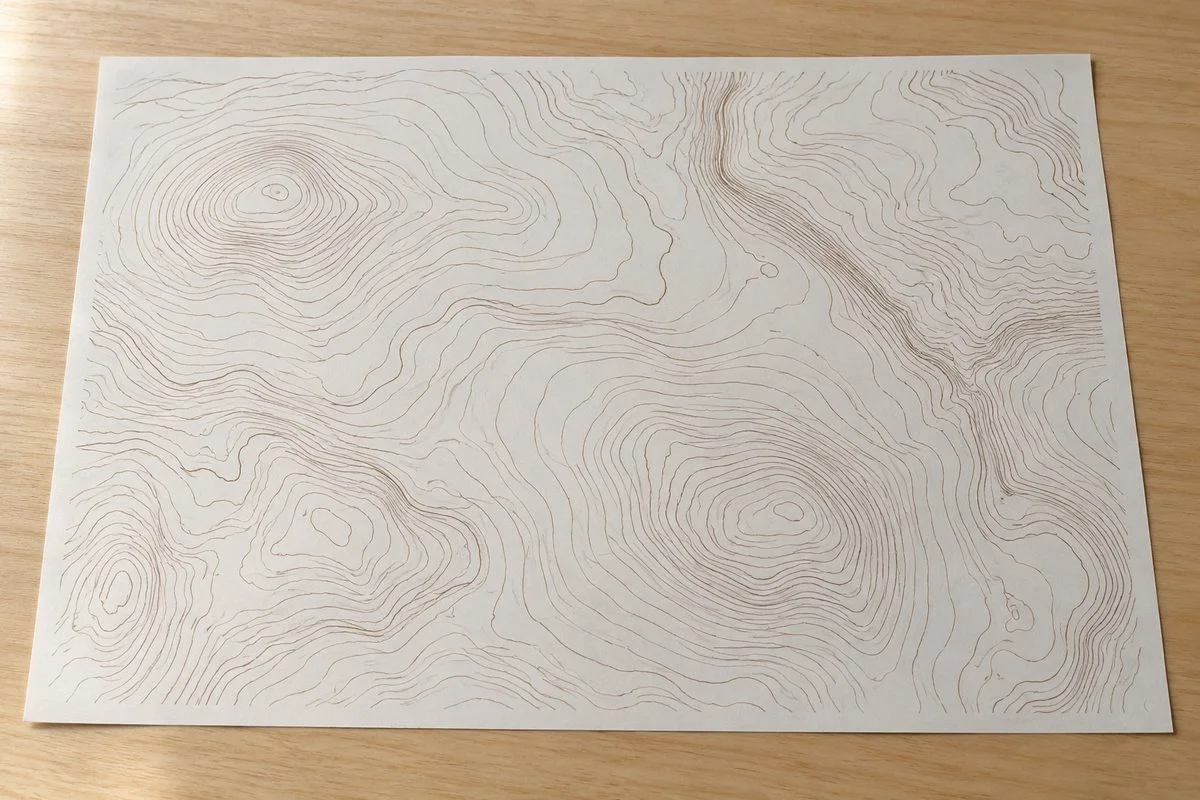
Printed contour map of hilly terrain spread across a classroom desk.

Concept Lab · Common misconception

The tempting mistake in Three Dimensional Geometry

Open standalone misconception page →

Must nonparallel lines meet in space?

Wrong

Two nonparallel lines always intersect.

Why it feels right. That works for two full lines in a plane.

Right

In three dimensions, nonparallel lines can be skew.

Worked example

The lines run in different directions and stay at different z-levels. No point can be on both.
  1. One line is (t,0,0) in direction (1,0,0).
  2. The other is (0,s,1) in direction (0,1,0).
  3. Their directions differ, and their z-coordinates stay 0 and 1 respectively, so the lines never meet.

Ask your child eight quick questions.

One per step. The answer and the reason are given.

  1. What must you do to direction ratios before calling them direction cosines?

    Divide by their vector's length. Direction cosines describe a unit direction, so their squares total one.

  2. Which point does this equation give when t is zero?

    (1,0,0)(1,0,0). Zero movement leaves the starting point unchanged.

  3. What happens to the direction numbers when you reverse the endpoints?

    All three signs reverse. Reversing subtraction reverses the movement along the same line.

  4. What happens to this angle if both direction vectors double?

    It stays 45∘45^\circ. Doubling the vectors changes their lengths, not their alignment.

  5. Which pair has different directions but no shared point, even when extended?

    The skew pair. Different directions do not guarantee a shared point in space.

  6. Which connector gives the shortest distance between these lines?

    MN. It is perpendicular to both lines, so it excludes movement along either line.

  7. What is P's distance from the y-axis?

    5\sqrt5. Only the x- and z-coordinate changes contribute to this perpendicular distance.

  8. How does the point-to-image distance compare with the point-to-foot distance?

    It is twice as long. The foot is halfway between the point and its image.

15 more questions with answers