Skip to content

Teach Application of Derivatives in eight steps.

For each idea: show it, ask before you tell, then say one line.

Gather paper and a pencil.

Common misconceptions & worked visual for this chapter · 15 practice questions with answers

How to teach it

Rates and direction of change

A=πr2A=\pi r^2

dAdr=2πr\frac{dA}{dr}=2\pi r

dAdr∣r=1=2π×1\left.\frac{dA}{dr}\right|_{r=1}=2\pi\times1

1. Rate of Change of Quantities

A derivative measures how quickly one quantity changes against another.

Show
Write these lines for a ripple. Name area A, radius r, and the circle constant pi.
Ask
At radius 1 cm, how quickly do you predict area changes with radius at that instant?
Say
The rate is two pi square centimetres per centimetre.
Used in
Water-level rates help estimate when a tank will overflow.
If your child says…“I'll put the radius in first, then differentiate.”
Ask
Does replacing the changing radius with one number preserve how the area changes?
What’s true
Differentiate before inserting the current radius; a shrinking radius has a negative time rate.
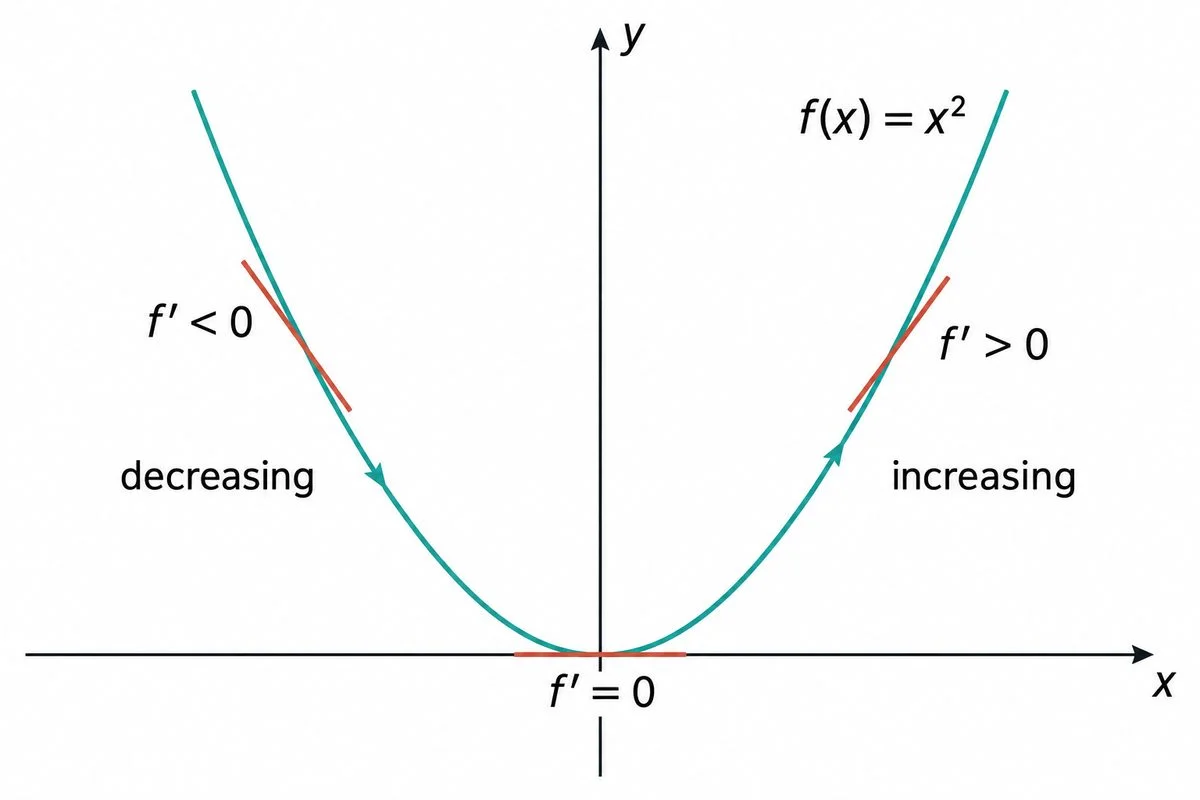
Parabola with tangents showing negative, zero and positive slopes from left to right.

2. Increasing and Decreasing Functions

Slope signs show where outputs rise or fall as inputs increase.

Show
Follow the diagram's parabola left to right. Call f prime the slope.
Ask
Where do these slopes predict falling and rising outputs?
Say
Negative slopes mean falling outputs; positive slopes mean rising outputs. Check intervals separately wherever the domain has gaps.
Used in
Sales trends show when demand rises, helping shops plan stock.
If your child says…“The square is positive, so the function increases.”
Ask
As a negative input approaches zero, does its square grow or shrink?
What’s true
Direction depends on the slope, not whether the output is positive.
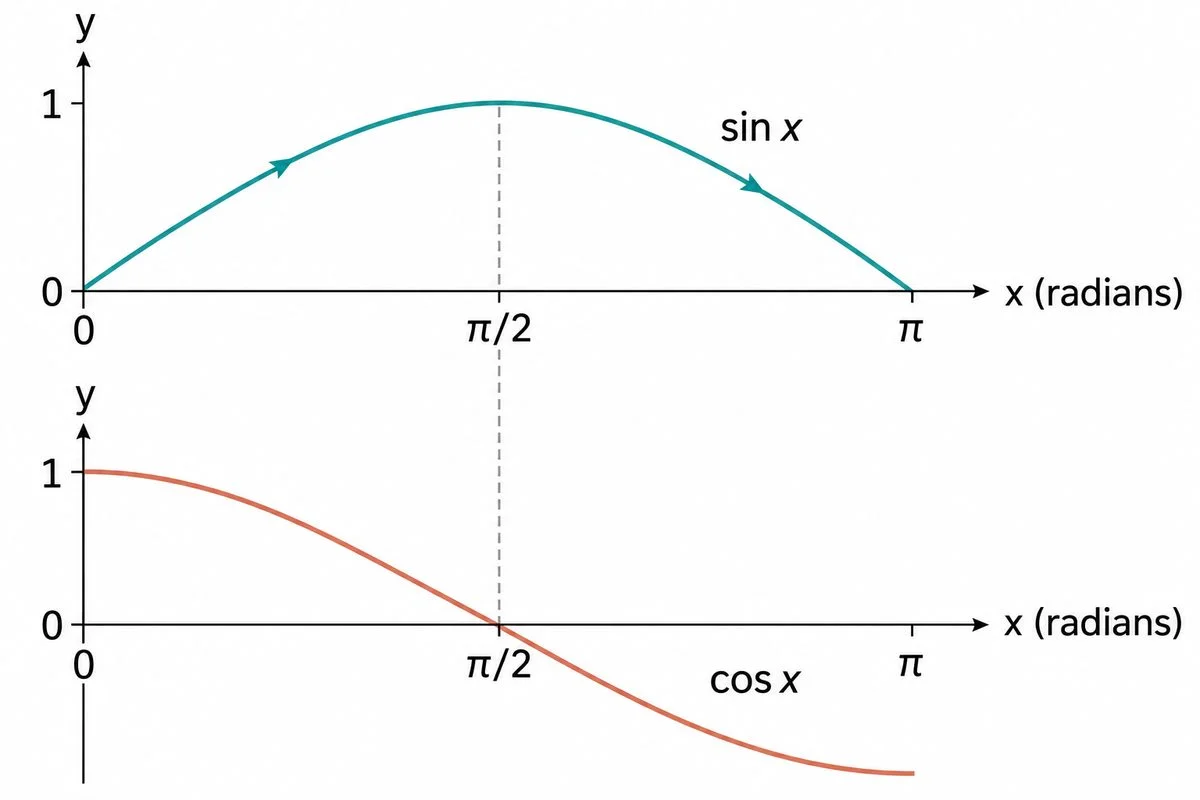
Aligned sine and cosine graphs connect sine's peak with cosine's change of sign.

3. Increasing and Decreasing Functions

Check slope signs throughout the allowed interval, including any parameter's effect.

Show
Look at the diagram, with angles in radians. Follow cosine below from zero to pi. Follow the dashed guide up to sine.
Ask
Where does cosine's sign predict that sine will change from rising to falling?
Say
Sine turns at π2\frac{\pi}{2} because its derivative, cosine, changes from positive to negative. Cosine controls the direction here.
Used in
Calculations for a swing predict when its direction reverses.
If your child says…“Sine and cosine stay positive throughout any interval.”
Ask
Where does the cosine curve lie below its horizontal axis?
What’s true
Cosine becomes negative after half pi within this interval.

Finding greatest and least values

f(x)=x2+1f(x)=x^2+1

f(x)−1=x2f(x)-1=x^2

f(0)=02+1f(0)=0^2+1

4. Maxima and Minima

Greatest and least outputs must actually occur within the domain.

Show
Write these lines for x squared plus one, allowing every real input. Say: A square cannot be negative.
Ask
Before evaluating, what do you predict the smallest output will be?
Say
The minimum value is 1, reached at input zero. There is no maximum because squares grow without bound.
Used in
Capacity limits tell packers how much a container can hold.
If your child says…“The minimum value is zero because x is zero.”
Ask
Which number does the function produce when you put zero in?
What’s true
The input locates the minimum; the output gives its value.
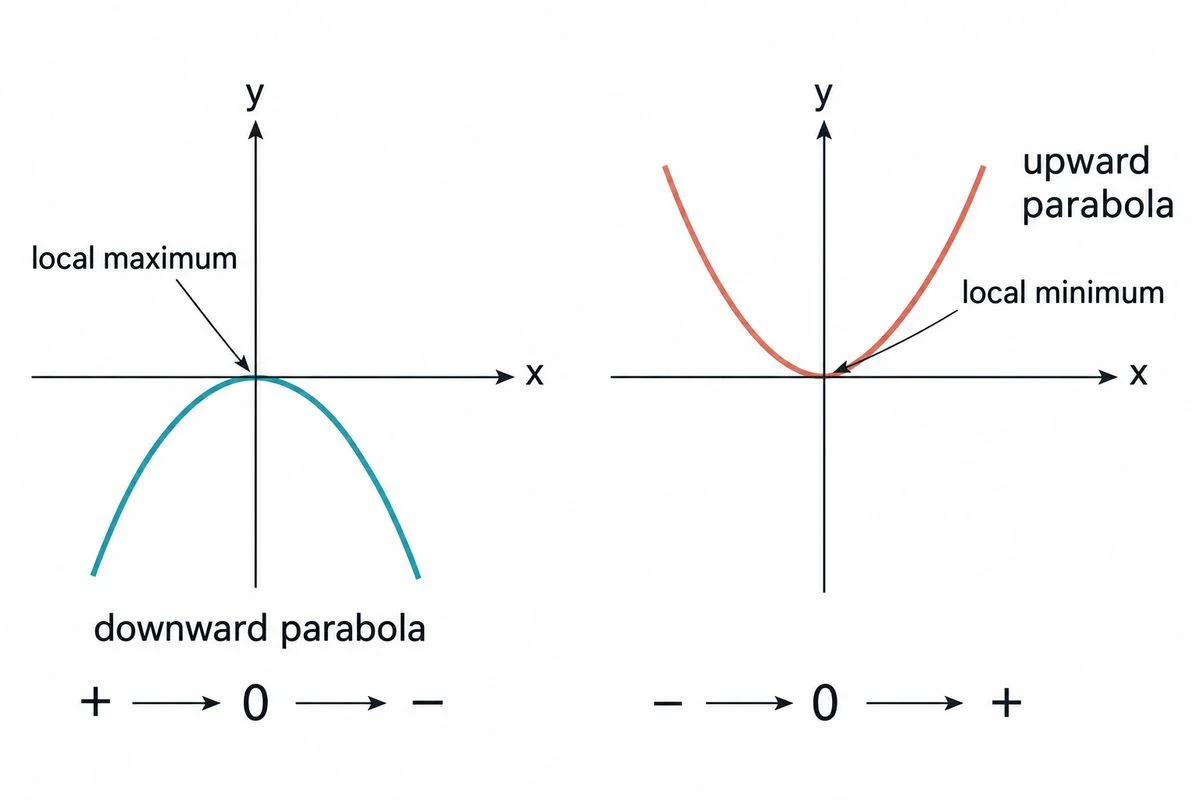
Two parabolas show opposite derivative sign changes at a local maximum and minimum.

5. Local Maxima and Minima; First Derivative Test

Nearby slope changes distinguish local peaks from local dips.

Show
Read the diagram's slope signs left to right beneath each curve.
Ask
Which curve has a local maximum at zero?
Say
Rising then falling gives the left curve a local maximum. Falling then rising gives the right curve a local minimum.
Used in
Road profiles locate nearby crests and dips, helping plan drainage.
If your child says…“Every zero slope must give a maximum or minimum.”
Ask
What do the slopes on either side tell us that zero alone cannot?
What’s true
A zero slope alone does not establish either kind of extremum.

f(x)=(x−1)2f(x)=(x-1)^2

f′(x)=2(x−1)f'(x)=2(x-1)

f′′(1)=2f''(1)=2

f(1)=(1−1)2f(1)=(1-1)^2

6. Second Derivative Test

At zero slope, slope change can identify a peak or dip.

Show
Write these lines. Name f double prime the second derivative: it measures how slope changes. Point out that the first derivative vanishes at input 1.
Ask
Before evaluating, what minimum output do you predict?
Say
The minimum is zero: the positive second derivative shows the slope rising through zero.
Used in
Cost models use minimum tests to identify cheaper production levels.
If your child says…“A zero second derivative means there cannot be a minimum.”
Ask
If slopes still change from negative to positive, what does that show?
What’s true
A zero second derivative leaves this test undecided.

f′(x)=3x2f'(x)=3x^2

f(−1)=−1f(-1)=-1

f(0)=0f(0)=0

f(1)=1f(1)=1

7. Maximum and Minimum Values of a Function in a Closed Interval

Compare all critical-point outputs and both endpoint outputs.

Show
Write the derivative first for x cubed, from −1 to 1, including both endpoints. After the prediction, write and compare the candidate outputs.
Ask
Before evaluating the candidates, where do you predict the greatest and least outputs occur?
Say
The minimum is −1 and the maximum is 1; both occur at endpoints.
Used in
Checking a day's full temperature record finds its hottest and coldest readings.
If your child says…“Only the zero-slope point needs checking.”
Ask
Which listed outputs are smaller or larger than the output at zero?
What’s true
An endpoint can beat every interior critical point.

Choosing the best dimensions

y=12−xy=12-x

A(x)=x(12−x)A(x)=x(12-x)

A′(x)=12−2xA'(x)=12-2x

A′(x)=0 ⇒ x=6A'(x)=0\ \Rightarrow\ x=6

8. Simple Problems on Maxima and Minima

Keep the constraint, then find and verify the best allowed value.

Show
Write these lines for rectangle sides x and y, perimeter 24 cm, and area A.
Ask
What greatest area do these lines predict?
Say
The 6 cm square gives 36 square centimetres. Across allowed sides, the derivative changes from positive to negative at 6, proving the maximum.
Used in
Package designers maximise capacity within material limits, reducing waste.
If your child says…“Both sides can keep growing while the boundary stays fixed.”
Ask
If both sides grew, what would happen to their fixed sum?
What’s true
With a fixed perimeter, lengthening one side forces the other to shorten.

A real problem

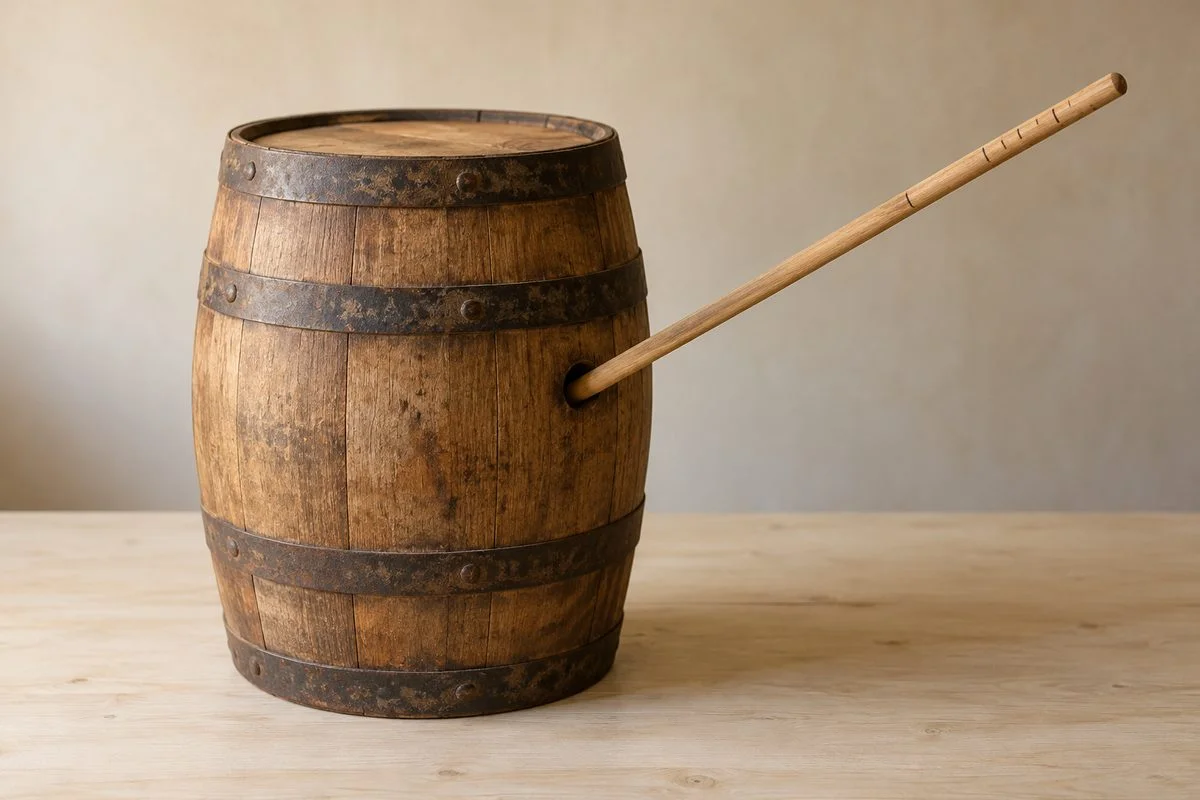
Kepler studied how to measure wine barrels.

His 1615 work examined wine-barrel measurement.

The work was called Stereometria Doliorum.

His work confirmed that a simple measuring rod worked for Austrian wine casks.

University of St AndrewsDictionary of Scientific Biography, hosted by St Andrews

Wooden barrel with a measuring rod inserted through its side opening.

Concept Lab · Common misconception

The tempting mistake in Application of Derivatives

Open standalone misconception page →

Does a zero derivative guarantee a maximum or minimum?

Wrong

Every point where f′(x) = 0 is a turning point.

Why it feels right. Smooth maxima and minima often have horizontal tangents.

Right

A stationary point can have a horizontal tangent while the function keeps increasing through it.

Worked example

The curve flattens at zero but rises on both sides. There is no local maximum or minimum there.
  1. For f(x) = x³, f′(0) = 0.
  2. Values go from −1 at x = −1 to 0 to 1 at x = 1, and the function increases throughout.

Ask your child eight quick questions.

One per step. The answer and the reason are given.

  1. Why would differentiating the substituted area give zero?

    You made it constant. Substitution first removes the variable whose change you need.

  2. For negative inputs moving towards zero, what happens to the positive squared outputs?

    They decrease. The derivative is negative throughout that interval.

  3. Sine rises near zero; what does it do between π2\frac{\pi}{2} and π\pi?

    It decreases. Its derivative, cosine, is negative throughout that part of the interval.

  4. Here, what does zero identify: the minimum output or its input?

    Its input. Putting zero into the function gives output 1.

  5. If slopes stay positive on both sides of a zero slope, which extremum occurs?

    Neither. The function keeps rising instead of changing direction.

  6. When both derivatives vanish, which first-derivative sign change would prove a local minimum?

    Negative to positive. The function falls before the point and rises after it.

  7. Which inputs supply both absolute extremes in this example?

    The endpoints, −1 and 1. Their outputs lie below and above the interior candidate's output.

  8. With this boundary fixed, what must happen to the width when the length increases?

    The width must decrease. The fixed perimeter links the two dimensions.

15 more questions with answers, 1 with pictures