Skip to content

Teach Vector Algebra in eight steps.

For each idea: show it, ask before you tell, then say one line.

Gather centimetre-squared paper, plain paper, a pencil and a ruler.

Common misconceptions & worked visual for this chapter · 15 practice questions with answers

How to teach it

Describe and combine displacements

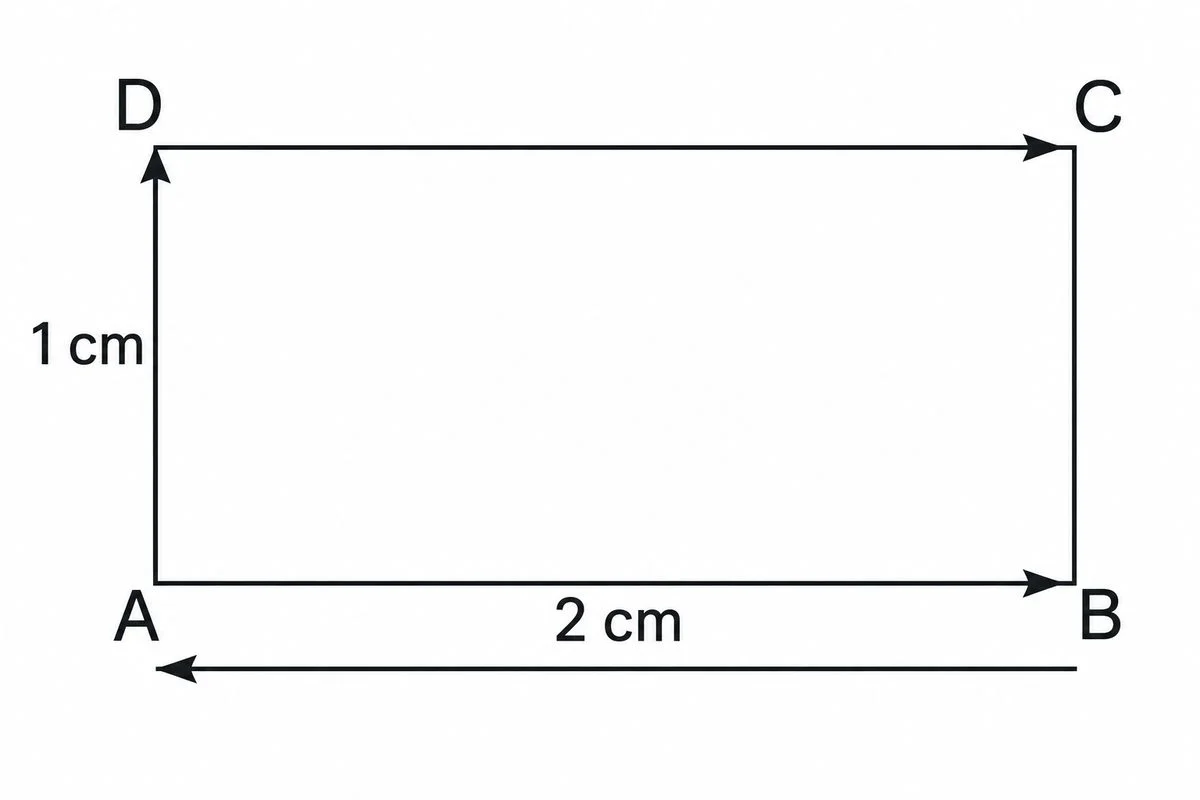
Rectangle with matching rightward arrows, an opposite leftward arrow and an upward unit-length side.

1. Scalars and vectors; types of vectors

Vectors give size and direction; scalars give size.

Show
In the rectangle diagram, compare AB and DC for length and direction. Then compare AB with BA.
Ask
Will AB and DC give equal displacements?
Say
They match; BA reverses AB.
Used in
Navigation uses displacement to locate destinations.
If your child says…“Equal vectors must start at the same place.”
Ask
Does starting higher change how far or which way DC goes?
What’s true
Equal vectors can start apart when their lengths and directions match.
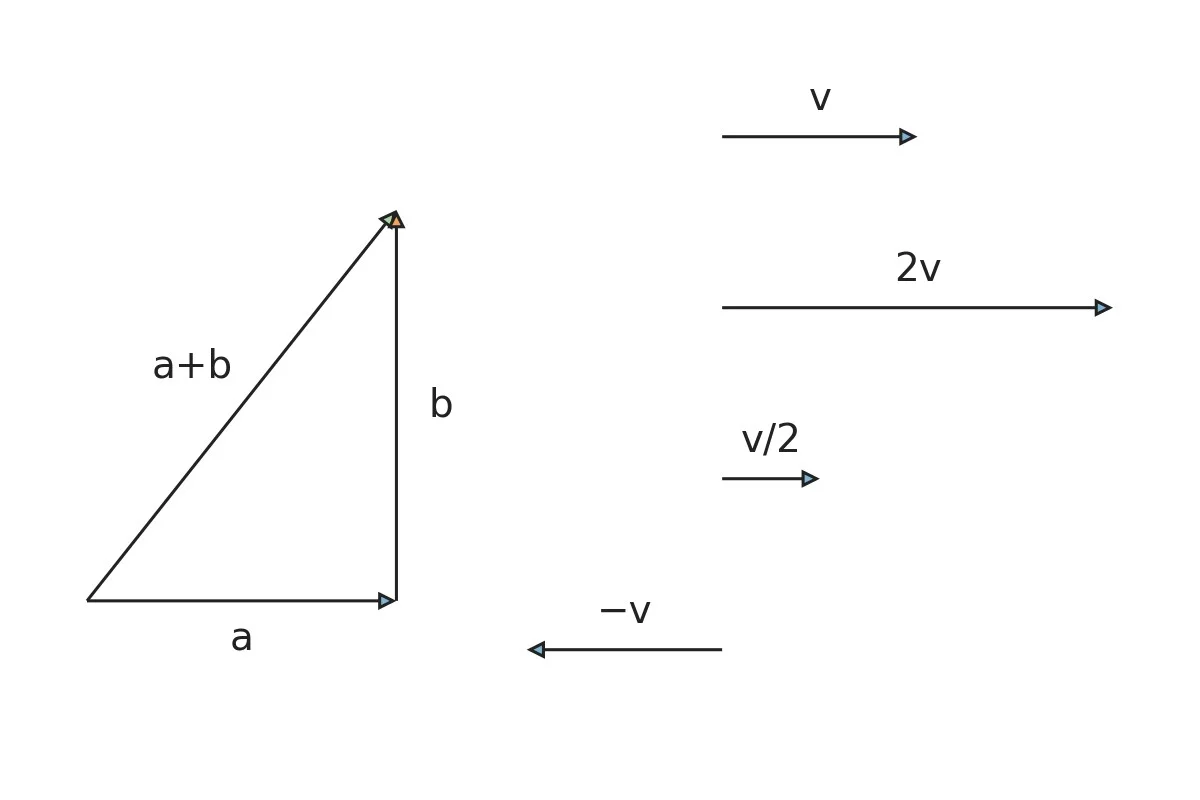
Joined arrows and their diagonal beside arrows showing positive and negative scaling.

2. Addition of vectors and multiplication of a vector by a scalar

Combine directed moves; stretch, shrink or reverse them.

Show
Follow the diagram's joined arrows. Compare the scaled arrows on the right.
Ask
Which single arrow replaces both moves?
Say
The diagonal gives their sum. Multipliers scale length.
Used in
Aircraft navigation combines wind and aircraft velocities to calculate ground motion.
If your child says…“I always add the lengths to get the resultant's length.”
Ask
Is the diagonal as long as the route along both joined arrows?
What’s true
Adding lengths gives the resultant's length only when nonzero moves point the same way.

v=(4−1)i^+(5−1)j^\mathbf v=(4-1)\hat{\mathbf i}+(5-1)\hat{\mathbf j}

v=3i^+4j^\mathbf v=3\hat{\mathbf i}+4\hat{\mathbf j}

∣v∣=32+42=5|\mathbf v|=\sqrt{3^2+4^2}=5

3. Components, magnitude and unit vector

Components give directed changes; unit vectors have length one.

Show
Write these lines for P(1,1) and Q(4,5). Name v as PQ, and i-hat and j-hat as horizontal and vertical unit vectors.
Ask
Using this length, what unit vector will point from P towards Q?
Say
Divide both components by five to keep the direction and make the length one. This gives v^=35i^+45j^\hat{\mathbf v}=\frac35\hat{\mathbf i}+\frac45\hat{\mathbf j}.
Used in
Robots use coordinate changes to reach chosen positions.
If your child says…“Multiplying PQ by 2 gives a vector of length 2.”
Ask
If PQ has length five, what length would doubling it give?
What’s true
First divide by the original length, then multiply by the required length.

PR→=13PQ→\overrightarrow{PR}=\frac13\overrightarrow{PQ}

r−i^=13(4i^−i^)\mathbf r-\hat{\mathbf i}=\frac13(4\hat{\mathbf i}-\hat{\mathbf i})

r−i^=i^\mathbf r-\hat{\mathbf i}=\hat{\mathbf i}

r=(1+1)i^\mathbf r=(1+1)\hat{\mathbf i}

4. Section formula

Locate a point using a segment's division ratio.

Show
Write these lines. Say: P is one unit rightwards; Q is four. R lies between P and Q, with PR:RQ equal to 1:2. Name i-hat as one unit rightwards and r as R's position vector.
Ask
Starting at P, where will moving one-third of the way towards Q place R?
Say
Adding the start gives r=2i^\mathbf r=2\hat{\mathbf i}.
Used in
Computer graphics uses endpoint weights to position points.
If your child says…“A ratio of 1:2 puts R nearer Q.”
Ask
Which part takes one share, and which takes two?
What’s true
PR is the shorter part, so R lies nearer P.

Measure alignment and projection

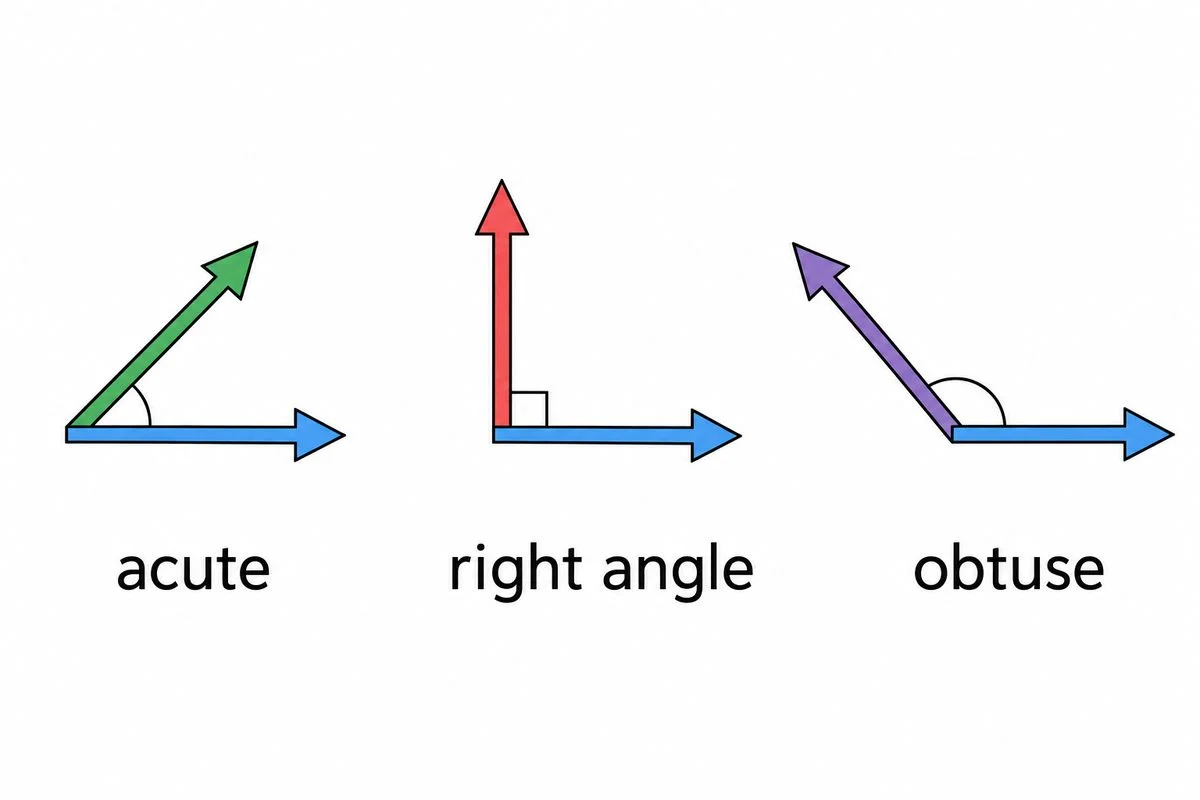
Equal-length arrow pairs make acute, right and obtuse angles.

5. Scalar product of two vectors

A number measuring alignment.

Show
Look across the diagram from acute to right to obtuse angles. Compare the unchanged arrow lengths.
Ask
How will the dot product's sign change as the angle widens?
Say
Acute angles give positive results, right angles zero, and obtuse angles negative.
Used in
Work calculations count force along displacement using dot products.
If your child says…“A zero dot product means one vector must be zero.”
Ask
In the middle diagram, does either arrow have zero length?
What’s true
Nonzero vectors at right angles also give a zero dot product.
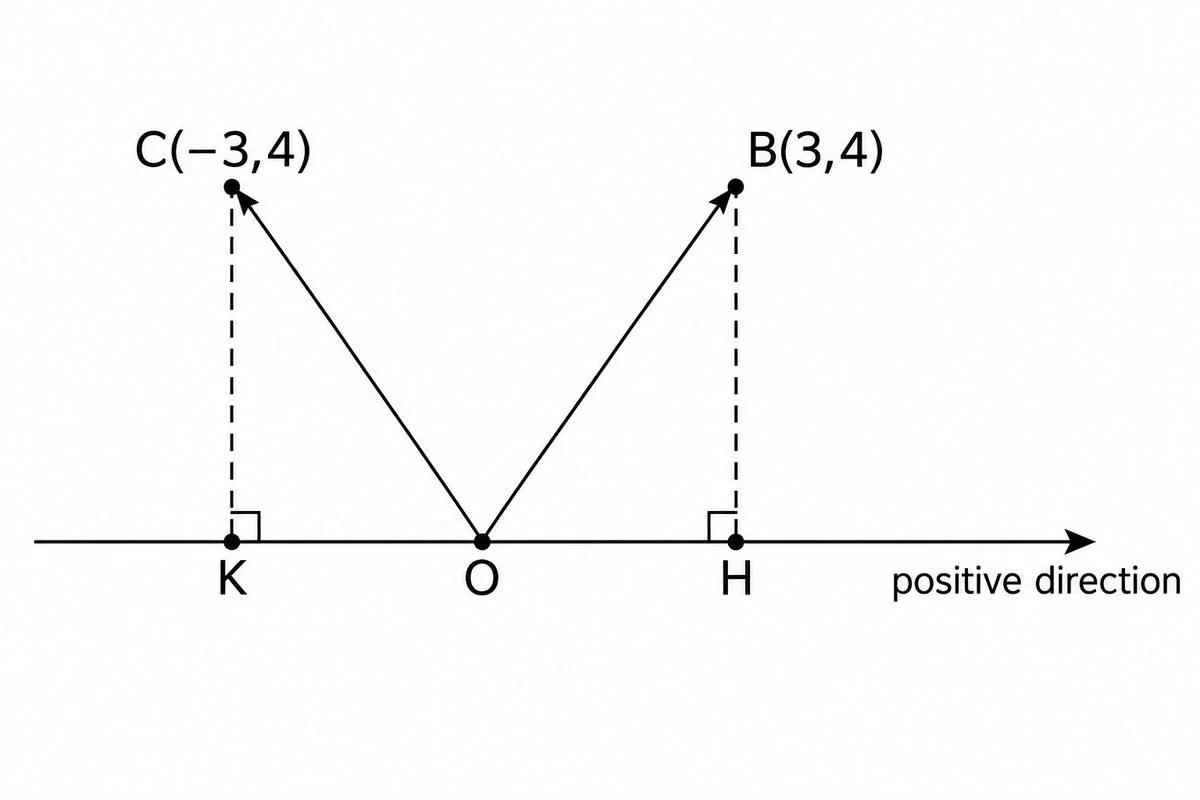
Two sloping arrows project onto opposite sides of a rightward horizontal axis.

6. Projection of a vector on a line

Signed progress along a chosen direction.

Show
Look at the diagram's rightward positive direction. Follow OB and OC down their perpendiculars to H and K.
Ask
What signed horizontal components will the two sloping arrows give?
Say
OB gives plus three, and OC gives minus three.
Used in
Resolving suitcase pulls identifies the useful horizontal force.
If your child says…“The horizontal projection is the whole sloping length.”
Ask
Does moving upwards add anything to the horizontal distance?
What’s true
Projection onto the positive horizontal axis gives the horizontal component.

Find perpendicular directions and areas

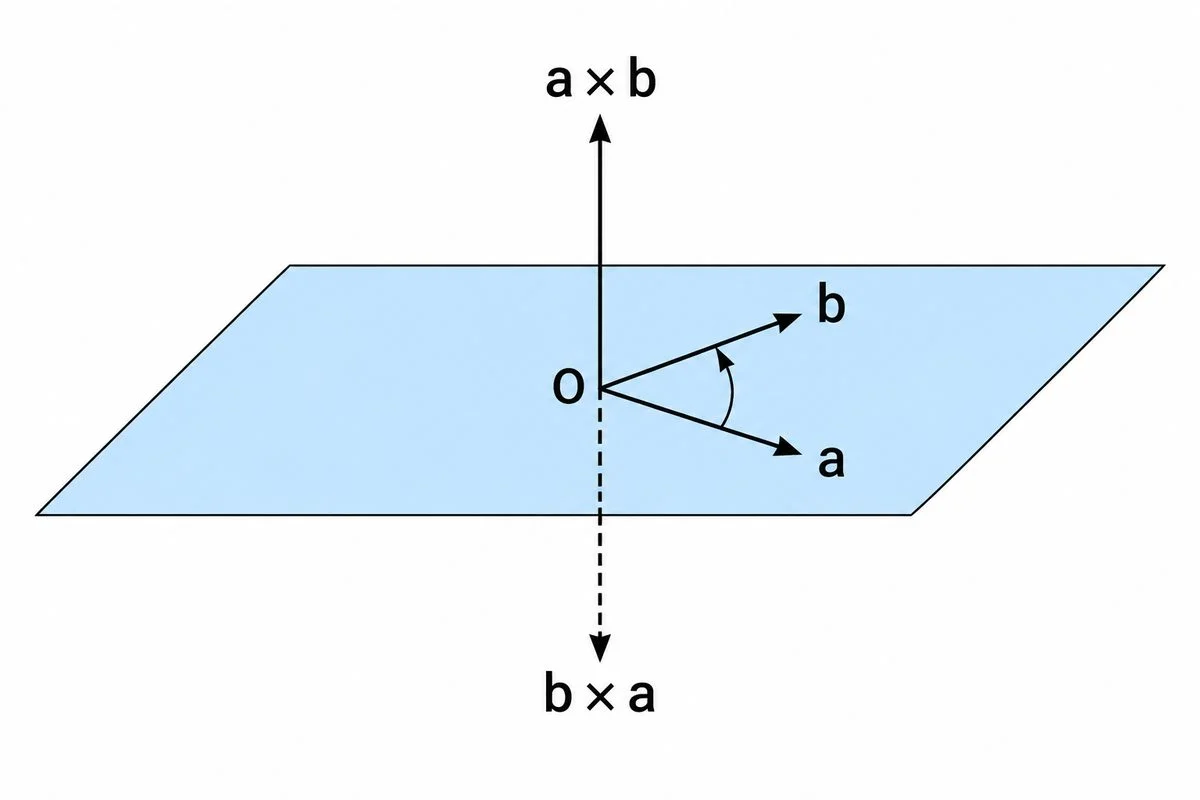
Two arrows in a plane have oppositely directed cross products perpendicular to that plane.

7. Vector product of two vectors

A perpendicular vector; order sets its direction.

Show
Look at vectors a and b in the diagram's plane. Curl your right-hand fingers from a towards b through the smaller angle. Follow your thumb's direction.
Ask
Which perpendicular direction will the product take if b comes first?
Say
The product reverses direction because the finger curl reverses.
Used in
Torque calculations predict a force's turning effect on doors.
If your child says…“Swapping the vectors leaves the cross product unchanged.”
Ask
Where does the right-hand thumb point when the finger curl reverses?
What’s true
Swapping nonparallel vectors reverses their cross product's direction without changing its length.
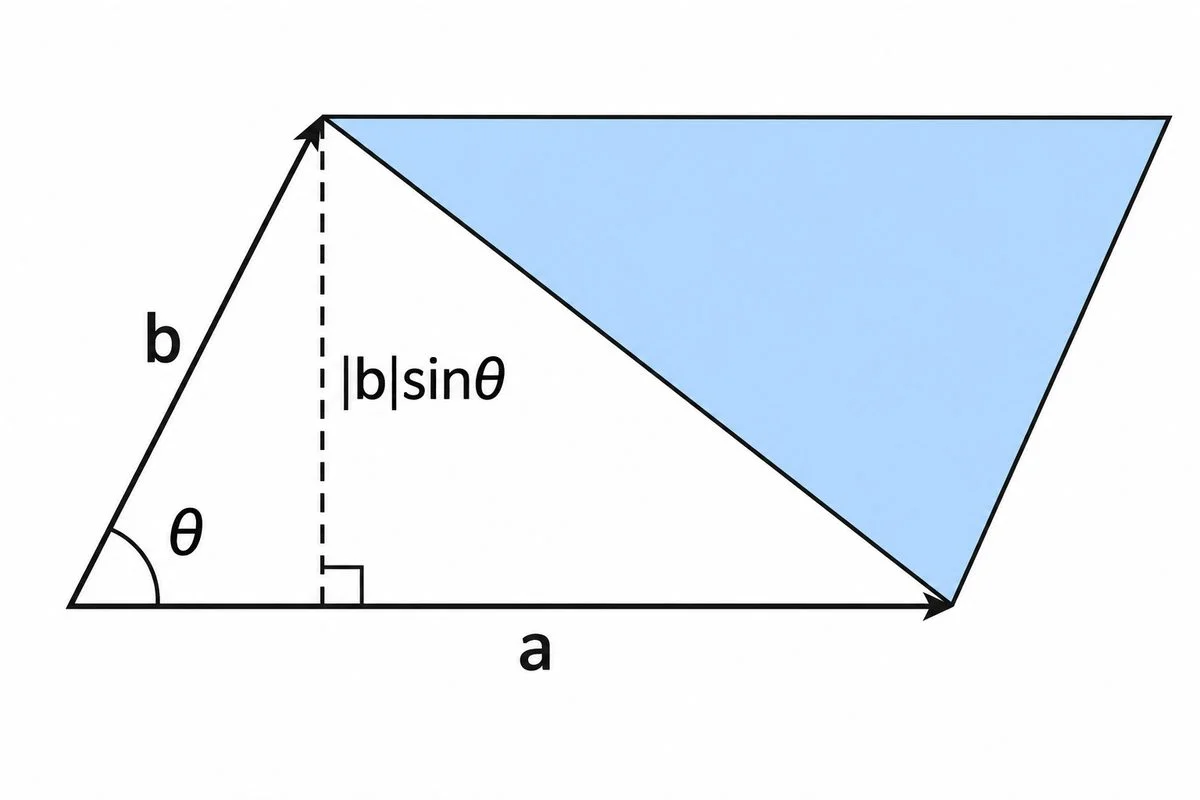
Parallelogram showing perpendicular height and a diagonal dividing it into two equal-area triangles.

8. Area using vector product

Cross-product length gives parallelogram area; triangles take half.

Show
Find the diagram's base, perpendicular height and diagonal. Theta names the angle; bars mean length.
Ask
What fraction of the area is shaded?
Say
Half the area is shaded, because the diagonal bisects the area.
Used in
Surveyors calculate triangular land areas from corner coordinates.
If your child says…“The triangle's area is the whole cross-product length.”
Ask
Does the shaded triangle fill the whole parallelogram?
What’s true
The cross product's length gives the area filled by both triangles together.

A real problem

Gravity assists helped Voyager reach the outer planets.

The Voyager spacecraft launched in 1977.

Gravity assists helped them reach the outer planets.

Adding velocity vectors explains the spacecraft's speed boost relative to the Sun.

A planetary flyby can accelerate a spacecraft without firing its thrusters.

WikipediaNASAESA

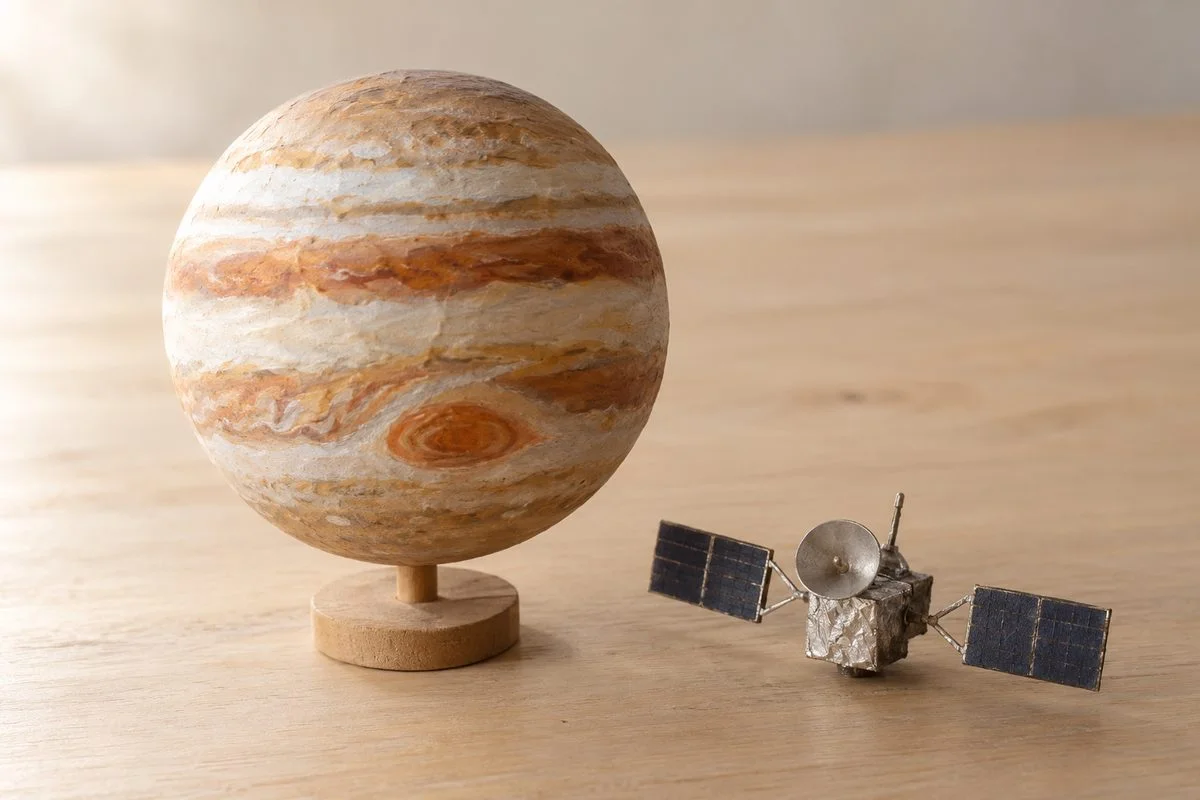
Miniature spacecraft beside a planet in a classroom solar-system model.

Concept Lab · Common misconception

The tempting mistake in Vector Algebra

Open standalone misconception page →

Does a zero dot product mean a vector is zero?

Wrong

If two vectors have dot product 0, at least one has length 0.

Why it feels right. A zero product of two ordinary numbers has that property.

Right

The dot product depends on direction as well as length.

Worked example

Each unit vector is nonzero. Their perpendicular directions make the dot product zero.
  1. The unit vectors (1,0) and (0,1) have dot product 1×0 + 0×1 = 0.
  2. Both have length 1 and they meet at 90°.

Ask your child eight quick questions.

One per step. The answer and the reason are given.

  1. Are AB and BA equal displacements?

    No. Their lengths match, but their directions are opposite.

  2. What is the resultant's length for perpendicular moves of 2 cm each?

    222\sqrt{2} cm. Pythagoras gives the diagonal's length, which is less than 4 cm.

  3. What factor gives PQ length 2 without changing its direction?

    25\frac25. Dividing by five gives unit length, then multiplying by two gives length two.

  4. Which endpoint lies nearer R in this division?

    P. PR takes one share, while RQ takes two.

  5. Two nonzero vectors have zero dot product. What angle lies between them?

    90 degrees. Their dot product is zero because they are perpendicular.

  6. What is OC's scalar projection onto the positive horizontal axis?

    −3. Its horizontal component points left, opposite to the chosen positive direction.

  7. What changes when two nonparallel vectors exchange places in a cross product?

    The product's direction reverses. Reversing the order reverses the cross product's direction.

  8. What is one triangle's area when the parallelogram covers 8 square centimetres?

    4 square centimetres. The diagonal divides the parallelogram into two triangles of equal area.

15 more questions with answers