Skip to content

Teach Determinants in eight steps.

For each idea: show it, ask before you tell, then say one line.

Gather paper and a pencil.

Common misconceptions & worked visual for this chapter · 15 practice questions with answers

How to teach it

Determinants and area

D=∣1211∣D=\begin{vmatrix}1&2\\1&1\end{vmatrix}

D=1×1−2×1D=1\times1-2\times1

D=1−2D=1-2

1. Determinants of order 2

A square array gives one number through a subtraction.

Show
Write these lines. Call the determinant D. Trace each diagonal while writing its product.
Ask
What number comes next?
Say
The answer is −1: subtract the second product from the first.
Used in
Graphics calculations use determinants to detect shapes flattened into lines.
If your child says…“The bars mean the answer must be positive.”
Ask
What does subtracting 2 from 1 give?
What’s true
Determinant bars allow negative values; they do not mean absolute value.
D=∣110011101∣D=\begin{vmatrix}1&1&0\\0&1&1\\1&0&1\end{vmatrix}

D=1(1×1−1×0)−1(0×1−1×1)D=1(1\times1-1\times0)-1(0\times1-1\times1)

D=1−(−1)D=1-(-1)

2. Determinants of order 3

Expand one row or column into smaller, signed determinants.

Show
Write these lines. For each first-row entry, cover its row and column. Count rows and columns from one. Add the entry's row and column numbers. An even sum gives plus; an odd sum gives minus.
Ask
What value completes the calculation?
Say
The answer is 2 because subtracting negative one adds one.
Used in
Design calculations use determinants to find volumes from the coordinates of edges.
If your child says…“Every row starts with a plus.”
Ask
Does choosing another row change where its entries sit?
What’s true
An entry's position fixes its sign, regardless of the row or column chosen.

D=∣1224∣D=\begin{vmatrix}1&2\\2&4\end{vmatrix}

D=2∣1212∣D=2\begin{vmatrix}1&2\\1&2\end{vmatrix}

D=2(2−2)D=2(2-2)

3. Properties of determinants

Row factors reveal scaling and help spot zero determinants.

Show
Write these lines. Point out the factor 2 removed from the second row.
Ask
What must the last expression equal?
Say
It equals zero because the identical rows give equal diagonal products.
Used in
Image resizing uses determinant scaling to calculate changes in picture area.
If your child says…“The rows differ, so the determinant cannot be zero.”
Ask
After taking out 2, how do the rows compare?
What’s true
Rows or columns that are multiples of each other also give zero.
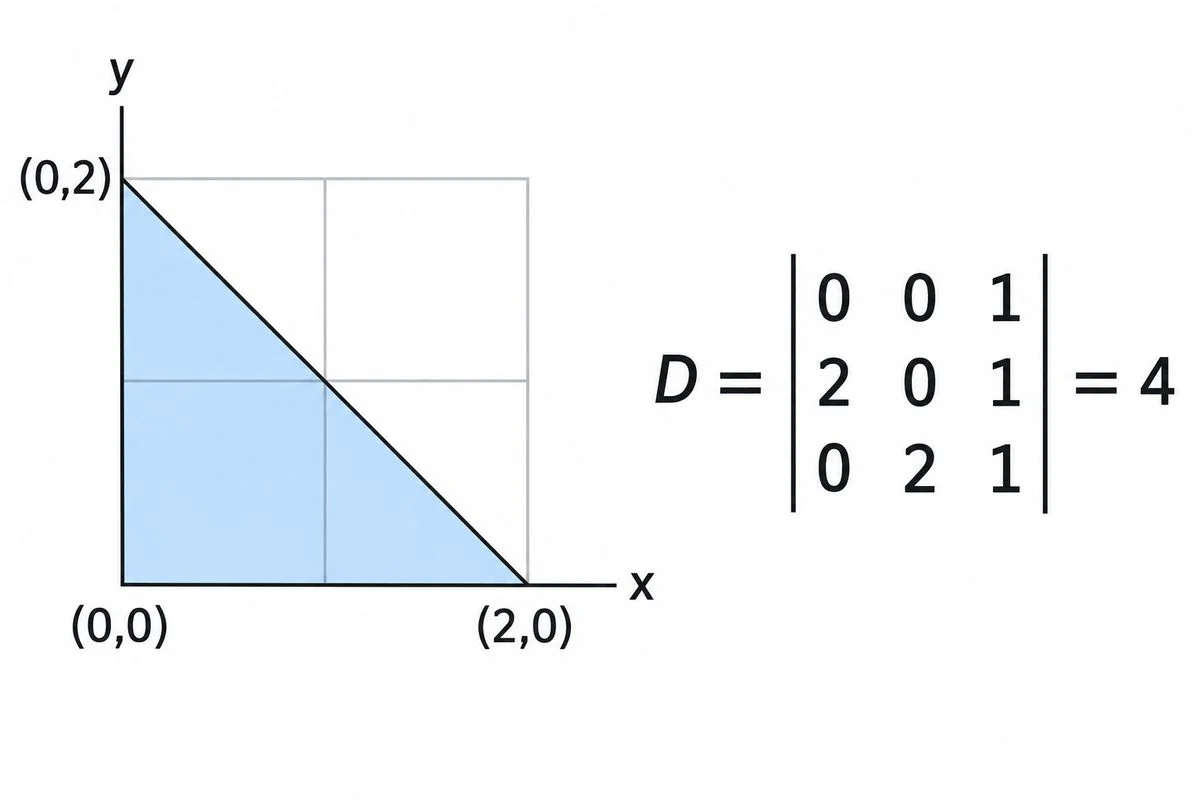
Diagram of a triangle inside a grid square, with its coordinate determinant alongside.

4. Area of a triangle

Half the coordinate determinant's absolute value gives triangle area.

Show
Find the triangle in the diagram. Read its coordinate determinant, D.
Ask
What area will counting give?
Say
The area is 2 square units: halve the determinant's absolute value.
Used in
Surveying uses coordinate determinants to calculate triangular land areas.
If your child says…“The determinant is 4, so the area is 4.”
Ask
How much of the enclosing square does the triangle fill?
What’s true
The determinant's absolute value measures twice the triangle's area.

A=[1213]A=\begin{bmatrix}1&2\\1&3\end{bmatrix}

M12=1M_{12}=1

A12=(−1)1+2×1A_{12}=(-1)^{1+2}\times1

5. Minors and cofactors

A minor is a smaller determinant; a cofactor includes its position sign.

Show
Write these lines. Call M₁₂ the minor and A₁₂ the cofactor for row one, column two. Cross out the row and column through 2.
Ask
What is this cofactor?
Say
It is −1 because this position needs a minus.
Used in
Cofactors help solve linked production equations to plan supplies.
If your child says…“The minor and cofactor are always equal.”
Ask
What sign does row one, column two need?
What’s true
The cofactor changes the minor's sign when its row and column numbers add to an odd number.

Inverses and equations

A=[1102]A=\begin{bmatrix}1&1\\0&2\end{bmatrix}

C=[20−11]C=\begin{bmatrix}2&0\\-1&1\end{bmatrix}

adj⁡A=CT=[2−101]\operatorname{adj}A=C^T=\begin{bmatrix}2&-1\\0&1\end{bmatrix}

∣A∣=1×2−1×0=2|A|=1\times2-1\times0=2

6. Adjoint and inverse of a matrix

Transpose the cofactor matrix. Divide each entry by the nonzero determinant.

Show
Write these lines. Call C the cofactor matrix. Transposing turns its rows into columns.
Ask
What matrix will undo multiplication by A when you divide this adjoint by 2?
Say
Divide every adjoint entry by the determinant, 2, to undo multiplication by A. The inverse has first row 1, negative one-half and second row 0, one-half.
Used in
Inverse matrices recover original drawing coordinates after a reversible transformation.
If your child says…“The cofactor matrix is already the adjoint.”
Ask
Where must the −1 move when the second row becomes the second column?
What’s true
The cofactor matrix must have its rows turned into columns.

(AB)(B−1A−1)=A(BB−1)A−1(AB)(B^{-1}A^{-1})=A(BB^{-1})A^{-1}

(AB)(B−1A−1)=AIA−1(AB)(B^{-1}A^{-1})=AIA^{-1}

(AB)(B−1A−1)=AA−1(AB)(B^{-1}A^{-1})=AA^{-1}

7. Properties of inverse matrices

Undo products in reverse order; rearrange equations by multiplication.

Show
Write these lines for invertible matrices A and B of equal order. Name I the identity.
Ask
What matrix completes the calculation?
Say
The identity remains because inverse pairs cancel.
Used in
Graphics software reverses transformations to restore original positions.
If your child says…“Invert each factor and keep the order.”
Ask
Which factors meet in the middle of the first line?
What’s true
Reversing the factor order makes the inverse pairs meet.

[1112][xy]=[35]\begin{bmatrix}1&1\\1&2\end{bmatrix}\begin{bmatrix}x\\y\end{bmatrix}=\begin{bmatrix}3\\5\end{bmatrix}

A−1AX=A−1BA^{-1}AX=A^{-1}B

X=[2−1−11][35]X=\begin{bmatrix}2&-1\\-1&1\end{bmatrix}\begin{bmatrix}3\\5\end{bmatrix}

X=[6−5−3+5]X=\begin{bmatrix}6-5\\-3+5\end{bmatrix}

8. Solution of a system of linear equations using inverse of a matrix

An inverse finds solutions; consistency means at least one exists.

Show
Write these lines. Call x and y prices, A coefficients, X the price column, and B totals.
Ask
What prices complete X?
Say
Prices are 1 and 2 rupees; check both totals.
Used in
Shopping equations reveal prices from purchase totals.
If your child says…“A zero determinant means there is no solution.”
Ask
Could repeating the same purchase equation make its existing solutions disappear?
What’s true
A zero coefficient determinant allows either no solutions or infinitely many.

A real problem

Leontief's model connected industries through matrix equations.

Leontief published his first input-output study in 1936.

His model tracked industries' dependence on supplies from other industries.

Solving its matrix equation gives the total production needed to meet final demand.

Cambridge University PressWikipediaUniversity of Strasbourg

Flour sacks on a delivery trolley outside a bakery.

Concept Lab · Common misconception

The tempting mistake in Determinants

Open standalone misconception page →

What happens to the determinant when every entry doubles?

Wrong

Doubling every entry doubles the determinant.

Why it feels right. The determinant scales when one row is multiplied, and I apply that once to the whole matrix.

Right

Scaling an n × n matrix by k scales each of its n rows and multiplies the determinant by kⁿ.

Worked example

Identity
10
01
det = 1
Every entry ×2
20
02
det = 4
Doubling both rows doubles each factor in the diagonal product. The determinant becomes four times as large.
  1. The 2 × 2 identity has determinant 1.
  2. The diagonal entries become 2 and 2 after scaling, so the new determinant is 4.

Ask your child eight quick questions.

One per step. The answer and the reason are given.

  1. Should the bars change this answer from −1 to 1?

    No. These bars mean determinant, so the negative answer stays.

  2. What signs belong to an expansion along the second row?

    Minus, plus, minus. Signs follow positions, so the second row begins with minus.

  3. What is the determinant when one row is twice another?

    Zero. Taking out the factor leaves identical rows whose contributions cancel.

  4. A triangle's coordinate determinant is −30. What is its area?

    15 square units. Area is half the determinant's absolute value.

  5. The minor at row one, column two is 4. What is its cofactor?

    −4. The position requires changing the minor's sign.

  6. Where does C's −1 appear in the adjoint?

    First row, second column. Transposing exchanges the entry's row and column positions.

  7. What is the inverse of the product AB?

    B inverse times A inverse. Reversing the order places each matrix beside its inverse.

  8. What does a zero coefficient determinant rule out?

    Exactly one solution. The equations may still have infinitely many solutions, so check further.

15 more questions with answers