1. Principal value branches and graphs of inverse trigonometric functions
Restrict angles, then swap inputs and outputs to get an inverse.
Show
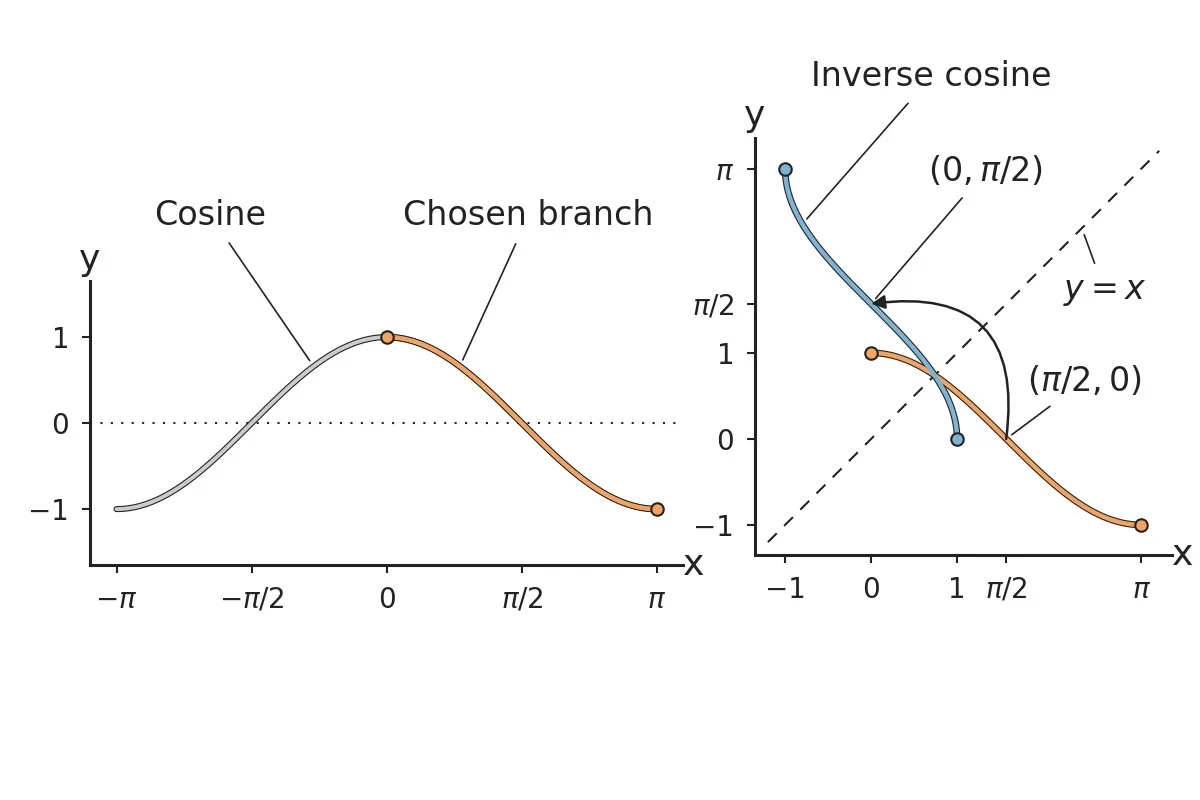
Find both zero crossings in the left diagram. Follow the highlighted branch, then its reflection on the right.
Ask
How many angles on the highlighted branch have cosine zero?
Say
Only one remains. Swapping inputs and outputs reflects this branch across the diagonal, giving inverse cosine.
Used in
Calculators use fixed angle intervals so each inverse key returns one answer.
If your child says…“We can undo a trigonometric function without restricting its angles.”
Ask
At height zero, how many crossings remain on the highlighted branch?
What’s true
Repeated values must be removed by restricting the original angles before reversing the function.
2. Principal values of inverse trigonometric functions
Find the permitted angle for each ratio before combining angles.
Show
Write these lines. Say, “Inverse sine finds y between minus and plus pi over two.”
Ask
Which permitted value of y comes next?
Say
Minus pi over six fits the branch.
Used in
Surveying turns measured side ratios into angles to map land.
If your child says…“Any angle with that sine is an answer.”
Ask
Would an angle beyond this interval still satisfy both requirements?
What’s true
The answer must match the ratio and belong to the chosen angle interval.
Find allowed inputs and outputs
3. Domain of an inverse trigonometric function
Find which inputs make the whole expression meaningful.
Show
Say, “Cosine outputs stay between minus one and one.” Write this line and underline x plus one. Say, “This whole input must stay between minus one and one, including both ends.”
Ask
What bounds on x follow after subtracting one from every part?
Say
Both bounds shift down by one: x runs from minus two to zero, including both ends.
Used in
Geometry software checks ratios before calculating angles, avoiding results with no real angle.
If your child says…“The allowed x values are always minus one to one.”
Ask
Is inverse cosine receiving x, or x plus one?
What’s true
The input restriction applies to the entire expression inside inverse cosine.
4. Range of an inverse trigonometric function
An output change moves the whole interval of possible answers.
Show
Write these lines. Say, “The shifted angle is y; x runs from minus one to one.”
Ask
What bounds on y follow after adding pi over two throughout?
Say
Both endpoints shift. The new range runs from zero to pi, including both ends.
Used in
Rotating dials use shifted angle scales to measure from a different starting direction.
If your child says…“Adding an angle changes only the upper end.”
Ask
What happens when you add pi over two to the lowest possible angle?
What’s true
Adding a constant shifts every output, including both endpoints.
Simplify and solve
5. Properties of inverse trigonometric functions
An inverse returns the matching angle inside its own branch.
Show
Say, “An angle and pi minus that angle share their sine.” Write this line. Mark five pi over six as outside inverse sine’s branch. Say, “The inner sine gives one half.”
Ask
Which angle between minus pi over two and pi over two gives the next line?
Say
The permitted angle has the same sine: y equals pi over six.
Used in
A calculator can recover a ladder’s acute inclination from its height-to-length ratio.
If your child says…“The inverse and sine always cancel.”
Ask
Does five pi over six fit inside inverse sine’s permitted interval?
What’s true
Cancellation returns the original angle only when that angle lies inside the inverse’s branch.
Use the given ratio to find the requested, different ratio.
Show
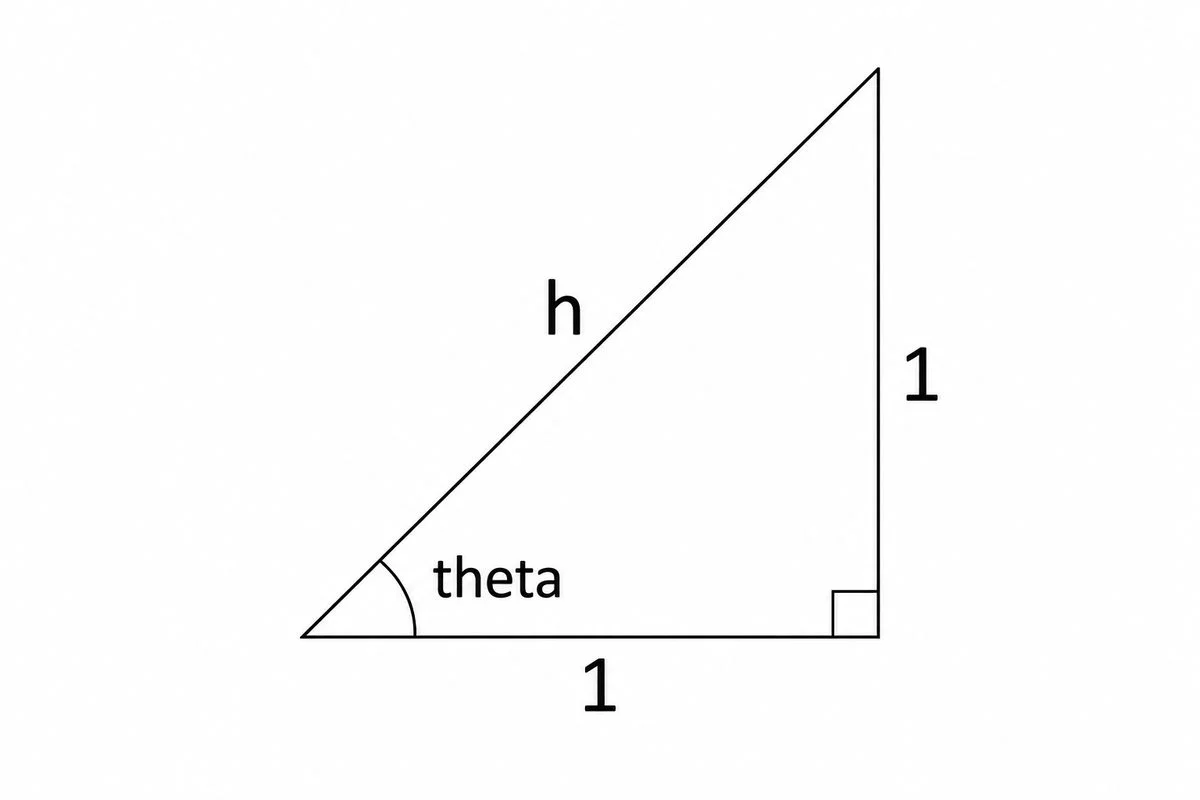
Look at angle theta in the diagram; its tangent is one. Identify its opposite side, adjacent side and hypotenuse h. Say, “Pythagoras gives h squared as two, so h is root two.”
Ask
What sine value comes next when you replace h?
Say
Sine divides the opposite side by the hypotenuse: sine of theta equals one over root two.
Used in
Ramp calculations convert slope into a height-to-length ratio to find the required ramp length.
If your child says…“Sine cancels inverse tangent, leaving one.”
Ask
Does sine use the adjacent side or the hypotenuse underneath?
What’s true
Sine and tangent compare different pairs of triangle sides.
7. Writing inverse trigonometric functions in the simplest form
Substitute an angle, simplify, then return to the original variable.
Show
Write these lines with x strictly between minus one and one. Say, “Choose theta strictly between minus and plus pi over two; cosine is positive.”
Ask
How can the final theta be written using x?
Say
Return to the original variable: theta equals inverse sine of x.
Used in
Computer graphics simplify angle formulas to calculate object rotations.
If your child says…“Reaching theta means I have finished.”
Ask
Which inverse function recovers theta from the substitution?
What’s true
The answer must use the original variable and respect the chosen angle interval.
Find a permitted angle, recover the input, then check it.
Show
Say, “Twice inverse tangent of x equals pi over two.” Write this equation. Say, “Call inverse tangent of x theta. Dividing by two gives theta as pi over four, inside inverse tangent’s branch.” Substitute the predicted answer into the original equation.
Ask
What value of x completes the working?
Say
The value is one; substitution satisfies the original equation.
Used in
Roof calculations solve angle equations to find slopes that meet a design.
If your child says…“Every value my working produces must be a solution.”
Ask
Does your value make the original equation’s two sides equal?
What’s true
A candidate must satisfy the original equation and all its restrictions.
A real problem
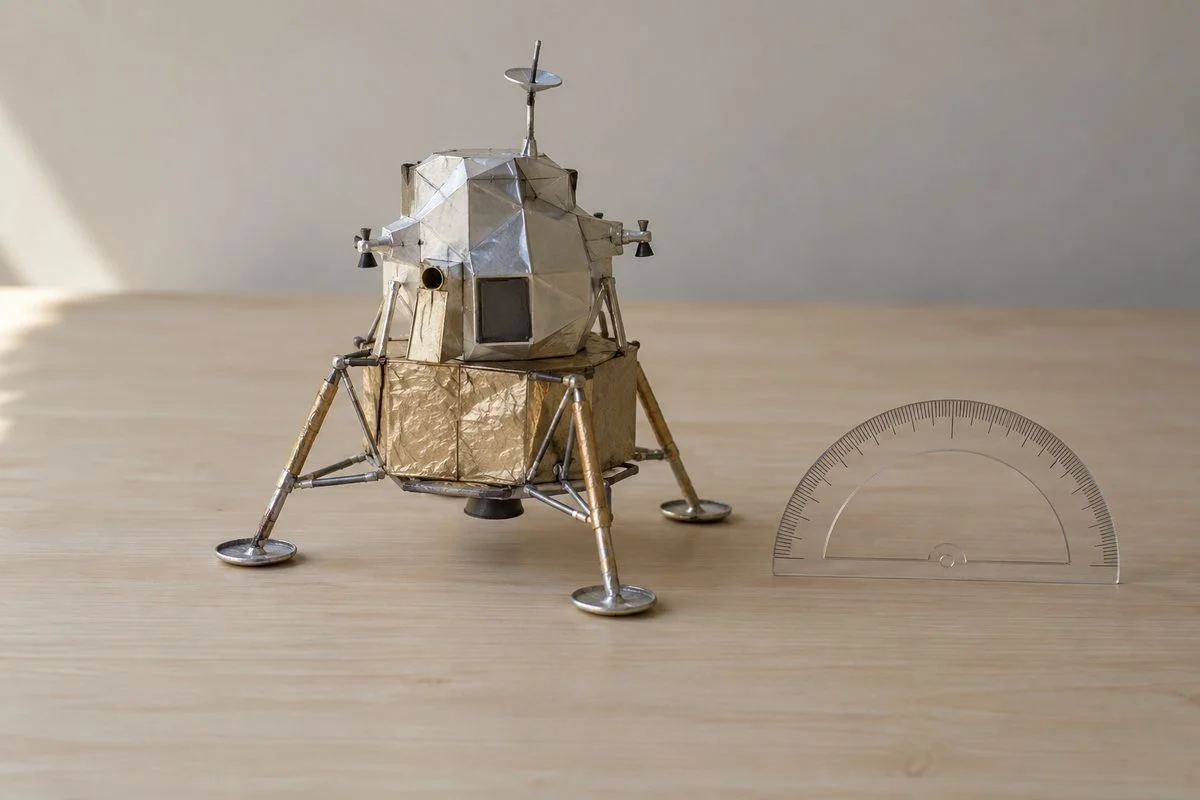
Lunar-landing software used inverse sine.
Eagle landed on the Moon on July 20, 1969.
A navigation system helped the mission reach the Moon and return.
The landing software used inverse sine to calculate a downward viewing angle for display.
We use cookies, including Meta’s and, if a ChatGPT advert brought
you, OpenAI’s, to see how visitors find us.
They are never used on your child’s screens in the app. You can turn them
off here, and change your mind any time.
Privacy policy