Skip to content

Teach Differential Equations in eight steps.

For each idea: show it, ask before you tell, then say one line.

Gather paper and a pencil.

Common misconceptions & worked visual for this chapter · 15 practice questions with answers

How to teach it

Read and check equations

d2ydx2+(dydx)2=0\dfrac{d^2y}{dx^2}+\left(\dfrac{dy}{dx}\right)^2=0

highest derivative=d2ydx2\text{highest derivative}=\dfrac{d^2y}{dx^2}

1. Order and degree of a differential equation

Order counts differentiations; degree measures the highest derivative's power, when defined.

Show
Write one line at a time, explaining it in plain words first. Say, 'Derivatives record how y changes with x.' Underline the derivative involving the most differentiations.
Ask
What order and degree will you write next?
Say
Order is two and degree is one.
Used in
Motion equations connect acceleration with changing speed, helping predict a vehicle's movement.
If your child says…“The biggest power gives the degree.”
Ask
Which derivative has the most differentiations, and what power does it carry?
What’s true
For equations polynomial in derivatives, degree uses only the highest derivative's power.
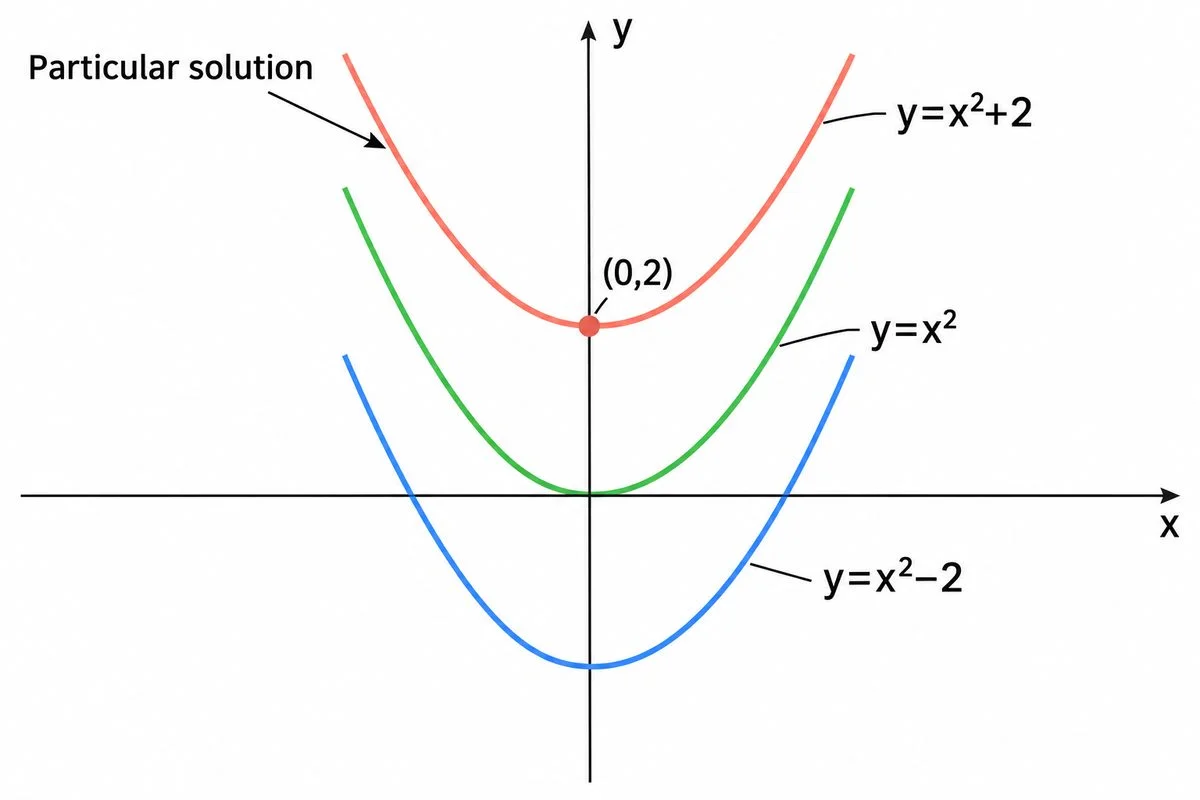
Three shifted parabolas, with the curve through the marked point highlighted.

2. General and particular solutions of a differential equation

General solutions describe families; particular solutions fix their arbitrary constants.

Show
Find the diagram's parabolas, then the marked point. Say, 'C shifts each curve vertically.'
Ask
Which curve passes through the marked point?
Say
The upper curve fits because the point fixes C=2C=2.
Used in
Starting conditions select a motion model's solution, allowing a particular movement to be predicted.
If your child says…“A particular solution still has an arbitrary constant.”
Ask
Could C change while this curve still passes through the marked point?
What’s true
A particular solution fixes every arbitrary constant.

Separate variables and use conditions

dydx=2xy\dfrac{dy}{dx}=2xy

dyy=2x dx\dfrac{dy}{y}=2x\,dx

∫dyy=∫2x dx\int\dfrac{dy}{y}=\int 2x\,dx

ln⁡y=x2+C\ln y=x^2+C

3. Differential equations with variables separable

Separate variables, integrate, then use a condition to fix the constant.

Show
Write one line at a time, explaining it in plain words first. Say, 'Slope equals twice x times positive y. Read ln as natural logarithm.'
Ask
What is y after exponentiating the last line?
Say
Exponentiation undoes the logarithm: y=ex2+Cy=e^{x^2+C}.
Used in
Filling-rate equations predict tank volumes from starting amounts.
If your child says…“I put the starting point into the rate equation to find C.”
Ask
Which written line contains C?
What’s true
The arbitrary constant appears after integration, so use the condition then.

dPdt=2P\dfrac{dP}{dt}=2P

P(t)=e2tP(t)=e^{2t}

2=e2T2=e^{2T}

4. Applications of differential equations

A rate equation predicts how a quantity changes over time.

Show
Write these lines. Say, 'P counts thousands of bacteria, initially one. Time t and doubling time T use hours. Growth rate equals twice P.'
Ask
When will this population reach two thousand?
Say
Take natural logarithms, then divide by two: T=ln⁡22T=\frac{\ln 2}{2} hours.
Used in
Continuous-interest calculations use proportional growth to predict how savings increase.
If your child says…“Proportional growth adds the same amount every hour.”
Ask
If the rate is twice P, what happens when P doubles?
What’s true
In this model, doubling the population doubles its growth rate.

Recognise and solve other forms

f(x,y)=x2+y2f(x,y)=x^2+y^2

f(λx,λy)=λ2f(x,y)f(\lambda x,\lambda y)=\lambda^2f(x,y)

dydx=x2+y2x2\dfrac{dy}{dx}=\dfrac{x^2+y^2}{x^2}

5. Homogeneous functions and homogeneous differential equations

Homogeneous functions scale by powers; homogeneous differential equations keep slopes unchanged.

Show
Write these lines. Say, 'f names the function; lambda scales both inputs. Keep x and lambda nonzero.'
Ask
How can the slope use only y divided by x?
Say
The squared scaling factors cancel, leaving degree zero: dydx=1+(yx)2\frac{dy}{dx}=1+\left(\frac{y}{x}\right)^2.
Used in
Scale drawings preserve slopes, so an enlarged plan keeps the same angles.
If your child says…“Any homogeneous function can be the slope in a homogeneous differential equation.”
Ask
If scaling changes the slope, can that slope depend only on the unchanged ratio?
What’s true
A homogeneous function may have another degree, but this equation type requires degree zero.

dydx=v+xdvdx\dfrac{dy}{dx}=v+x\dfrac{dv}{dx}

v+xdvdx=1+vv+x\dfrac{dv}{dx}=1+v

dv=dxxdv=\dfrac{dx}{x}

v=ln⁡∣x∣+Cv=\ln|x|+C

6. Solving homogeneous differential equations

Replace the ratio, separate variables, integrate, then restore the original variables.

Show
Use slope one plus y divided by nonzero x. Write one line at a time, explaining it in plain words first. Say, 'Set y equal to v times x. Use the product rule because v changes with x.'
Ask
What equation results when you replace v by y divided by x?
Say
Restore the original ratio: yx=ln⁡∣x∣+C\frac{y}{x}=\ln|x|+C.
Used in
Slope rules involving position ratios let designers calculate a curve's shape.
If your child says…“The derivative of v times x is just v.”
Ask
Where does the change in v appear in the first line?
What’s true
Both factors can change, so differentiating their product needs both terms.

dydx−yx=1\dfrac{dy}{dx}-\dfrac{y}{x}=1

I=e∫(−1/x) dx=x−1I=e^{\int(-1/x)\,dx}=x^{-1}

1xdydx−yx2=1x\dfrac{1}{x}\dfrac{dy}{dx}-\dfrac{y}{x^2}=\dfrac{1}{x}

7. Linear differential equations and integrating factor

An integrating factor turns the left side into one product's derivative.

Show
Write these lines for positive x. Say, 'P is y's signed coefficient. I names the integrating factor.'
Ask
Which product's derivative replaces the final left side?
Say
The product rule combines both terms: ddx(x−1y)=1x\frac{d}{dx}(x^{-1}y)=\frac{1}{x}.
Used in
Cooling models use linear equations to estimate how temperature changes during storage.
If your child says…“I can read P before dividing by x.”
Ask
When every term is divided by x, what happens to y's coefficient?
What’s true
Read P with its sign only after making the derivative's coefficient one.

dydx+y=1\dfrac{dy}{dx}+y=1

exdydx+exy=exe^x\dfrac{dy}{dx}+e^xy=e^x

ddx(exy)=ex\dfrac{d}{dx}(e^xy)=e^x

exy=ex+Ce^xy=e^x+C

8. Solving linear differential equations

Multiply throughout, integrate the product derivative, then divide every term.

Show
Write one line at a time, explaining it in plain words first. Say, 'Multiply every term by e to the power x. The left side becomes a product derivative.'
Ask
What is y after dividing every term, including C, by e to the power x?
Say
The constant must also be divided: y=1+Ce−xy=1+Ce^{-x}.
Used in
Tank mixing models predict concentration, helping determine when a mixture reaches a required strength.
If your child says…“I can add C after dividing.”
Ask
Why would the division apply to one term on the right but skip C?
What’s true
C enters during integration and must undergo the same division as every other term.

A real problem

A radioactivity study explained decay and replenishment.

Rutherford and Soddy published their radioactivity study in 1902.

After an initial rise, the separated material's activity decreased approximately exponentially.

Thorium maintained its activity by continuously producing fresh radioactive material at a constant rate.

McGill UniversityLe Moyne College — original research paper

Glass beakers and a stopwatch on a laboratory bench.

Concept Lab · Common misconception

The tempting mistake in Differential Equations

Open standalone misconception page →

Does an initial value only check a solution?

Wrong

All curves y = Ceˣ solve y′ = y, so any one works when y(0) = 2.

Why it feels right. The entire family satisfies the differential equation.

Right

An initial condition selects the member of a solution family that passes through the specified point.

Worked example

Each curve solves the differential equation. The condition at x = 0 selects the curve that crosses the vertical axis at 2.
  1. At x = 0 the family has y = C.
  2. Requiring y(0) = 2 sets C = 2 and gives y = 2eˣ.

Ask your child eight quick questions.

One per step. The answer and the reason are given.

  1. What is the degree of this equation?

    One. The second derivative has power one, despite the squared first derivative.

  2. How many arbitrary constants does the highlighted curve's equation contain?

    None. The condition fixes C at two, leaving no arbitrary choice.

  3. Where must you substitute the given point to find C?

    Into the integrated equation. The rate equation contains no arbitrary constant to fix.

  4. What happens to this model's growth rate when the population doubles?

    It doubles. The rate is proportional to the population, rather than constant.

  5. Another equation’s slope doubles when both inputs double. Is it a homogeneous differential equation?

    No. The slope must stay unchanged when both inputs scale together.

  6. When differentiating v times x, which term appears besides v?

    xdvdxx\frac{dv}{dx} The new variable v can change with x.

  7. What is P after making the derivative's coefficient one?

    −1x-\frac{1}{x} Dividing changes the coefficient's size while keeping its minus sign.

  8. What does the constant term become after the final division?

    Ce−xCe^{-x} The entire right side is divided by the integrating factor.

15 more questions with answers