Skip to content

Teach Carbon and its Compounds in eight steps.

For each idea: show it, ask before you tell, then say one line.

Gather a completely cold sooty pot, vinegar, baking soda, an open cup and a teaspoon.

An adult handles the vinegar and baking soda. Do not taste them or heat anything.

Common misconceptions & worked visual for this chapter · 15 practice questions with answers

How to teach it

Bonds and structures

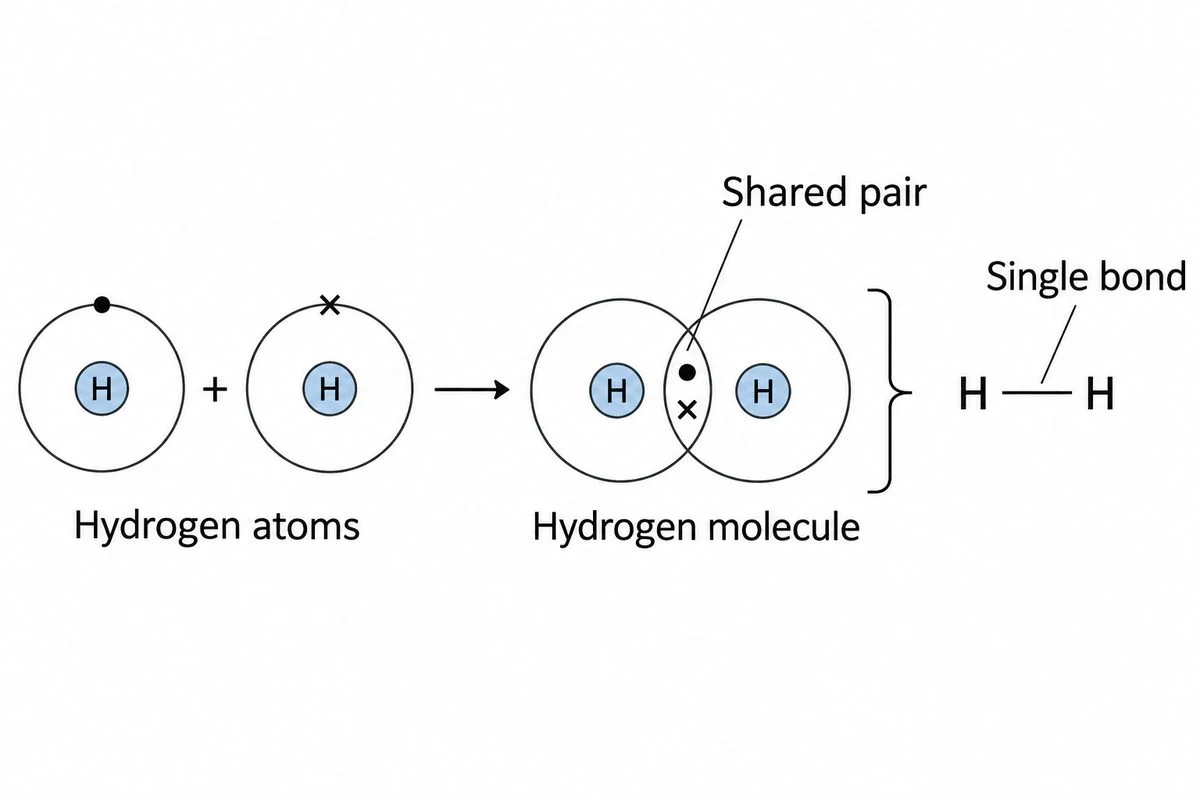
Hydrogen atoms share an electron pair, also shown as a single bond.

1. Covalent bonding

Atoms bond by sharing pairs of electrons.

Show
Follow the diagram from separate hydrogen atoms to their shared pair, then the single bond.
Ask
What will hold these hydrogen atoms together?
Say
Both nuclei attract the shared pair, holding the atoms together. Each hydrogen counts both electrons in its filled first shell.
Used in
Covalently bonded plastics usually conduct electricity poorly, so plastic coverings help protect people from electric shocks.
If your child says…“One atom gives its electron to the other.”
Ask
Which atoms have the shared pair within their shells?
What’s true
Both atoms share the pair rather than transferring electrons completely.
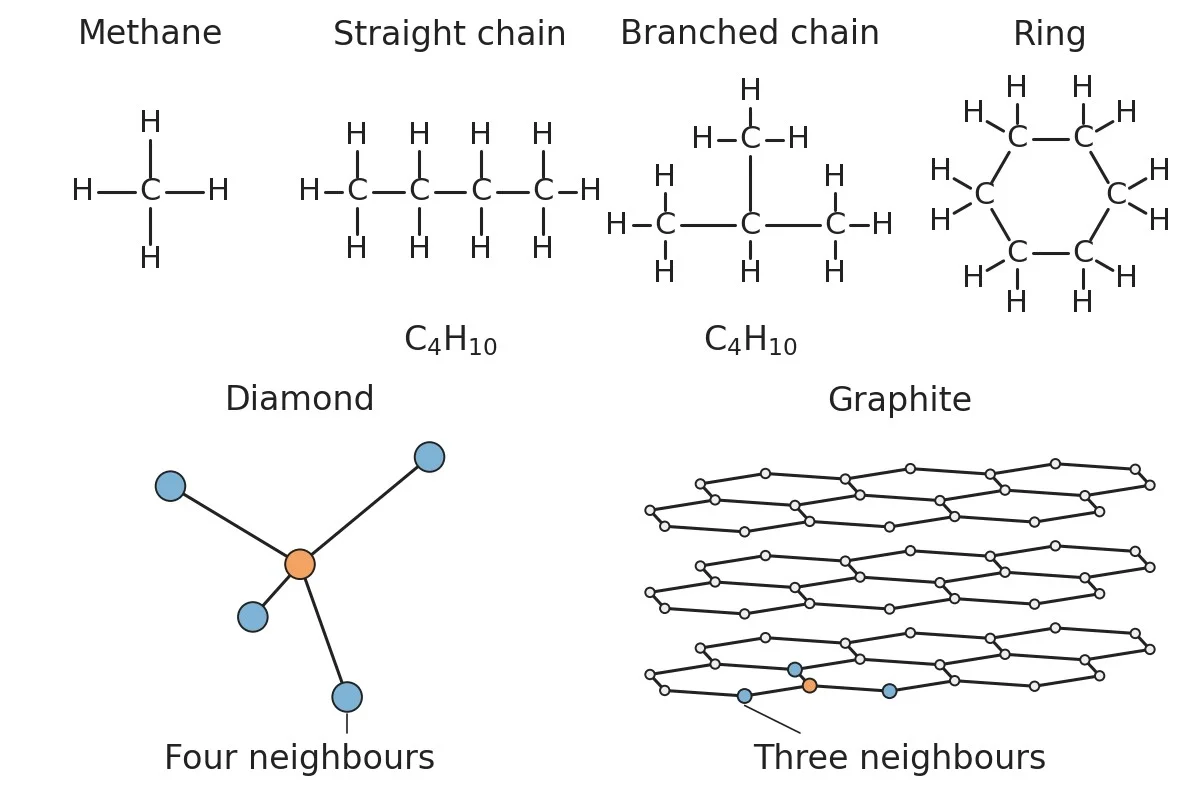
Carbon structures show four bonds, chains, branches, a ring, diamond and graphite.

2. Tetravalency, catenation and carbon structures

Carbon makes four bonds and joins other carbons.

Show
Find methane in the diagram. Trace the chains and ring, then compare diamond and graphite.
Ask
Will these carbon structures behave alike?
Say
Carbon forms four bonds and joins itself in different arrangements. Diamond’s network and graphite’s layers give different properties.
Used in
Graphite's layers slide apart, allowing pencils to leave marks on paper.
If your child says…“The same formula must mean the same compound.”
Ask
What differs between these butanes: their atom counts or their connections?
What’s true
Some compounds have matching atom counts but different connections, making them structural isomers.
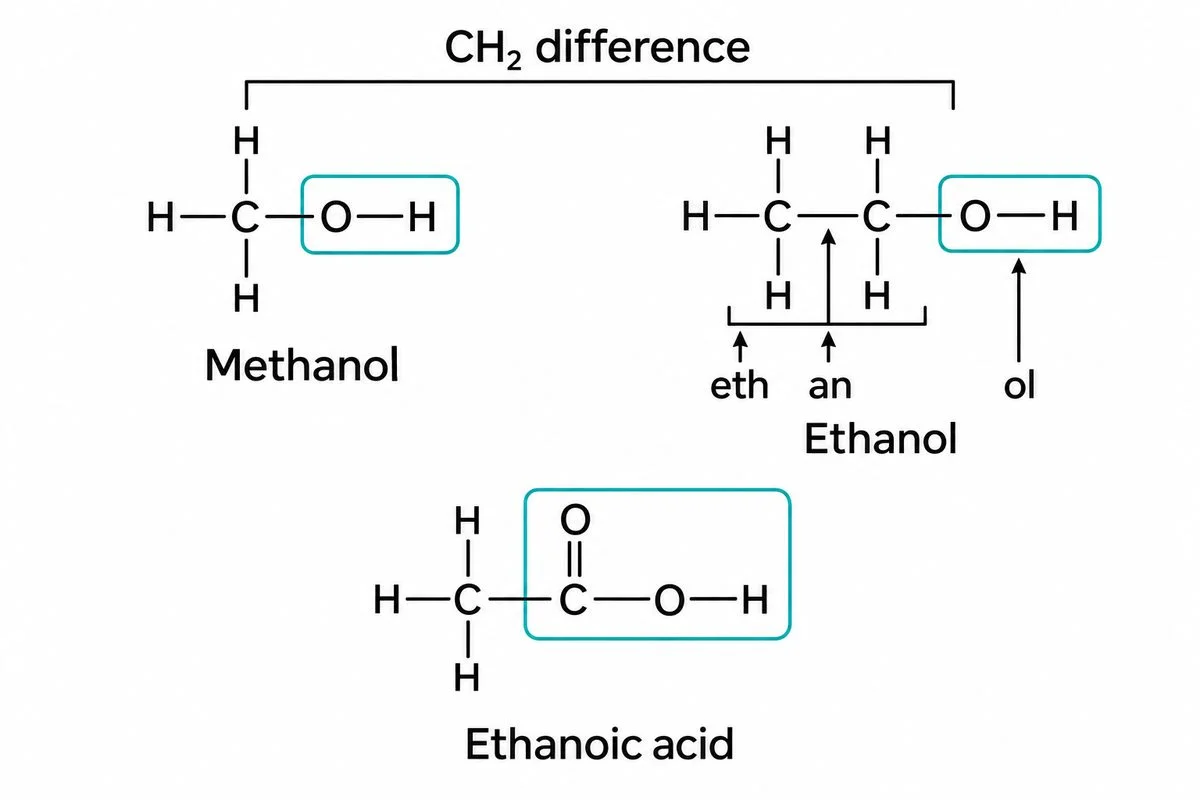
Alcohol structures show the family difference, ethanol’s name parts and ethanoic acid’s different group.

3. Homologous series, functional groups and nomenclature

Family members have similar chemical properties.

Show
Compare the diagram’s alcohols. Follow ethanol’s name parts, then find ethanoic acid’s group.
Ask
Will different functional groups react alike?
Say
‘Eth’ means two carbons, ‘an’ indicates saturation, and ‘ol’ identifies an alcohol. Successive alcohols differ by one carbon and two hydrogens. Different functional groups give different characteristic reactions.
Used in
Chemical names identify cleaning ingredients, helping people compare products.
If your child says…“The next member just adds two hydrogens.”
Ask
What changes besides the hydrogen count between methanol and ethanol?
What’s true
The change includes one carbon as well as two hydrogens.

Reactions of carbon compounds

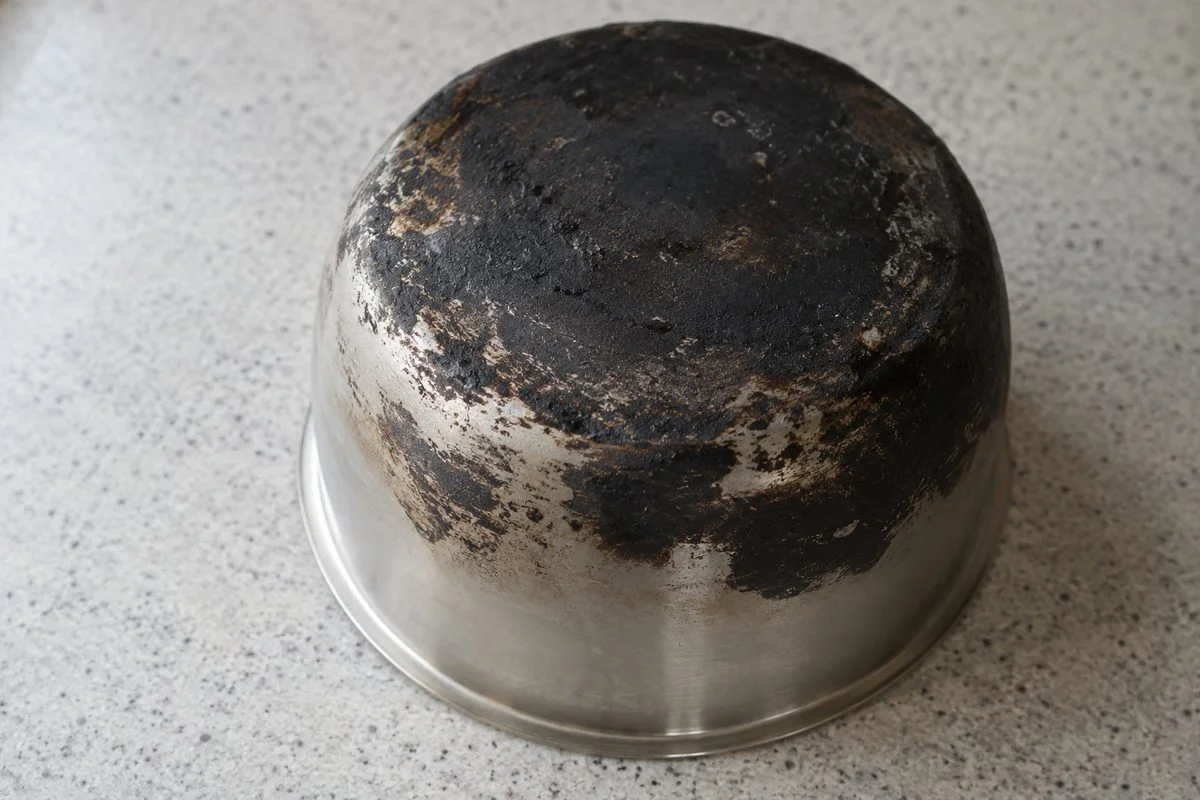
Cold cooking pot turned upside down with soot on its base.

4. Combustion and oxidation

Burning releases heat, but oxidation can also happen without burning.

Show
Turn a completely cold, sooty cooking pot upside down. Point to the black deposit.
Ask
Would a better oxygen supply reduce soot during burning?
Say
Yes, a better oxygen supply would reduce soot. Too little oxygen can cause soot.
Used in
Burning carbon fuels supplies heat for cooking.
If your child says…“The black soot means the fuel burned completely.”
Ask
If all the carbon became carbon dioxide, what would leave this black deposit?
What’s true
Complete burning of a hydrocarbon forms carbon dioxide and water, leaving no unburnt carbon.
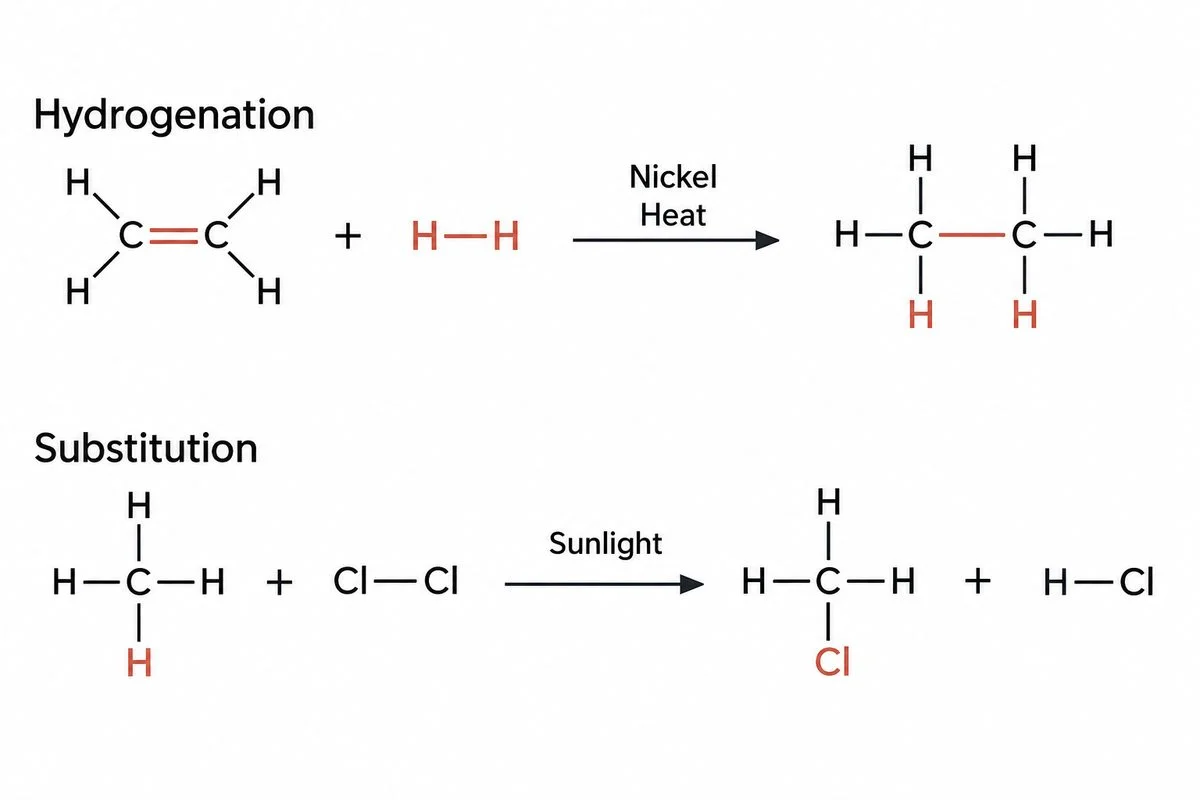
Hydrogen adds across ethene’s double bond, while chlorine replaces hydrogen in methane.

5. Addition, hydrogenation and substitution

Addition attaches atoms; substitution replaces atoms already present.

Show
Find ethene’s double bond in the diagram’s top row. Follow hydrogen joining with heat and nickel. Below, track chlorine replacing hydrogen in methane.
Ask
How will adding hydrogen change ethene’s double bond?
Say
Hydrogenation adds hydrogen across the double bond, making it single. Unsaturated ethene becomes saturated ethane, whose carbon atoms have only single bonds. Below, chlorine replaces hydrogen in sunlight: that is substitution.
Used in
Hydrogenation makes vegetable oils firmer, helping produce spreadable fats.
If your child says…“Adding hydrogen makes more double bonds.”
Ask
How can each carbon keep four bonds while gaining a bond to hydrogen?
What’s true
Hydrogenation reduces double bonds and increases saturation.
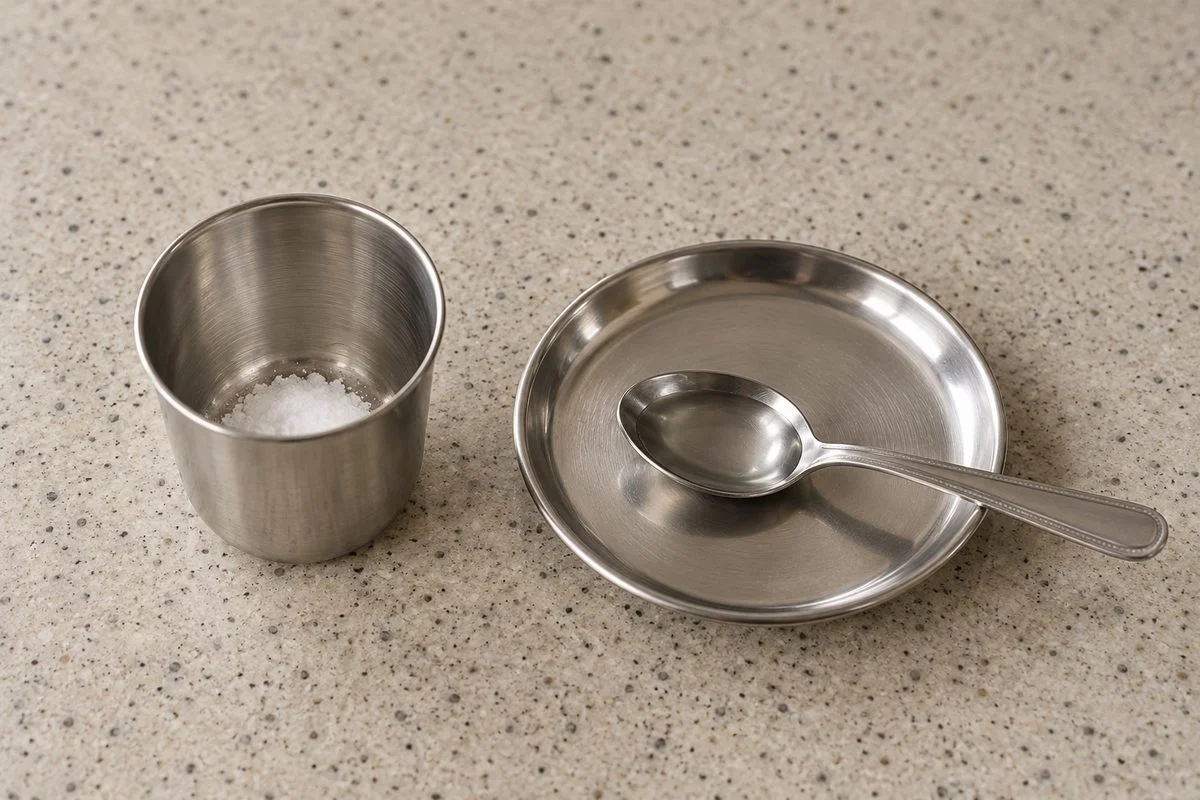
A teaspoon of vinegar beside an open cup containing baking soda.

6. Ethanol, ethanoic acid and esterification

Ethanoic acid produces carbon dioxide with baking soda, or esters with ethanol.

Show
An adult holds vinegar above baking soda in an open cup. After predicting, add it.
Ask
What will happen when they mix?
Say
Ethanoic acid in vinegar releases carbon dioxide from baking soda.
Used in
Ethanol dissolves other substances, making it useful as a solvent.
If your child says…“The bubbles are hydrogen.”
Ask
Baking soda contains hydrogencarbonate. Which gas do acids release from carbonates and hydrogencarbonates?
What’s true
Ethanoic acid releases carbon dioxide when it reacts with baking soda.

How cleaning works

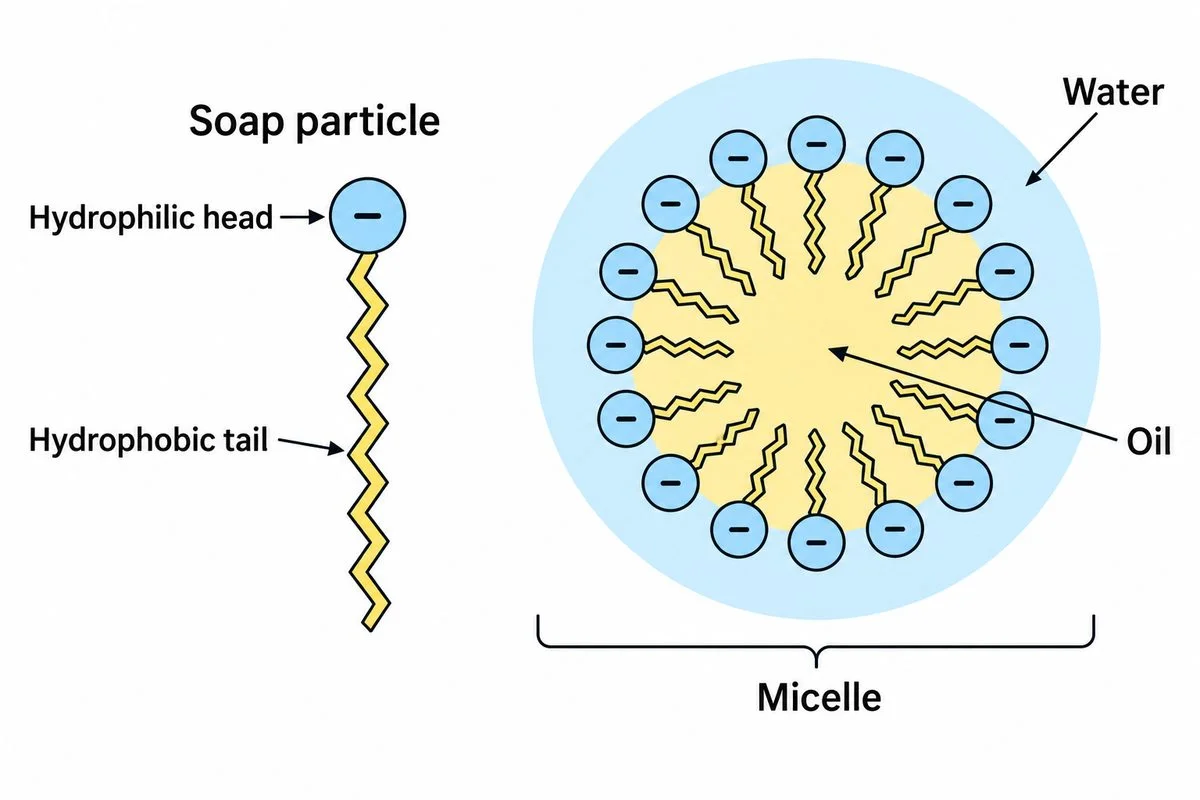
Soap tails point into an oily droplet while charged heads face surrounding water.

7. Soap molecules and micelles

Soap clusters surround oily droplets so water can carry them away.

Show
Find the soap particle’s head and tail in the diagram. Follow their positions around the oil.
Ask
How will these soap particles help water carry away oil that cannot dissolve?
Say
The tails enter oil while the charged heads face water. This cluster, a micelle, holds an oily droplet so rinsing can carry it away.
Used in
Soap helps remove oily dirt from clothes during washing.
If your child says…“The soap heads point into the oily dirt.”
Ask
Which ends can face water if the tails are inside the oil?
What’s true
Soap tails interact with oil while the charged heads face the surrounding water.
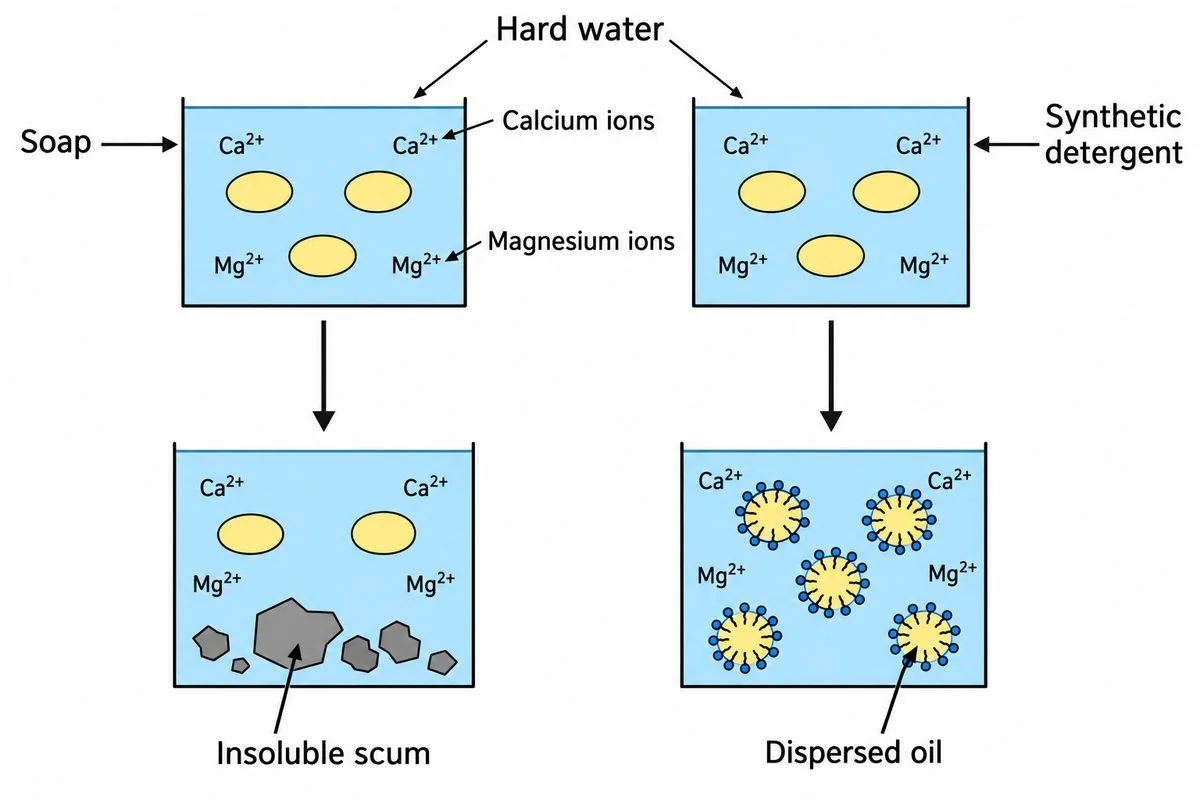
Soap forms scum in hard water while detergent keeps oil droplets dispersed.

8. Soap in hard water and detergents

Hard water wastes soap by forming scum.

Show
Follow the diagram’s arrows: soap towards scum, detergent towards dispersed oil.
Ask
Which cleaner will work better here?
Say
Calcium and magnesium ions waste soap as solid scum. Detergents avoid this scum and keep cleaning.
Used in
Detergents clean in hard water without forming the deposits that waste soap.
If your child says…“Detergent foam proves the water is soft.”
Ask
If detergent foams in either kind of water, can its foam tell them apart?
What’s true
Detergent lather alone cannot identify water hardness.

A real problem

India’s ethanol blending programme

India launched its Ethanol Blended Petrol Programme in 2003.

Ethanol made from plant materials is a renewable fuel.

Mixing ethanol into petrol helps reduce India’s dependence on imported crude oil.

Press Information BureauUS Department of EnergyPress Information Bureau

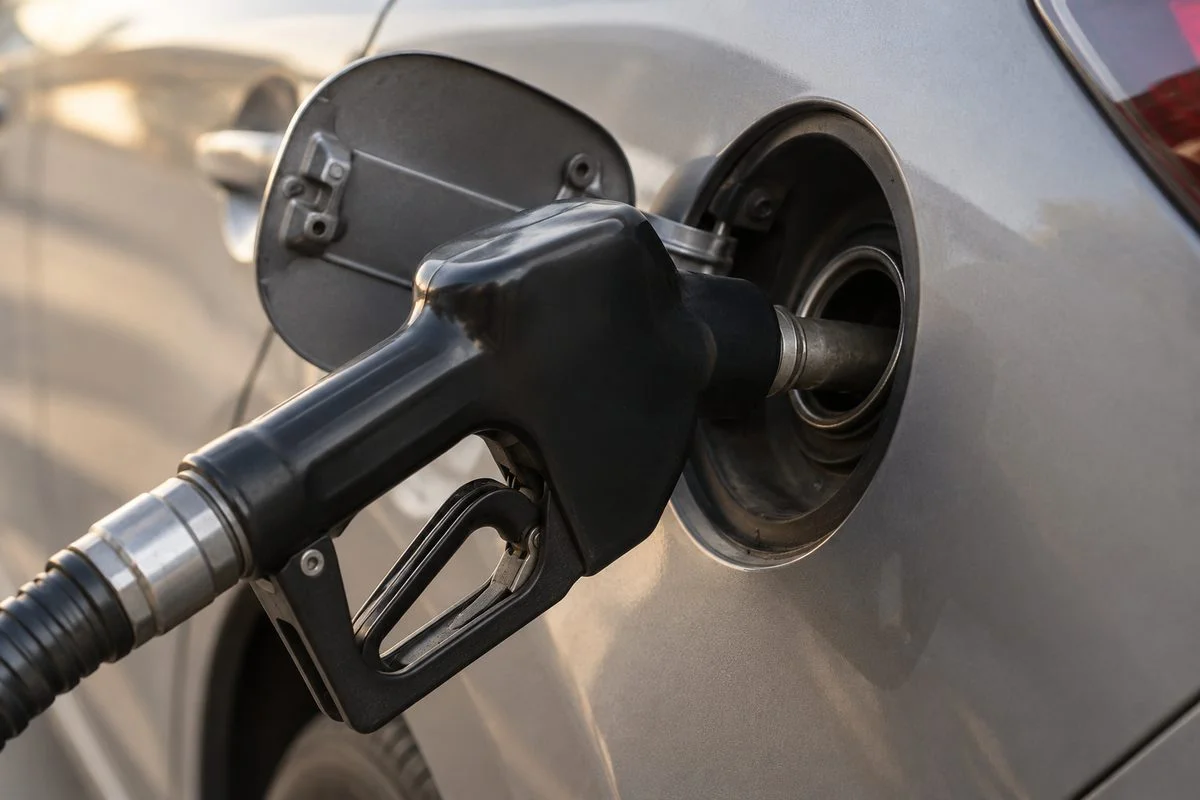
Unbranded petrol nozzle inserted into a car’s fuel opening.

Concept Lab · Common misconception

The tempting mistake in Carbon and its Compounds

Open standalone misconception page →

Can a double bond count as just one bond toward carbon’s valency?

Wrong

Each carbon in ethene makes only three bonds.

Why it feels right. I count neighbouring atoms rather than shared pairs.

Right

A double bond contributes two shared pairs.

Worked example

Each C has two C–H single bonds and two lines to the other C. That gives bond order four per carbon.

In H₂C=CH₂, each carbon has two C–H bonds and a C=C double bond, giving a total bond order of four.

Ask your child eight quick questions.

One per step. The answer and the reason are given.

  1. What happens to the electrons between these bonded hydrogen atoms?

    They are shared. Both nuclei attract the same pair of electrons.

  2. What must you compare besides atom counts when deciding whether two structures match?

    How the atoms connect. Matching atom counts can hide different connections.

  3. What extra atoms does ethanol contain compared with methanol?

    One carbon and two hydrogens. Each step adds a carbon and two hydrogens.

  4. What does a soot deposit tell you about the burning?

    It was incomplete. Some carbon remained unburnt instead of becoming carbon dioxide.

  5. What happens to a carbon–carbon double bond when hydrogen adds across it?

    It becomes a single bond. New carbon–hydrogen bonds form as the carbon–carbon double bond becomes single.

  6. Which gas escapes when vinegar reacts with baking soda?

    Carbon dioxide. The acid reacts with hydrogencarbonate to release carbon dioxide, not hydrogen.

  7. Which parts of soap molecules point towards the oily centre of a micelle?

    The tails. Tails interact with oil; charged heads face water.

  8. What kinds of water can produce lather with detergent?

    Both hard and soft water. Detergent lather does not prove that water is soft.

15 more questions with answers