Skip to content

Teach Heredity in eight steps.

For each idea: show it, ask before you tell, then say one line.

Gather paper and a pencil.

Common misconceptions & worked visual for this chapter · 15 practice questions with answers

How to teach it

Differences across generations

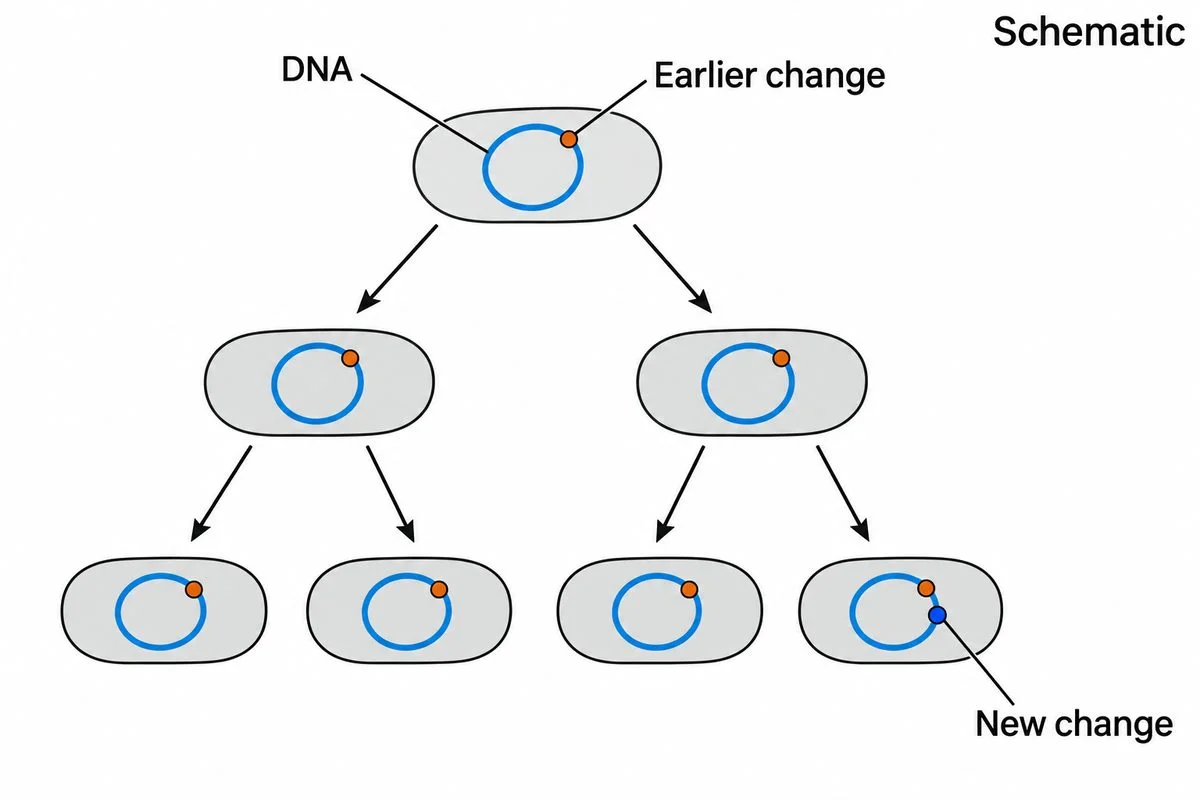
Bacterial descendants retain an orange DNA change; one also gains a blue change.

1. Accumulation and inheritance of variation

Inherited differences can persist while new differences appear.

Show
Look at the diagram's orange DNA mark in successive generations. Cover the lowest row with paper. Uncover it after predicting.
Ask
If a descendant gains a blue DNA change, must it lose the orange change?
Say
That descendant keeps both changes. Earlier changes can pass on.
Used in
Inherited differences in sugarcane cuttings let growers select plants with useful traits.
If your child says…“Each new difference wipes out the old ones.”
Ask
Which marks remain together in the lowest bacterium?
What’s true
A descendant can retain an earlier DNA change alongside a new one.
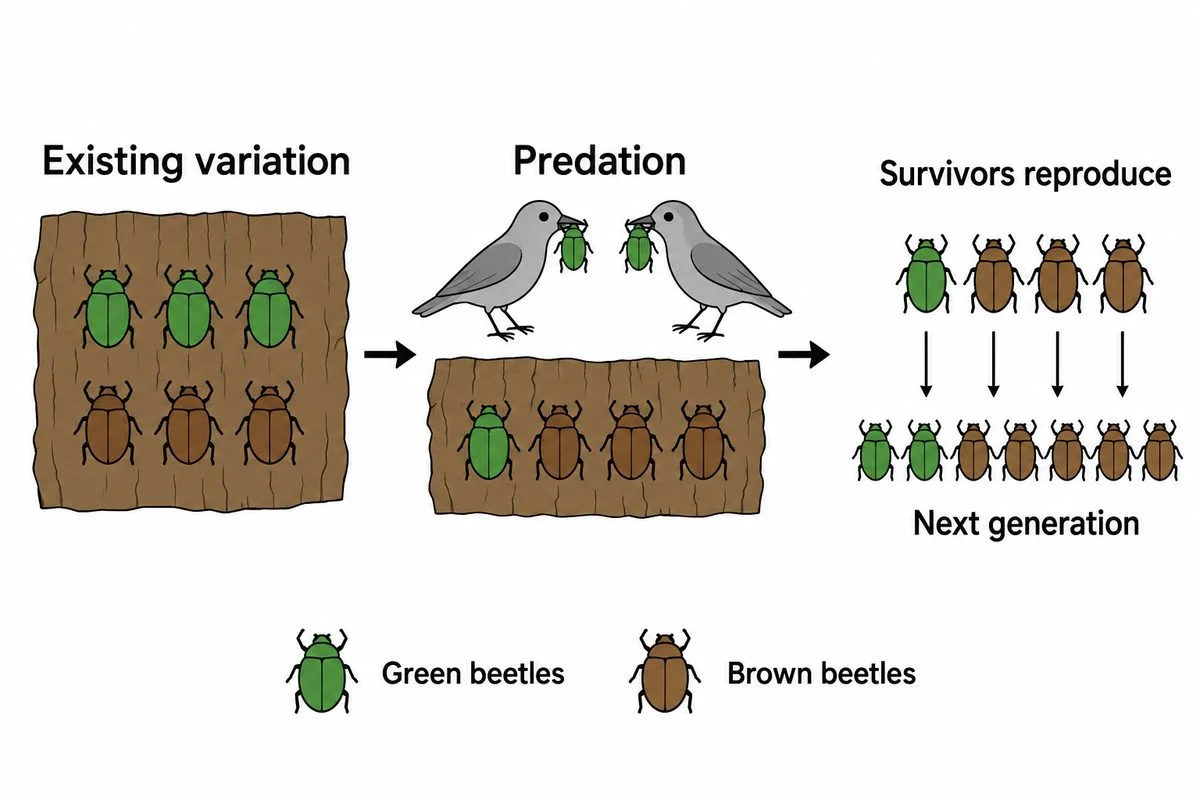
Existing brown beetles survive predation more often and produce a larger share of descendants.

2. Environmental selection

Conditions favour existing variants that survive or reproduce better.

Show
Look at the diagram's mixed beetles, then the birds catching green beetles. Cover the final panel until after predicting.
Ask
With birds catching more green beetles, which colour will probably become commoner in later generations?
Say
Brown beetles blend into this bark and survive more often. Their offspring inherit colour here, so brown beetles become a larger share.
Used in
Tracking inherited antibiotic resistance helps explain why some treatments fail.
If your child says…“The birds make green beetles turn brown.”
Ask
Were brown beetles present before the birds arrived?
What’s true
Predation favours brown beetles already present, whose surviving descendants can become more common.

How traits are inherited

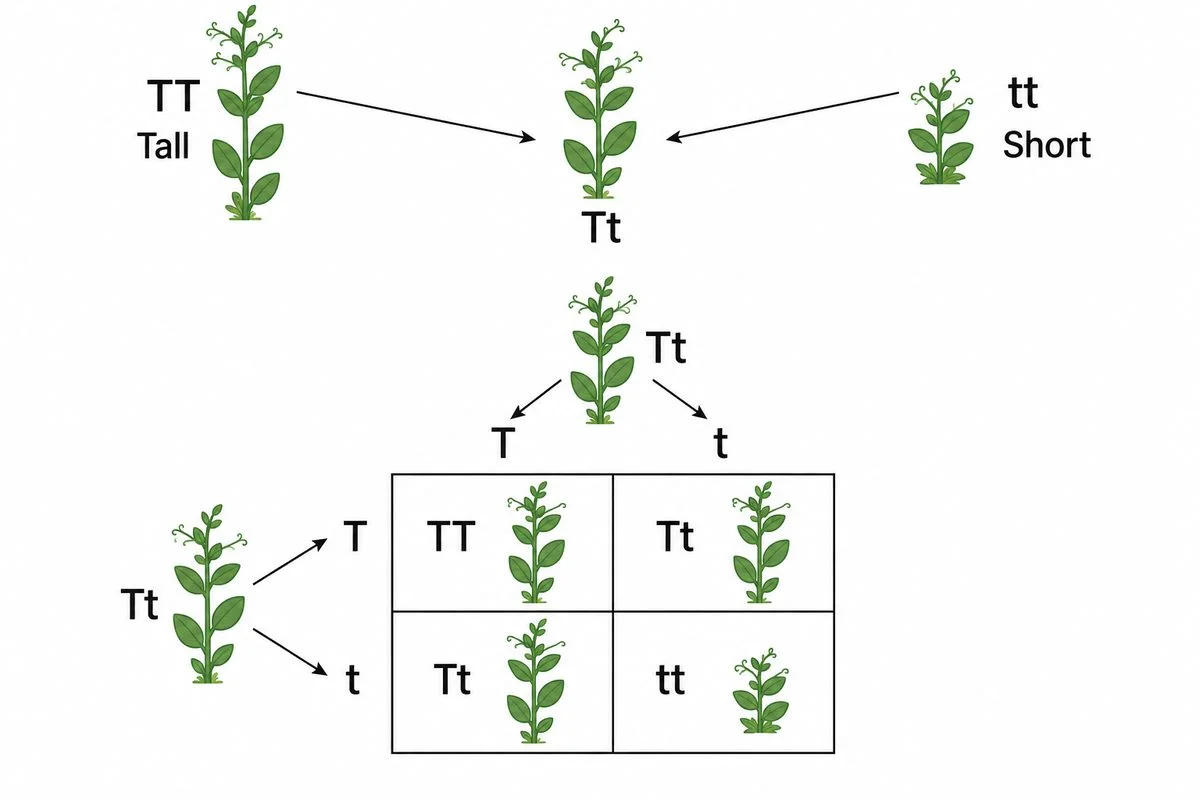
Pea crosses show tall Tt parents producing TT, Tt and short tt combinations.

3. Mendel's monohybrid crosses and dominance

Genotype is the gene pair; phenotype is its observable effect.

Show
Trace the diagram's TT and tt parents to tall Tt offspring. Cover the square until after predicting.
Ask
How could these tall parents produce short offspring?
Say
Both can contribute t, producing short tt offspring.
Used in
Pea crosses reveal hidden gene versions, helping breeders predict offspring traits.
If your child says…“Two tall Tt plants can only have tall offspring.”
Ask
What gene pair forms when each parent passes on t?
What’s true
Dominant T hides recessive t's effect without removing t.
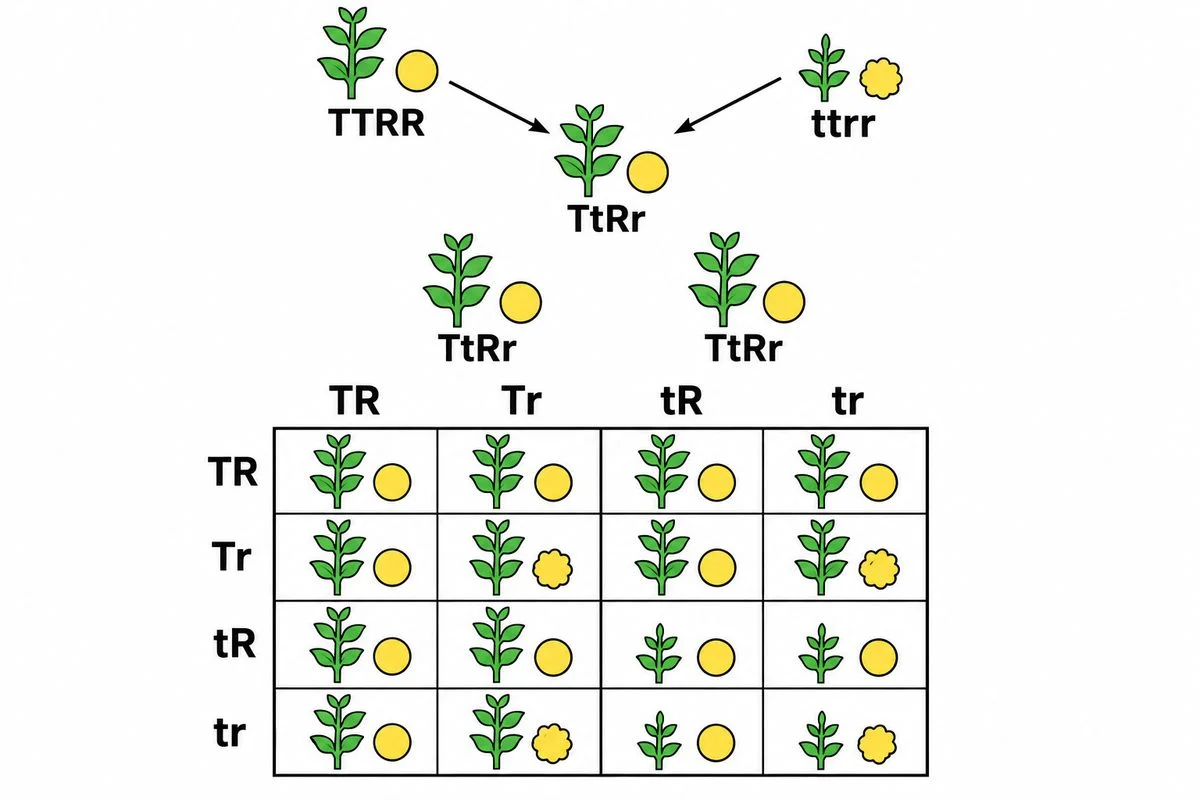
A pea cross produces parental combinations alongside tall-wrinkled and short-round offspring.

4. Dihybrid crosses and independent inheritance

Independent inheritance allows new combinations of parental traits.

Show
Trace the diagram's tall-round and short-wrinkled parents to TtRr offspring. Cover the square; find their contributions: TR, Tr, tR and tr.
Ask
Must tallness stay paired with round seeds?
Say
Independent inheritance also allows tall-wrinkled and short-round offspring.
Used in
Breeders combine independently inherited traits to improve crops.
If your child says…“Shortness and wrinkled seeds must always stay together.”
Ask
Which offspring pictures combine short plants with round seeds?
What’s true
The chapter's independently inherited pea traits can appear in combinations absent from the original parents.
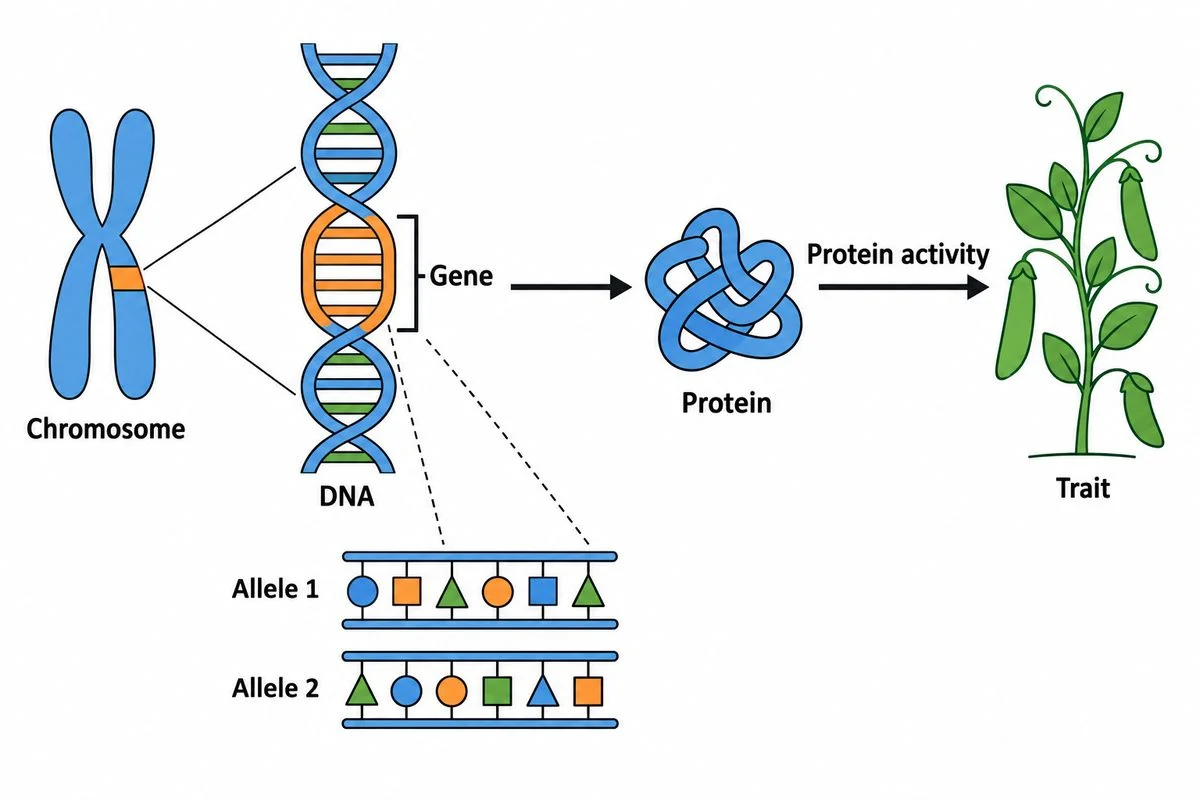
A chromosome's gene supplies protein instructions; protein activity influences a plant trait.

5. Genes, alleles and trait expression

Gene versions influence traits through the proteins they help make.

Show
Look at the diagram's chromosome, then its enlarged DNA section. Follow the gene's arrows towards the protein and stem growth. Compare the two alleles below.
Ask
If this gene changes, could protein activity and stem growth change too?
Say
A gene carries instructions for a protein, which can influence growth. Different versions, called alleles, can change how well that protein works.
Used in
Wheat breeders used inherited dwarfness to reduce crops falling over.
If your child says…“A gene turns into the plant's stem.”
Ask
What lies between the gene's instructions and growth in this diagram?
What’s true
In peas, genes affect proteins that help make growth hormone, which influences stem growth.
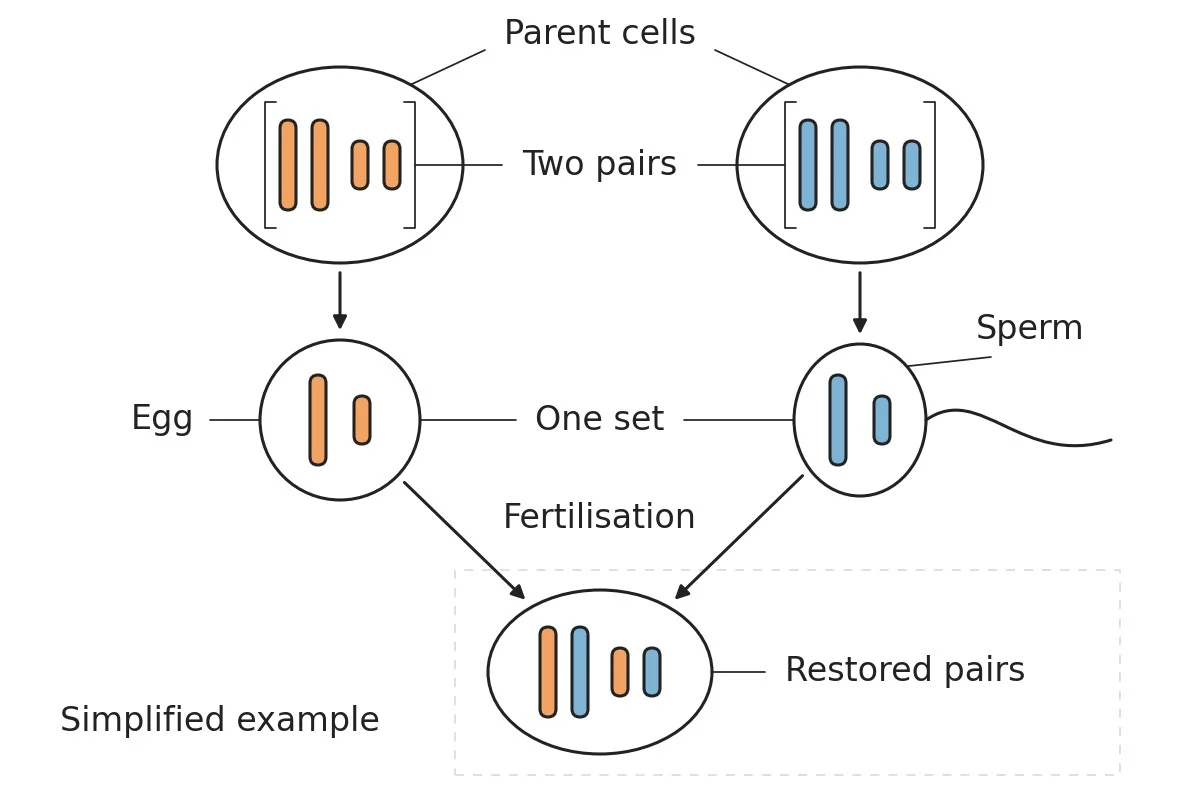
Gametes receive one chromosome per pair; fertilisation restores both pairs.

6. Chromosome pairs, gametes and fertilisation

Gametes carry one chromosome per pair. Fertilisation restores pairs.

Show
Find the long and short chromosome pairs in the diagram's parent cells. Follow one chromosome per pair into each gamete. Cover the fertilised egg until after predicting.
Ask
Will joining these gametes double the parents' chromosome number?
Say
Each gamete supplies one chromosome per pair, so joining restores pairs.
Used in
Halving before fertilisation keeps chromosome numbers steady across generations.
If your child says…“The offspring gets twice the parents' chromosome number.”
Ask
Did each gamete receive whole pairs or one member from each?
What’s true
Each gamete supplies half the body-cell chromosome number, so joining restores the usual number.

Sex determination

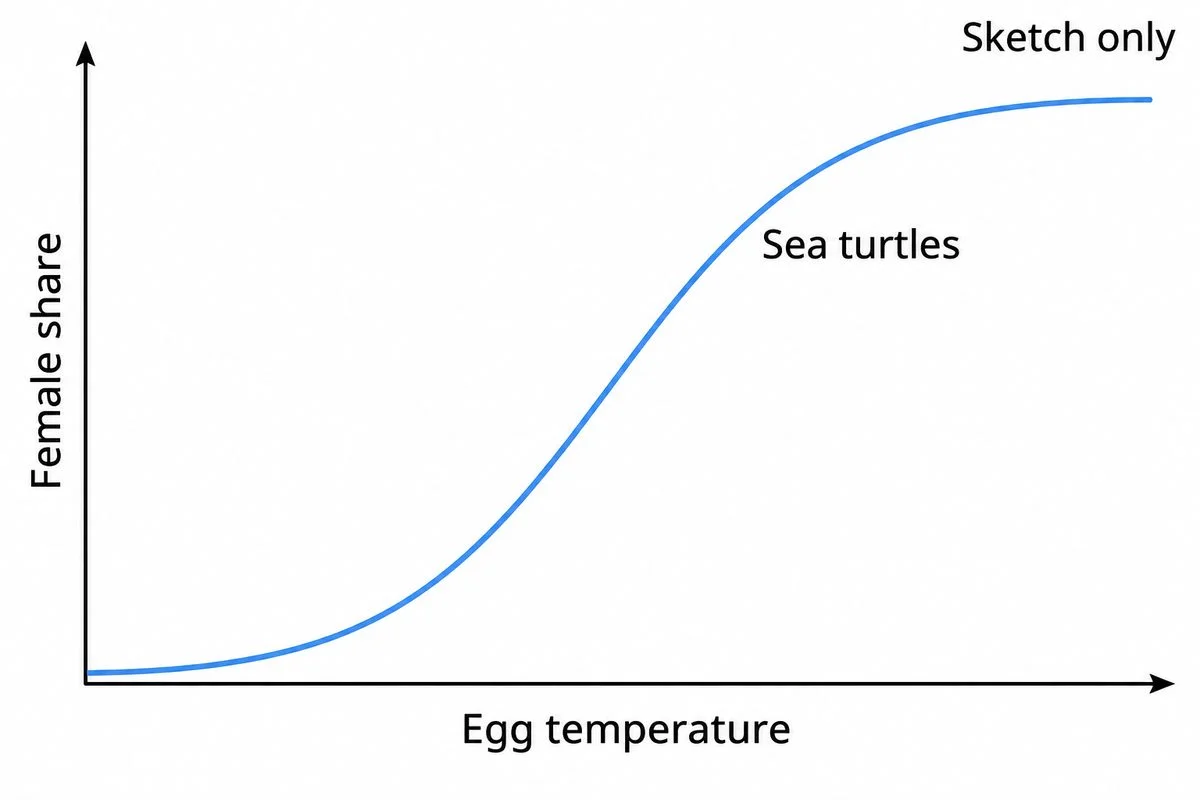
Diagram showing a rising female share as sea-turtle egg temperature increases.

7. Diverse mechanisms of sex determination

Different species determine sex in different ways.

Show
Find 'Egg temperature' and 'Female share' on the sea-turtle diagram. After predicting, trace the line rightwards.
Ask
Would warmer eggs here produce more females or males?
Say
The line shows more females at warmer temperatures.
Used in
Reptile breeders manage egg temperature to influence offspring sex in species where temperature affects it.
If your child says…“Every species uses X and Y, just like humans.”
Ask
How could the human chromosome rule alone explain the temperature effect shown here?
What’s true
The human XX–XY pattern does not apply to every species.
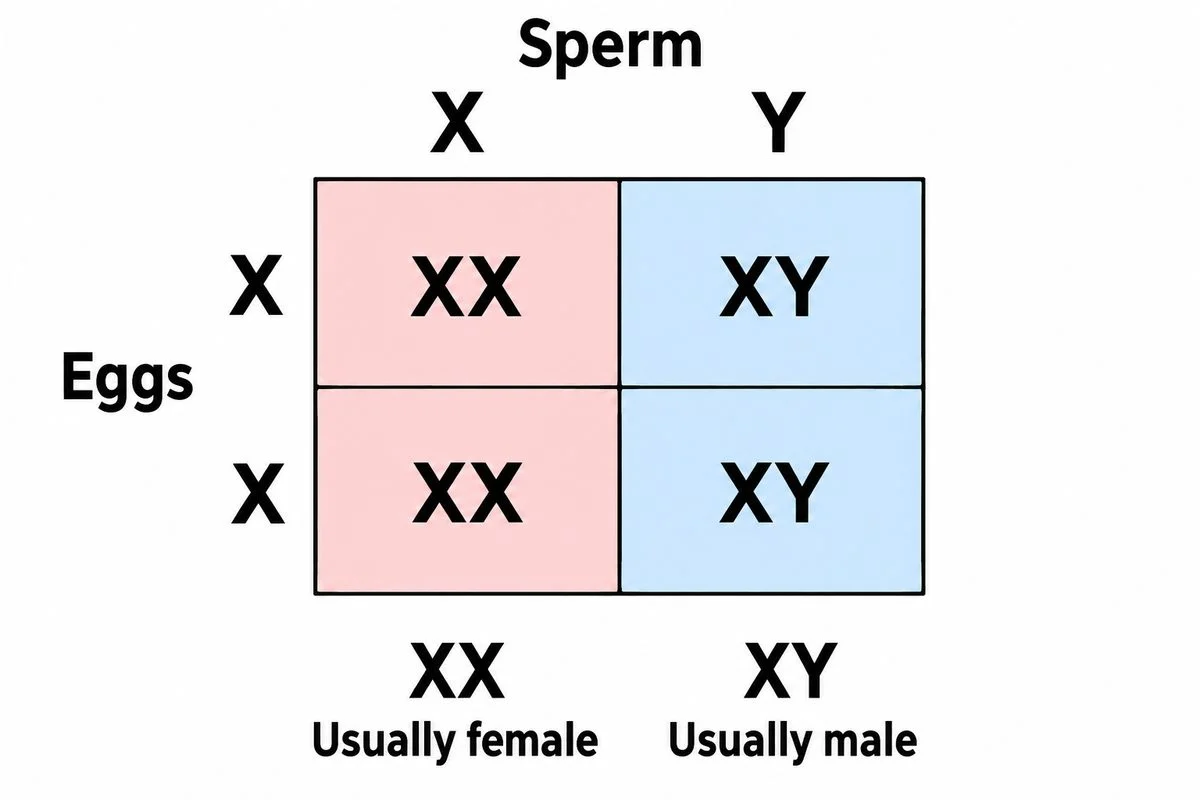
X-bearing eggs combine with X-bearing or Y-bearing sperm to give XX or XY.

8. Human XX–XY inheritance and probability

An X-bearing egg joins an X-bearing or Y-bearing sperm.

Show
Find the diagram's egg and sperm contributions. Cover the inner cells.
Ask
What chances would you predict for XX and XY?
Say
X-bearing and Y-bearing sperm occur in roughly equal numbers, making XX and XY similarly likely.
Used in
Neither parent chooses the fertilising sperm, so blaming either parent has no scientific basis.
If your child says…“Two sons mean the next baby must be a girl.”
Ask
Can earlier births stop either kind of sperm fertilising the next egg?
What’s true
Earlier births do not determine whether an X-bearing or Y-bearing sperm fertilises the next egg.

A real problem

Inherited dwarfness helped wheat resist falling over.

Breeders reduced wheat height genetically to address lodging, when crops fall over.

Dwarfing genes made wheat more tolerant of lodging.

Kalyan Sona was released in 1967 for cultivation across India's wheat-growing areas.

It helped South Asian wheat production move from shortage to surplus.

G.B. Pant UniversityFAOCIMMYT

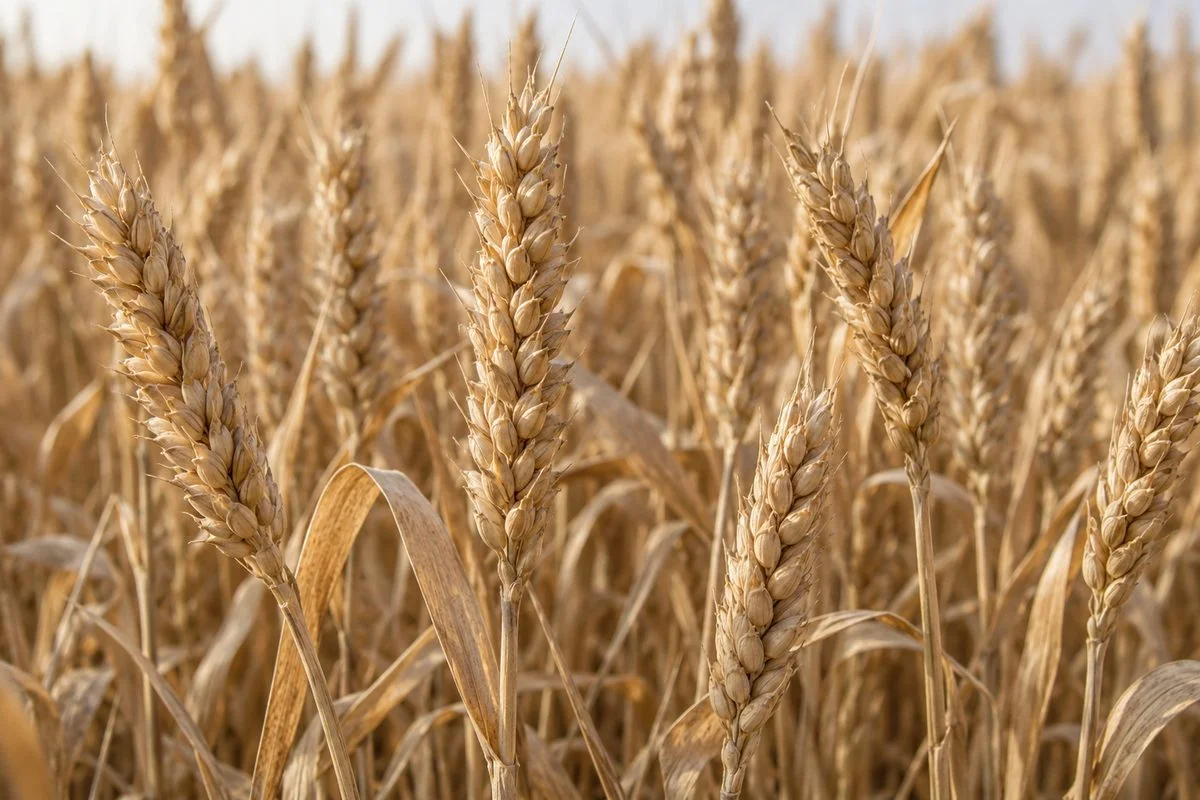
Ripe wheat field with upright grain-bearing stalks.

Concept Lab · Common misconception

The tempting mistake in Heredity

Open standalone misconception page →

Does dominant mean more common?

Wrong

A dominant allele must be found in most people.

Why it feels right. The word dominant sounds like it means widespread.

Right

Dominance describes expression in a heterozygote.

Worked example

Example plants
Aa🟣
aa⚪
aa⚪
aa⚪
aa⚪
One plant can show the dominant trait even when the other plants do not carry the allele.
  1. In a hypothetical population, only one plant carries a dominant purple allele.
  2. That plant can be purple even when almost all others are white.

Ask your child eight quick questions.

One per step. The answer and the reason are given.

  1. Which changes does the descendant with the blue mark carry?

    Both orange and blue changes. A new DNA change need not erase an earlier inherited change.

  2. When birds arrived, was brown colour already present in this beetle population?

    Yes. Selection favours existing inherited differences rather than creating needed ones.

  3. What gene pair gives these tall Tt parents a short offspring?

    tt. Each tall parent can contribute its hidden t version.

  4. Besides wrinkled seeds, what seed shape could this cross's short offspring have?

    Round seeds. Independent inheritance allows height and seed shape to form new combinations.

  5. What does a gene provide instructions for making?

    A protein. Proteins influence growth processes rather than genes turning into visible features.

  6. How many chromosomes from each pair enter a gamete?

    One. Separating pairs before fertilisation prevents chromosome numbers from doubling each generation.

  7. What environmental condition can affect sex in some reptiles?

    Egg incubation temperature. Sex determination depends on the species rather than one universal chromosome rule.

  8. After two sons, which chromosome combinations remain possible at the next conception?

    XX and XY. Earlier births do not control the next sperm's chromosome contribution.

15 more questions with answers